
Расшифровка индивидуальных различий в светочувствительности: Доктор Ху Даньдань из Университета Фудань обсуждает количественные исследования и применение точного циркадного освещения
On July 16, "Ancient Town Lighting Expo Mingren Online" and the "Fudan Light" Series Salon joint session invited Dr. Hou Dandan, Postdoctoral Fellow from Fudan University Human Phenome Research Institute, to present a theme sharing on "Analysis of Mechanisms of Individual Differences in Light Regulation of Circadian Rhythms and Their Application Research". The salon was hosted by Hong Bing, Secretary General of the Lighting Alumni Association of Fudan University and Chief Editor of China Light Media.

Dr. Hou Dandan
Deeply engaged in light biology, lighting ergonomics, and color science fields, serving as a committee member for multiple technical committees of the International Commission on Illumination (CIE), participating in multiple national key R&D plans and major special projects, leading or participating in the formulation of multiple national and group circadian lighting standards, holding more than ten domestic and international patents.
This sharing revolves around four main sections: construction of quantitative models for light regulation of human circadian rhythms, establishment of cohorts based on typical light climate zones in China, impact of environmental and genetic factors on light-regulated circadian rhythms, and application of precise light intervention in clinical and general lighting.
From "Third Type Photoreceptor Cells" to Quantitative Models: Non-Visual Effects of Light Become Visible
Dr. Hou first reviewed milestone discoveries in photobiology. In 2002, Prof. Berson from Brown University, USA, discovered that there exist a third type of photoreceptor cells—ipRGCs (intrinsically photosensitive Retinal Ganglion Cells) on the human retina, breaking the long-held textbook cognition that only cone and rod photoreceptor cells were recorded. This discovery explained why blind people can also perceive environmental brightness and darkness, knowing when to sleep and when to wake up, and opened the door to research on non-visual effects of light.
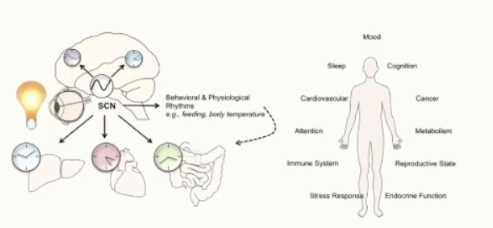
Non-imaging vision (photobiological effects) - Non-visual pathway
Light not only allows humans to "see" the world, but profoundly affects the body's biological clock——regulating sleep and wakefulness, liver metabolism, heart function strength, and intestinal digestion ability, which highly aligns with the TCM concept of "Zi Wu Liu Zhu".
In terms of quantification, currently two mainstream models are globally recognized:
The first is the CS model (circadian stimulus) developed by Prof. Rea's team at the US LRC, using nighttime melatonin suppression rate as an output indicator;
The second is the α-opic equivalent illuminance model proposed by the Lucas team, which has been standardized and promoted by CIE.
Dr. Hou pointed out that in 2024, CIE released a position statement emphasizing: "Proper light at proper time"——the effect of light depends not only on spectrum and intensity, but also on the timing of illumination. The same beam of light is beneficial in the morning but may be risky at night.
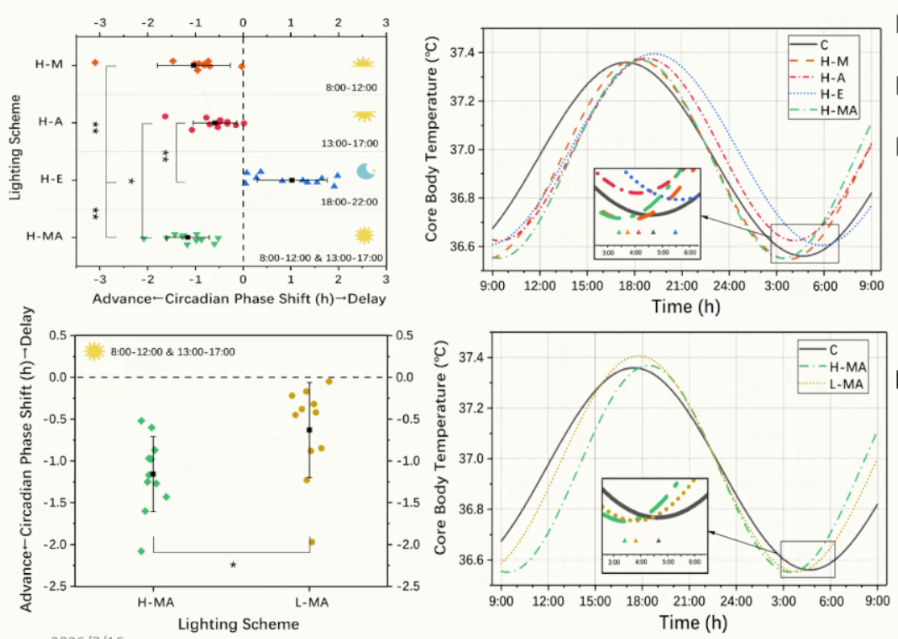
Based on this, Dr. Hou and Prof. Lin Yandan's team focused on the time dimension to conduct systematic experiments. By tracking objective indicators such as core temperature via oral capsules, they found:
1. Timing of light exposure determines the direction (advance or delay) and amplitude of circadian rhythm shift, acting as a "steering wheel"
2. Duration of light exposure is an important factor affecting phase shift direction and CPS amplitude, and it is not linear accumulation, but rather effectiveness accumulation based on photobiological effects.
3. Rhythm stimulation level is an important factor affecting amplitude; the stronger the light, the greater the force pushing the rhythm
Daily cycle photobiological effect accumulation study experimental results
The team constructed a prediction model for light intervention of human circadian rhythm phase DCLA (durational circadian lighting accumulation) effective light accumulation model, with fitting accuracy reaching over 95% on their own data, and still reaching 93% after including three European external research data.
This model has been included in the national standard GB/T 46119-2025 "Dose of Non-Visual Biological Effects of Light on the Human Eye" officially implemented in March 2026, achieving a closed loop from basic research to industrial application.
Individual Differences: A Shocking 50-Fold Gap
Dr. Hou emphasized that behind the statistical mean with good model fitting, individual differences are an issue that cannot be ignored.
"How big is the difference in response to the same light stimulus in different individuals?"
Research data reveals: Similarly achieving 50% nighttime melatonin suppression rate, the most sensitive individuals require only 6 lux, while the least sensitive individuals need 350 lux, a difference exceeding 50 times. Some people's circadian rhythms can advance or delay by 2~3 hours under light exposure, while others' rhythms remain almost "motionless".
"If the problem of individual differences is not solved, health lighting may be effective for 50% of people and ineffective for another 50%——it's like flipping a coin."
Factors affecting individual light sensitivity include:
◇Age: Children's melatonin suppression rate can reach 88%, while adults are only around 40%; at age 60, retinal cone cell density is only about 60% of that at age 10;
◇Myopia: Affects sleep latency and sleep duration;
◇Iris Color: Lighter iris color has higher transmittance and greater melatonin suppression rate;
◇Light History: People living in strong light areas for a long time tend to be "morning types", while those in dim light areas lean towards "night types";
◇Genetic Background: Multiple genetic loci regulating melanopsin (OPN4 gene), dopaminergic transmission pathways, glutamate receptor pathways, etc., all affect light sensitivity.
Five Light Climate Zone Cohorts: Unique Research Advantages of China
To crack the light response differences of thousands of faces, relying on China's unique geographical advantages, based on typical light climate characteristics of our country, the team built five categories of light climate zone population cohorts, establishing population cohorts at different locations at the same latitude to explore the two core dimensions affecting human light sensitivity.
Zone
Covered Area
Light Environment Characteristics
Category 1
Tibet, Qinghai, Northern Yunnan
Strong Light
Category 2
Inner Mongolia, Most of Xinjiang
Relatively Strong Light
Category 3
Beijing and Surroundings
Moderate
Category 4
Northeast, Shanghai and Most of Southern Areas
Weaker Light
Category 5
Sichuan-Chongqing Region
Weak Light
This is a unique natural experiment field globally, preliminary results are exciting:
● Category 1 Zone (Lhasa) Population: Total melatonin throughout the day is higher, circadian rhythm oscillation amplitude is larger, pupil contraction ability is stronger—they are more sensitive to light.
● Category 5 Zone (Chongqing) Population: Melatonin total amount does not rise well in 1 day, physiological oscillation effect is weaker.
● Even for people with identical genetic factors, under different light climate zones, sleep duration and sleep phase have significant differences——environmental modification effect on genetics is very strong.
"Returning to Lhasa" is not just a song.
Research found that Lhasa's extremely strong natural light (up to 100,000 Lux) increases the body's serotonin ("happy hormone") levels, thereby promoting dopamine and melatonin levels improvement, happy during the day, able to sleep at night. "Being unhappy means returning to Lhasa, originally there is scientific reasoning."
Precise Light Intervention: Landing Exploration from Clinical to General Lighting
In clinical applications, Dr. Hou's team has carried out multiple practices.
◆ Depression Auxiliary Treatment: Jointly with Shanghai Mental Health Center, adding light auxiliary intervention for moderate-to-severe depression patients without stopping medication, rapid response seen within two weeks. High light sensitivity population efficacy significantly better than low light sensitivity population, suggesting future light therapy should stratify first, then diagnose and treat.
◆ Post-Stroke Cognitive Impairment Rehabilitation: At Shanghai Third Rehabilitation Hospital, the team performed light sensitivity typing on patients before implementing light stimulation, efficiency significantly improved.
◆ General Lighting Scenarios: Dr. Hou painted a future picture of personalized light formulas——by obtaining user's usual residence (light climate zone) via mobile phone positioning, combined with age, gender, sleep time type and simple questionnaires (such as sensitivity to light after getting up at night, degree of waking up affected by light in the morning, etc.), light sensitivity can be determined without everyone needing gene sequencing. Importing this information into intelligent light regulation systems can output personalized light formulas.
"From the perspective of fixture cost, existing smart lighting products already possess adjustment capabilities for color temperature, brightness, CS value, EDI value, etc., what is truly lacking is not hardware, but the logic behind it——what kind of light curve should be used for people in different regions, different ages, and different light sensitivities."
Interactive Q&A
In the Q&A session, Dr. Hou Dandan provided detailed answers to questions concerning the audience:
Q: Different individuals have significant differences in circadian rhythm regulation response to light, does this mean future lighting products need customized design for different populations? Is cost controllable?
A: From the perspective of pure fixture cost, there is not much difference from now. Smart lighting has developed for many years, products already possess adjustment capabilities for color temperature, brightness, CS value, EDI value, etc. What truly needs changing is not product hardware, but the control logic behind it——different regions, different populations should use different light curves. Product function costs have no obvious increase.
As for diagnosis cost, not everyone needs gene sequencing. Through a few simple questions (such as usual residence, age, light sensitivity response, etc.), combined with mobile phone positioning to obtain light climate zone, 90% can determine light sensitivity type. We are developing such questionnaire tools.
Q: What is the practical significance of National Standard GB/T46119-2025 "Dose of Non-Visual Biological Effects of Light on the Human Eye" for consumers and manufacturers?
A: This standard mainly answers two questions: First, what indicators are used to quantify non-visual effects of light, the standard sorted out three major indicator systems——α-opic equivalent illuminance system, Rhythm Stimulus Value CS Model System, and DCLA-CPS System based on Chinese population; Second, it gives dose values these indicators should reach under typical application places.
The most valuable is, the standard appendix provides correction coefficients for different light climate zones. For example, Lhasa and Chongqing have enhancement coefficients and attenuation coefficients respectively, instead of a nationwide "one size fits all". China is vast, regional differences are huge, standards should adapt to life characteristics of people in different regions.
Q: What landed cases exist for precise light intervention in clinical settings? Such as sleep disorder treatment, shift worker rhythm regulation or depression auxiliary treatment?
A: Currently mainly attempted in Depression and Post-Stroke Cognitive Rehabilitation two directions. In terms of depression, jointly with Shanghai Mental Health Center added light auxiliary intervention for moderate-to-severe patients, rapid response within two weeks, and high light sensitivity population efficacy is better.
In post-stroke cognitive impairment patients at Third Rehabilitation Hospital, we first do light sensitivity typing then perform light stimulation, efficiency rate increased by about 20% compared to previous reports. We are gradually verifying this idea in different diseases, step by step.
Q: Based on cohort research of typical light climate zones in our country, natural light environment differences between different regions are large, should school lighting design adopt different circadian lighting schemes according to different geographical regions?
A: This question is raised very well. We hope at the landing level, whether home lighting, classroom lighting or hospital lighting, differentiated standards for different regions can be given. In the non-visual biological effect dose standard, the first correction coefficient has already been given. For classroom lighting, besides non-visual parts, visual function, color discrimination, etc. also have obvious regional differences, subsequently the industry will gradually perfect zoning and scenario-based classroom circadian lighting design specifications. These results we will report out successively.
China Light
Официальный сайт Китайской ассоциации светотехнической промышленности и мультимедийная платформа для отрасли освещения. Мы не только предоставляем авторитетную и своевременную информацию об освещении, но и стремимся быть партнёром компаний в их развитии. От продвижения бренда и расширения каналов до консалтинга, подготовки кадров и участия в разработке стандартов — мы предлагаем комплексные профессиональные услуги, помогая компаниям повышать качество и эффективность и совместно содействуя качественному развитию отрасли освещения.
Контакты для сотрудничества
仇纯 (г-жа): 158 6155 3579
顾君 (г-н): 137 7157 5253