
The results of the random inspections of lighting products in Guangdong, Shaanxi, and Shanghai have been released.
Recently, market supervision authorities in Guangdong, Shaanxi, and Shanghai have successively released the results of quality inspections for lighting products. As the transition period for updating the CCC certification standards for luminaires enters its final hundred-day countdown, a clear industry dividing line is emerging: compliance capability is increasingly replacing price as the primary factor determining whether lighting companies can remain competitive.
Guangdong: Three Lighting Companies Still Fail Re‑inspection
On August 28, the Guangdong Provincial Administration for Market Regulation issued Announcement No. 22 of 2026, publicly notifying six manufacturing enterprises that failed quality inspections and did not rectify their non‑compliance within the prescribed timeframe. Among them, three were lighting‑related companies:
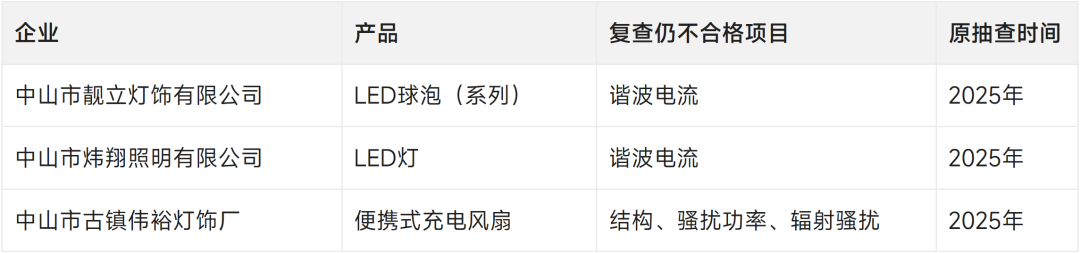
A noteworthy detail in the list is that Weiyu Decorative Lighting Factory’s non‑compliant product was not a luminaire but a portable charging fan—its emissions power and radiated interference are related to the same electromagnetic compatibility items tested for luminaires. This highlights the situation where some small and medium-sized enterprises in Guzhen’s industrial cluster are expanding into multiple product categories while lagging behind in building robust quality management systems.
The intensity of this round of regulatory signals is most clearly reflected in the escalating sequence of enforcement measures. Starting 60 days after the announcement and before 90 days, the regulatory authorities will organize a re‑inspection; until the re‑inspection is passed, companies are prohibited from producing or selling the same products. If the re‑inspection still fails, the company will be ordered by law to suspend operations and undergo a specified period of rectification; should the re‑inspection remain unsuccessful upon completion of the rectification period, the business license will be revoked.
From requiring corrective action to public notification, then to suspension and rectification, and ultimately license revocation, the chain of penalties progresses step by step with no room for compromise—meaning the time window available for affected companies to make necessary adjustments has become extremely limited.
Shaanxi: Six Batches of Luminaires Found Non‑Compliant
On August 19, the Shaanxi Provincial Administration for Market Regulation served “Notices of Unqualified Results from Product Quality Supervision Inspections” to multiple batches of products via public notice. All six batches of lighting products failed on the criterion of “harmonic current limits.”
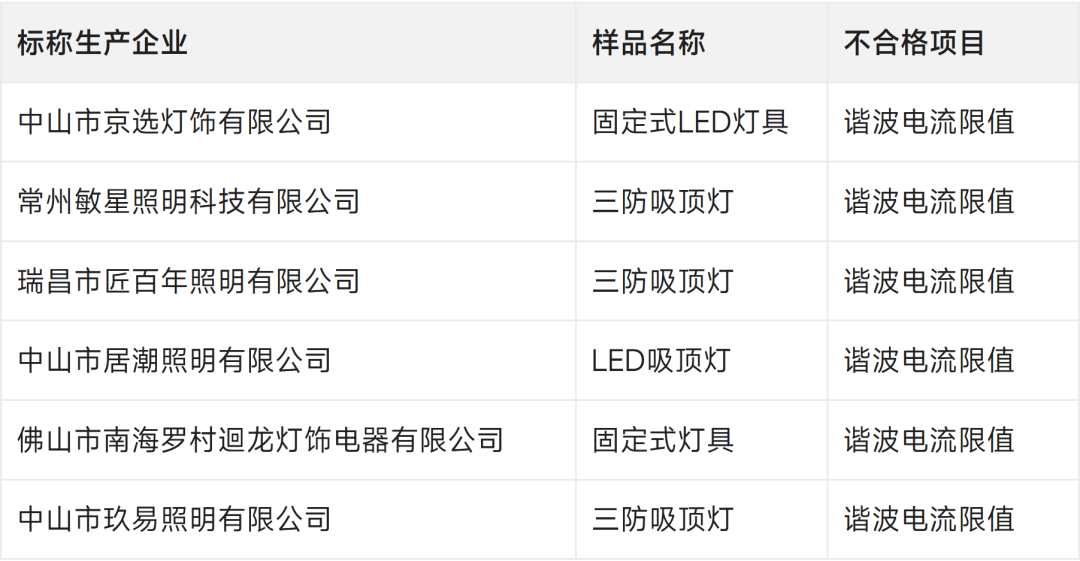
The very method of delivering these notices deserves attention: According to relevant regulations, regulatory authorities resort to public announcements only when direct delivery through conventional channels proves impossible, which to some extent reflects potential passivity on the part of certain involved enterprises in engaging with regulators.
Shanghai: All Five Batches Pass Inspection
In stark contrast to Guangdong and Shaanxi, Shanghai announced inspection results on September 20. The 2026 Shanghai municipal road and tunnel LED lighting energy efficiency labeling and metrology supervision inspection sampled five batches of products, all of which passed inspection.
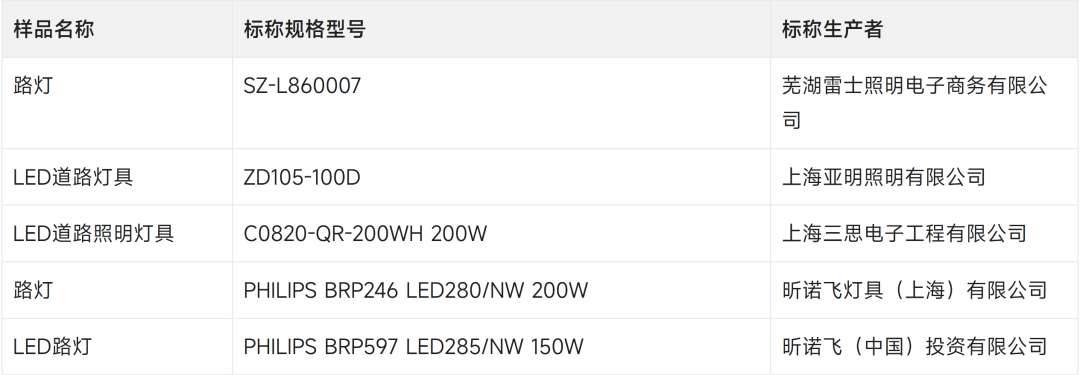
Although the sample size is relatively small and should not be overinterpreted, two key insights remain worth noting.
First, leading companies consistently passing regulatory inspections demonstrate that current standards are not unattainable; compliance hinges more on a company’s commitment and investment in quality management.
Second, from a product‑category perspective, road and tunnel lighting represents the segment with the strongest engineering focus—procurement is highly professional, acceptance testing rigorous, and accountability traceable—while the categories where non‑compliant products are concentrated—such as ceiling lights, bulbs, and reading lamps—are precisely those aimed at ordinary consumers facing the greatest information asymmetry.
The distribution pattern of problematic products indicates that the weaker the regulatory oversight and specialized expertise in a given area, the greater the concentration of quality risks.
Compliance Capability Determines the Fate of Lighting Companies
When viewed against the national regulatory timeline, the implications of these inspections become even clearer.
On the certification front, the safety standard underlying the CCC certification for luminaires has shifted from GB 7000.1-2015 to GB/T 7000.1-2023. Starting January 1, 2026, certification bodies are required to issue certificates based on the new version; certificates issued under the old standard must be converted by December 31, 2026, at the latest. Failure to comply will result in suspension, and certificates remaining unconverted as of March 31, 2027, will be revoked.
On the channel side, the “List of Key Industrial Products Subject to Online Sales Regulation (2026 Edition)” takes effect on December 1, 2026, bringing luminaires under the scope of CCC certification management. Ordinary classroom lighting and reading desk lamps must also meet the requirements of GB 40070, raising the compliance threshold for online sales accordingly.
Combining this with earlier reports from China Light Network on the “State Administration for Market Regulation’s CCC Effectiveness Inspection” and CCTV’s exposé of irregularities surrounding Zhongshan luminaires, alongside the recent announcements from Guangdong, Shaanxi, and Shanghai, we can see that behind the “unqualified test results” lies a failure to meet standards across both certification and mass‑production stages.
With only about one hundred days remaining until the December 31 deadline for upgrading the CCC certification for luminaires, four critical threads—the standards, certification, distribution channels, and random inspections—are converging. The direction of this round of regulation is now unmistakable: for lighting companies, compliance is no longer optional—it is a prerequisite for market access.
It is foreseeable that, once the transition period concludes, companies unable to complete certificate conversions and quality rectifications will accelerate their exit, while those that continue to pass regulatory inspections will secure stronger market positions in this reshuffling. The industry’s differentiation has only just begun.
Sources: Guangdong Provincial Administration for Market Regulation Announcement No. 22 of 2026, Shaanxi Provincial Administration for Market Regulation’s public notice delivery, Shanghai Municipal Administration for Market Regulation’s inspection results, China Quality Certification Center’s upgrade notice, State Administration for Market Regulation’s 2025 Annual Certification Effectiveness Inspection Report, CCTV’s “Weekly Quality Report,” and other publicly available media reports. All data cited herein are based on official releases.
China Light
The official website of the China Association of Lighting Industry and a full-media platform for the lighting sector. We provide authoritative and timely lighting information while striving to be a growth partner for businesses. From brand promotion and channel expansion to consulting, talent training and participation in standards development, we provide comprehensive professional services to help businesses improve quality and efficiency and jointly advance the high-quality development of the lighting industry.
Business Contacts
仇纯 (Ms.): 158 6155 3579
顾君 (Mr.): 137 7157 5253