
Factory closures continue! The global automotive lighting leader has announced the shutdown of another plant.
Following the closure of Fuzhou Koito Automotive Lighting in 2025, global automotive lighting leader Japan’s Koito Manufacturing Co., Ltd. (KOITO, hereinafter referred to as “Koito”) has initiated another dissolution and liquidation process for its Chinese subsidiary.
On October 20, 2026, Koito issued an official announcement stating that, at its board meeting on September 28, the company formally resolved to commence the dissolution and liquidation procedures for its wholly owned subsidiary, “Hubei Koito Automotive Lighting Co., Ltd.” (hereinafter referred to as “Hubei Koito”). This automotive lighting plant, located in Xiaogan, Hubei, established in 2014 with a registered capital of 5 billion Japanese yen, has officially entered its countdown to exit.
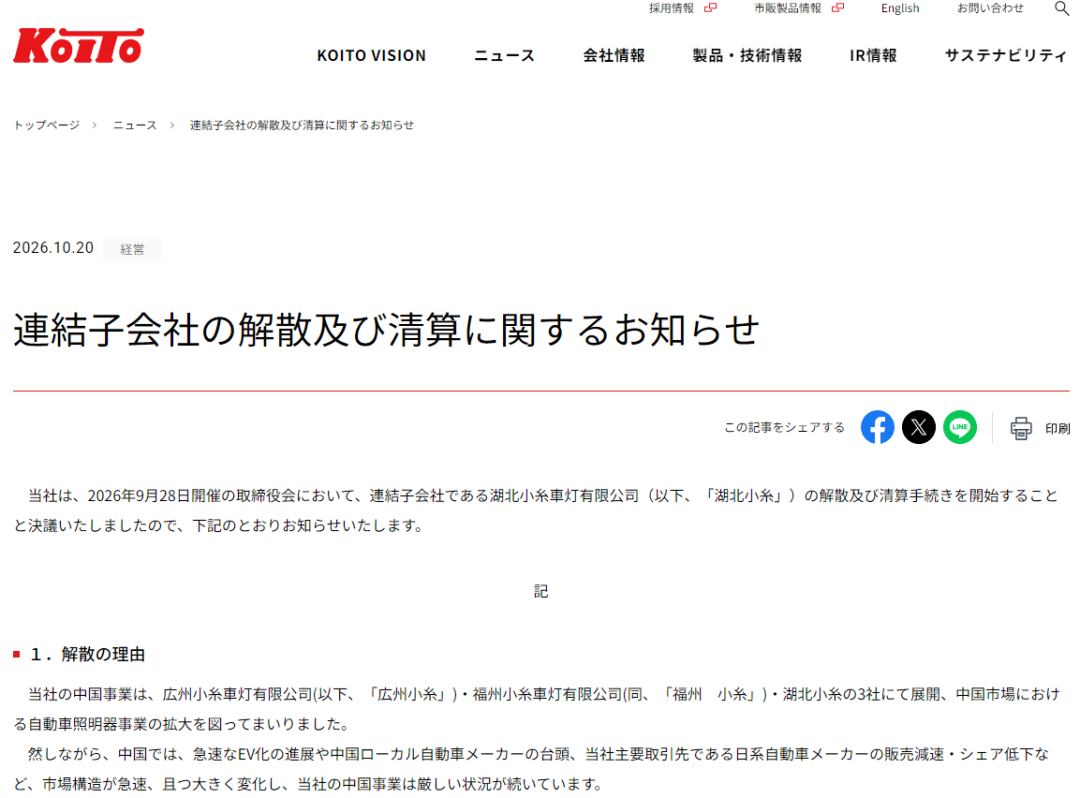
01 Continuous Restructuring: From Fuzhou to Hubei—Koito Continues Optimizing Its Production Capacity in China
In the past, Koito had set up three major automotive lighting production bases in China: Guangzhou Koito, Fuzhou Koito, and Hubei Koito, serving Japanese‑brand vehicle manufacturers in the Chinese market and expanding its automotive lighting business footprint.
capacity restructuring:April 2025 · Dissolution of Fuzhou Koito
This was Koito’s earliest production base in China; upon its closure, it directly reduced approximately 15% of its automotive lighting capacity in China. At the time, the official statement indicated that “going forward, the Chinese operations would continue through Guangzhou and Hubei.”
March 2026 · Consolidation of Production Lines in Guangzhou
Koito centralized its marker light production operations into Guangzhou Koito, further consolidating production resources.
October 2026 · Dissolution of Hubei Koito
Koito once again announced the dissolution of Hubei Koito. With this decision, only Guangzhou remains operational among the three major bases. Just a year and a half after closing Fuzhou Koito, even Hubei could no longer sustain itself.
Hubei Koito had a registered capital of 5 billion Japanese yen and was a wholly owned subsidiary of Koito, primarily engaged in the manufacturing and sales of automotive lighting products. Its general manager was Hideaki Nonaka.
In its announcement, Koito openly acknowledged the multiple pressures from the market environment: the rapid penetration of electric vehicles in China, the strong rise of domestic automakers, slowing sales of Japanese‑brand vehicles—the core customers of Koito—and a continuous decline in market share. Coupled with geopolitical uncertainties in the Middle East, the operating environment for Koito’s China business has grown increasingly challenging.
Therefore, to further enhance the group’s overall production efficiency and profitability, Koito chose to dissolve Hubei Koito, seeking to rationalize its business structure and achieve centralization of operational resources.
Koito also emphasized that it will strictly comply with labor laws and employment agreements, properly reassign employees, and minimize the impact of this liquidation on both staff and the local community. The group will continue to focus on its remaining operations, fully safeguarding earnings and future growth.
According to the announcement, the specific timeline for completing the liquidation process remains undetermined.
Koito stated that this dissolution and liquidation will have a relatively minor impact on its consolidated financial results for the fiscal year ending March 2027. Should any significant developments arise, the company will promptly disclose them to the public.
02 Tying Up with Japanese Automakers: Japanese Component Suppliers All Feel the Pain
In other words, Koito now has only one automotive lighting production base left in China—Guangzhou.
Why was Hubei Koito shut down? Its customer base—including Dongfeng Nissan, Honda, and Toyota—includes projects within its service radius, meaning its client mix happened to be right at the point where the downturn was deepest.
It is reported that the share of Japanese passenger cars in the Chinese market has dropped from just over 20% in 2020 to less than 10% by 2025. Automotive lighting is a typical “follow‑the‑factory” business—supplying components tailored to specific vehicle platforms—so it has been particularly hard hit.
Guangzhou Koito managed to stay open because it is geographically closer to key clients such as GAC Toyota and GAC Honda, and Koito explicitly concentrated marker light production and related capacities in Guangzhou, making it easier to maintain high utilization rates.
Compared with pre‑liquidation levels, the company’s automotive lighting production capacity in China will shrink by 66%.
“Koito’s successive factory closures are not isolated incidents but a microcosm of the broader challenges facing the Japanese automotive supply chain in the Chinese market,”
On the one hand, Koito’s business is ; as Japanese brands lose ground amid the new energy wave, declining orders directly ripple through the component supply chain, leading to underutilized factory capacity. Although Koito has attempted to expand into the domestic new‑energy vehicle market, new orders have failed to make up for the shortfall.
On the other hand, the domestic automotive lighting landscape has already undergone a major reshuffle, with local players like Xingyu Shares and Huayu Vision rapidly rising to capture substantial orders from new‑energy vehicle manufacturers, .
Moreover, today’s foreign‑owned component suppliers show clear differentiation: some, like Koito, opt for shrinking inefficient capacity and concentrating resources, positioning Guangzhou as their central hub in China; others choose deep localization of R&D to compete for incremental opportunities in the new‑energy sector.
Koito currently follows the former approach, consolidating resources in Guangzhou. Whether it can secure more orders from domestic new‑energy vehicle manufacturers going forward will determine the future trajectory of its China operations. As the global leader in automotive lighting, Koito has reached a critical juncture where it must redefine its position in the Chinese market.
China Light
The official website of the China Association of Lighting Industry and a full-media platform for the lighting sector. We provide authoritative and timely lighting information while striving to be a growth partner for businesses. From brand promotion and channel expansion to consulting, talent training and participation in standards development, we provide comprehensive professional services to help businesses improve quality and efficiency and jointly advance the high-quality development of the lighting industry.
Business Contacts
仇纯 (Ms.): 158 6155 3579
顾君 (Mr.): 137 7157 5253