
Breakthrough! Far-UVC LEDs achieve a record-breaking data transmission rate of 1.5 Gbit/s.
Researchers from the Ferdinand Braun Institute – Leibniz Institute for High Frequency Technology (FBH) in Berlin, Germany, along with the Institute of Photonics at the University of Strathclyde in the UK and the LiFi Research Centre at the University of Cambridge, have achieved data transmission rates of up to 1.5 Gbit/s using a new type of far-UVC Light-emitting diode (LED). These devices, developed by FBH, have set a new speed record in wireless optical communication at wavelengths below 235 nm.
Far-UVC technology offers unique advantages for outdoor communications: within this spectral range, sunlight generates virtually no background signal. As a result, it holds promise for establishing reliable outdoor optical communication links, complementing radio-frequency (RF) systems when they reach their performance limits. Autonomous vehicles, drones, connected industrial machinery, robots, and civil defense applications all rely on dependable wireless data connections—yet an increasing number of systems are competing for limited frequency resources.
Wireless optical communication can effectively supplement RF technologies. However, systems employing visible or infrared light face a significant challenge outdoors: the sun also emits radiation in these wavelength ranges. Solar background radiation can interfere with optical signals, making reliable data transmission difficult. Consequently, such systems often require precise alignment of laser beams.
UVC Communication Unaffected by Solar Background Radiation
Below 280 nm, most solar radiation is absorbed by the upper atmosphere, leaving little to reach the Earth’s surface. Therefore, wireless optical communication using UVC light is largely immune to solar background interference. In this experiment, the researchers employed far-UVC light at wavelengths below 235 nm. This radiation is strongly absorbed by the non-viable outer layers of skin, penetrating much less deeply into living tissue compared to longer-wavelength UV radiation. For this reason, such UV light is considered safer for human health and suitable for applications requiring operation in close proximity to people.
Optimizing Far-UVC LEDs for Practically Feasible Data Rates
Dr. Jan Ruschel, a senior scientist at FBH, stated: “We specifically optimized these LEDs for optical communication applications within this spectral range. Their luminous output power ranks among the highest in international research, and they support exceptionally fast modulation—making them ideal for both indoor and outdoor optical data exchange.” To achieve this, the FBH team divided the emitting surface of the far-UVC LED into numerous smaller areas. This design reduces junction capacitance and increases current density, enabling higher modulation bandwidths than conventional devices with larger emitting areas.
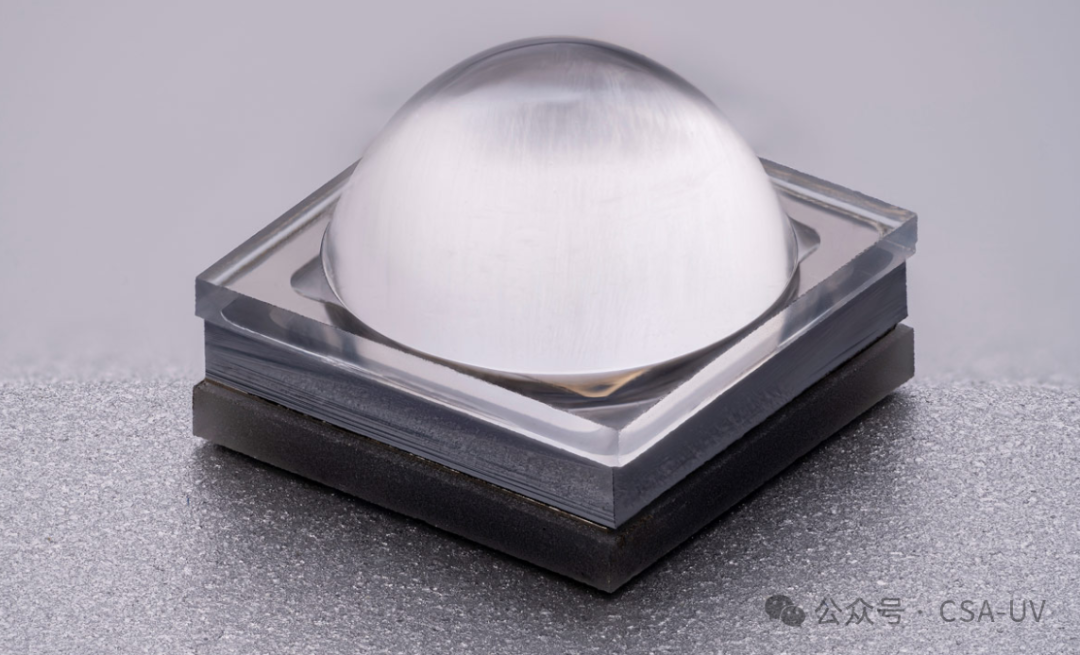
Far-UVC LED equipped with a Lens and Reflector
Researchers from the University of Strathclyde and the University of Cambridge used these LEDs to build and test a wireless optical communication system. Under direct line-of-sight conditions between transmitter and receiver, the system achieved data rates of up to 1.5 Gbit/s over a 30 cm transmission distance. These measurements, conducted under indoor lighting conditions, set a new record for short-wavelength optical communication data rates.
This work was carried out as part of the TITAN project at the UK National Telecommunications Research Centre, led by the University of Cambridge and funded by the Engineering and Physical Sciences Research Council (EPSRC). Recently, the researchers presented their findings at the International Symposium on Communication Systems, Networks, and Digital Signal Processing. (Paper DOI: 10.1109/CSNDSP68462.2026.11654373)
Next Steps: Enabling Longer-Range Non-Line-of-Sight Communication
Far-UVC technology may offer another advantage. Molecules in the air scatter light—a phenomenon known as Rayleigh scattering—which becomes more pronounced at shorter wavelengths. Even when transmitter and receiver are not directly aligned, or obstacles block the direct line of sight, some optical signals can still reach the receiver. This characteristic makes UVC light particularly well-suited for exploring so-called non-line-of-sight communication. Researchers now aim to determine how effectively far-UVC LEDs can leverage this feature. They also plan to further optimize both the transmitter and receiver to achieve longer, practically viable transmission distances, while investigating how atmospheric conditions affect signal propagation. Ruschel remarked: “Achieving data rates with real-world applicability is an important first step. Moving forward, we seek to clarify the practical transmission distances and environmental conditions under which far-UVC communication can be deployed—especially assessing its effectiveness in scenarios without direct line-of-sight.”
Research Significance
Throughout this article, it is not merely the 1.5 Gbit/s rate that merits attention, but rather the broader potential of far-UVC LEDs in short-wavelength wireless optical communication.
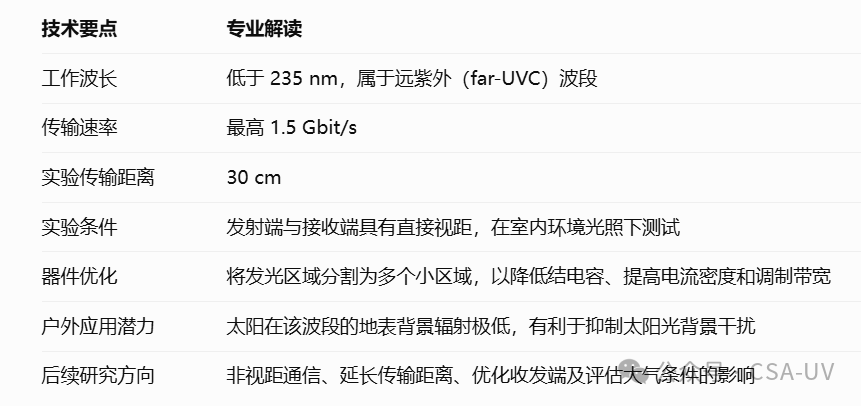
Two Key Points Require Special Attention:
The 1.5 Gbit/s figure represents experimental results obtained under 30 cm line-of-sight conditions and does not yet signify long-distance outdoor communication. Real-world applications will require validation of transmission distance, link loss, receiver sensitivity, bit error rate, and environmental adaptability.
Non-line-of-sight communication remains an area for future research, not a verified outcome of this study. While strong Rayleigh scattering at short wavelengths may help signals bypass direct line-of-sight constraints, scattering also leads to energy loss; actual performance must be confirmed through experimentation. Furthermore, the biological safety of far-UVC light must be evaluated in conjunction with wavelength, irradiation intensity, exposure duration, and applicable safety standards—not assuming all usage conditions are safe simply because penetration depth is shallow.
From the perspective of the UV LED Industry, the key significance of this research lies in optimizing device architecture to enhance the high-speed modulation capabilities of far-UVC LEDs and exploring new application directions for UVC in wireless optical communication. It provides experimental evidence supporting the expansion of far-UVC LEDs beyond traditional disinfection uses into high-speed optical communication—but several engineering challenges remain before mature commercial communication products can emerge.
Source: csa-uv
China Light
The official website of the China Association of Lighting Industry and a full-media platform for the lighting sector. We provide authoritative and timely lighting information while striving to be a growth partner for businesses. From brand promotion and channel expansion to consulting, talent training and participation in standards development, we provide comprehensive professional services to help businesses improve quality and efficiency and jointly advance the high-quality development of the lighting industry.
Business Contacts
仇纯 (Ms.): 158 6155 3579
顾君 (Mr.): 137 7157 5253