
Hospitals / Schools / Elderly Care Facilities / Vehicle-mounted—Fully Compatible! Fudan University’s Liu Hao and Liu Deqiang Dissect the All‑Domain Light Purification Solution
On September 11, the "Fudan Light" Salon Series was broadcast live via Ming Classroom and the Lao Hong Talks Lighting video channel. The event specially invited two core alumni researchers behind the 2026 Lighting Innovation Award’s Outstanding Achievement—“R&D of a Photocatalytic Air Disinfection Device”—Liu Hao and Liu Deqiang, to deliver a comprehensive presentation covering everything from underlying principles to industrialization.

The guest speaker, Liu Hao, is a Fudan alumnus who graduated with a bachelor’s degree from Fudan University in 1998. He is the founder and general manager of Sichuan Ousheng Optical Instruments Co., Ltd., with over 20 years of deep expertise in precision optics, focusing on lighting and imaging optics.
The other guest speaker, Liu Deqiang, is also a Fudan alumnus, having earned his undergraduate degree in Chemistry from Fudan University in 1991. With extensive experience in materials science and chemistry, he currently serves as the chief engineer at Shanghai Lantai HuanYu Technology Co., Ltd.
The salon was hosted by Hong Bing, Secretary-General of the Fudan Alumni Association’s Lighting Alumni Chapter and Editor-in-Chief of China Light All-Media, and was simultaneously livestreamed on the Ming Classroom “Fudan Light” channel and the Lao Hong Talks Lighting video account.
From Materials to Products: A Technology That Sparks Wider Adoption
At the outset of the presentation, Liu Hao explained the project’s origins. Born out of Liu Deqiang’s core material, the decision to develop a finished product stemmed from the fact that this material lacked mature market applications. Promoting the material alone would struggle to build trust, so they opted for a “lead‑by‑example” approach: first creating products and real-world applications to encourage industry-wide adoption and enable more consumers to benefit from the new material’s value. He then invited team member Manager Gong to provide a detailed technical overview.
Core Principles and Four Major Breakthroughs
Starting with the core technology of the photocatalytic air disinfection device, Manager Gong delved into its operating principles. This technology employs 365nm UVA light to irradiate a multi‑component nano‑titanium‑based material. Upon absorbing light energy, the material generates highly reactive electron–hole pairs: holes oxidize organic compounds, while water reacts to form hydroxyl radicals; oxygen in the air combines with these radicals to produce superoxide radicals. These free radicals directly disrupt the molecular structures of formaldehyde, benzene, and other VOCs, completely oxidizing them into harmless carbon dioxide and water. In terms of sterilization and detoxification, they irreversibly destroy bacterial and viral protein shells and genetic material, achieving highly efficient inactivation.
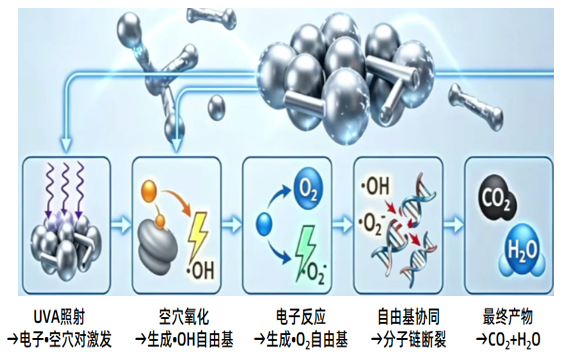
Manager Gong emphasized that hydroxyl radicals possess an exceptionally high oxidation potential—second only to fluorine—and far surpass conventional ozone used in many commercial systems. They indiscriminately attack all types of organic matter, achieving thorough mineralization and broad‑spectrum degradation. Unlike traditional activated carbon or HEPA filters, which rely on physical adsorption and easily become saturated, photocatalytic materials neither participate in chemical reactions nor volatilize or degrade over time.
Turning to technological breakthroughs, Manager Gong summarized them into four key areas:
First, the use of synergistic doping with multiple precious metals creates a more efficient reaction interface, significantly boosting negative oxygen ion production and multiplying the target decomposition rate constant;
Second, hexagonal honeycomb filter carriers with 45-degree inclined pores are stacked in multiple layers, greatly increasing catalytic active sites and specific surface area per unit volume;
Third, a hexagonal honeycomb aluminum structure paired with a high‑density UV array excitation system markedly enhances the separation and transport efficiency of photogenerated charge carriers, substantially expanding the effective irradiation area;
Fourth, the team independently developed a microscopic protective coating technology for carrier surface chemical bonds, applying more than ten processing steps to stably coat the honeycomb aluminum carrier with a layer meeting Level 0 adhesion standards, ensuring a designed lifespan of 5 to 10 years without replacement.
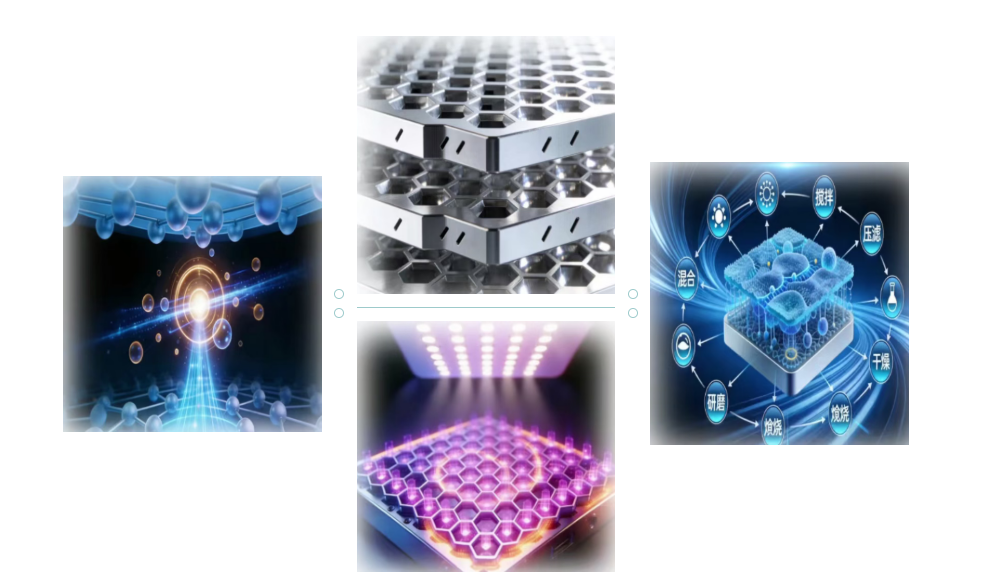
In addition, Manager Gong introduced the team’s proprietary two-phase interfacial synthesis technology. By constructing heterostructures and broadening the spectral response range, it suppresses charge recombination, dramatically boosts quantum efficiency, and delivers overall performance superior to mainstream photocatalytic materials on the market. Developing this coating technology took two years to ensure stable adhesion of the catalytic material onto the honeycomb aluminum substrate—chosen specifically because of its ample specific surface area, low airflow resistance, and ability to withstand air currents, with adhesion successfully passing comprehensive tests conducted by Midea and several major automotive manufacturers.
Safe Design: No Ozone, Human‑Machine Coexistence
Addressing the industry’s widespread concern about ozone generation, Manager Gong explained that 365nm falls within the long‑wave ultraviolet spectrum, carrying very low energy incapable of reacting with atmospheric oxygen. Therefore, no ozone is produced under normal operating conditions, and third‑party testing confirms ozone emissions far below national standards. By contrast, traditional 254nm UV lamps, if not shielded against the 185nm wavelength, almost invariably generate ozone. Because there is no ionizing radiation or secondary pollution, the product supports safe human‑machine coexistence. The material has no regular replacement cycle, requiring no consumable changes for 5 to 10 years. Internally, a patented light lock system provides complete UV shielding, with third‑party measurements showing near‑zero leakage.
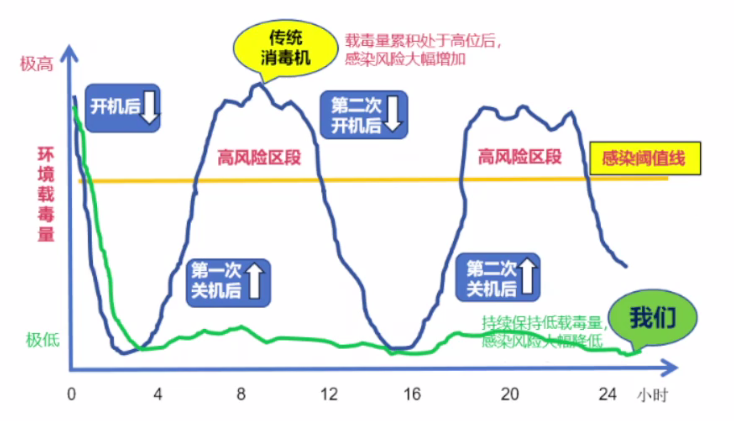
A schematic illustrating environmental toxin levels and cross‑contamination risks
Addressing the common pain point of traditional disinfection devices—rapid rebound after shutdown—Manager Gong noted that conventional units operate intermittently: they quickly eliminate bacteria and viruses upon startup but see a swift resurgence once turned off. In contrast, this product supports continuous 24‑hour operation, maintaining airborne microorganisms and pollutants at extremely low levels, effectively preventing secondary cross‑contamination at the source. Citing his own office experience, he pointed out that during flu season, roughly half the staff would typically call in sick; however, since installing the product, both employees have remained at work, and no flu outbreaks have occurred in the office over the past two years.
As an integrated “lighting + purification” solution, the product’s lighting function is equally meticulous: it uses full‑spectrum light sources and American full‑spectrum LED beads, achieving a color rendering index of 98 and featuring excellent anti‑glare design.
Comparison with Traditional Technologies
Manager Gong also provided a comparative analysis of mainstream technologies available on the market.
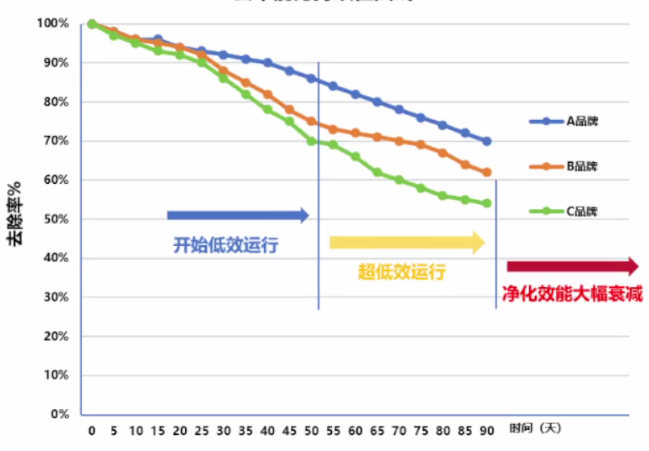
Curve depicting sustained removal efficiency
HEPA filters combined with activated carbon rely on physical adsorption. Over time, activated carbon accumulates pollutants, clogging the filter mesh; even a newly installed unit may begin losing effectiveness after just 3 to 5 days of operation, becoming essentially saturated within 10 days under harsh conditions, often accompanied by unpleasant odors like sourness or mold. Most UV‑C photocatalytic systems primarily employ physical killing methods, leaving blind spots, struggling to decompose formaldehyde, suffering rapid lamp degradation, and posing risks of ozone leakage. High‑voltage discharge technologies such as ozone generators and plasma devices almost invariably produce ozone, requiring frequent electrode maintenance. Negative oxygen ion generators mainly depend on dust adsorption and settling, offering limited sterilization efficacy, with electrodes potentially emitting ozone and aging rapidly, necessitating replacement. In contrast, this product relies predominantly on chemical decomposition, breaking down TVOCs, formaldehyde, and viruses at their source without accumulating pollutants through physical adsorption, supporting 24‑hour human‑machine coexistence.
Third‑Party Testing and Real‑World Applications
Regarding how to verify the product’s effectiveness, Manager Gong outlined results from a series of authoritative third‑party testing institutions:
Ozone Emissions: In a 30‑cubic‑meter chamber, measured over 2 hours at 0.002 mg/m³, well below the national standard of 0.1 mg/m³;
Staphylococcus aureus: In a 30‑cubic‑meter chamber, achieved a kill rate exceeding 99% within 1 hour;
Natural Bacterial Mortality Rate: In a 30‑cubic‑meter chamber, achieved a mortality rate exceeding 98% within 2 hours;
H1N1 Influenza Virus Removal Rate: In a 30‑cubic‑meter chamber, achieved a removal rate exceeding 99.9% within 2 hours;
UV Leakage Levels: At 30 cm from the device, UV intensity measured less than 1 µW/cm², far below the national requirement of 5 µW/cm²;
ROHS Compliance Test for Photocatalytic Core Material: All indicators met EU standards;
250L Gas Bag Test: For Class 1A/1B high‑risk carcinogens, achieved a removal rate exceeding 99% within 2 hours; for Class 2 carcinogens, achieved a 96% removal rate within 2 hours.
Application scenarios span schools, offices, kindergartens, elderly care facilities, nurseries, hospitals, hotels, government and corporate offices, family living rooms, bedrooms, studies, children’s rooms, senior citizen rooms, bathrooms, pet spaces, animal farms, pesticide‑free vegetable farms, vehicle terminals, stations, and other enclosed environments, as well as factory workshops, sterile rooms, laboratories, and more.
The product is available in various forms, including ceiling‑mounted (with integrated lighting), wall‑mounted, mobile floor‑standing, vehicle‑mounted, and embedded versions. Embedded models integrate seamlessly into existing fixtures, functioning as flat panel lights while delivering disinfection and purification capabilities. Typical application cases include the emergency and resuscitation wards of Sichuan Provincial People’s Hospital, the Forensic Science Center of the Provincial Public Security Department, community hospitals, and the Mianyang Base of the China Giant Panda Protection Research Center.
Liu Deqiang subsequently elaborated on the progress of industrialization. Practical applications fall into several major categories:
Medical Sector: Initially developed to remove up to 99.9% of coronavirus during the COVID‑19 pandemic, now collaborating with Guangzhou Respiratory Health Institute (affiliated with Academician Zhong Nanshan);
Animal Husbandry Sector: Partnering with several large, well‑known domestic companies;
Automotive Sector: Four major domestic automakers have entered the vehicle installation trial phase.
However, he acknowledged that since relevant national standards for air disinfection are still under development, official promulgation is expected next year, meaning broader industry acceptance and widespread adoption will require further effort.
Interactive Q&A Session
Following the presentation, host Hong Bing engaged in dialogue with the two speakers, addressing questions submitted by viewers in the live chat. Below are highlights from the actual Q&A session:
Q: What is the core working principle of the photocatalytic air disinfection device? How do 365nm UVA light and the multi‑component nano‑titanium‑based material collaborate to achieve efficient disinfection and purification?
Liu Deqiang: Photocatalysis fundamentally involves photocatalytic materials that participate in chemical reactions without being consumed themselves. They convert light energy into chemical energy, generating hydroxyl radicals. These radicals possess powerful oxidizing properties—equivalent to temperatures of around 2,200 degrees Celsius—enabling them to oxidize organic compounds, bacteria, and viruses, rendering them harmless. Their oxidative capacity surpasses that of ozone. Hydroxyl radicals exist for extremely short durations and must remain in contact with the material’s surface to exert their effects; therefore, they pose no harm to humans and operate through direct contact.
Host’s Follow‑up Question: Is the material truly non‑depleting?
Liu Deqiang replied that as long as the material remains intact and meets three conditions, it can continue functioning: first, access to air is required to transform atmospheric oxygen and water into hydroxyl radicals and negative oxygen ions; second, a power supply—namely, the 365nm UV LED—is necessary. The host then asked: If 365nm has a finite lifespan and degrades over time, why is it still described as “zero consumables”? Liu Hao clarified that while 365nm does degrade, its service life can be extended by reducing operating power. The LED’s rated lifespan is approximately 30,000 hours, with a nominal power rating of 2W, but in practice, it operates at only 0.5 to 1W—effectively halving its power consumption. This lower power output results in reduced heat generation, while luminous efficacy and radiation efficiency actually improve.
Q: Compared with commonly available filter‑type air purifiers, what are the key differences in consumable maintenance and long‑term usage costs?
Liu Hao: Conventional products require regular replacement of activated carbon and filters, as they quickly become saturated, with a nominal lifespan of six months to one year. In environments with high pollutant concentrations, saturation often occurs within just one or two months, necessitating replacement; otherwise, purification efficiency plummets, leading to unpleasant odors and secondary contamination. In contrast, this product’s photocatalytic material and LED components are designed for long‑term durability, virtually eliminating the need for consumable replacements during normal use.
Host’s Follow‑up Question: If dust settles on the LED beads and the honeycomb nano‑titanium material, will it affect disinfection performance?
Liu Deqiang responded that the material is self‑cleaning: it breaks down organic matter, so any dust adhering to its surface inevitably contains organic components and will be decomposed. Experiments confirm that even after a year of normal airflow, the filter remains remarkably clean; in smoking rooms, areas illuminated by the device stay free of yellowing, while unilluminated zones may show discoloration due to tobacco residue.
Q: Quantum efficiency has improved by over 50%, and overall catalytic efficiency exceeds that of comparable products by a factor of ten. How were these breakthroughs achieved through material formulation and structural engineering?
Liu Deqiang: Primarily through two approaches. First, material synthesis: Conventional titanium dioxide nanoparticles have a bandgap of 3.2 electron volts, causing many electrons to remain trapped and unable to participate in reactions. We engineered a ternary structure, inserting a transitional layer of precious metals to reduce the bandgap. Second, coating process: Typically, catalytic materials are bonded to surfaces using adhesives, which obscure the material’s surface and limit its contact with air and water. Our core technology eliminates the need for any adhesive, allowing the material to transition directly onto metal surfaces, greatly enhancing utilization rates.
Q: The product covers diverse settings—hospitals, schools, nursing homes, offices, hotels, animal farms, and more. What is the current status of market promotion, and what plans are in place for expanding applications?
Liu Deqiang: In the nursing home sector, supplies have already been delivered to several facilities in Fujian and Guangdong. For hospitals, collaboration with Guangzhou Respiratory Health Institute is underway, with prototype units soon to be released for promotional purposes under their name. In the manufacturing sector, several large factories in Dongguan—with workshop areas under 1,500 square meters—have been operating test units for two to three months. In the automotive field, among the four major domestic automakers, some have entered full‑vehicle installation verification, while others have completed tender processes and are undergoing validation. The product is installed behind the car’s cabin air filter as a module, targeting the pre‑installation market.
Liu Hao added: Export efforts are prioritized, with North American and Amazon merchants already requesting samples to address issues such as pet litter box odors and livestock odor control. Partnerships with major clients like Changhong allow for direct delivery of complete units, as well as component supplies and turnkey technical solutions. The vehicle‑mounted air purifier is slated for release in October, packaged as a compact box that can be placed inside the car to tackle formaldehyde and unpleasant odors.
Additional Discussions
Beyond the core questions above, viewers raised several practical concerns, which the hosts and guests addressed on the spot.
Regarding toilet deodorization, Liu Hao noted that toilet odors are far milder than extreme odor scenarios, and can be resolved within minutes of startup. Considering power and energy consumption, operation can be slowed down; as long as the device runs continuously, toilets generally remain odor‑free.
Concerning whether there will be ozone smells in enclosed spaces, whether VOCs can be eliminated, and whether smoke removal is effective, Liu Deqiang stated that 365nm produces no ozone; VOCs—so long as they are volatile organic compounds—can be removed, with a 48W machine achieving approximately 90% removal efficiency in a 30‑cubic‑meter space within one hour. As for smoke odors, nicotine testing according to national standards shows a 99.999% removal rate within one hour (according to third‑party data).
On disinfection area and radiation parameters, Liu Deqiang explained that disinfection coverage depends primarily on power and airflow; 365nm itself emits no ultraviolet radiation externally, and each unit’s surface radiation intensity follows standardized values, allowing customization based on different scenarios and needs.
When asked whether prolonged exposure might affect human health, Liu Hao introduced the product’s light lock system, which completely shields UV rays inside the device, releasing treated air only after processing. Third‑party testing confirms zero UV emissions. Liu Deqiang added that long‑term use essentially amounts to redox reactions, producing negative oxygen ions that leave users feeling refreshed.
Summary
This salon comprehensively showcased an award‑winning innovation—from material R&D and process breakthroughs to prototype testing and multi‑scenario industrial implementation. The cross‑disciplinary integration of optical engineering and materials chemistry offers a fresh approach to public‑space air management—one that is “zero consumables, ozone‑free, and compatible with human‑machine coexistence.”
END
Note: This article is compiled from recordings of the September 11, 2026 presentation titled “R&D of a Photocatalytic Air Disinfection Device” by Professors Liu Hao and Liu Deqiang, organized and published by Ming Classroom.
China Light
The official website of the China Association of Lighting Industry and a full-media platform for the lighting sector. We provide authoritative and timely lighting information while striving to be a growth partner for businesses. From brand promotion and channel expansion to consulting, talent training and participation in standards development, we provide comprehensive professional services to help businesses improve quality and efficiency and jointly advance the high-quality development of the lighting industry.
Business Contacts
仇纯 (Ms.): 158 6155 3579
顾君 (Mr.): 137 7157 5253