
Traffic Reconfiguration: A Practical Analysis of How Lighting Brands Transition from “Invisible” to AI-Prioritized Recommendations
On August 6, the “Light Path Together Resource Gathering Series – Salon Edition,” jointly organized by China Light Network’s Ming Classroom and the Ningbo Lighting Exhibition, was successfully held in the Ming Classroom livestream room. This salon featured a special guest, Mr. Hong Bing, Chief Editor of China Light All-Media and Executive Dean of Ming Classroom, who delivered a presentation titled “Let the World See Your Brilliance—From ‘AI Can’t See’ to ‘Proactively Cited by AI’ in 30 Days.” Using real-world case studies from China Light Network, he explained how lighting brands can overcome communication challenges and capture new traffic channels in the AI era.
A Dramatic Shift in the Value-Driven Traffic Landscape: 60% of Search Traffic Is Now Turning to AI
At the beginning of the salon, Mr. Hong Bing posed a thought-provoking question: When you encounter a problem and need to search for information, do you use Baidu, Google, or Duobao, DeepSeek?
His answer? He personally uses AI more than 70% of the time.
This shift in habits is reshaping the fundamental logic of brand communication.
According to Gartner, a globally authoritative IT research firm, by the end of 2026, over 60% of traditional search traffic will have shifted to AI-generated responses.
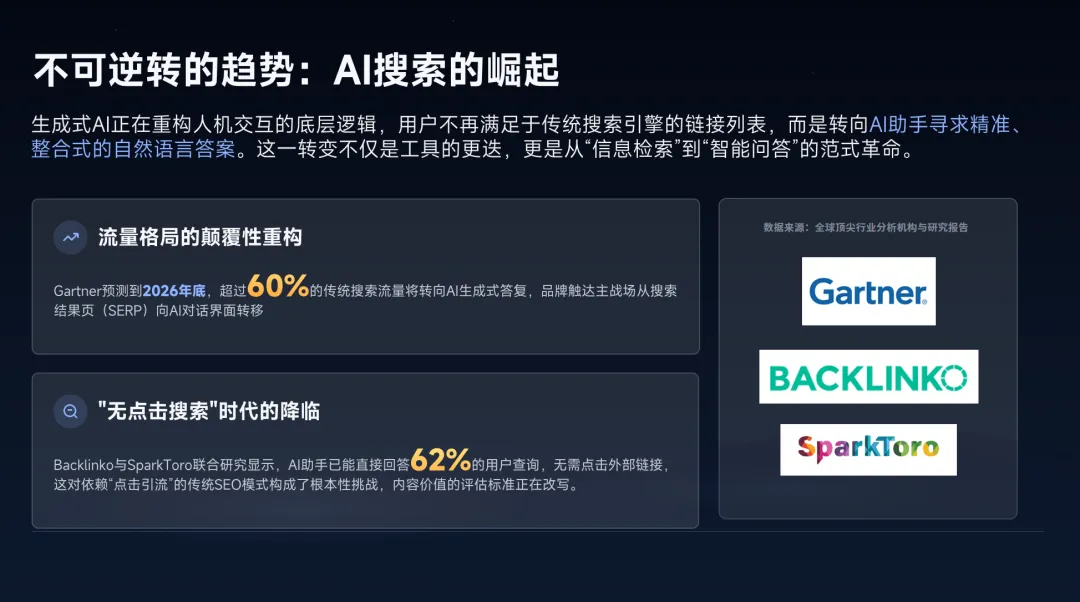
The main battleground for brand reach is shifting from search results pages to AI dialogue interfaces. Users are no longer satisfied with lists of links from search engines; instead, they directly ask AI questions, receive precise, integrated answers, and can even follow up with further queries for deeper insights.
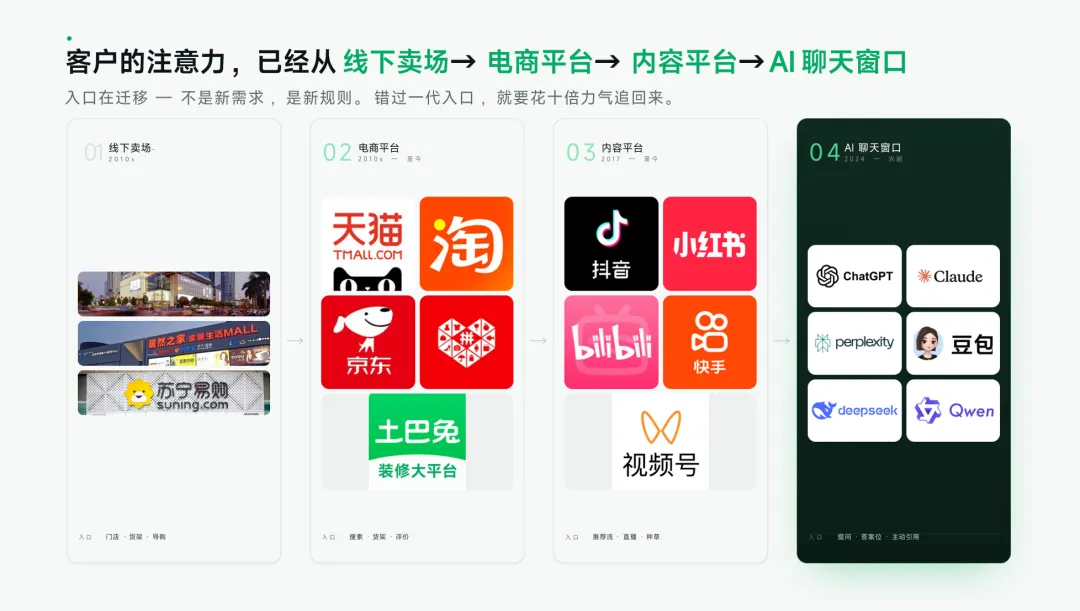
This isn’t just an evolution of tools—it’s a paradigm shift from information searching to intelligent Q&A.
The harsh reality is that AI Q&A operates on a zero-sum game. Traditional search allows users to scroll through ten pages and see dozens of brand links, whereas AI provides only three to five brand names per query—with no second page and no “load more” option. Brands that fail to secure one of these coveted spots risk becoming completely invisible in the AI era.
The Official Website Makes a Comeback:
From “Digital Business Card” to “AI Cognitive Hub”
Why Do Lighting Companies Create So Many Short Videos and WeChat Accounts, Yet AI Still Doesn’t Notice You?
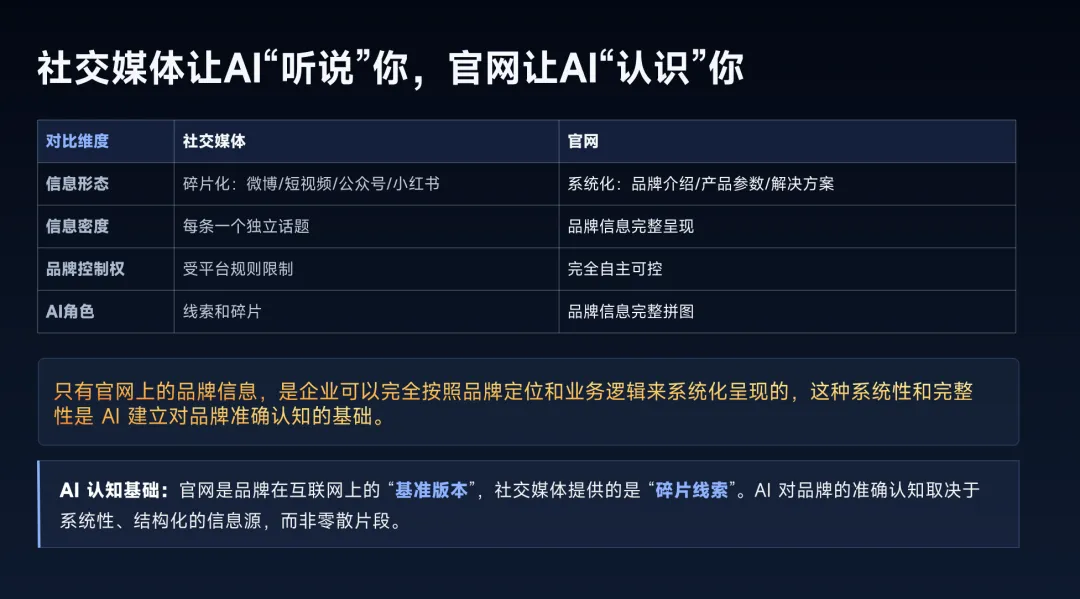
Mr. Hong Bing offered the key answer: AI is a large language model, and its efficiency in understanding text far surpasses that of images and videos. Short videos consume vast amounts of tokens but remain difficult for AI to interpret effectively, while fragmented, multi-platform content often leads AI to form vague or even contradictory brand perceptions.
In contrast, the official website—being the most authoritative and centralized source of brand information—is evolving from a once-overlooked “digital business card” into a core information source that AI relies on to understand your brand.
“A brand’s presence and credibility in AI depend on how much AI‑understandable information it has left behind on the internet.”
Social media lets AI “hear” about you, but only the official website enables AI to “know” you.
However, many lighting companies’ websites have fallen into disrepair—hesitating to renew domain names, failing to update content for years, and maintaining architectures stuck in the past decade. Mr. Hong Bing pointed out incisively that such websites suffer from three major shortcomings:
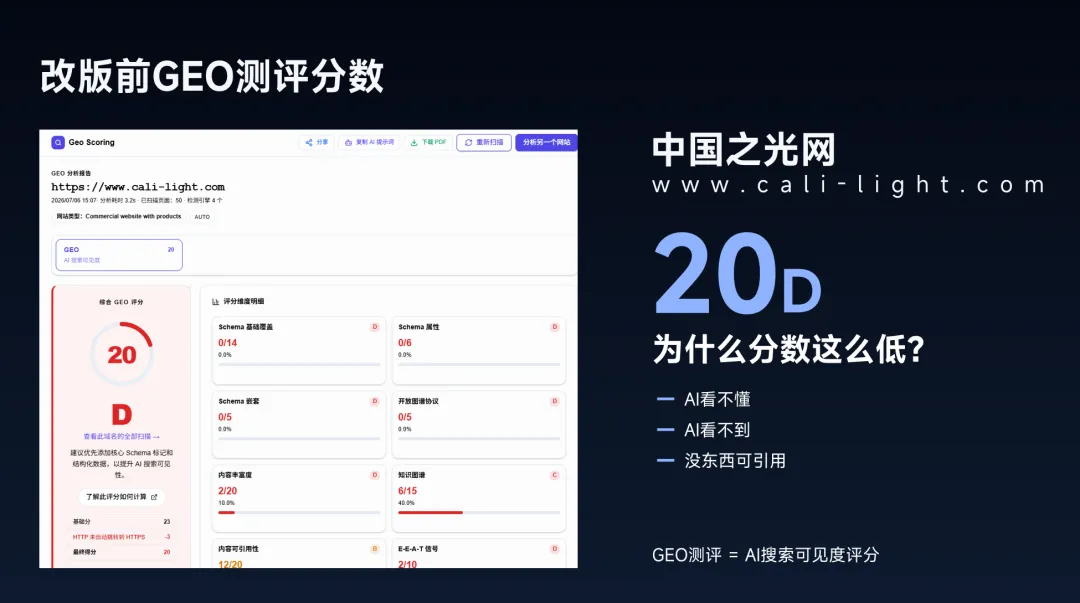
1. AI Can’t Understand It: Outdated code structures contain redundant elements, preventing AI from parsing structured information.
2. AI Can’t See It: Backend systems block access by AI crawlers.
3. No Content to Reference: Long-term lack of updates leaves insufficient core materials like product specifications and project case studies.
30-Day Real-World Results: China Light Network’s GEO Score Rises from 20 to 96
Using China Light Network’s own transformation journey as an example, Mr. Hong Bing demonstrated a complete, replicable roadmap.
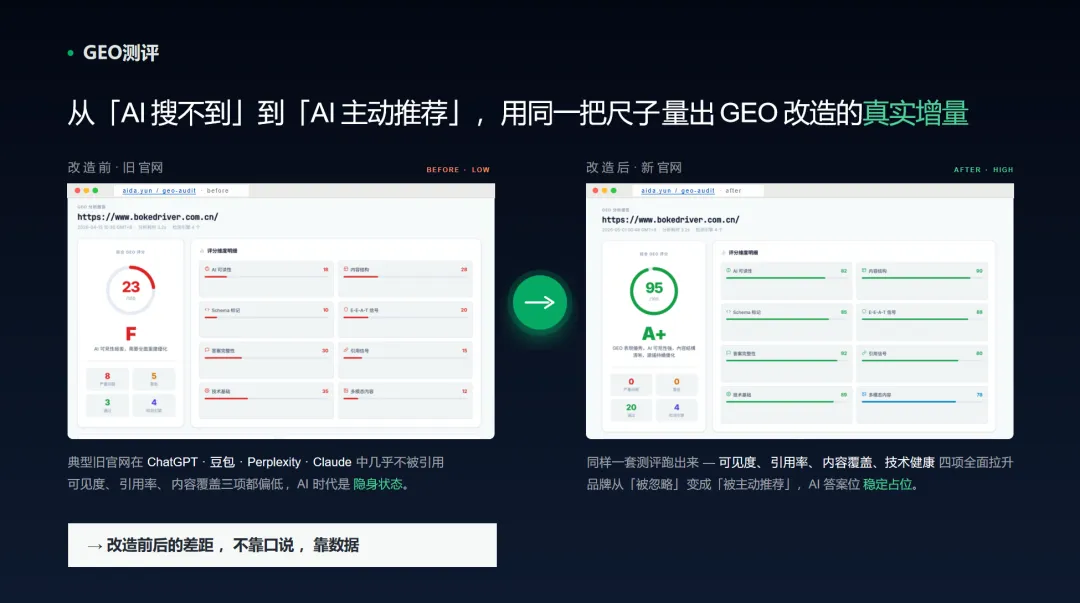
Before the overhaul, this industry portal—which had been operating for 17 years—scored only 20 points on the GEO (Generative Search Engine Optimization) scale—a relatively high score compared to others, as many company websites barely reached 10 points.
After 30 days of systematic restructuring, and just over ten days after going live, the GEO score soared to 96 points, with significant improvements across key dimensions such as AI visibility, content richness, and authority.
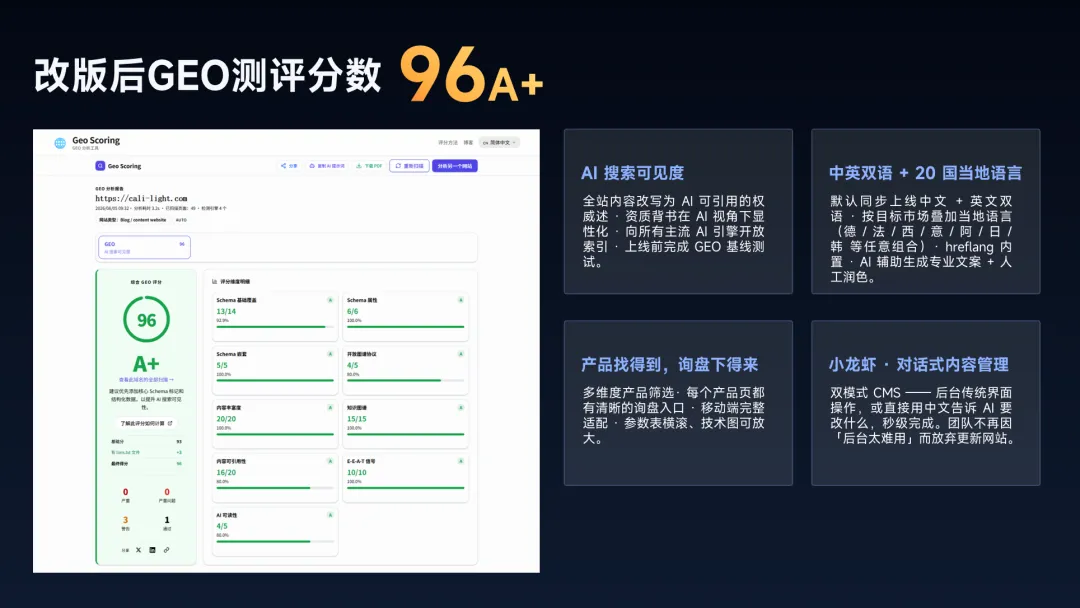
Post-restructuring backend data shows that active page views reached 4.068 million, spanning 20 platforms, with 59% of traffic coming from AI engines (such as Duobao, OpenAI, ByteDance), and the remaining 41% from traditional search engines.
The Four AI Assistants Behind the Restructuring
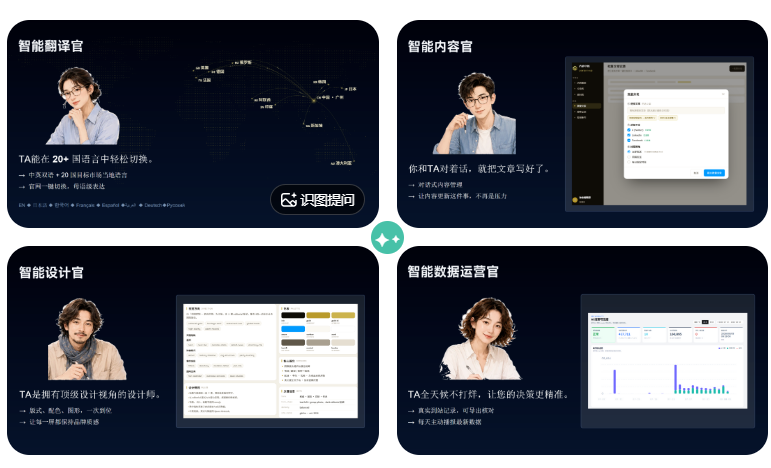
China Light Network introduced four AI agents, dramatically reducing what previously required 3–4 marketing staff:
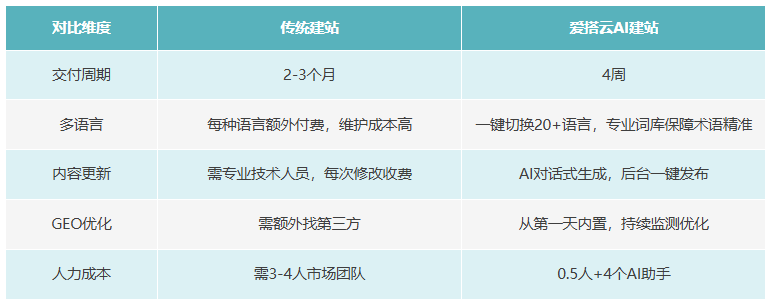
1. Intelligent Translator: Equipped with a specialized terminology database for the lighting industry (containing thousands of technical terms), it generates precise translations in over 20 languages with a single click, eliminating errors common in machine translation.
2. Intelligent Content Creator: Generates articles via conversational back-end interactions and can batch-publish them across overseas social media platforms (LinkedIn, Facebook, Twitter, etc.).
3. Intelligent Designer: From color schemes to graphic layouts, it produces high-quality visual pages from a top designer’s perspective.
4. Intelligent Data Operations Officer: Operates 24/7, providing real-time updates on website traffic and AI crawler activity, with automatic alerts for anomalies.
Key Concepts: SEO vs. GEO
Mr. Hong Bing carefully clarified these two easily confused concepts:
◆Traditional SEO (Search Engine Optimization): Focuses on optimizing keywords and external links for search engines, competing for ranking positions on search result pages, with users clicking on links to visit the official website.
◆GEO (Generative Search Engine Optimization): Designed specifically for AI Q&A, ensuring that when answering questions, AI directly includes your brand in its response.
With both old and new traffic channels running in parallel today, lighting companies should prioritize building a GEO‑optimized official website as their core infrastructure, while simultaneously maintaining basic SEO to capture all available traffic sources.
AiDaYun: Let AI Proactively Recommend Your Brand
Based on China Light Network’s practical experience, China Light All-Media, together with its technology partner Beansmile, has jointly developed an AI‑powered website-building solution tailored for the lighting industry—AiDaYun.
Compared with traditional website builders, AiDaYun achieves a leap forward in next-generation technology:
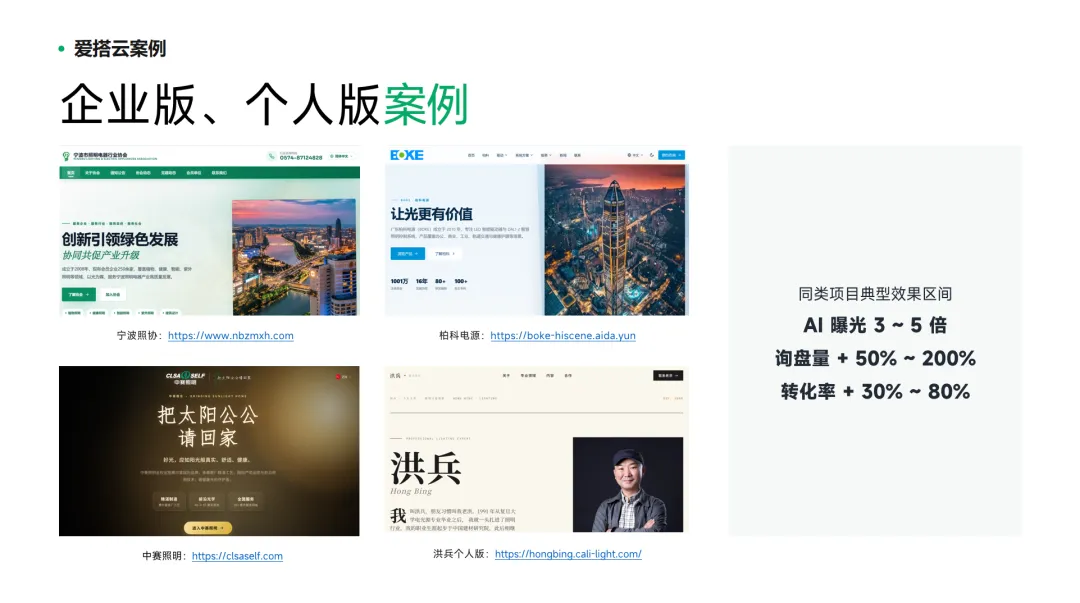
Currently, companies such as Boco Power, ZhongSai Lighting, and the personal IP “Lao Hong Talks Lights” have completed their upgrades, resulting in a 3–5 fold increase in AI exposure, along with simultaneous growth in inquiries and conversion rates.
Breaking Free from Isolation: Building a Brand Ecosystem for the AI Era
Mr. Hong Bing emphasized that isolated optimizations are far from sufficient; companies must build a three‑part brand ecosystem to establish sustainable competitive barriers:
1. Brand Infrastructure: Construct an AI‑friendly official website as the core information source for the brand.
2. Continuous Content Creation: Focus on core market segments, target long-tail vertical keywords, and consistently produce professional written content, avoiding irrelevant clutter that dilutes brand positioning.
3. Layered Authority Endorsements: Participate in national and industry standards development, win prestigious awards, and secure coverage from authoritative media outlets—AI algorithms integrate these signals to boost brand weight.
AI Has Memory Inertia: The Earlier a Brand Enters the AI Model, the Harder It Is for Later Entrants to Replace It. This is the dividend of our times.
Interactive Q&A
Q
Since AI responses only display a handful of brands, how can lighting companies with limited budgets cost-effectively secure a spot in AI answers?
A
Mr. Hong Bing pointed out that the key lies in “early action + focused deep cultivation.” First, transform the official website into an AI‑friendly structure—the core information source for AI crawling. At the same time, ramp up written content production—text is far more AI‑friendly and significantly cheaper to create than short videos. With limited budgets, avoid broad competition within the “lighting” category; instead, focus on a single vertical keyword to master it thoroughly. For example, if specializing in explosion-proof lighting, concentrate exclusively on that niche, continuously strengthen the content matrix around your specialty, and generate highly targeted, high-conversion traffic.
Q
My official website hasn’t been updated in years, and I’ve only been producing short videos—how can I resolve the issue of AI being unable to retrieve complete brand information?
A
“This isn’t just about patching things up—it requires rebuilding the foundation from scratch.” Mr. Hong Bing used the analogy of constructing a house: brick-and-mortar structures built in the 1970s and 1980s simply couldn’t support modern needs, so the official website infrastructure for the AI era must be as solid as reinforced concrete. Companies need to preserve existing content and rebuild the website using new infrastructure. With AI‑assisted website builders, tasks that once required 2–3 marketing personnel can now be accomplished by half a person plus four AI assistants—at a lower overall cost.
Q
My content is scattered across multiple platforms, leading to conflicting brand information captured by AI—how can I standardize these efforts?
A
“Content integration must be consistent,” Mr. Hong Bing stressed. Companies should distill their brand’s core values and ensure that all official websites, social media accounts, and short video content consistently reinforce this central message. Avoid filming scenes unrelated to the brand just to attract attention—AI will become confused.
By repeatedly emphasizing the same professional direction through diverse examples, authoritative certifications, and real-world case studies, AI will prioritize recommending your brand when users conduct searches.
Q
How can I cost-effectively produce multilingual content adapted to overseas AI search requirements?
A
“We still rely on AI—and a well‑curated vocabulary.” Mr. Hong Bing shared his practical experience: in the past, China Light Network spent heavily on creating English versions, yet struggled to maintain ongoing updates. Now, with AI and specialized term databases, companies only need to establish a terminology library specific to the lighting industry (covering dozens of terms related to illuminance, color temperature, healthy lighting, etc.), allowing AI agents to quickly translate precise multilingual articles. China Light Network is continuously updating its industry-specific lexicon, enabling businesses to obtain high‑quality multilingual content in one stop.
Final Thoughts
Start taking action today—after six months, you’ll not only have gained traffic, but also established barriers that will be hard to surpass.
Companies that missed out on the short-video boom may still catch up in the AI era—but this time, the window of opportunity could be even shorter.
China Light
The official website of the China Association of Lighting Industry and a full-media platform for the lighting sector. We provide authoritative and timely lighting information while striving to be a growth partner for businesses. From brand promotion and channel expansion to consulting, talent training and participation in standards development, we provide comprehensive professional services to help businesses improve quality and efficiency and jointly advance the high-quality development of the lighting industry.
Business Contacts
仇纯 (Ms.): 158 6155 3579
顾君 (Mr.): 137 7157 5253