
The Ministry of Agriculture and Rural Affairs has issued the “15th Five-Year Plan for National Crop Production Development” | Full Text
National Plan for the Development of Crop Production during the 15th Five-Year Plan Period
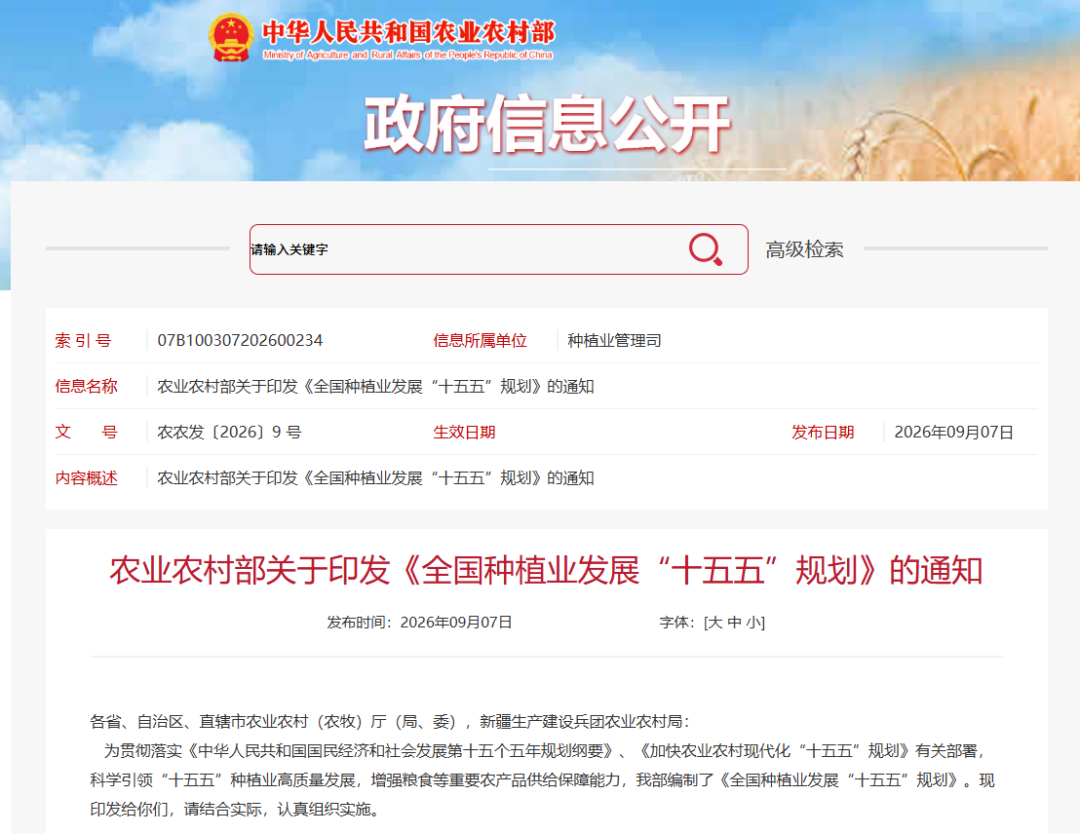
Crop production is a foundational industry that ensures national food security and accelerates the modernization of agriculture and rural areas, serving as an important carrier for continuing the agricultural civilization. To scientifically guide high-quality development of crop production during the 15th Five-Year Plan period and strengthen the capacity to ensure supply of grain and other key agricultural products, this plan has been formulated in accordance with the Outline of the 15th Five-Year Plan for National Economic and Social Development of the People’s Republic of China and the “15th Five-Year Plan” for Accelerating Agricultural and Rural Modernization.
I. Overall Requirements
Guided by Xi Jinping Thought on Socialism with Chinese Characteristics for a New Era, we will thoroughly implement the spirit of the 20th National Congress of the Communist Party of China and all plenary sessions of the 20th Central Committee, earnestly carry out the arrangements made at the Fourth Plenary Session, fully apply General Secretary Xi Jinping’s important discourses and instructions on “agriculture, rural areas, and farmers” work, anchor ourselves in the goal of agricultural and rural modernization, coordinate the development of science-based agriculture, green agriculture, quality-oriented agriculture, and brand-driven agriculture, and simultaneously focus on increasing yields and productivity, enhancing ecological sustainability, and boosting both output and incomes. We will deeply implement the strategies of "storing grain in the land" and "storing grain in technology," practice the concept of a "big food" approach, develop new productive forces in agriculture, optimize regional layouts and varietal structures, comprehensively consolidate the foundation of food security, promote green, high-quality development of crop production, enhance overall agricultural productivity and improve quality and efficiency, thereby providing solid support for advancing comprehensive rural revitalization and accelerating the building of a strong agricultural nation.
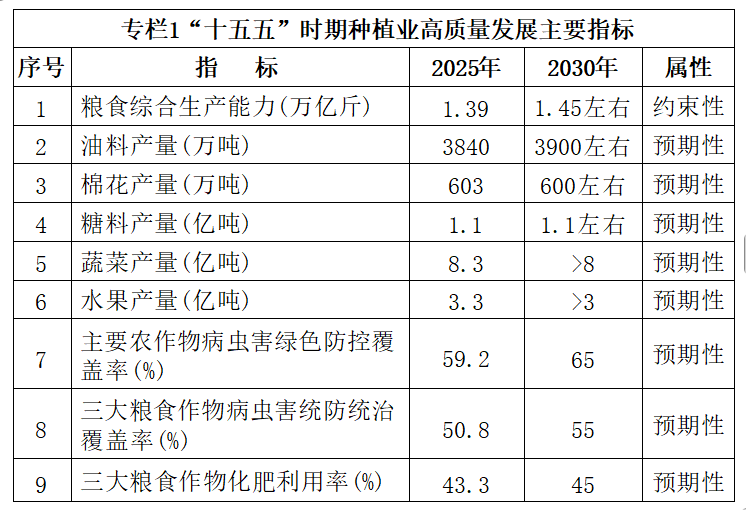
By 2030, comprehensive grain production capacity will steadily increase, firmly safeguarding the bottom lines of basic self-sufficiency in grains and absolute food security. Soybean, oilseed, cotton, and sugar crop production capacities will be consolidated and enhanced, maintaining reasonable levels of self-sufficiency. Vegetable, fruit, and tea supplies will be balanced, diverse, and safe, with diversified offerings better aligned with consumer demand. Efficient water use in agriculture will continue to advance, chemical fertilizers and pesticides will be applied scientifically and precisely, and green production practices in crop cultivation will keep improving. Agricultural condition and disaster monitoring and early warning systems will become more accurate, disaster prevention, mitigation, and relief capabilities will be comprehensively strengthened, and significant progress will be made in achieving high-quality development of crop production.
II. Strengthening Supply Security for Grain and Other Key Agricultural Products
We will always prioritize strengthening supply security for grain and other key agricultural products as our top and bottom-line task, coordinating efforts to stabilize yields, improve quality, and increase profitability, thus ensuring adequate quantity, diversity, and quality.
1
Enhancing Grain Production Capacity
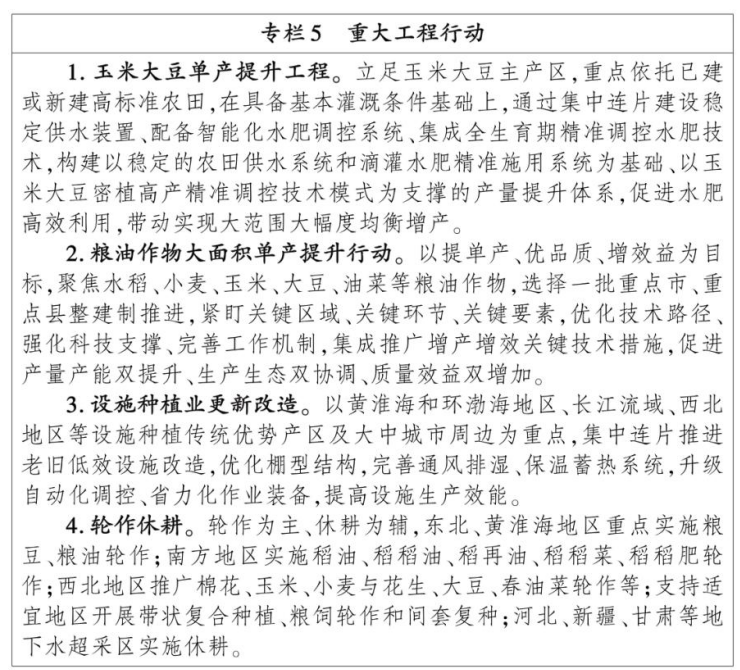
Adhering to the dual strategy of stabilizing acreage while increasing per-unit yield, we will launch a new round of initiatives to boost grain production capacity by 100 billion jin, promoting integrated improvements through superior farmland, seeds, machinery, and methods, and driving large-scale increases in per-unit yield. We will optimize planting structures, elevate grain quality, and shift from prioritizing yield alone toward a balanced emphasis on both yield and quality.
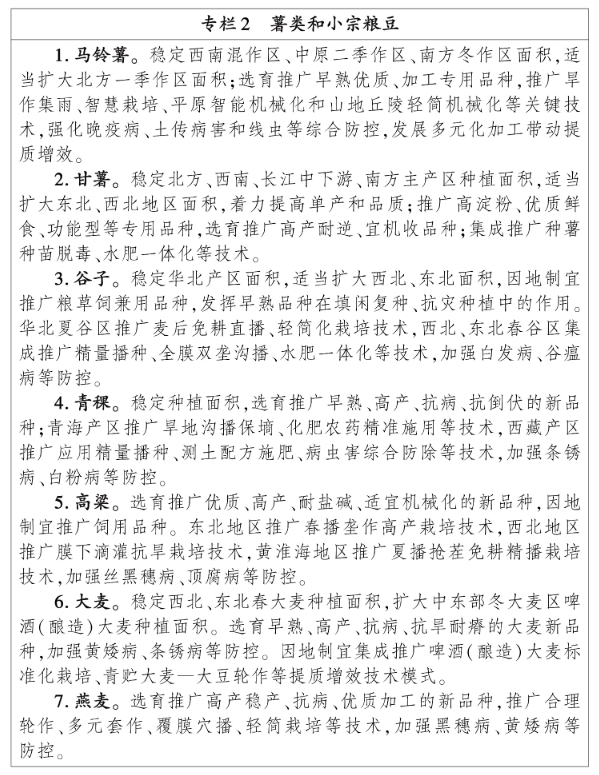
1. Stabilizing Rice Production. Maintain planted area, optimize variety mixtures, and develop high-quality, flavorful rice varieties. In Northeast China: Increase the proportion of paddy rice irrigated by surface water, moderately reduce well-irrigated cold-region rice, and cultivate high-quality long-grain japonica rice. In the middle and lower reaches of the Yangtze River: Stabilize double-cropping rice production, improve the quality of early-, mid-, and late-season rice; promote centralized seedling raising and mechanized transplanting and broadcasting, curb the spread of direct-seeded and clean-field rice; popularize indica-japonica hybrids, heat-tolerant varieties, and those resistant to rice leafhoppers. In Southwest China: Stabilize medium-season rice, develop regenerative rice suited to local conditions; promote centralized seedling raising and mechanized transplanting, appropriately increase planting density. In South China: Stabilize double-cropping rice production, develop premium rice varieties such as silk-milled rice.
2. Stabilizing Wheat Production. Keep winter wheat acreage steady, focus on boosting per-unit yield, and develop specialized high-quality wheat varieties. In the Huang-Huai-Hai region: Cultivate high-gluten and medium-gluten wheat, select and promote high-yielding varieties resistant to sprouting, dry-hot winds, and efficient water conservation, widely adopt high-performance seeders, and meticulously prepare fields to improve seeding quality. In the middle and lower reaches of the Yangtze River: Develop low-gluten and medium-gluten wheat, select and promote varieties resistant to scab and sprouting, raise the level of wheat production from rice stubble. In the Southwest and Northwest: Stabilize acreage, select and promote varieties resistant to stripe rust, emphasize meticulous field preparation and seeding quality, and drive increases in dryland wheat yields.
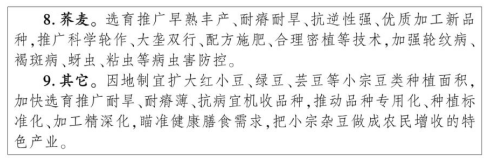
3. Increasing Corn Production Capacity. Coordinate the development of grain corn, fresh-eating corn, and silage corn, primarily promoting integrated water-fertilizer management combined with appropriate planting density to unlock maximum yield potential. In Northeast China: Stabilize acreage, implement rational crop rotation, integrate deep loosening and conservation tillage, widely promote high-performance seeders, and adopt high-yield, stable-density techniques such as wide-row dense planting. In the Huang-Huai-Hai region: Select and promote heat-resistant, scab-resistant, and other resilient high-yielding varieties, accelerate adoption of high-performance seeders, moderately increase planting density, and enhance drying capacity. In the Northwest: For rain-fed areas, integrate full-film double-row furrow sowing, water-efficient dense planting, and drought-resistant water-conservation technologies; in irrigated zones, promote integrated water-fertilizer management. In Southwest China: Select and promote compact, densely planted varieties, appropriately increase planting density, develop intercropping of corn and soybeans according to local conditions, and raise the level of mechanization in mountainous farming operations.
2
Consolidating Soybean and Oilseed Production
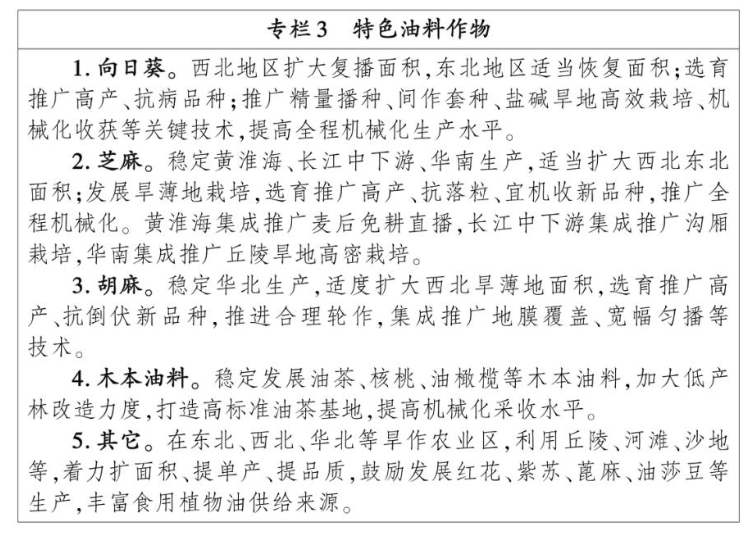
Deeply implement the national project to boost soybean and oilseed production capacity, adopting multiple approaches and measures, tapping latent potential, expanding acreage, focusing on per-unit yield, and increasing supplies of edible vegetable oils.
1. Enhancing Soybean Production Capacity. Consolidate gains from expanded planting, stabilize acreage, implement rational crop rotation, and concentrate on boosting per-unit yield. Maintain edible soybeans, develop oil-use soybeans, and promote genetically modified soybeans tailored to local conditions. In Northeast China: Stabilize acreage, optimize layouts for high-oil, high-yield, high-protein soybeans, appropriately increase planting density, and widely adopt seed coating, wide-row dense planting, and integrated water-fertilizer management techniques. In the Huang-Huai-Hai region: Stabilize net-cropping and strip-composite planting areas, develop high-protein, high-yield soybeans, vigorously promote high-performance seeders and specialized harvesters, and widely adopt techniques such as rational dense planting, no-till mulching, and seed coating. In Southern China: Steadily develop strip-composite planting, explore expanding young orchards intercropped with soybeans and other interplanting models, select and promote high-protein, high-yield varieties, and strive to raise the level of mechanized planting.
2. Unlocking Rapeseed Production Potential. Expand winter rapeseed plantings, develop spring rapeseed, steadily increase acreage, vigorously boost per-unit yield, select and promote high-oil, high-oleic acid, highly resistant varieties, and effectively improve pressing and processing standards. In the winter rapeseed-producing regions along the Yangtze River: Continuously tap idle winter fields to expand rapeseed acreage, tailor-made rice-rapeseed, rice-rice-rapeseed, and rice-re-rapeseed models, select and promote short-life-cycle, disease- and crack-resistant, machine-harvest-friendly varieties, and widely adopt techniques such as rational dense planting and "one promotion, four protections." In the spring rapeseed-producing regions of the Northwest and Northeast: Develop grain-oil and oil-feed rotations, tap potentials in cold and saline-alkali lands, and widely adopt no-till direct seeding, film mulching, and segmented harvesting techniques.
3. Enhancing Peanut Production Capacity. Implement rational crop rotation and intercropping, moderately expand acreage; steadily boost per-unit yield, maintain high quality and ensure safety. In the Huang-Huai-Hai region: Tap acreage potential, promote spring sowing changes to summer sowing; select and promote high-oil, high-oleic acid, resilient, machine-harvest-friendly varieties, and widely adopt ridge-prevention-of-flooding and single-seed precision sowing techniques. In Northeast China: Accelerate variety renewal and replacement, raise coverage of commercial varieties; widely adopt seed treatment with chemicals, ridge-covering techniques. In Southern China: Through dry grain and fruit orchard intercropping, moderately develop peanut production.
3
Stabilizing Cotton and Sugar Crop Production
Consolidate advantageous production areas, raise per-unit yield levels, promote high-quality varieties, and advance full-process mechanization.
1. Improving Cotton Supply Quality. Consolidate Xinjiang cotton regions, stabilize acreage along the Yellow River and Yangtze River, and develop high-quality cotton. In Xinjiang: Stabilize advantageous production areas, reduce less suitable ones; promote machine-picked cotton varieties coordinated in length, strength, and fineness, encourage long-staple cotton development, and explore creating smart production scenarios. Along the Yellow River and Yangtze River: Stabilize traditional cotton areas, promote intercropping and post-wheat (oil) direct seeding, tap saline-alkali land planting potential, integrate complementary machine-compatible varieties and cultivation techniques, and improve machine-picking quality.
2. Raising Sugar Crop Production Capacity. Stabilize acreage, combine superior seeds and methods, integrate agricultural machinery and agronomy, and raise per-unit yield and sugar content. In sugarcane-producing areas: Promote high-yield, high-sugar varieties resistant to adversity, good perennial growth, and suitable for full-process mechanization; enhance detoxification and healthy seedling propagation capabilities, and promote joint machine harvesting and phased machine harvesting collaborations. In beet-producing areas: Cultivate high-yield, high-sugar varieties suitable for single-bud mechanical harvesting, raise the level of seed pelletization processing, and widely adopt under-film direct seeding and rational dense planting techniques.
4
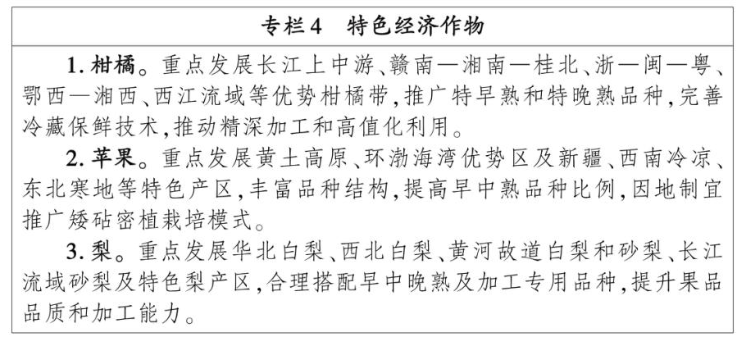
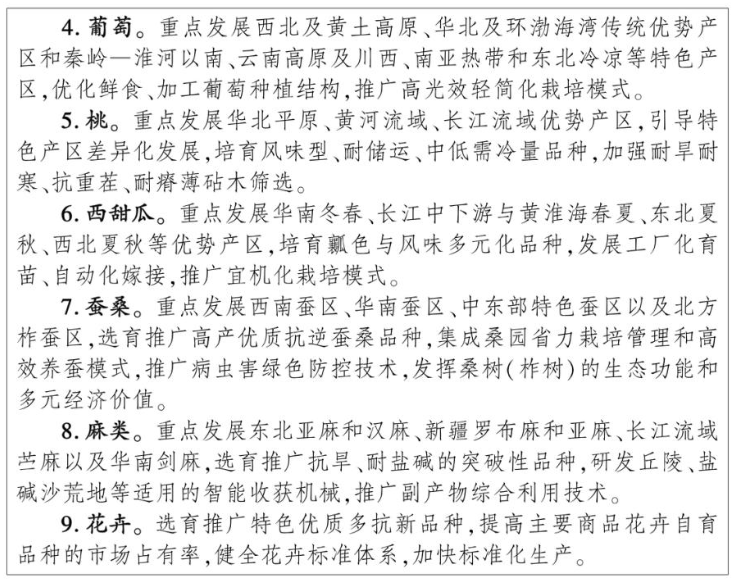
Enriching the "Vegetable Basket" Product Range
Stabilize production scale, develop high-quality products, and enhance diversified supply capabilities and quality/safety standards.
1. Promoting Balanced Vegetable Supply. Develop south-to-north vegetable transportation and cool-climate vegetable production, stabilize large and medium-sized city vegetable production and surrounding areas, enhance off-season supply and emergency preparedness capabilities, and promote steady production and quality improvement of edible mushrooms. Undertake renovations of aging facilities, accelerate adoption of machine-compatible production modes and specialized varieties, raise year-round production, three-dimensional planting, and intelligent control levels. Improve vegetable price monitoring and information release mechanisms, strengthen comprehensive analysis of supply and demand situations, and coordinate seasonal, regional, and varietal supply adjustments.
2. Advancing Fruit Quality Improvement. Stabilize bulk fruits, optimize ripening schedules, develop specialty production areas and varieties, and guide fruit planting toward concentration in advantageous regions. Accelerate renovation of old, low-efficiency orchards, promote standardized orchard construction, simplified cultivation, facility-based disaster prevention, and widely adopt grass-growing, precise water-fertilizer management techniques to improve fruit quality. Establish a sound fruit grading standard system, expedite development and application of intelligent, efficient grading and sorting equipment, refine pre-cooling and storage facilities, and complete end-to-end cold-chain logistics, driving processing efficiency gains.
3. Enhancing Tea Industry Quality and Efficiency. Coordinate development of tea culture, tea industry, and tea technology. Promote regionally appropriate planting, reduce non-suitable areas, and accelerate propagation of clonal tea tree varieties. Renovate old, low-efficiency tea gardens, improve infrastructure, promote integrated water-fertilizer management and green pest control techniques, build eco-friendly tea gardens, develop green food teas, organic teas, and eco-low-carbon teas. Drive clean, automated, and intelligent processing, develop new tea beverages, new tea foods, and tea-derived products.
4. Elevating Traditional Chinese Medicine Material Quality. Develop authentic medicinal herb production, optimize planting layouts, and guide gathering toward authentic production areas. Protect and utilize TCM germplasm resources, promote artificial breeding of wild endangered herbs, increase supply of high-quality seeds and seedlings. Popularize simulated-environment cultivation, intercropping, and other eco-friendly planting models, integrate key technologies such as continuous cropping obstacle management and green pest control. Refine timely harvesting, post-harvest processing, and initial processing techniques, develop fresh-cutting and graded sorting at origin, and raise the level of origin processing.
III
Deepening Green Transformation of Crop Production
5
Advancing Water-Saving and Efficiency in Agriculture
Develop water-saving agriculture by zone and category, improve water resource utilization efficiency. Promote drought-resistant, water-saving varieties, integrate supporting high-efficiency water-saving technologies. Strengthen soil moisture monitoring and forecasting, advance irrigation based on soil moisture, mitigate drought-related losses. In paddy fields, implement shallow wet irrigation, smart irrigation, and other techniques to reduce irrigation water usage; in irrigated fields, accelerate micro-irrigation and sprinkler systems, systematically promote integrated water-fertilizer management; in drylands, integrate rainwater collection, deep loosening for water storage, mulch cover for moisture retention, and increased application of water-retaining agents, promoting water conservation, increased grain yields, and improved efficiency.
6
Improving Precision Fertilization Levels
Optimize and upgrade soil testing formulas, promote fertilization tailored to soil conditions, plant needs, and specific circumstances. Accelerate application of rapid soil nutrient testing, plant nutrition diagnostics, and other technologies to dynamically monitor soil fertility changes and crop nutritional status. Scientifically determine nutrient input and application ratios, promote organic-inorganic synergy, and enhance the accuracy of recommended fertilization plans. Integrate smart precision fertilization, drone fertilization, side-deep fertilization, and other modes to improve fertilizer utilization efficiency.
7
Advancing Precision Medication for Quality and Efficiency
Continue advancing scientific selection and application of medications, expand the use of environmentally friendly pesticides such as microbial and plant-derived types, accelerate integration of natural enemy releases, physicochemical controls, and other green pest control techniques to improve disease and pest control effectiveness. Standardize drone spraying operations, intensify promotion of intelligent, high-performance plant protection equipment, and raise the level of precision medication. Foster and strengthen professional service organizations to improve operational efficiency and broaden the scope of unified pest control coverage.
IV
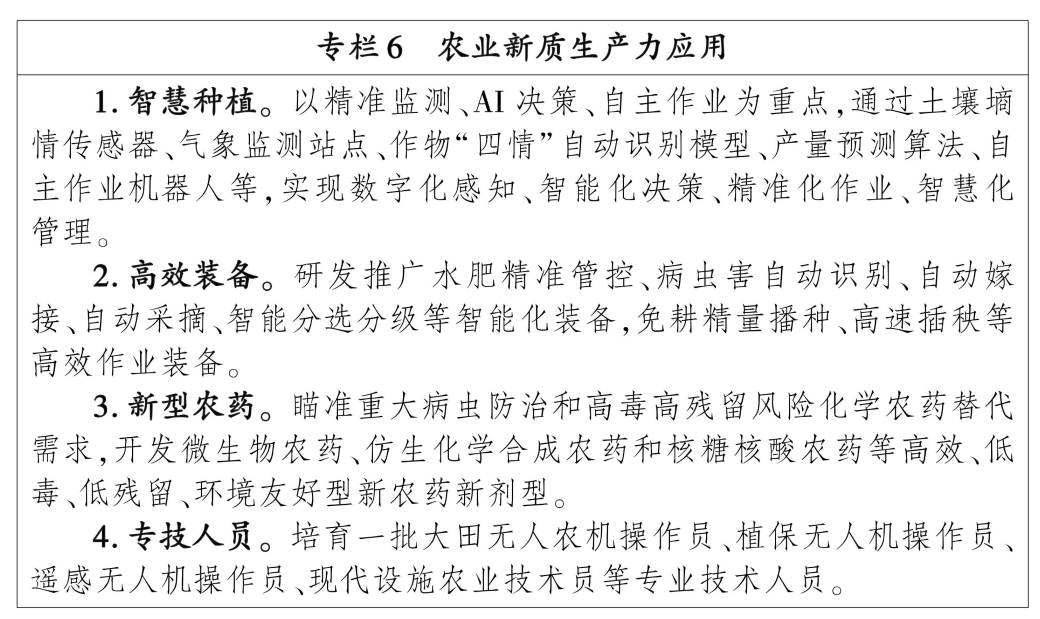
Unleashing the Leading Role of New Agricultural Productive Forces
8
Selecing and Promoting Breakthrough Varieties
Tap into outstanding germplasm and genetic resources, select and promote wheat resistant to scab, rice resistant to rice leafhoppers, corn tolerant to dense planting and machine harvesting, high-oil, high-yield soybeans, short-life-cycle rapeseed, high-quality cotton, high-yield, high-sugar sugar crops suitable for machine harvesting, specialized vegetables, flavor-excellent and functional fruits and vegetables, as well as high-yield, high-resistance varieties against adversity and pests, facilitating renewal and replacement.
9
Integrating and Promoting Pioneering Technologies
Promoting Intelligent Seedling Raising for Rice, precision irrigation, micro-sprinklers for wheat, quality-focused cultivation, precise regulation for corn, machine harvesting of grains, wide-row dense planting for soybeans, integrated water-fertilizer management, "one supplement, four increases" for rapeseed, reduced loss during machine harvesting, high-efficiency directional regulation for cotton, as well as intelligent facility control, automatic fruit and vegetable picking, precision green weed control, and other technologies to raise the rate of effective technological implementation and coverage.
10
Developing and Applying Specialized Equipment
Accelerate research and development of precision dense planting sowing machines, efficient low-loss harvesting equipment, high-quality bed preparation tools, operation quality monitoring devices, adaptive adjustment gear, etc.; develop and promote large, high-end intelligent agricultural machinery suitable for scaled plots, as well as lightweight, efficient machines adapted to hilly and mountainous terrains; promote pneumatic precision sowing machines, large-capacity harvesters, large joint land preparation machines, hybrid-powered tractors, heavy-load plant protection drones, and other high-performance advanced models to enhance operational quality and efficiency.
11
Researching and Promoting Innovative Inputs
Integrate cutting-edge technologies such as gene editing, nucleic acid interference, biosynthesis, and create novel products like ribonucleic acid pesticides, microbial pesticides, etc. Tap into resilient, stable-effect microbial strains, bio-based wrapping materials, humic acid-enhancing biomass resources, screen and develop new fertilizers, accelerate promotion of microbial fertilizers, slow-release fertilizers, value-added fertilizers, and other green, efficient fertilizer products. Strengthen research on anti-adversity, yield-enhancing growth regulators, and soil conditioning agents such as acid-base balancing and fertility-enhancing treatments.
12
Strengthening Smart Scenario Promotion
Advance equipment R&D, technology integration, scenario creation, and raise the level of digitalization in crop production. Conduct research and development on sensors, specialized chips, model algorithms, and other components, expand applications of drones, IoT, robots, accelerate adoption of precise sensing, intelligent analysis, autonomous regulation, and other digital technologies, speed up demonstration and promotion of smart farm scenarios, and foster intelligent production throughout the entire crop lifecycle.
V
Enhancing Disaster Prevention, Mitigation, and Relief Capabilities in Agriculture
13
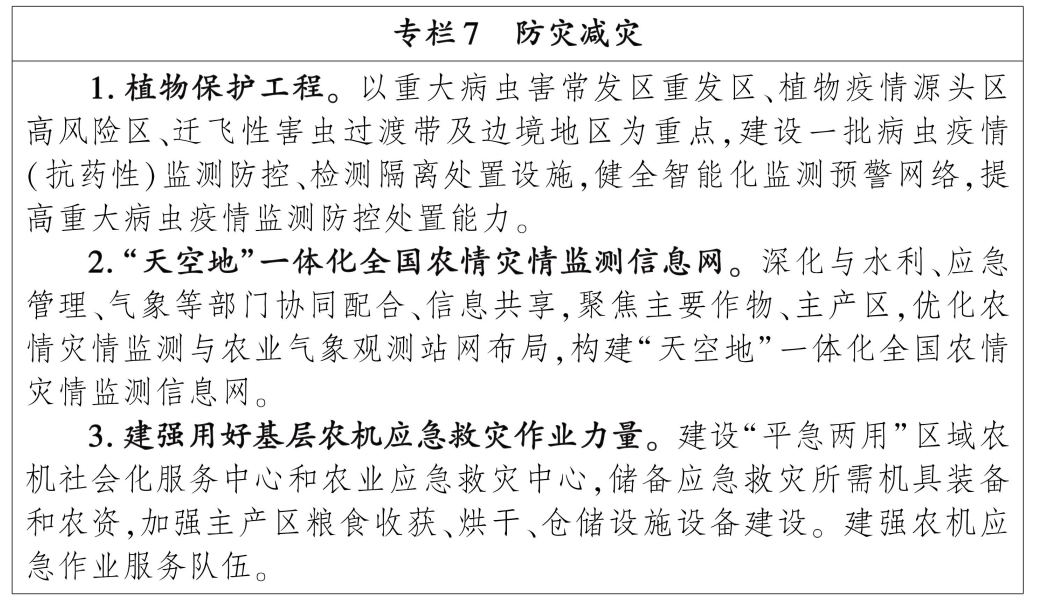
Improving Disaster Monitoring and Early Warning Levels
Use technology to monitor disasters, analyze risks, and provide intelligent decision support, shifting from "subjective experience judgment" to "technology-driven precision empowerment," accelerate the establishment of a robust monitoring and early warning system, optimize station network layout, develop remote-sensing satellites, drones, radar, ground-based IoT, and other monitoring technologies, and promote the construction of an integrated "sky-ground" monitoring network. Build databases on seedling conditions, soil moisture, pest infestations, and disaster situations, and enhance emergency command capabilities for disaster prevention, mitigation, and relief.
14
Strengthening Meteorological Disaster Prevention and Response
Prevent first, combine prevention and treatment, shift from "post-disaster relief-centric" to "pre-disaster prevention-first," optimize departmental coordination, early warning issuance, material reserves, and other mechanisms. Transition from "passive emergency response" to "normal, long-term preparedness," balance emergency and routine readiness, promote high-standard farmland construction by zone and category, strengthen ditch repair and maintenance, improve emergency relief facilities, equipment, and deployment capabilities. Build robust agricultural machinery emergency response teams, reinforce grassroots disaster prevention and relief specialist squads. Intensify scientific research and disaster pattern studies, promote new technologies and models for disaster prevention and mitigation.
15
Strengthening Pest and Disease Control to Reduce Losses
Coordinate plant protection capacity planning and pest/disease control efforts, integrate big data, AI, IoT, and other information technologies, along with drones, embodied robots, and other advanced equipment, with traditional plant protection methods, to enhance major crop pest and disease monitoring and response capabilities. Gradually establish related data standards and management systems, and strengthen big data's ability to support pest and disease control and loss reduction.
VI
Organizational Implementation
Implement the central coordination mechanism, with provinces taking overall responsibility and cities/counties executing tasks; enforce the requirement of shared party and government responsibility for food security and the "vegetable basket" mayor accountability system; strengthen departmental collaboration and work linkage, pool efforts, and ensure all tasks are carried out. Reinforce policy support and coordination in pricing, subsidies, insurance, etc., and establish a diversified investment framework prioritizing fiscal support, financial backing, and active social participation. Strengthen technical extension services and plant protection inspection systems, establish a multi-faceted, efficient, collaborative, joint-defense agricultural technology promotion mechanism. Intensify regular, long-term oversight of "greenhouse houses" and abandoned farmland. Strengthen law enforcement team building and policy interpretation, enhance enforcement and regulatory capabilities, and foster a positive social atmosphere.
Source: Ministry of Agriculture and Rural Affairs
China Light
The official website of the China Association of Lighting Industry and a full-media platform for the lighting sector. We provide authoritative and timely lighting information while striving to be a growth partner for businesses. From brand promotion and channel expansion to consulting, talent training and participation in standards development, we provide comprehensive professional services to help businesses improve quality and efficiency and jointly advance the high-quality development of the lighting industry.
Business Contacts
仇纯 (Ms.): 158 6155 3579
顾君 (Mr.): 137 7157 5253