
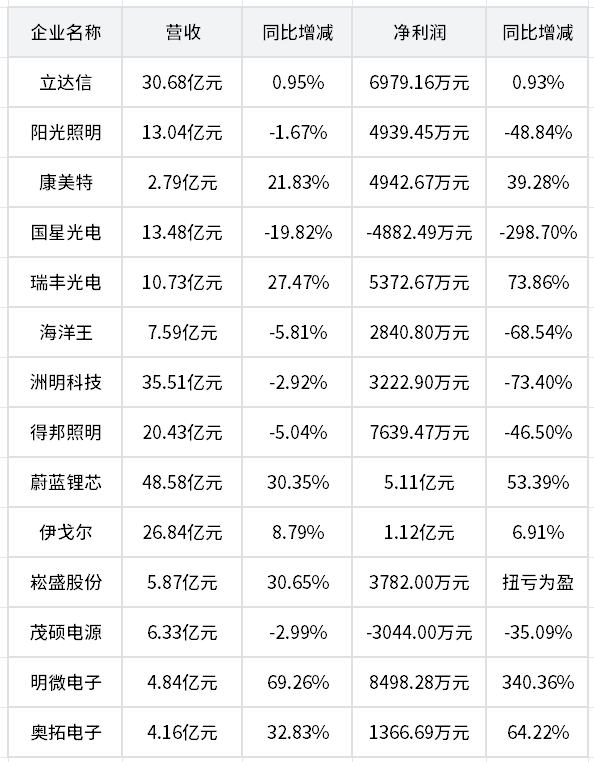
Fourteen LED-listed companies, including Lite-On, Sunlight, and Nationstar, have released their 2026 semi-annual reports.
Recently, LED lighting companies have been releasing their 2026 semi-annual reports one after another.
Ledaxin
Ledaxin’s 2026 semi-annual report shows that in the first half of this year, the company achieved revenue of RMB 3.068 billion, up 0.95% year over year; net profit attributable to shareholders was RMB 69.7916 million, up 0.93% year over year.
During the reporting period, the company adhered to its strategy of “dual core businesses—brand OEM and domestic–international dual circulation,” working hard to maintain the stability of its OEM operations while simultaneously developing its branded business. In particular, the company continued to invest in its own brands, driving product upgrades around smart lighting and healthy light environments, strengthening external ecosystem partnerships, and diversifying channel expansion. These measures effectively enhanced the balance and risk resilience of the company’s operations, ensuring stable revenue growth.
The company has made significant progress in restructuring its global supply chain. The first phase of its self-built production base in Chachoengsao, Thailand, has been completed, with relocation and production already underway. Construction of the second phase is progressing smoothly, expected to finish infrastructure by 2026 and officially commence operations in 2027. With this, the company now operates a manufacturing footprint featuring dual bases in Zhangzhou Changtai, China, and Chachoengsao, Thailand, working in synergy.
Meanwhile, the company maintained strong investment in R&D and innovation, actively promoted business upgrades, accelerated overseas supply chain development, and fully implemented its Digital Operations Platform (DOP).
Sunshine Lighting
Sunshine Lighting disclosed its 2026 semi-annual report. In the first half of 2026, the company recorded total operating revenue of RMB 1.304 billion, down 1.67% year over year; net profit attributable to shareholders was RMB 49.3945 million, down 48.84% year over year.
During the reporting period, on the international market front, the European region leveraged localized platforms in Denmark, Belgium, and other countries to consolidate strategic partnerships with leading supermarket chains and major importers, driving steady growth in outdoor lighting. In the Americas, the company continued refining its “China–Thailand–Vietnam” capacity layout, accelerating capacity ramp-up and utilization at its Thai facility while focusing on a three-year plan to double sales to strategic retail customers. Meanwhile, in the Asia-Pacific region, new market business units were cultivated to achieve sales growth outpacing the group average. For weaker regions such as Africa, Latin America, and Oceania, the company adopted a dual-drive approach of “localization + digitalization,” replicating Australia’s successful experience in cultivating key strategic clients, aiming to break into the ten-million‑level customer segment for the first time.
In the domestic market, engineering projects focused on high‑growth sectors like rail transit, commercial real estate, industrial manufacturing, education, and healthcare, establishing a dual-channel system of direct sales teams and core distributors. Distribution operations accelerated the shift from traditional wholesale toward a new retail model emphasizing “product + service + experience,” building regional light‑art experience centers and expanding digital channels such as livestream e‑commerce and content‑driven recommendations. Outdoor lighting efforts concentrated resources on landscape lighting, smart streetlights, road illumination, and other categories with technological barriers and brand premium potential.
In addition, in R&D and innovation, the company consolidated its core technical strengths in optical design, electronic control, thermal management, and intelligent systems, increasing investment in next‑generation products such as smart lighting, healthy lighting, off‑grid lighting, and megawatt‑scale AEM electrolyzer technologies. It also advanced domestic substitution of core components and pursued platform‑based, modular designs to continuously improve product cost‑effectiveness.
Hydrogen energy equipment is being developed as a second growth curve, gaining momentum.
Kangmeite
In the first half of 2026, Kangmeite reported total operating revenue of RMB 279 million, up 21.83% year over year; net profit attributable to shareholders reached RMB 49.4267 million, up 39.28% year over year.
Kangmeite listed on the Beijing Stock Exchange on July 8, 2026, marking the release of its first semi‑annual report post‑listing. According to available data, the company primarily engages in the R&D, production, and sales of advanced polymer materials, including electronic packaging materials and high‑performance modified plastics. Since its inception, Kangmeite has consistently driven business growth through R&D, achieving continuous technological breakthroughs and industrialization across three major technical platforms: silicone‑based packaging materials, epoxy‑based packaging materials, and modified expandable polystyrene materials. Among these, its flagship electronic packaging material is an adhesive used for LED chip encapsulation, widely applied in emerging displays, general semiconductor lighting, specialized semiconductor lighting, semiconductor device packaging, aerospace, and other fields.
Guoxing Optoelectronics
In the first half of 2026, Guoxing Optoelectronics reported operating revenue of RMB 1.348 billion, down 19.82% year over year; net profit attributable to shareholders stood at RMB -48.8249 million, a 298.70% decline compared to the same period last year.
By product category, LED packaging and component revenues totaled RMB 983 million, accounting for 72.92%; epitaxial wafers and chips generated RMB 67.7902 million, up 29.49% year over year, raising their share to 5.03%.
Regarding the reasons behind the performance pressure, Guoxing cited three main factors. First, global macroeconomic volatility and weak recovery in end‑consumer demand have weakened overall industry growth momentum. Second, persistently high prices of upstream precious metals and other core raw materials have put downward pressure on traditional product selling prices, impacting both overall revenue scale and gross margin levels. Third, although emerging businesses such as smart wearables, optocouplers, and automotive applications are showing positive growth trends, their economies of scale have yet to fully materialize, making it difficult to offset the downward pressure on conventional product prices during this period.
Ruifeng Optoelectronics
In the first half of 2026, Ruifeng Optoelectronics reported operating revenue of RMB 1.073 billion, up 27.47% year over year; net profit attributable to shareholders reached RMB 53.7267 million, up 73.86% year over year.
Backed by strong R&D capabilities, the company uses business units as implementation vehicles to aggressively expand its Mini LED business, scaling production in an orderly manner based on customer demand, with notable results from structural adjustments. Leveraging Mini LED technology, the company has now established comprehensive innovative LED solutions for automotive lighting and display applications, further focusing on vehicle‑related markets and continuously strengthening technological innovation and product iteration. This year, sales of automotive LEDs and in‑vehicle backlights have grown significantly, market share steadily increased, and the competitive advantages of Mini backlight products have expanded, driving overall revenue and gross profit higher.
On the other hand, the company has optimized its organizational structure and operational management models, deeply integrating information and automation technologies into production and operations. It has comprehensively built intelligent manufacturing systems, full‑chain quality control frameworks, and efficient R&D management mechanisms, continuously improving internal operational efficiency and tightly controlling operating costs. These measures have yielded significant results, leading to steady growth in the company’s financial performance.
Haiyangwang
According to Haiyangwang’s semi‑annual report, the company recorded operating revenue of RMB 759 million, down 5.81% year over year; net profit attributable to shareholders was RMB 28.408 million, down 68.54% year over year.
The company stated that in the first half of 2026, due to structural differentiation within the industry, slower fiscal budget approvals, and intense price wars among competitors, some downstream customers experienced delayed order revenue recognition compared to expectations.
At the same time, the company remained committed to its “Lighting+” strategy, increasing forward‑looking investments in business deployment and product development, which temporarily raised operating expenses. Combined with external factors, both revenue and profits declined year over year. However, looking at individual quarters, the company’s various operational improvement initiatives began to show effects in the second quarter: compared to the first quarter, losses were reversed, and operational quality improved quarter over quarter.
AI and industrial lighting have become central themes for 2026. Under the “Lighting+” strategy, the company continues to increase forward‑looking investments in underlying architectures, intelligent control hardware, software platforms, and AI algorithms.
The announcement also noted that domestically, the company remains customer‑centric, leveraging its professional industry operation system to deliver complete digital transformation packages, transitioning from a mere product supplier to a provider of “Lighting+ Light‑Interconnected” smart scene solution services.
Internally, the landscape lighting and municipal illumination industries served by its subsidiary Mingzhihui are under overall pressure. The company proactively scaled back or abandoned certain projects, prioritizing cash flow, which somewhat impacted first‑half revenue.
Zhouming Technology
In the first half of 2026, Zhouming Technology reported total operating revenue of RMB 3.551 billion, down 2.92% year over year. By region, the domestic market posted solid growth, up 3.17% year over year, while overseas markets saw a slight year‑on‑year decline of 7.06% due to fluctuating industry demand. Overseas revenue still accounted for 56.96%, remaining the company’s core revenue base.
Net profit attributable to shareholders stood at RMB 32.229 million, down 73.40% year over year. Profitability faced temporary pressure, mainly stemming from two factors: first, rising upstream raw material costs combined with a declining share of high‑margin overseas business, resulting in a 3.13% year‑on‑year drop in overall gross margin and a RMB 141 million reduction in total gross profit; second, exchange rate fluctuations in the first half led to foreign‑exchange losses of RMB 129 million, significantly impacting operating profit.
From a market structure perspective, the domestic market continued to drive revenue growth as the core engine, while overseas operations covered more than 160 countries and regions worldwide. The company kept deepening its presence in mature European and American markets, accelerating expansion into emerging markets, and continuously improving its localized operational systems, effectively mitigating risks associated with single‑region market volatility.
From a product structure standpoint, the core smart display business provided solid support, while high‑end products enjoyed rapid growth.
On the order reserve front, the company secured new orders worth RMB 4.437 billion in the first half, up 17.61% year over year, ensuring ample reserves for revenue recognition and sustained performance in the second half. As the proportion of high‑end products increases and new business deployments accelerate, the company’s product value-added and profitability are expected to continue recovering.
Debang Lighting
Debang Lighting disclosed its 2026 semi‑annual report. During the reporting period, the company recorded operating revenue of RMB 2.043 billion, down 5.04% year over year; net profit attributable to shareholders was RMB 76.3947 million, down 46.50% year over year.
The company attributed the profit decline primarily to increased foreign‑exchange losses and a drop in gross margin.
Its development strategy focuses on improving quality and efficiency, deepening “functional lighting,” actively expanding “Lighting+” offerings to upgrade its primary growth trajectory, while specializing in “automotive lighting” as an engine to vigorously develop multi‑category in‑vehicle controllers, thereby building a robust second growth curve.
Notably, the company successfully completed the acquisition of Zhejiang Jiali Industrial Co., Ltd. (Lishui), holding 67.48% equity and continuing to ramp up investments in automotive lighting and in‑vehicle components, laying a solid foundation for its “second growth curve.”
Blue Lithium Core
In the first half of 2026, Blue Lithium Core reported total operating revenue of RMB 4.858 billion, up 30.35% year over year; net profit attributable to shareholders reached RMB 5.11 billion, up 53.39% year over year.
Blue Lithium Core credited its rapid growth to the competitiveness of its products and rising downstream demand, with lithium battery business expanding rapidly year over year, while LED and metal logistics & distribution businesses remained generally stable.
During the reporting period, the company’s LED business generated approximately RMB 861 million in total revenue, up about 0.16% year over year; Huai’an Shunchang reported net profit of approximately RMB 82.995 million.
Igor
Igor announced its 2026 mid‑year report, stating that the company achieved operating revenue of RMB 2.684 billion, up 8.79% year over year; net profit attributable to shareholders was RMB 1.12 billion, up 6.91% year over year.
Igor emphasized that the simultaneous growth in both revenue and profit was largely driven by a further concentration of product mix toward higher value‑added segments. Transformer equipment accounted for 71.38% of total revenue, while lighting products represented 16.88%, together comprising 88.26% of total income, firmly consolidating their dominant position. At the same time, the regional market structure adjusted accordingly, with overseas revenue climbing to 48.20%. However, sales collection efficiency had not yet improved in tandem, leaving operating cash flow negative at RMB -22.7752 million, down 125.20% year over year.
Songsheng Shares
Songsheng Shares reported operating revenue of RMB 587 million in the first half, up 30.65% year over year; net profit attributable to shareholders reached RMB 37.820 million, turning a loss into a profit year over year.
In recent years, the company has consistently reinforced its core business around a dual‑drive strategy of digital power supplies plus energy storage components. The semi‑annual report indicates that during the reporting period, Songsheng’s LED lighting driver power supply business generated RMB 471 million in revenue, up 14.83% year over year, with high‑power supplies contributing RMB 425 million, up 18.98% year over year.
The company’s sports lighting sector has also seen rapid development, with LED lighting driver power supplies successfully deployed in numerous domestic and international projects. Drawing on years of experience in sports lighting projects, Songsheng launched its new NS‑V series—a five‑in‑one dedicated power supply for sports lighting—supporting D4i, DMX/RDM, 0‑10V, PWM, and resistance dimming functions, providing greater flexibility and control for sports lighting applications.
Additionally, during the reporting period, the company introduced compact, highly efficient PA‑HF series outdoor lighting D4i smart drivers, along with the industry’s first commercial D4i product—the NH‑V‑F series—making its lineup of intelligent products increasingly diverse.
Its energy storage component business is primarily managed through its wholly owned subsidiary, Shenzhen Songsheng Innovative Technology Co., Ltd., which handles core energy storage system components. During the reporting period, this business generated RMB 109 million in revenue, up 250.21% year over year.
Maoshuo Power Supply
Maoshuo Power Supply released its 2026 mid‑year report, stating that the company’s operating revenue stood at RMB 6.33 billion, down 2.99% year over year; net profit attributable to shareholders was RMB -30.44 million, down 35.09% year over year.
Maoshuo Power Supply explained that in the first half of 2026, the lighting industry entered a mature stage, amid complex international conditions, intensifying competition, and multiple factors such as volatile raw material prices and extended project delivery cycles, all placing temporary pressure on the company’s operating performance.
In response, the company continued advancing digital transformation and optimizing its operational systems, integrating domestic production bases while increasing investment in its Vietnamese factory. Simultaneously, through product innovation, it expanded into areas such as LED driver power supplies, industrial control power supplies, rail‑mounted power supplies, and general robot power supplies. Furthermore, the newly commissioned Vietnamese plant, coupled with equipment upgrades and line modernizations at its Indian and Brazilian facilities, helped refine global production capacity and supply chains, enhancing overseas service capabilities and order delivery efficiency.
Mingwei Electronics
In the first half of 2026, Mingwei Electronics reported operating revenue of RMB 4.84 billion, up 69.26% year over year; net profit attributable to shareholders reached RMB 84.9828 million, up 340.36% year over year.
According to the announcement, Mingwei Electronics’ operating performance was influenced by several key factors:
1) Rising industry sentiment and increased marketing investments led to year‑over‑year growth in both product sales volume and selling prices, boosting overall revenue;
2) Continuous optimization of product structure and improved in‑house packaging and testing efficiency resulted in year‑over‑year increases in product gross margins;
3) As product gross margins rebounded, the net realizable value of inventory rose, reducing inventory‑related asset impairment losses year over year.
On the product level, during the reporting period, Mingwei Electronics’ display driver products generated RMB 3.26 billion in revenue, serving as the absolute mainstay; linear power supplies contributed RMB 1.02 billion; power management products brought in RMB 772.70 million.
Aoto Electronics
In the first half of 2026, Aoto Electronics reported operating revenue of RMB 4.16 billion, up 32.83% year over year, primarily driven by growth in its LED video display system business; net profit attributable to shareholders reached RMB 136.69 million, up 64.22% year over year.
By region, Aoto Electronics’ domestic market generated RMB 2.23 billion in revenue, up 35.47% year over year, while overseas markets brought in RMB 1.93 billion, up 29.92% year over year.
In the first half of 2026, facing a complex and uncertain external environment, Aoto Electronics remained anchored to its “AI+Video” strategy, accelerating the practical application of artificial intelligence and intelligent video technologies to enhance the core product’s smart manufacturing capabilities.