
Central authorities have made it clear: develop agricultural factories! What does this mean?
Recently, the CPC Central Committee and the State Council issued the “Opinions on Developing New‑Type Productive Forces,” explicitly proposing “the development of new forms such as agricultural factories”, and coordinating their implementation with a new round of initiatives to boost grain production capacity by 100 billion jin and to revitalize the seed industry.
The original text reads: “Deeply implement the new round of initiatives to increase grain production capacity by 100 billion jin, the seed industry revitalization campaign, the smart agriculture initiative, the high‑quality development program for agricultural machinery and equipment, the modernization drive for facility agriculture, and the project to improve conditions for agricultural scientific and technological innovation; develop new forms such as agricultural factories.”
How should we interpret these Opinions, and what do they signify? Read on👇
What exactly is an “agricultural factory”?
Simply put, an agricultural factory is a production model that, through modern technological means, makes agricultural production resemble an industrial assembly line—where environmental conditions, growth cycles, and product quality are all under strict control.
This term is not entirely new. In June 2023, the Ministry of Agriculture and Rural Affairs issued the “Guiding Opinions on Developing Modern Facility Agriculture,” calling for “accelerating the development of new facility‑agriculture business models such as agricultural factories”; in April 2025, the CPC Central Committee and the State Council released the “Plan for Accelerating the Building of a Strong Agricultural Country (2024–2035),” explicitly stating the need to “develop new forms such as agricultural factories.” By this year, “agricultural factories” have been elevated to an even more prominent position.
From the perspective of existing foundations, China’s facility agriculture has already reached a considerable scale. According to data from the National Bureau of Statistics, by 2025, the area dedicated to facility agriculture in China will reach 39.96 million mu, ranking first globally. Agricultural factories represent a higher‑tech, more intelligently managed production form that builds upon this established foundation of facility agriculture.
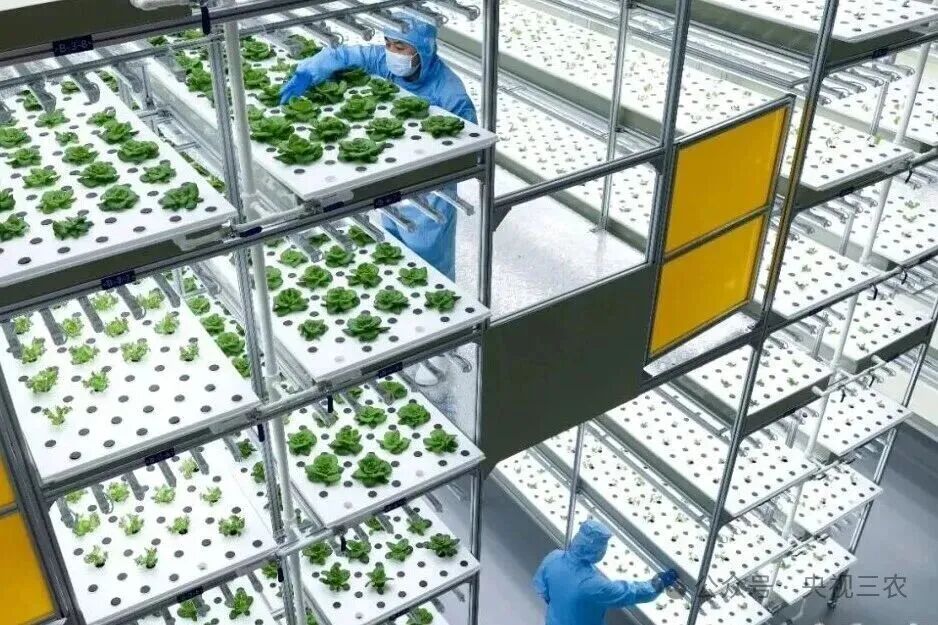
A membrane‑type vegetable factory in Dachang Hui Autonomous County, Langfang, Hebei Province
The national strategy behind promoting agricultural factories centers on expanding the boundaries of agricultural production, particularly in contexts where land resources are limited and natural conditions pose constraints. These factories serve to address weaknesses, strengthen seedlings, improve supply chains, and create additional space, helping agriculture shift from relying primarily on weather conditions to achieving controllable production through advanced technology.
From “relying on the weather” to “growing according to procedures”
First and foremost, the most tangible change brought by agricultural factories is breaking free from the limitations imposed by nature.
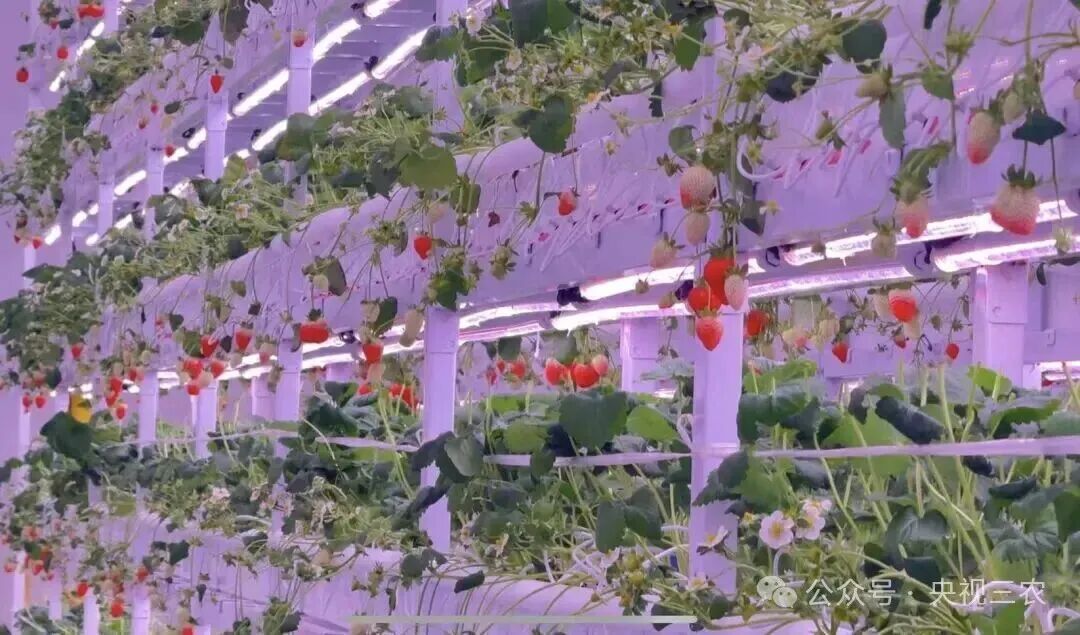
A smart strawberry factory illuminated by LED grow lights
For example, in Wenjiang District, Chengdu, there stands the largest large‑scale, three‑dimensional strawberry cultivation smart factory in Southwest China. While traditional open‑field cultivation yields only three to four harvests per year, this facility can consistently produce ten harvests annually; its five workshops generate a total annual output of 73 tons—30 to 40 times that of conventional field farming.
Here, hundreds of sensors continuously monitor temperature, humidity, light levels, and carbon dioxide concentrations; LED lighting adjusts its “light formula” according to each stage of strawberry growth; and irrigation volumes and nutrient ratios are automatically regulated throughout the process.
This transformation carries significance far beyond simply increasing yields.
Secondly, agricultural factories eliminate seasonal and land‑related constraints: crops no longer depend on droughts, floods, or cold snaps, enabling year‑round continuous production. Even in challenging environments—such as deserts, saline‑alkali lands, reclaimed industrial sites, or urban vertical spaces—where traditional farming is costly, factory‑style production can make efficient use of limited land.
In Minle County, Gansu Province, an intelligent glass greenhouse was built on barren desert terrain, employing integrated water‑and‑fertilizer technology that saves up to 80% of both water and fertilizer while avoiding any occupation of arable land. Meanwhile, in Keping County, Xinjiang, a sand‑culture (soilless) system uses drip irrigation to precisely deliver nutrient solutions, effectively addressing soil scarcity and salinization issues in desert areas; 250 new solar greenhouses have already been constructed.
Thirdly, agricultural factories enable closed-loop recycling of water and nutrients, maintain controlled environmental conditions, reduce pesticide use, and ensure consistent product quality. The entire production process is fully recordable and traceable, making it easier to connect with supermarkets, e‑commerce platforms, and other channels that demand high standards of consistency.
Strengthening the Industry Chain: Farmers Must Upgrade Their Skills
In the future, as agricultural factories become increasingly widespread, not only will farming practices evolve, but the agricultural industry chain will also expand and strengthen, leading to an overall upgrade of the sector. Farmers themselves will transition from labor‑intensive roles to more technically skilled positions:
Crop varieties and planting methods suited to traditional open‑field cultivation may not necessarily work well in factory settings characterized by soilless systems, multi‑layered structures, and low light levels. This calls for developing crop varieties specifically adapted to factory conditions and researching complementary cultivation techniques, which in itself opens up new avenues for research and production.
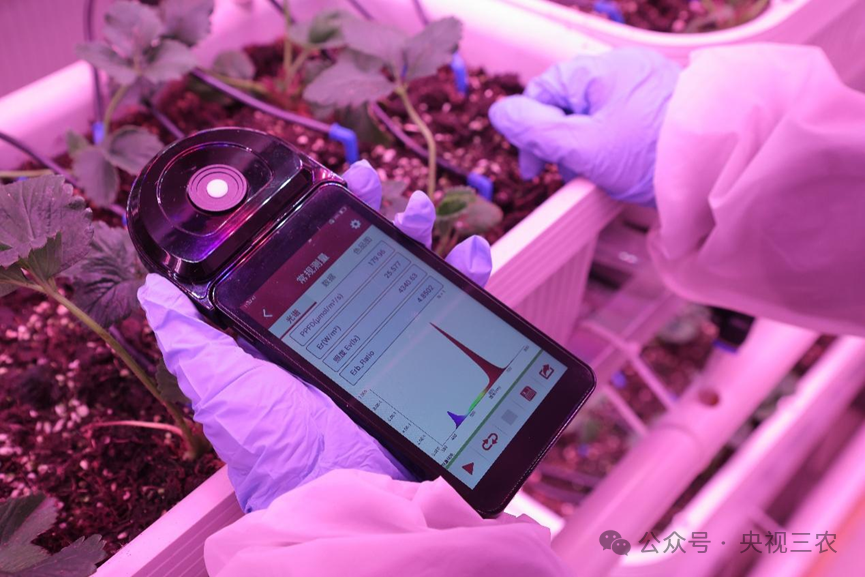
Using a plant‑light analysis instrument to collect key data
As the industry transforms, so too must the people working within it. A crucial sentence in the Opinions’ general requirements states: “Promote the optimized combination and upgrading of workers, tools, and materials.” In the past, agricultural production often relied heavily on physical strength and experience; going forward, new types of agricultural talent—those who understand technology, manage operations effectively, and skillfully wield digital tools—will play an increasingly vital role.
It’s also important to note that, alongside these deployments, the central government has drawn clear red lines: any misuse of policies under the guise of developing new‑type productive forces will be strictly prohibited, and reckless rushes into projects or blind investments will face serious accountability. Agricultural factories require substantial investment and consume significant energy; they’re not suitable everywhere, nor are they cost‑effective in every situation. Economic and energy considerations must guide decisions, with careful planning and gradual implementation.
The phrase “relying on the weather” has been part of Chinese culture for thousands of years. What agricultural factories aim to do is provide an additional pathway—one that ensures stable yields and income—even when nature doesn’t cooperate.
Source: CCTV Rural Affairs
China Light
The official website of the China Association of Lighting Industry and a full-media platform for the lighting sector. We provide authoritative and timely lighting information while striving to be a growth partner for businesses. From brand promotion and channel expansion to consulting, talent training and participation in standards development, we provide comprehensive professional services to help businesses improve quality and efficiency and jointly advance the high-quality development of the lighting industry.
Business Contacts
仇纯 (Ms.): 158 6155 3579
顾君 (Mr.): 137 7157 5253