
Extreme differentiation! Performance summaries for the first three quarters of 2026 across the lighting Industry / Supply chain are here!
The following article is from the Guangya Lighting Research Institute, author Wen Qidong
Finished Lighting Products Segment
Overall Performance of Lighting/Automotive Lighting Companies in the First Three Quarters of 2026
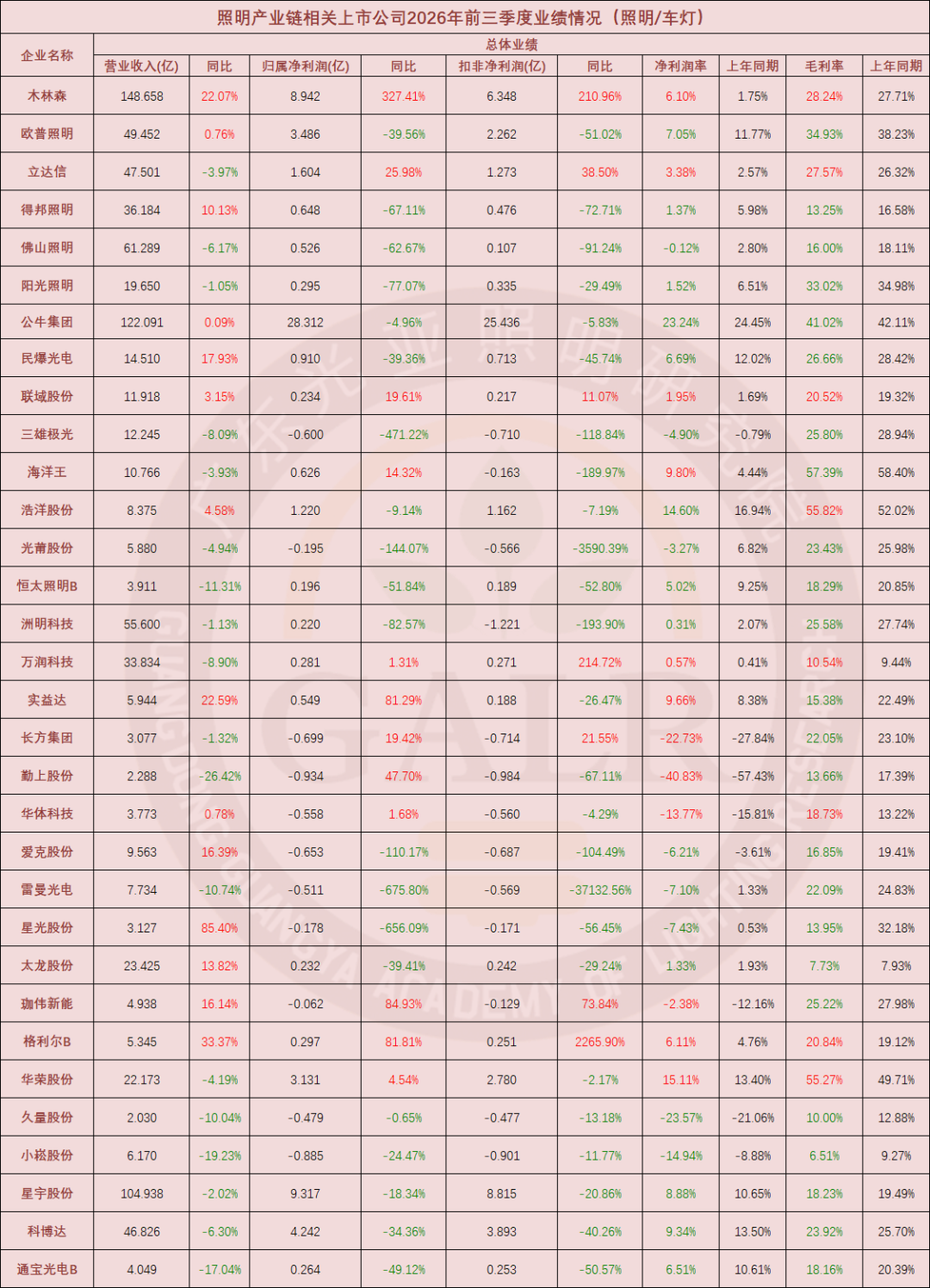
Among 32 companies related to finished lighting products (including automotive lighting): the finished lighting segment’s total revenue for the first three quarters increased slightly by 3.4% year-on-year (YoY). This segment accounts for the largest share of revenue across the entire Industry / Supply chain, but its growth rate only marginally exceeds that of the Epitaxy chip segment. Moreover, 11 out of the 32 companies reported losses, representing over one-third—the highest loss ratio among the five major segments—exhibiting a pattern of “steady recovery at the top, gradual exit at the bottom.” Overall, industry demand remains weak, price competition and capacity pressures have yet to be fundamentally alleviated, and profit margins are under significant strain due to material cost inflation, foreign exchange losses, and policy changes. The reshuffling and adjustment phase involving capacity elimination is far from over.
Packaging Segment
Overall Performance of Packaging Companies in the First Three Quarters of 2026
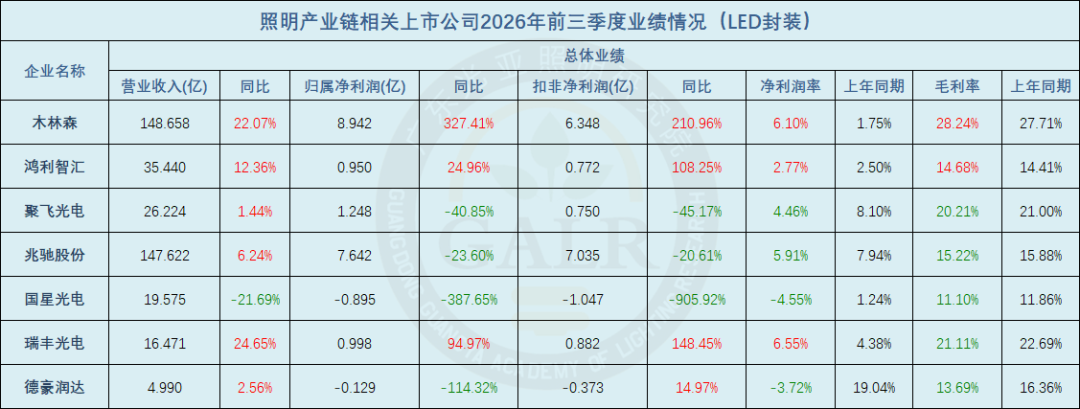
LED packaging companies saw their combined revenue grow by 11.7% year-on-year in the first three quarters. Among the five major segments, this segment posted mid-to-upper range revenue growth, while profits nearly doubled thanks to leading player Mulinsen, delivering significantly better performance than last year. Overall, the strong growth in the LED packaging segment reflects both a low base effect and concentration among leading firms. Double-digit revenue expansion indicates marginal improvement in end-market demand, but gross margins remain relatively low compared to other segments, underscoring that LED packaging remains a thin-margin link. The sustainability of the recovery hinges on whether downstream demand and prices can stabilize.
Epitaxy Chip Segment
Overall Performance of Epitaxy Chip Companies in the First Three Quarters of 2026
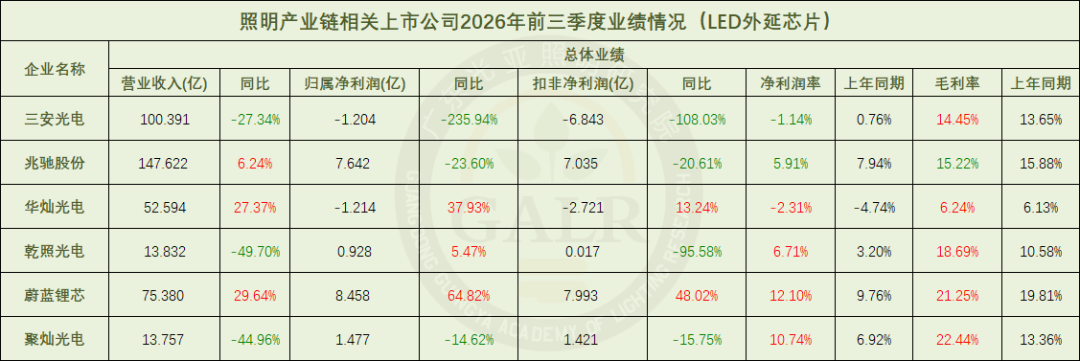
The LED epitaxy chip segment, comprising 6 companies, recorded a slight year-on-year revenue increase of 1.3% in the first three quarters. However, net profit attributable to parent company fell by 50.6% YoY, dragged down by losses at Sanan and HC SemiLight, making it the only segment among the five where revenue was virtually stagnant and profits plummeted. Of the 6 companies, 2 reported losses, indicating that the segment remains in a deep phase of capacity and price clearance. The core issue persists: an imbalance between supply and demand for LED epitaxy chips coupled with soft pricing. Downstream demand contraction has rippled upstream, with some companies posting substantial losses and overall sector profitability remaining weak—this warrants close attention. Notably, companies relying solely on the chip business have seen deteriorating earnings, whereas those diversifying into broader applications have performed comparatively better.
Lighting Engineering Segment
Overall Performance of Lighting Engineering Companies in the First Three Quarters of 2026
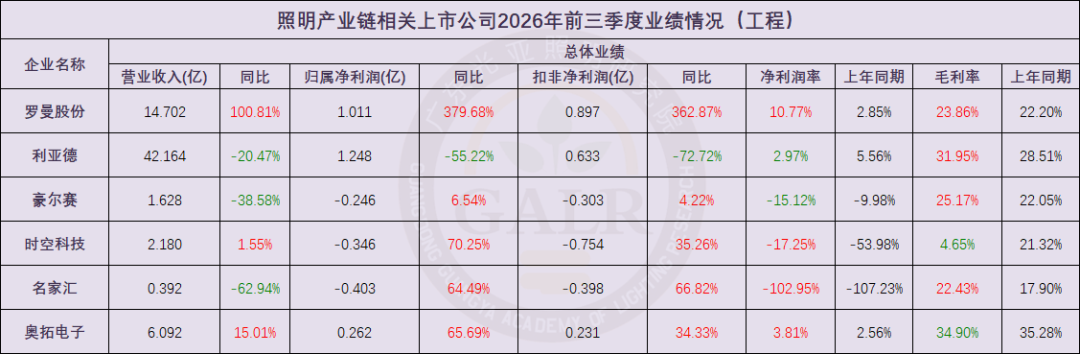
Publicly listed companies in the lighting engineering segment heavily depend on local government investment rhythms in cultural tourism and infrastructure. Order volatility and long payment cycles keep the sector in a volatile clearing-out phase. Companies performing reasonably well mainly demonstrate revenue growth through business expansion and cross-industry investments.
Supporting Components Segments
Overall Performance of Supporting Component Companies in the First Three Quarters of 2026 (Power Supplies/Materials/Components/Accessories/Equipment)
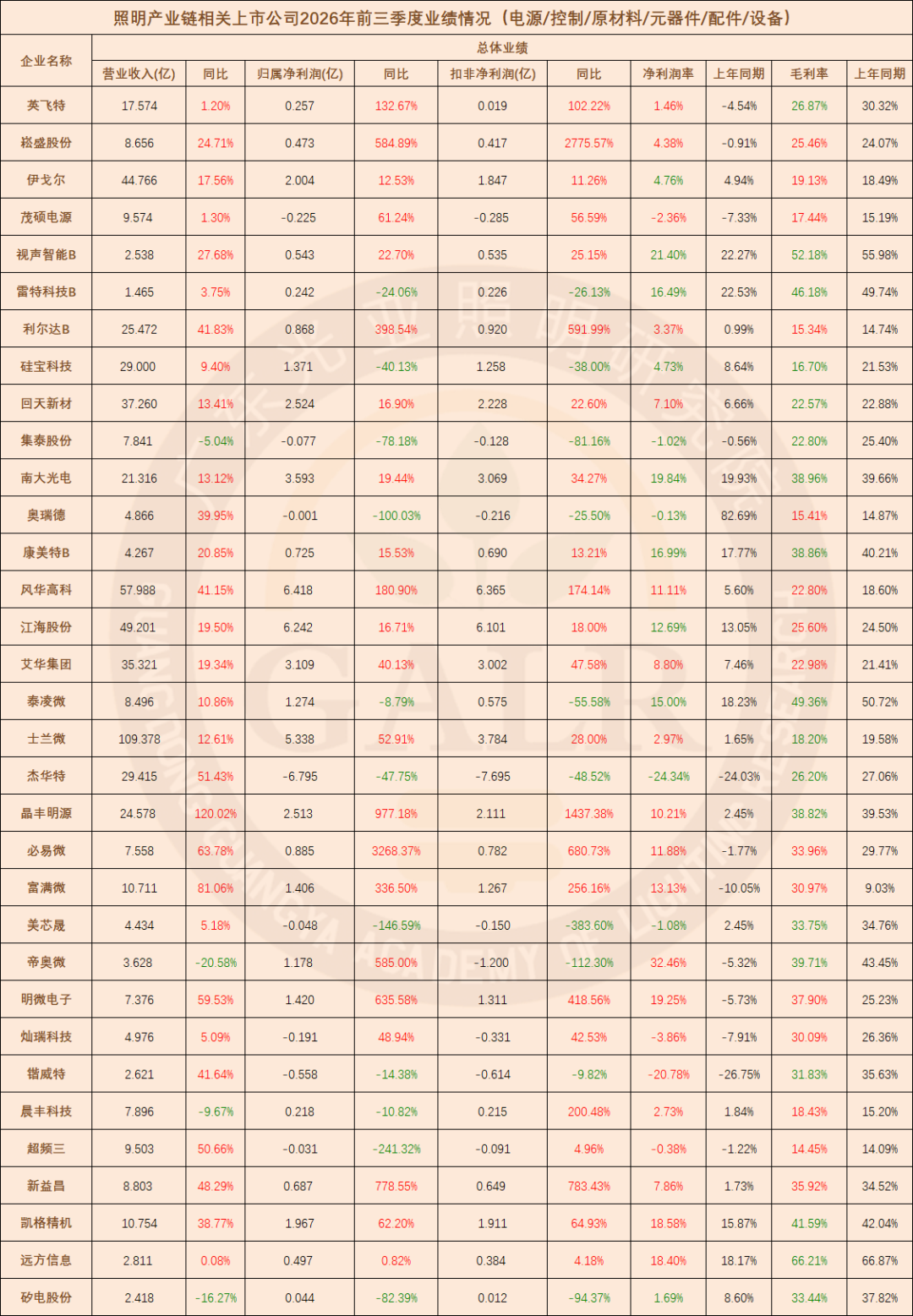
The supporting components segment, consisting of power supply, control, component, raw material, accessory, and equipment firms, totals 33 companies. Their combined revenue grew by 27.0% year-on-year in the first three quarters, with 29 out of the 33 reporting revenue growth—a growth rate of 88%. Net profit attributable to parent company surged by 160.4% YoY, largely driven by the driver chip sub-segment and a pronounced low-base effect. This segment boasts average gross and net profit margins of 32.2% and 6.8%, respectively—both among the highest in the Industry / Supply chain—and serves as the primary source of profit expansion across the entire chain this period. Risks stem mainly from a loss ratio approaching one-quarter, with 8 out of the 33 companies reporting losses. Overall, benefiting from accelerated domestic substitution, rising smartization demand, structural capacity mismatches, and a semiconductor cycle recovery, this segment currently exhibits the strongest prosperity and growth potential within the lighting Industry / Supply chain. However, it is crucial to distinguish cyclical rebounds from sustained growth and remain vigilant about slowing growth rates against a backdrop of high comparative baselines.
In the first three quarters of 2026, the performance of listed companies in the lighting Industry generally followed a pattern of “moderate aggregate expansion but severe structural divergence.” The lighting applications segment remains the largest in scale yet carries the highest loss ratio, with downstream applications still struggling under heavy burdens. Profit growth across the Industry / Supply chain was primarily fueled by earnings recovery in components, power supplies, and packaging segments—driven by low bases rather than a broad-based revival in overall demand. Profits throughout the chain are concentrating from downstream manufacturers and brand giants toward mid-to-upstream leaders with technological and scale barriers.
Since the beginning of 2026, amid fluctuating geopolitical conflicts, persistently high upstream costs, and declining currency competitiveness, it is believed that “top-line stabilization while profit margins face extreme pressure” will continue to define the performance of listed lighting companies in 2026. Intense reshuffling within the lighting Industry under conditions of stock-based competition will persist. Circumstances outweigh individual capabilities; leading enterprises with higher technological barriers, stronger international presence, and diversified business structures possess greater counter-cyclical advantages.
Author of This Article
Wen Qidong
Executive Vice President and Chief Researcher, Guangya Lighting Research Institute (GALR)
Executive President, International Confederation of Lighting Commerce (CILCA)
Deputy Director, Low-Carbon Lighting Research Center, China Society for Urban Studies (CSUS)
China Light
The official website of the China Association of Lighting Industry and a full-media platform for the lighting sector. We provide authoritative and timely lighting information while striving to be a growth partner for businesses. From brand promotion and channel expansion to consulting, talent training and participation in standards development, we provide comprehensive professional services to help businesses improve quality and efficiency and jointly advance the high-quality development of the lighting industry.
Business Contacts
仇纯 (Ms.): 158 6155 3579
顾君 (Mr.): 137 7157 5253