
“Lighting Up / City Built” Series, Part 5: Smart Light Poles Integrating New Infrastructure and the Digital Foundation—Implementation Logic and Strategies for Lighting Companies to Achieve a Breakthrough
As cities enter a deeper phase of urban renewal, smart light poles have become a key breakthrough for transforming and upgrading the lighting industry. Integrating multiple functions into a single pole, they seamlessly connect various hot‑spot areas such as new infrastructure deployment, low‑carbon urban governance, and digital twin applications, serving as an indispensable foundational platform for smart city development.
Looking at the current implementation status across major Chinese cities, while smart light poles appear fully functional with broad prospects, they commonly face challenges such as difficulties in advancing deployment, weak practical applications, and chaotic post‑implementation management.
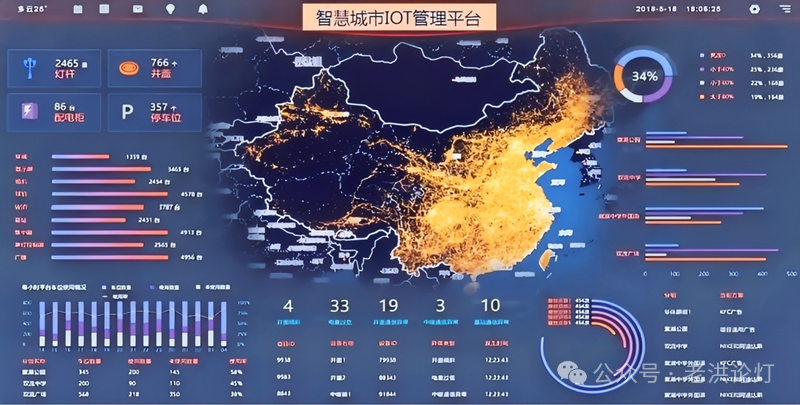
This article takes a holistic view of urban renewal, systematically outlining the scientific rationale behind the successful deployment of smart light poles. Drawing on the practical experience of pioneering cities like Beijing, Hangzhou, and Shenzhen, it delves into the industry’s real‑world pain points, proposes a comprehensive, replicable framework, and offers strategic guidance for lighting companies seeking to integrate and lead this transformation.
Part One
Multi‑Purpose Pole: The Core Logic Behind Smart Light Pole Deployment
(1) Integrated Hardware Layout: Long‑Term Benefits Through Unified Planning
The core advantage of smart light poles lies in their multi‑device integration and unified mounting, enabling multiple functions under one pole and coordinated management across networks:
1. Equipped with an LED intelligent lighting system that supports on‑demand dimming and time‑based energy saving, significantly reducing urban illumination energy consumption;
2. Pre‑equipped with space for 5G micro‑base stations, filling communication blind spots and strengthening the foundation of new infrastructure;
3. Integrated with charging stations for new energy vehicles, enhancing the city’s convenient energy‑replenishment network and supporting green mobility;
4. Fitted with environmental monitoring sensors, AI‑powered video security systems, drone inspection hubs, and other smart terminals, empowering refined urban management.
Through unified upfront planning, synchronized cabling, and预留 expansion interfaces, these poles can be installed once and reused over the long term, avoiding repeated road excavations and redundant construction, thereby substantially cutting urban development costs.
(2) Connection to the City’s Digital Backbone: Enabling Comprehensive Smart Management
The operational energy consumption, environmental and meteorological data, pedestrian and vehicle traffic patterns, and security video feeds generated by all smart light poles are anonymized and securely uploaded to the cloud, fully integrated into the city’s digital twin platform.
This enables three‑dimensional visualization, real‑time monitoring, and remote control of every light pole across the city. Equipment malfunctions, changes in pedestrian flow, or shifts in lighting demand can all be detected and addressed with a single click, establishing a new model of visualized, intelligent urban management.
(3) Optimizing Project Initiation and Positioning: Elevating Overall Project Status
Traditionally, projects are often submitted under the banner of “night‑scene illumination,” resulting in low project hierarchy, limited funding channels, and scant policy support.
Reclassifying such initiatives as integrated urban smart‑space renewal projects allows them to be smoothly included in the priority lists for new infrastructure and urban renewal, expanding funding sources and broadening policy coverage, thus removing early‑stage obstacles to implementation.
Part Two
Implementation Challenges and Solutions
Across numerous pilot programs nationwide, smart light poles often boast elegant designs on paper but encounter significant difficulties during actual deployment. Early pilots in Hangzhou and subsequent implementations in many regions have revealed common issues, while also yielding mature, viable solutions.
(1) Coordination and Management Challenges and Countermeasures
1. Challenges:
Multiple administrative departments—including urban management, public security, transportation, telecommunications, and state‑owned investment entities—are involved, leading to overlapping responsibilities, cumbersome approval processes, and high coordination costs. Once completed, the poles may lack proper maintenance, easily turning into mere vanity projects.
In public‑private partnership models, ownership of the pole structure, smart devices, and operational assets remains unclear, causing disputes over equipment replacement, location adjustments, and functional expansions, which hinder long‑term iterative operations.
2. Countermeasures:
Drawing on the top‑level coordination models of Beijing and Hangzhou, establish a dedicated task force led at the municipal level, implementing a unified master plan, centralized approval, and standardized acceptance procedures across the entire city. At the project initiation stage, simultaneously create an asset registration ledger to clearly define ownership of pole hardware, smart devices, and operational assets; delineate maintenance responsibilities among departments and adopt a cost‑sharing mechanism—operators cover 5G‑related expenses, state‑owned investors manage charging station operations, and government funds ensure basic lighting maintenance—thereby preventing jurisdictional conflicts from the outset.
(2) Planning and Construction Challenges and Countermeasures
1. Challenges:
Lack of unified citywide construction standards results in scattered installations across districts, with inconsistent specifications that prevent forming a cohesive network. Scenarios are not tailored to specific contexts such as roads, scenic areas, residential neighborhoods, or industrial parks, leading to either redundant features or insufficient supporting infrastructure. In older urban areas, complex underground utility networks make relocation difficult, approval processes lengthy, and road‑breaking works costly, often causing public inconvenience.
Industry equipment brands are diverse, communication protocols incompatible, making interconnection between systems challenging and creating serious data silos. Harsh outdoor climates accelerate equipment aging and failure, while concentrated mounting of multiple devices increases risks of overload and electromagnetic interference.
2. Countermeasures:
Following the advanced practices of Suzhou, Shanghai, Guangzhou, and Qingdao, issue unified municipal technical standards for smart light pole construction, customizing designs according to different application scenarios. Adopt pre‑emptive pipeline surveys combined with trenchless construction techniques, implement parallel departmental approvals to shorten timelines and reduce renovation costs, and establish municipal equipment access thresholds along with a centralized control platform to break down data barriers between systems. Use only industrial‑grade outdoor hardware, rigorously controlling pole load capacity and electromagnetic shielding design to ensure stable operation around the clock.
(3) Funding and Commercial Challenges and Countermeasures
1. Challenges:
The initial capital outlay is substantial, relying heavily on government appropriations, placing significant fiscal pressure on local budgets. Most cities operate on a single revenue stream, deriving meager income solely from advertising and charging services, resulting in long payback periods. Unclear rules for EMC energy‑saving profit sharing and public‑private revenue distribution further prolong cash flow cycles, dampening private sector interest.
2. Countermeasures:
Referencing Nanjing’s diversified operating model, build a multi‑channel financing system involving government funds, special bonds, telecom operators, and state‑owned investment platforms, sharing construction costs among stakeholders. Clearly specify in cooperation contracts the allocation of revenues from energy savings, charging services, pole advertising, and night‑tourism activities, diversifying commercial monetization pathways. Establish a transparent EMC energy‑saving profit‑sharing mechanism to close funding loops, shorten return periods, and enable projects to become self‑sustaining and enter a virtuous cycle.
(4) Operational Support Challenges and Countermeasures
1. Challenges:
A widespread “build first, maintain later” mentality prevails, with projects securing construction funding but lacking regular maintenance budgets. Traditional maintenance teams lack expertise in servicing 5G and smart sensing equipment, leading to large‑scale equipment failures within just one or two years after installation.
Smart light poles host numerous camera‑based surveillance, pedestrian‑monitoring, and road‑condition‑sensing terminals, containing both sensitive urban security information and personal privacy data. With massive data volumes, inadequate protection could easily result in information leaks or cyberattacks.
2. Countermeasures:
On the maintenance side, include annual upkeep costs for smart light poles in the government’s regular budget and entrust professional operation platforms with centralized management. Adopt modular equipment designs to facilitate quick repairs and replacements; use revenues from charging stations, pole advertising, and night‑tourism activities to fund routine maintenance, establishing a long‑term care mechanism.
On the data‑security front, drawing on Shenzhen’s mature security management system, equip hardware with encryption chips, isolate sensitive data onto separate network segments, and implement tiered access controls. All externally shared data undergoes anonymization, and the control platform obtains cybersecurity certification, automatically intercepting cyberattacks while balancing urban governance needs with citizen privacy protection.
Part Three
Practical Strategies for Lighting Companies to Take the Lead and Break Barriers
In urban renewal, lighting companies have long been relegated to passive suppliers or low‑end contractors, with limited influence and narrow value‑added opportunities. In fact, enterprises can proactively position themselves and empower themselves, addressing implementation challenges while elevating their standing and gaining initiative within the urban renewal management framework.
First, Engage Early in Planning and Gain Access to Decision‑Making Circles
Companies should move beyond the traditional model of entering a project only after winning a bid. Instead, actively engage with urban renewal task forces, urban management authorities, state‑owned investment entities, and telecommunications regulators during the project initiation and planning stages. Leveraging expertise in lighting design, pole structure, pipeline construction, and energy‑saving management, they can propose localized deployment standards, scenario‑specific implementation plans, and recommendations for optimizing aging utility networks. By participating as technical consultants in preliminary discussions, they transform from rear‑end construction partners into front‑end planning participants, securing early advantages and avoiding late‑stage competitive pressures.
Second, Strengthen End‑to‑End Capabilities and Become an Indispensable Implementation Partner
Proactively adapt to urban construction challenges by developing integrated smart pole hardware compatible with multiple protocols, breaking down device fragmentation and data silos. Master trenchless construction techniques and methods for relocating old‑city pipelines to reduce costs and speed up implementation. Assemble cross‑functional teams capable of handling lighting maintenance, 5G equipment, smart sensing, and platform operations. With integrated product, construction, and maintenance capabilities, address the industry’s chronic issues of heavy construction, light maintenance, and frequent breakdowns, building an irreplaceable operational barrier and becoming a trusted implementation partner for governments.
Third, Innovate Operating Models and Build Self‑Sustaining Cooperative Advantages
Move beyond the mindset of profiting from single projects by creating diversified business models that link EMC energy‑saving profit sharing, charging station operations, pole media, and night‑tourism economies. Offer governments low‑fiscal‑pressure, payback‑oriented, closed‑loop cooperation proposals. Form joint ventures with telecom operators and local state‑owned investment entities, participate in special bonds and diversified financing, clearly define asset ownership, revenue distribution, and operational responsibilities, enabling projects to become self‑sustaining and elevating companies from engineering subcontractors to partners in operating smart urban spaces.
Fourth, Forge State‑Owned Partnerships to Set Industry Benchmarks and Secure High‑Level Positions
Deeply collaborate with local state‑owned investment entities and cultural‑tourism state‑owned enterprises, leveraging state‑owned platforms to overcome bureaucratic hurdles related to interdepartmental approvals, asset registration, and site expansion. Develop regional benchmark demonstration projects, establish replicable application standards, and participate in drafting local industry regulations. Use proven track records and professional standards to gain bargaining power and priority cooperation status, completely escaping price competition and ascending to become core participants in urban renewal and smart light pole–related new infrastructure initiatives.
Part Four
Conclusion
The true value of smart light poles lies not merely in adding more devices, but in integrating resources through a single pole, connecting new infrastructure networks, solidifying the city’s digital backbone, and invigorating the urban nighttime economy.
Top‑level government coordination sets the direction, while practical enterprise implementation is the key. Governments should undertake comprehensive top‑level planning and design, while lighting companies must cultivate end‑to‑end empowerment capabilities. Only through this two‑way synergy can we truly resolve the persistent challenges of planning, coordination, construction, operation, and profitability, transforming smart light poles from pilot prototypes into normalized, self‑sustaining, long‑term operational foundations for urban renewal.
About the Author

Qian Zongming Secretary General of Jiangsu Lighting Society, Executive Dean of Jiangsu Lighting Research and Design Institute
Has long been engaged in MBA teaching, as well as theoretical research and practical applications in lighting economics and the night‑tourism economy.
China Light
The official website of the China Association of Lighting Industry and a full-media platform for the lighting sector. We provide authoritative and timely lighting information while striving to be a growth partner for businesses. From brand promotion and channel expansion to consulting, talent training and participation in standards development, we provide comprehensive professional services to help businesses improve quality and efficiency and jointly advance the high-quality development of the lighting industry.
Business Contacts
仇纯 (Ms.): 158 6155 3579
顾君 (Mr.): 137 7157 5253