
China’s domestic Micro-LED automotive supply chain is transitioning from “fragmented competition” to “systemic collaboration.”
On August 28, Qianzhao Optoelectronics, Huayu Vision, and Jinghe Optoelectronics signed a Strategic Cooperation Framework Agreement in Xiamen, establishing a deep industry alliance focused on Micro‑LED applications for automotive lighting. From January, when Xingyu Co., Ltd. joined forces with Xinlian Integration and Jiufengshan Laboratory to invest RMB 3 billion in a Micro‑LED project, to May, when Qianzhao Optoelectronics entered into a strategic partnership with Sitan Semiconductor, and now this tripartite alliance that links upstream, midstream, and downstream segments, China’s domestic Micro‑LED automotive supply chain is transitioning from “fighting alone” to “systematic collaboration.”
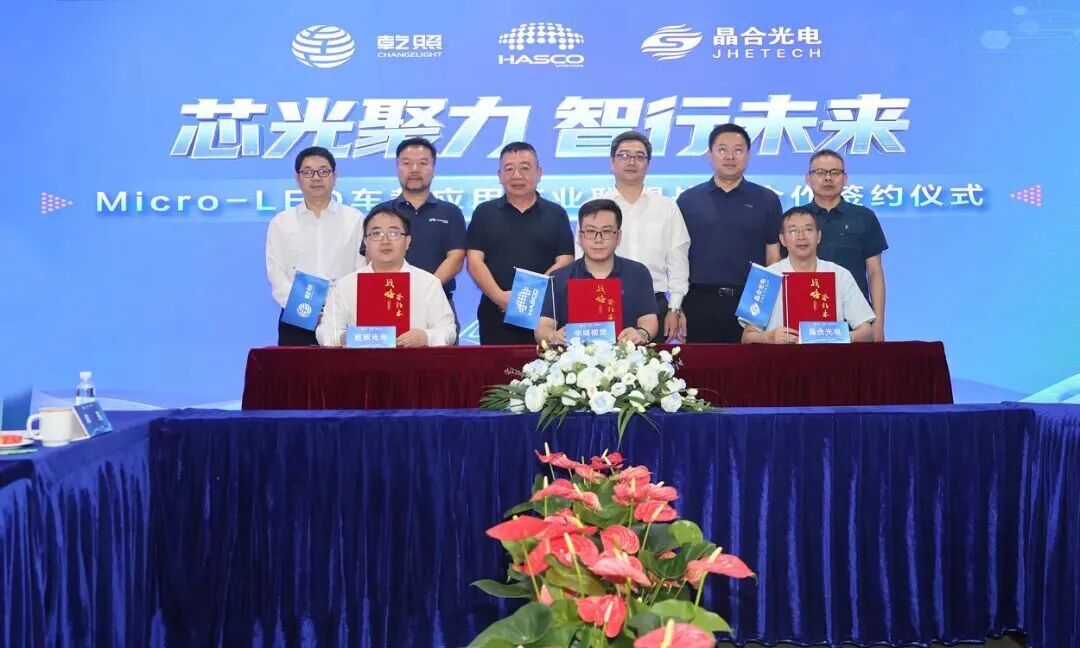
▲ The strategic signing ceremony between Qianzhao Optoelectronics, Huayu Vision, and Jinghe Optoelectronics (Image source: @Qianzhao)
From a market perspective, Micro‑LED, with its high brightness, low power consumption, long lifespan, and pixel‑level controllability, is regarded as the core direction for next‑generation automotive lighting. According to QYResearch data, the global Micro‑LED automotive lighting market was valued at approximately USD 75 million in 2025 and is projected to reach USD 3.195 billion by 2032, with a compound annual growth rate of 68.5%. A TrendForce report indicates that Micro‑LED adaptive headlights are rapidly gaining traction in the premium vehicle segment, with models such as Volkswagen Tiguan L Pro, Porsche Cayenne, NIO ET9, and Mercedes-Benz GLC SUV already adopting this technology.
At the chip level, breakthroughs have been achieved first in the upstream segment. Chips represent the “first mile” of Micro‑LED integration into automotive applications. Qianzhao Optoelectronics boasts industrial-scale capabilities spanning UV, visible, and infrared LED epitaxy and chip manufacturing, giving it a clear early‑mover advantage in both core Micro‑LED technologies and large‑scale production. Zhaochi Semiconductor has reached a monthly production capacity of 100,000 automotive‑grade Micro‑LED chips and plans to ramp up to mass production in the first half of 2026, already supplying several high‑end domestic vehicle models. Jucan Optoelectronics has also begun mass production of high‑value‑added automotive lighting chips.
The midstream packaging and testing segment has likewise addressed critical bottlenecks. As a national-level “Little Giant” enterprise specializing in niche, specialized, and innovative fields, Jinghe Optoelectronics has built China’s first advanced Micro‑LED packaging and testing production line, integrating chip design, CMOS driver development, and cutting‑edge packaging and testing capabilities. At the Shanghai International Automotive Lighting Exhibition in March 2026, the company unveiled its Huaxin series of digital lighting source chips and the Huaqing series of high‑pixel controllers. Its new factory in Shanghai Lingang is expected to begin operations in the first quarter of 2027, ensuring sufficient production capacity for large‑scale deployment.
Meanwhile, the downstream system integration side is accelerating the transition toward full‑vehicle implementation. Huayu Vision has been deeply engaged in automotive electronic lighting for over three decades, possessing end-to-end capabilities—from optical design to complete assembly. Xingyu Co., Ltd., together with Xinlian Integration and Jiufengshan Laboratory, established Wuhan Xingxi Guang, planning to invest RMB 3 billion in an R&D and manufacturing project for intelligent Micro‑LED lighting technologies; in April 2026, it launched the M‑50K automotive light source chip.
The most notable aspect of this tripartite alliance lies in its closed-loop mechanism: the three parties have established a collaborative feedback loop—“demand articulation–product supply–sample validation–technical feedback–mass‑production cooperation”—centered around two key areas: white‑light Micro‑LEDs and color‑pixelated light sources. Mao Haifeng, General Manager of Huayu Vision, emphasized that this coordinated effort will significantly shorten the validation cycle from R&D to mass production. Meanwhile, Yu Tao, Chairman of Jinghe Optoelectronics, noted that the maturity of midstream module and packaging/testing capabilities is a crucial step for bringing Micro‑LED technology into vehicles.
As capabilities across the chip, packaging/testing, and system integration stages continue to mature, China’s domestic supply chain is undergoing a pivotal shift—from “single-point breakthroughs” to “full‑chain coordination.” From Qianzhao Optoelectronics partnering with Huayu Vision and Jinghe Optoelectronics to close the loop, to Xingyu Co., Ltd.’s substantial investment, and then to Zhaochi and Jucan successively achieving mass production and real‑world deployment, China’s Micro‑LED automotive lighting industry has entered the fast lane of large‑scale manufacturing. It is foreseeable that whoever can take the lead in coordinating and securing positions within this round of supply-chain integration will gain a decisive edge in the global competition for next‑generation automotive lighting—and this, precisely, is the true significance of this tripartite alliance for China’s domestic supply chain.
This article is sourced from the official WeChat account of China Lighting Appliance Magazine.