
Can AI even design products now? Luo Ke Ke Hong Yuan: Hold on—there are two stages it still can’t handle.
On October 28, the “Guzhen Lighting Expo: Bright Minds Online” salon—hosted by Zhongshan Guzhen Light City Expo Co., Ltd. and organized by China Zhi Guang All-Media & Ming Classroom—welcomed a new online session, themed “Product Innovation in the AI Era”.

The guest speaker for this session was Mr. Hong Yuan, General Manager of Rococo Consulting’s East China Region and Vice President of the Nanjing Industrial Design Association.
With extensive experience in design and design management, he has led his team to develop hundreds of products that have gone public, serving clients such as A.O. Smith, Keda Intelligent, CRRC Group, and the Palace Museum, and winning numerous domestic and international design awards, including iF, Red Dot, Taiwan Golden Pin, and Red Star Awards.
Over the course of more than an hour, Mr. Hong began by discussing Rococo’s initiatives in AI, introducing their self-developed AI design platform “Jellyfish Intelligence.” Starting from initial tasks like logo, branding, and packaging generation, the platform has evolved to integrate AI algorithms into the entire design workflow—from front-end user requirement input, through mid-stage integration of graphics, colors, creativity, materials, and manufacturing processes, to final design output. AI is embedded at specific points throughout the process to boost efficiency, but the ultimate judgment on what is good, beautiful, or suitable for the current context still rests with seasoned designers.
“AI doesn’t replace designers—it just changes how we work,” emphasized Mr. Hong. He stressed that only by continuously learning design workflows and gaining deep insights into various industries can AI provide better feedback, which is precisely where design firms’ competitive edge lies in the AI era.
A Few Case Studies: Seeing How AI Is Used
From “Super Symbols” to Scene Integration
In a packaging project for a skincare product designed for extremely cold environments, the team initially drew inspiration from classic bottle shapes to create scene-based expressions. Later, they directly brought AI into the mix, combining the bottle shape with snow huts and hot air balloons.
Case Study Showcase


AI-generated creative renderings of Xiuyan She skincare essence
According to Mr. Hong, traditionally such designs would require repeated refinement of creative concepts and careful integration of environmental elements, resulting in significant workload. AI, however, offers a different approach.
He also extended this logic to other fields: lighting design, for example, could explore how luminaires can deeply integrate with urban landscapes and local culture, with designers then evaluating options based on manufacturing feasibility, cost, and formability to select the best solution.
Entering Unfamiliar Industries: First, “Feed” the AI
When developing an Arabic coffee pot, the team had no prior experience with this category. Traditional research yielded results that customers described as “on the right track but missing the essence.” By switching to AI, from early cultural research and analysis of colors, materials, and manufacturing techniques to targeted training, AI produced designs that were far more aligned with the desired outcome.
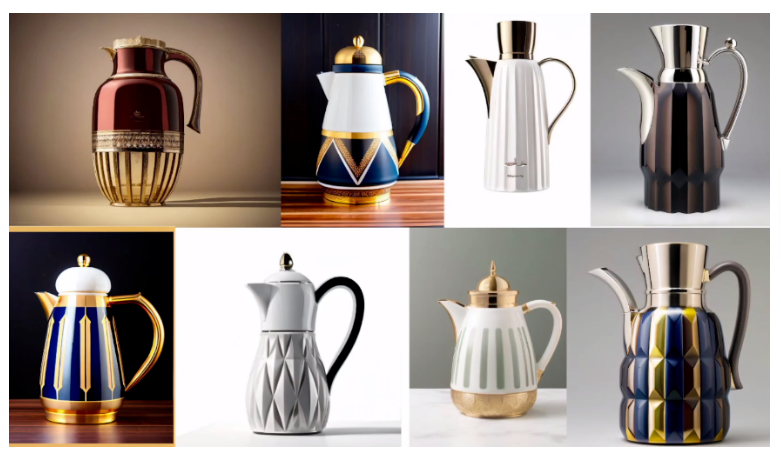
AI-generated creative renderings of the “Arabic Pot” after training
Even more impressively, once the basic framework—including the body, handle, spout, and lid—was established, the remaining variations were quickly generated by AI, leading to a wide array of customized designs. With 24 emirates in the Middle East, each could potentially have its own exclusive version. In effect, one AI-driven project transformed a “one-to-one” design process into a “one-to-many” scenario.
E‑Sports Trophies and “AI Drift”
When designing virtual trophies for games like Valorant, Honor of Kings, and Delta Force, the brief called for creativity, technological flair, and a futuristic vibe. Through concept feeding, continuous card-drawing iterations, and ongoing adjustments to prompts, lighting, materials, and manufacturing processes, the team gradually refined their proposals until they were ready for implementation.
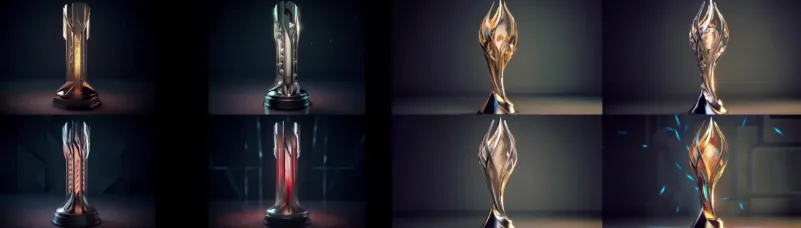
Game‑related trophy concepts after repeated card draws
Mr. Hong also highlighted a common term in the design community—“drift”: the final output from AI may differ significantly from your original vision. “Don’t expect a single simple prompt to deliver perfect results”—only through meticulous refinement of descriptions, careful adjustment of lighting, materials, and manufacturing processes, combined with designers’ expertise in mass production and real-world application, can AI solutions become increasingly focused and productizable.
End‑User Products Empowered by AI
AI Companion Robot “Nuo Bao”
Previously, robots operated strictly according to pre-programmed routines. After integrating AI algorithms, these devices became “thoughtful, alive, and warm”: they can learn your preferences and habits through daily interactions, and even customize personality traits like zodiac sign, gender, and temperament. The demonstration videos shown were all real‑world footage—not AI‑generated—and individual posts on social media garnered hundreds of thousands of views and likes. “Good products speak for themselves,” turning the product itself into a source of content, while OTA updates enable continuous learning and iteration.

AI companion robot Nuo Bao
AI Meeting Recorder in Collaboration with DingTalk
Equipped with multi‑microphone audio capture and speaker‑identification capabilities, it automatically organizes agenda items, conclusions, and action items, summarizes key takeaways, provides suggestions on speaking pace and emotional tone, and even selects the MVP of the meeting. This single device integrates the functions of a voice recorder, meeting assistant, translator, and personal assistant—all originally requiring four or five separate devices.
Based on this, Mr. Hong pointed out: product innovation in the AI era requires an upgrade in thinking
From functional value to emotional value (such as Pop Mart blind boxes)
from function to intelligence (like Huawei’s smart cockpit)
from function to service (such as ride-hailing platforms)
and even toward forms of “silicon‑based life.”
Applying These Ideas to the Lighting Industry
Smart streetlights, beyond providing basic illumination, can adapt to seasonal, climatic, and event‑specific scenarios, offering emotional and contextual adjustments. Eye‑care desk lamps could evolve into AI‑enabled interactive terminals on desks—leveraging existing physical space to empower AI, while adhering to Occam’s Razor principle of “do not multiply entities unless necessary,” rather than adding unnecessary hardware to homes.
Interactive Q&A Session
During the salon’s interactive segment, Mr. Hong addressed several questions most pertinent to lighting industry professionals.
Question: With so many types of AI tools available, how should lighting companies choose the ones best suited to their specific needs during the early stages of product design?
Answer: You don’t necessarily need to go overseas. Domestic options like DouBao are excellent, along with Kouzi, Wenxin Yiyan, Tongyi, Qianwen, and others—quick to adopt and equipped with built-in image-generation features. Design‑focused tools like Midjourney, Nano Banana, SD, etc., are also viable. The key takeaway is: Localized AI tools possess unique insights into Chinese culture, history, and contemporary Chinese aesthetics, making them especially recommended for creating Chinese‑style, locally tailored solutions. For tech‑savvy, cutting-edge styles, foreign tools like GPT, SD, and Midjourney perform better.
Here are two pieces of advice:
First, use them often, cultivate a habit of conversing with AI, and discover your own preferred communication style; second, keep using them consistently, allowing data to accumulate and iterate over time.
GPT is indeed powerful, but it isn’t right for everyone—some users find DouBao works even better, producing outputs that surpass GPT. Ultimately, finding the tool that best suits you is what matters most.
Question: AI‑generated solutions are highly efficient, yet often lack practical feasibility. How can we balance rapid prototyping with manufacturability in real‑world applications?
Answer: AI sometimes “seriously talks nonsense”—it’s an excellent productivity booster, but human judgment is still needed to set the direction. We frequently encounter entrepreneurs who casually toss out a few images generated by AI, claiming, “Let’s bring this product to life,” only to discover upon closer inspection that costs, mold splits, material choices, and manufacturing processes simply aren’t feasible in practice.
Therefore, AI can be integrated into the workflow, but it cannot replace human understanding and experience of the industry; we must continually guide AI, rather than letting it lead us astray. When AI produces striking visuals with strong visual impact, it’s wise to pause, assess whether the proposal aligns with your company’s goals and capabilities, and proceed accordingly.
Question: Currently, what tasks can AI already handle in decorative lighting product design, and which aspects remain difficult to delegate to AI?
Answer: There are two areas that remain challenging to replace:
First, directional judgment—many companies submit product definition documents spanning dozens of pages, but upon closer examination, these often fail to meet basic industry standards or even prove impractical. Only industry experience can determine what truly meets market demands, providing clear guidance to AI and discarding unrealistic assumptions.
Second, backend mass‑production and implementation—while AI excels at generating visual concepts, when it comes to actual design implementation—modeling, component breakdown, mold design, thermal simulation, illuminance simulation—the lighting industry still lags behind. Especially avoid relying on AI‑provided timelines, molding processes, material specifications, or cost estimates. Based on our experience, over 90% of such projections are unrealistic, as the same mold can yield vastly different outcomes depending on opening methods, materials, and processing cycles, with price differences exceeding tenfold. Much of this knowledge resides in human minds, not online databases, so AI naturally lacks the necessary insights. Never cut corners at these critical junctures—always intervene personally.
Question: AI‑generated exterior designs carry potential copyright risks. What pitfalls should companies watch out for when using AI for product design?
Answer: At present, we’re still in a “regulatory phase.” Since AI‑generated content relies on data fusion and integration, copyright issues remain somewhat ambiguous, with no clear national AI copyright legislation yet in place. As far as I know, the state is expected to introduce an AI copyright registration and traceability mechanism in 2027, potentially enabling tracking back to the conceptual diagrams or inspirations underlying the generated designs.
In the future, copyright reviews will shift from manual to AI‑driven, with real-time assessments—scoring originality and patent registrability of generated content, automatically completing copyright registration once certain thresholds are met. This transformation—from weeks of manual review to mere minutes—will mark a major overhaul of the entire copyright system, as the state continues to improve and refine related regulations.
Question: What skill shifts will designers face in the AI era? And what new competencies should corporate design teams acquire?
Answer: Three key areas:
First, mastering multiple AI platforms—it’s essential for designers to become proficient across diverse tools, each excelling in different domains: some platforms excel at handling large outdoor lighting projects with strong environmental and mechanical engineering considerations, while others are better suited for household panel lights, desk lamps, and mood‑setting ambient lighting that evoke warmth and emotion.
Second, learning to converse with AI—don’t just say, “I want a nice-looking desk lamp”; instead, articulate your needs in designer‑friendly language: “for a study setting, feminine styling, rounded contours, macaron colors, OLED panel, adjustable brightness, touch‑controlled buttons”—only then can AI truly understand your requirements.
Third, maintaining awareness of industry trends, design styles, manufacturing processes, and implementation technologies—to guide and steer AI, rather than being controlled by it. Keep in mind that a single project often requires revisiting prompts a dozen times before achieving the desired result.
Conclusion
Throughout the salon, Mr. Hong repeatedly emphasized one core idea: in the AI era, every industry deserves a fresh reimagining powered by AI, but AI is an assistant, not a judge—choosing the right tools, learning to communicate effectively, and staying grounded in sound judgment are the keys for lighting companies to seize this wave of design opportunities.
As he concluded, addressing online participants, he offered this encouraging message:
“In the AI era, let’s all strive to live as imaginatively as possible.”
Note: This article is compiled from recordings of Mr. Hong Yuan’s presentation titled “Product Innovation in the AI Era” delivered on October 28, 2026, at Ming Classroom, and published by Ming Classroom.
China Light
The official website of the China Association of Lighting Industry and a full-media platform for the lighting sector. We provide authoritative and timely lighting information while striving to be a growth partner for businesses. From brand promotion and channel expansion to consulting, talent training and participation in standards development, we provide comprehensive professional services to help businesses improve quality and efficiency and jointly advance the high-quality development of the lighting industry.
Business Contacts
仇纯 (Ms.): 158 6155 3579
顾君 (Mr.): 137 7157 5253