
San'an Optoelectronics’ Q3 Report: A Loss of 120 Million; Creditors Now Include Banks—Is This a Turning Point, or Just a Final Glimmer?
The Q3 report is out! Sanan Optoelectronics posted a loss of 120 million yuan in the first three quarters, and just the same week, its controlling shareholder had another 70 million shares frozen by a bank—performance is stabilizing, but equity is bleeding. Is this leading compound semiconductor company really stable?
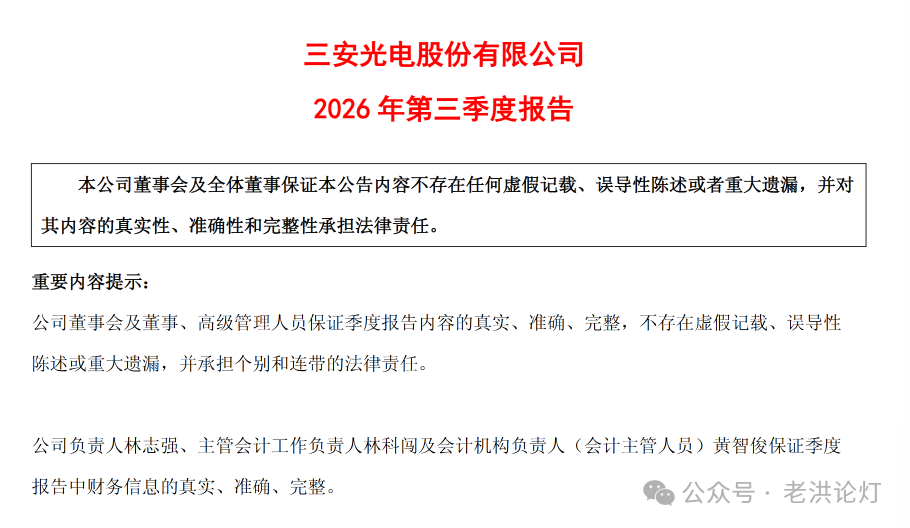
After the market closed on October 29, Sanan Optoelectronics released its Q3 results: revenue for the first three quarters totaled 10.039 billion yuan, down 27.34% year-on-year; net profit attributable to shareholders was a loss of 120 million yuan; excluding non-recurring items, the loss stood at 684 million yuan. In Q3 alone, revenue reached 3.572 billion yuan, down 26.05% YoY, while net profit attributable to shareholders remained a loss of 22.53 million yuan.
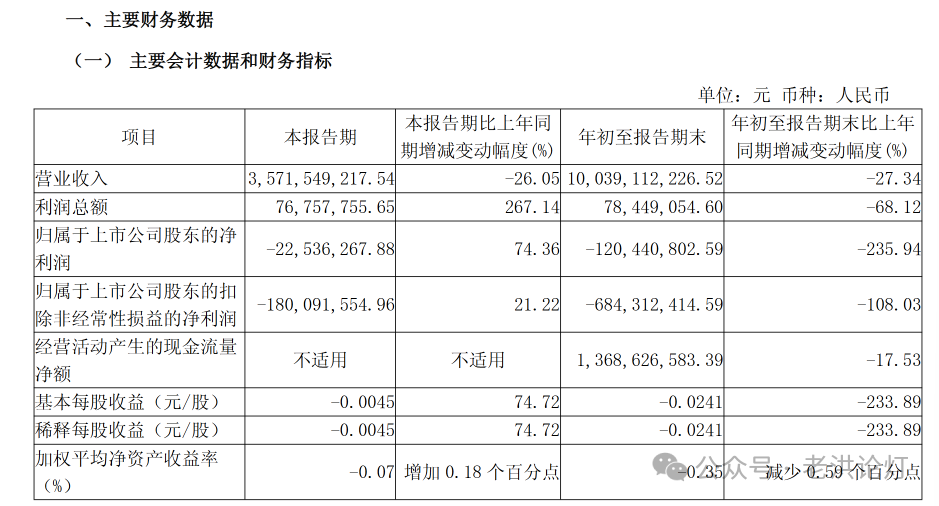
The sharp decline in revenue was mainly due to changes in accounting treatment: precious metal scrap recycling has been switched to physical exchange, no longer recognized as revenue. According to the company, after stripping out this effect, Q3 revenue grew 11.25% YoY and the first three quarters saw a 9.77% increase, indicating that the core business is actually expanding. Losses are also narrowing: Q2 reported a loss of 165 million yuan, which shrank to 22.53 million in Q3, with a year-on-year reduction in net loss of 74.36% for the quarter.
Structural trends are diverging: according to public information, AI optical chips have turned profitable, partnering with four of the world’s top ten optical module manufacturers—two are shipping 400G/800G products in volume, and one has samples of 1.6T ready for delivery. Production capacity has expanded from 2,750 wafers per month to 4,500. Mini/Micro LED holds over 50% domestic market share, with orders booked through 2027, and 6-inch silicon carbide capacity stands at 16,000 wafers per month. However, filters and power electronics remain underperforming, compounded by foreign-exchange losses, inventory write-downs, and self-assessed tax adjustments, dragging down overall profitability.
The financial structure is improving: the company disclosed that its debt-to-equity ratio fell from 39.90% to 34.89%, with operating cash flow reaching 1.369 billion yuan. Yet the stock price hasn’t responded positively: closing at 9.00 yuan on October 29, with a market cap of 44.9 billion yuan, it has retraced more than 60% from its intraday high of 23.18 yuan on June 26. Public mutual funds hold an extremely low stake—almost negligible—while institutional target prices still hover around 18.5 yuan.
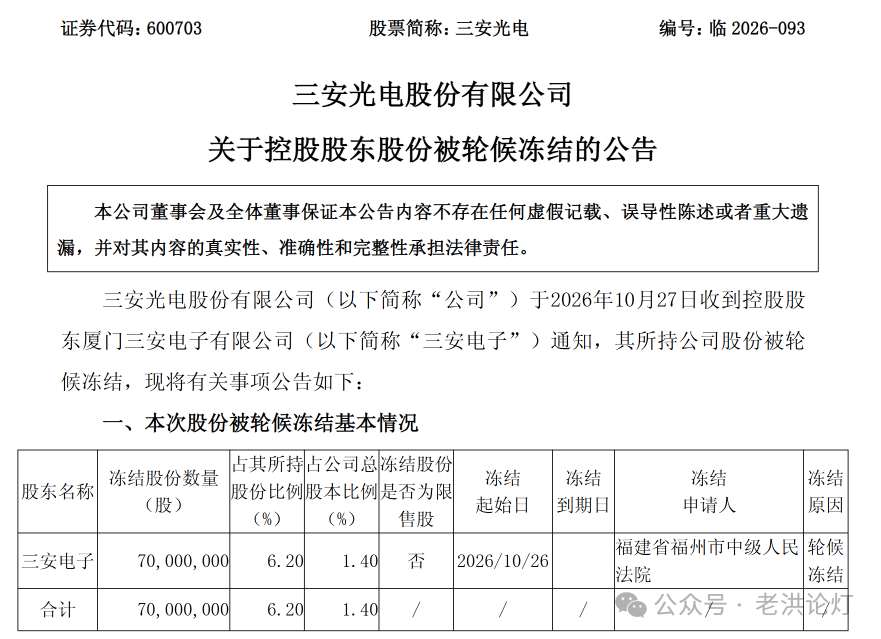
That same week, on October 28, the company issued another announcement (No. 2026-093): its controlling shareholder, Sanan Electronics, had 70 million shares placed under pending freeze by the Fuzhou Intermediate People’s Court, related to a letter-of-credit dispute with the Fuzhou Branch of Zhejiang Commercial Bank. According to the company, the total number of shares under pending freeze now amounts to 8.283 billion, representing 166.03% of the company’s total share capital. Earlier, on October 15, Sanan Electronics and Sanan Group were petitioned for bankruptcy reorganization by Changjiang Anxin and Hunan Lugu, resulting in a judicial freeze on all 1.312 billion shares; controlling shareholder Lin Xiucheng was detained in March, criminally detained in September, and formally arrested on October 23. The company rarely acknowledged: “There exists a risk that could affect the stability of the company’s control.”
Old Hong believes this earnings report should be viewed on two levels: the listed company is stopping the bleeding, yet the sword hanging over its equity continues to drip blood.
First, let’s be fair: the 27% drop in revenue is largely due to accounting adjustments, not a collapse; Q3 losses narrowed, optical technology turned profitable, and Mini LED orders extend into next year—all genuine signs. The AI optical chip initiative strikes at the very moment of the computing power boom, offering a rare opportunity to secure a foothold in the global supply chain. It’s reasonable to say a turning point has arrived.
But Old Hong wants to pour cold water on these hopes. First, profit quality: excluding non-recurring items, the loss still stands at 684 million yuan, with only optical technology contributing to the turnaround—making the full-year improvement look more like a quarter-over-quarter recovery rather than a year-on-year reversal. Second, valuation factors: the stock has fallen from 23 yuan to 9 yuan, with public mutual funds nearly liquidating their holdings, and professional investors voting with their feet. Third—and most critically—the issue of control. With 166% of total shares under pending freeze, the controlling shareholder’s stake has effectively been frozen, leaving behind a long line of creditors—from individual Lin Suzhen to industrial investors like Changjiang Anxin and Hunan Lugu, and commercial banks such as Zhejiang Commercial Bank. Pending freezes don’t necessarily mean an immediate change of ownership, but they hang like a sword above the head, with each subsequent disposition triggering a cascade of claims from downstream creditors.
So where does equity go from here? In the short term, the listed company remains operationally independent and won’t shut down immediately; in the medium term, the biggest variable is the bankruptcy reorganization petition filed on October 15—if accepted, the controlling group’s equity could be reshaped through judicial restructuring, potentially replacing the actual controller, though governance would likely persist. Looking ahead, platforms like Sanan that occupy strategic technological positions are more likely to be taken over by state-owned or industrial investors rather than sold off cheaply—even if ownership changes. A painful but thorough restructuring could pave the way for a leaner, more agile future.
This also serves as a wake-up call for peers in the lighting and optoelectronics industries: a founder’s halo cannot replace sound governance; the real safety net lies in a clean balance sheet and an independent operating system. Core businesses must be robust, equity must be stable—neither can be sacrificed.
Follow Old Hong’s insights on lighting to illuminate your path forward!
About the Author, Hong Bing:
Hong Bing currently serves as Editor-in-Chief of China Light Network and Agricultural Lighting Network—the official websites of the China Lighting Electrical Appliances Association—Executive Dean of Ming Classroom, Executive Vice President of the Beijing Lighting Electrical Appliances Association, Deputy Chairperson of both the Talent Training Committee and the Agricultural Lighting Professional Committee of the China Lighting Electrical Appliances Association, Executive Deputy Chairperson of the Lighting Alumni Association of Fudan University, and a Board Member of the Ecological Environment Alumni Association of CEIBS. He graduated from Fudan University’s Department of Light Sources and Lighting Engineering in 1991, earned an MBA from CEIBS in 2003, and subsequently worked in R&D, product planning, and marketing at institutions including the China Building Materials Academy, Panasonic, GE, and OSRAM. In 2008, he received Siemens’ Global Top Plus Award and Siemens’ China Excellence Performance Award, and founded China Light Network in 2009.
For More Exciting Content, Please Follow Our Official WeChat Account and Video Channel
“Old Hong on Lighting”
China Light
The official website of the China Association of Lighting Industry and a full-media platform for the lighting sector. We provide authoritative and timely lighting information while striving to be a growth partner for businesses. From brand promotion and channel expansion to consulting, talent training and participation in standards development, we provide comprehensive professional services to help businesses improve quality and efficiency and jointly advance the high-quality development of the lighting industry.
Business Contacts
仇纯 (Ms.): 158 6155 3579
顾君 (Mr.): 137 7157 5253