
CCTV exposes chaos surrounding CCC certification for lighting products in Zhongshan! A major industry-wide test is upon us.
On September 13, CCTV News and China Central Television revealed the findings of an undercover investigation conducted during the nation’s first quality inspection in Zhongshan, known as the “Capital of Chinese Lighting.” The inspection team conducted unannounced visits to lighting‑fixture markets and uncovered persistent violations: some small businesses and storefronts were found selling products without any certification, falsely using CCC‑certified labels, and other non‑compliant practices.
According to CCTV reports, in late July, the Office of the National Coordination Leading Group for Building a Quality‑Driven Nation, together with relevant member agencies, launched the country’s first nationwide quality inspection. Inspection experts visited Zhongshan’s Global Lighting City, Ruifeng Lighting City, and Qingfeng Lighting City, while CCTV reporters documented the on‑site conditions in real time.
At several retail outlets, inspectors discovered numerous LED ceiling lights that, although bearing certificates of conformity, lacked information on the manufacturer’s name and address on their labels. Additionally, some LED office lamps sold at these stores displayed the CCC mark but did not correspond to any specific model number. Sales staff explained: “The certificate isn’t tied to a particular model—it’s a generic, one‑size‑fits‑all certificate.”
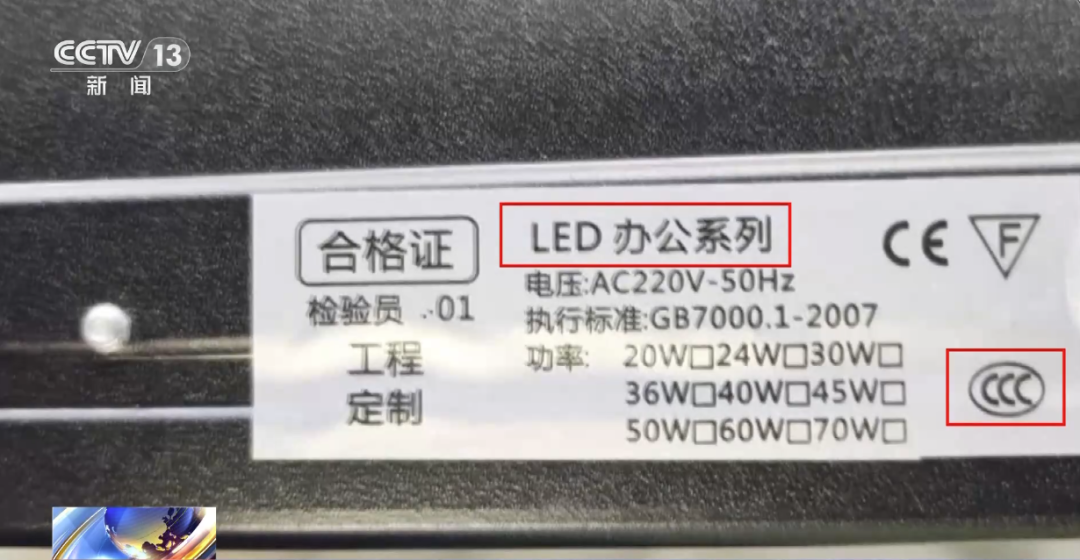
(Image source: CCTV News official account)
The situation was even more serious at the warehouse of Yihu Lighting Processing Shop in Guzhen Town. Upon opening and inspecting 27 boxes of eye‑protective classroom lamps, inspectors found that although the products bore the CCC mark, they could not produce valid certificates; the labels, certificates of conformity, and outer packaging all lacked the manufacturer’s name and address—classic examples of “three‑no” products. At the scene, authorities also seized 11 boxes of LED panel lights, similarly missing both a manufacturer’s name and a valid CCC certificate. Furthermore, the boxes carried markings for two different companies, including “Zhongshan Heyi Lighting Fixture Factory,” which turned out to be nonexistent, suggesting fabricated company information.
On the production side, Guangdong Yixun Lighting Co., Ltd. continued mass‑producing lamps and storing finished goods despite having its CCC certificate revoked. Subsequent enforcement sampling inspections covered 19 batches, with 18 batches totaling 1,430 non‑conforming items. Local authorities have confiscated the implicated lamps and imposed penalties on the company.
Inspection experts noted that companies deliberately conceal their names and addresses to sever traceability chains and evade liability for compensation or regulatory oversight following accidents. Given that lighting fixtures operate directly on 220V mains voltage, such products pose severe safety risks. Products listed under national standards must obtain CCC certification; placing uncertified items on the market constitutes a violation. Currently, the inspection findings have been handed over to Zhongshan authorities, who have initiated investigations into all involved parties and launched a targeted campaign to improve lighting product quality.
Industry Insights: Diverse Violations Amid Rising Compliance Barriers
Zhongshan serves as a core hub for China’s lighting industry, accounting for the majority of domestic residential lighting demand. Its mature supply chain and low manufacturing costs represent significant competitive advantages. However, the sheer scale of this industry has also led to prolonged price wars among countless small enterprises and wholesale market stalls, where counterfeit certifications and “three‑no” products have become common tools for undercutting competitors.
Based on publicly disclosed cases, current violations can be broadly categorized into three types:
First is “certificate substitution”: after obtaining a certificate, Company A allows Company B to affix it directly, or uses a single certificate across multiple products with similar exteriors but differing internal components, effectively employing a “generic certificate.” Yet, CCC certification adheres to the principle of “one certificate per model,” requiring strict alignment between certificate details and actual products. Any changes to power supplies, light sources, insulating parts, or other critical components may necessitate reapplication or certificate extensions. In such cases, the CCC mark stamped on the product’s exterior is merely an invalid printed logo.
Second is “revoked certificates with continued production”: when a company’s certificate is revoked due to failing random inspections, instead of halting production of the affected models, they simply repackage the products or change the manufacturer’s name and keep producing.
Third is “fake certificates” or “borrowed certificates”: traders or processing shops hold genuine certificate numbers but independently manufacture lamps whose models, manufacturers, or key components do not match the certified specifications. Such risks have already surfaced in engineering and school procurement projects, largely because buyers typically only review photocopies of certificates without logging onto official platforms to verify certificate status, manufacturer details, or specific model numbers—resulting in a disconnect between certificates and actual products entering distribution channels.
The root cause of these irregularities lies in how intense price competition squeezes compliance margins. Obtaining a standard CCC certificate—from application through factory audits to final issuance—often takes several months and incurs substantial costs. When price wars reach extreme levels, some small and medium‑sized merchants begin treating “compliance” as an optional add‑on rather than a mandatory requirement.
▼▼
Effective January 1, 2026, the new GB/T 7000.1‑2023 lighting safety standard will become mandatory, requiring all existing certificates to be replaced by year’s end. Meanwhile, starting December 1, 2026, the “Key Industrial Products List for Online Sales” will take effect, mandating that online retailers also hold valid certificates. These regulations impose strict CCC‑certification requirements on both e‑commerce platforms and manufacturers/sellers alike.
Moreover, data from the State Administration for Market Regulation’s 2025 CCC validity inspections reveal that 79 certificates were revoked, including 43 embedded luminaires, 25 fixed‑type fixtures, and 11 portable units. This trend corroborates findings from the Zhongshan undercover investigation: embedded lights, panel lamps, and classroom lighting are areas where certificate‑product mismatches frequently occur and where high‑risk revocations overlap, making them prime targets for channel‑level verification.
With the mandatory implementation of these new rules, small and medium‑sized manufacturers long reliant on “generic certificates” now face their toughest test yet, while those committed to compliance stand to benefit from upcoming regulatory reshuffles. As oversight expands from offline to online, and certificate management evolves from static to dynamic, the lighting industry’s “compliance exam” has officially begun.
Sources: CCTV News official account, video platform, compiled and edited by the author
China Light
The official website of the China Association of Lighting Industry and a full-media platform for the lighting sector. We provide authoritative and timely lighting information while striving to be a growth partner for businesses. From brand promotion and channel expansion to consulting, talent training and participation in standards development, we provide comprehensive professional services to help businesses improve quality and efficiency and jointly advance the high-quality development of the lighting industry.
Business Contacts
仇纯 (Ms.): 158 6155 3579
顾君 (Mr.): 137 7157 5253