
Lighting Chronicles | A Century of Osram: Sold All the Lamps, Keeping Only the Light → Understand Osram’s Business Direction in One Article
Introduction: How Many “OSRAM” Brands Are There, Exactly?
Many longtime friends in the lighting industry share a common question: Wasn’t OSRAM doing well? Why do we keep hearing news about it restructuring its business and selling assets?
The reality is this: there’s only one OSRAM brand, but today three companies either operate businesses under that name or own it:
The OSRAM Light bulbs and home luminaires you buy at supermarkets or online go into LEDVANCE’s pocket—a company acquired by a Chinese consortium comprising IDG Capital, Mulinsen, and Yiwu State-owned Assets. “OSRAM” is a brand they’re licensed to use.
Ams Osram—listed in Switzerland and headquartered in Austria—is the company behind EVIYOS pixel headlights, TMF8829 dToF sensors, and AI optical interconnects. In 2020, Austrian sensor firm ams completed its acquisition of OSRAM.
In the architectural landscape lighting sector, those specialized “OSRAM/Traxon” luminaires (known as Zhuosheng Lighting in the Chinese market) belong to Hong Kong’s Youchang Group—also operating under brand licensing.
This century-old brand lives on in three distinct financial statements: two license its name, while one both owns the brand and holds core light-emitting chip technology.
This article will lay out the full picture: who currently controls each segment of OSRAM’s business.
I. Origins: The Name Itself Signified Filament Production (1906–2013)
The name Osram was coined from two metals:Osmium + Wolfram—cutting-edge materials for incandescent lamp filaments when the brand was registered in 1906.
In 1919, AEG, Siemens & Halske, and the German Gaslight Company (Auer-Gesellschaft) merged their respective incandescent lamp operations, establishing OSRAM GmbH in Berlin. This wasn’t a startup story but rather a national-team consolidation within Germany’s lighting industry.
It remained part of the Siemens ecosystem for decades: in 1976, Siemens acquired AEG-Telefunken’s stake, raising its ownership to 79%; then in 1978, it purchased the remaining 21% from GE, becoming the sole shareholder. GE had held shares since 1929, though few today remember this period of U.S. investment.
By the time OSRAM spun off and went public in 2013 (OSRAM Licht AG, Frankfurt), it had become the world’s second-largest lighting company, firmly No. 1 in automotive lighting, and also controlled a previously overlooked yet pivotal division—optoelectronic semiconductors (OSRAM Opto Semiconductors): LEDs, lasers, and other “light-emitting chips.”
Fun fact: Infineon also spun off from Siemens in 1999. Thirty years later, when Infineon bought OSRAM’s sensor business, it was essentially a distant relative of OSRAM.
II. The First Subtraction: Selling Off Light Bulbs (2015–2017)
The rationale is straightforward. As LED adoption turned light sources from “technical products” into “commodities,” prices kept falling, replacement demand weakened, and traditional light source and luminaire manufacturing became low-margin, capital-intensive operations. In 2015, OSRAM began divesting its general lighting business; on July 26, 2016, it signed an agreement with a Chinese consortium (IDG Capital + Mulinsen + Yiwu State-owned Assets) for over €400 million; closing occurred on March 3, 2017, with an initial payment of €485.7 million and potential additional brand licensing revenue of up to €100 million.
The entire portfolio was consolidated into a new entity, LEDVANCE:traditional light sources, LED sources and luminaires, smart home lighting, distribution channels covering ~150 countries, and licenses for two brands—Sylvania in North America and OSRAM elsewhere. This division of responsibilities had been in place since 1993, following OSRAM’s acquisition of GTE’s Sylvania operations in North America. However, the nature of these licenses differed: OSRAM held transitional licenses (for light sources until September 2021, extendable to September 2026; for luminaires and smart home products until September 2019), while Sylvania enjoyed permanent exclusive rights in the U.S., Canada, Puerto Rico, etc., excluding automotive lighting. Brand ownership never changed hands; only usage rights were sold.
This deal established the fundamental model for the following decade: OSRAM adopted a “three-pillar strategy”—retaining onlyspecialty lighting, lighting solutions & systems, and optoelectronic semiconductors. Looking back, the first two pillars were gradually divested, leaving only the third.
III. Merging Small to Grow Big:
Acquired by a Sensor Firm (2019–2020): In 2019, OSRAM Became the Target Itself.
In July 2019, a consortium led by Bain Capital and Carlyle Group made the first offer at €35 per share (totaling ~€3.4 billion); Austrian sensor firm ams soon joined the bidding, raising its offer to €38.5. After Carlyle declined to match the higher bid, Bain teamed up with Advent Capital in September to prepare a stronger counteroffer. On October 18, ams announced a tender offer at €41 per share, valuing the company at ~€4.6 billion (formal documents issued November 7)—days later, Bain and Advent withdrew from the race.
During multiple rounds of bidding, ams also purchased nearly 20% of shares on the secondary market, becoming OSRAM’s largest shareholder. Closing occurred on July 9, 2020, with ams holding 69% equity, corresponding to a cash consideration of ~€2.7 billion for tendered shares; at the Annual General Meeting on June 2, 2021, shareholders approved changing the legal name to ams-OSRAM AG, effective January 18, 2022.
This “small-to-big” acquisition has been frequently cited in the industry: ams, then valued at ~€3 billion, used bridge loans and a share issue to acquire the much larger OSRAM. To understand all subsequent asset divestitures, one key insight suffices—ams prioritized OSRAM’s optoelectronic semiconductor assets. LED drivers, luminaires, and specialty bulbs were excluded from the core business from the outset.
The biggest strategic adjustment post-merger came with Micro LED: OSRAM invested nearly $1 billion in a Malaysian Kulim 8-inch wafer fab (industry estimates suggest total investment exceeded this figure; the company did not disclose exact costs). According to Counterpoint, Yole, and other industry firms, the project originally aimed to supply Apple Watch Micro LED chips—but Apple never officially confirmed its role as a customer. On February 28, 2024, the company announced the client had canceled the cornerstone project, triggering impairment charges of €600–900 million; actual annual costs totaled €576 million (including €490 million in impairments and €86 million in transition expenses). With that, the Kulim 8-inch fab shut down, and the Micro LED strategy contracted accordingly.
Following this adjustment, the company’s< strong>strategic focus shifted to digital photonics.
IV. Where Did the Business Go? A Complete List of Over Ten Deals (2017–2026)
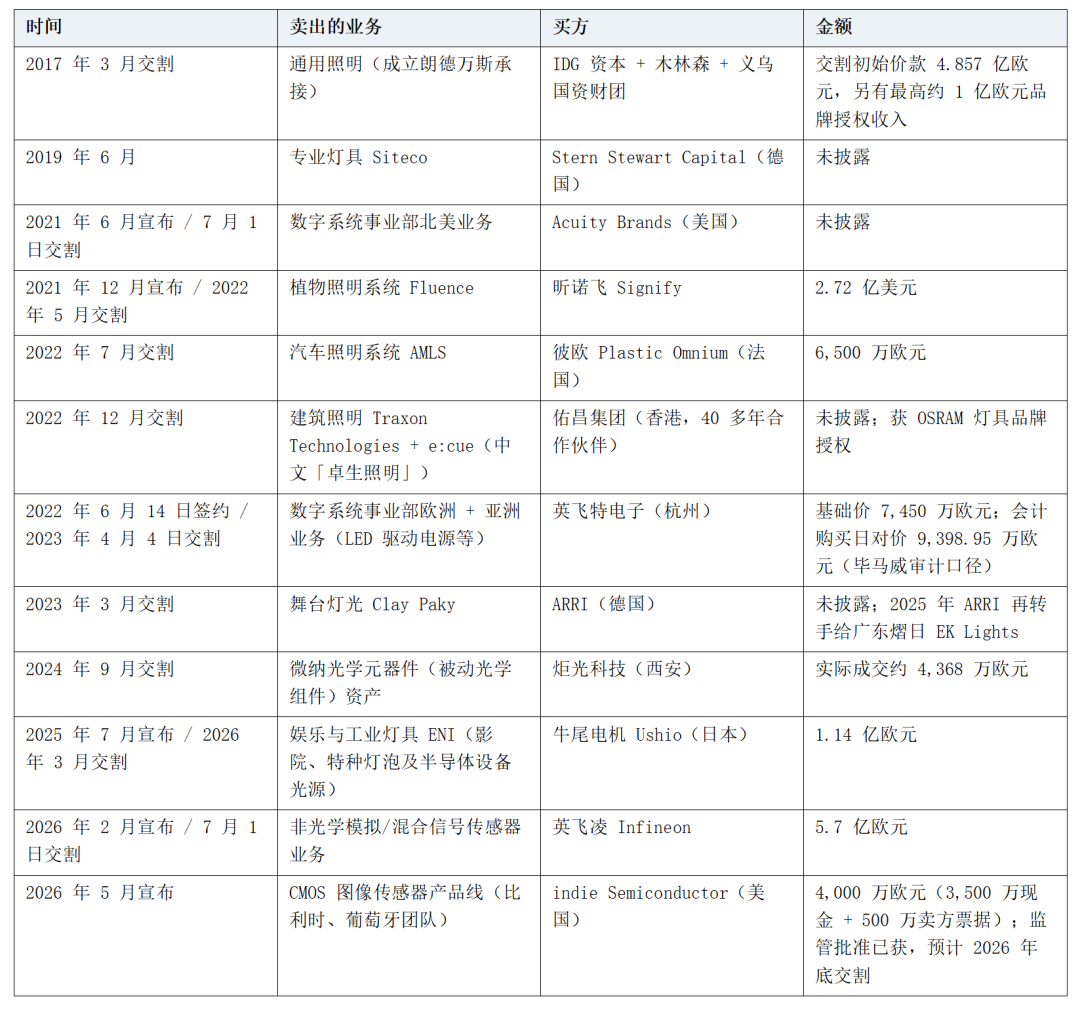
Behind these dozen transactions lie two main threads:
The first thread is deleveraging. OSRAM left a relatively high level of financial leverage after the ams acquisition, prompting the company to accelerate its deleveraging plan, targeting asset disposals generating over €500 million in proceeds—the €570 million from Infineon represented the largest single gain, bringing total expected cash inflows from this effort to ~€670 million. By Q3 2026, net debt had further declined to €883 million (excluding the Kulim factory sale-and-leaseback; including it, €1.344 billion), while cash reserves stood at €1.392 billion.
The second thread is refocusing. Every divestiture announcement reiterated the same message:Focusing on core areas of “light sources, visualization, and sensing”. By February 2026, the company officially defined itself as a“leader in Digital Photonics”—turning light into pixels (Micro LED), perception into chips (optical sensors), and connectivity into bits (optical interconnects).
One detail worth noting for Chinese lighting professionals: among the buyers, Mulinsen, Inventronics, Juguang, and Youchang collectively took over four OSRAM divisions directly, accounting for one-third of the 12 deals—and many were among the highest-value transactions. Adding Guangdong EK Lighting’s acquisition of Clay Paky from ARRI brings the total number of Chinese buyers to five.
The industrial restructuring of this European century-old giant involved nearly half of its acquirers being connected to the Chinese business community—what was purchased included brands, distribution channels, and mature manufacturing systems.
V. What Remains Today
After this round of restructuring, ams-OSRAM has become a completely different company:
Emitters: LEDs, infrared LEDs, VCSELs and lasers, UV-C LEDs, EVIYOS pixel headlights (already in mass production for vehicles), ALIYOS flexible foil light sources;
Optical Sensors & Modules: spectral sensing, dToF laser ranging, optical pressure sensing, ambient light detection for smartphones, entering mobile phones, wearables, robotics, and AR glasses;
Driver ICs & Software: integrating components into “intelligent photonic systems”;
Growth Axes: automotive pixelated headlights, AR glasses Micro LEDs, AI data center optical interconnects, robotics and biosensing;
And retaining a portion of traditional automotive bulbs and aftermarket services (OSRAM Automotive)—which, according to the company, provides “reliable cash flow to support semiconductor business growth.”
In terms of scale, the company has entered a new tier: FY2025 revenue reached €3.323 billion, adjusted EBITDA margin 18.3%, free cash flow €144 million, and annual design orders exceeding €5 billion.
The Q3 report released on November 13, 2026, maintained the same trend—quarterly revenue €829 million, down 3% year-on-year (mainly due to business sales; optoelectronic semiconductors still up 9% YoY); net profit €319 million, largely driven by gains from the Infineon deal; excluding that, the quarter still posted a net loss of €35 million; net debt fell to €883 million.
The real financial highlight lies in one sentence: profit margins slipped from 18.3% in 2025 to 16.3% in Q3, with guidance for Q4 at 16.0% ± 1.5%. According to the company, this reflects the ongoing transition cost of reshaping its portfolio after shedding lower-margin businesses—the transition costs of portfolio rebalancing are not yet fully resolved. The company sets a target date of 2030: double-digit compound growth in semiconductor revenues and adjusted EBITDA margins no lower than 25%; closer-term goal: positive free cash flow by 2027.
As the company defines it, today’s ams-OSRAM is a< strong>“Digital Photonics” company: no longer a traditional lighting enterprise, but rather a< strong>semiconductor company focused on light.
VI. Who Really Owns “OSRAM” Now?
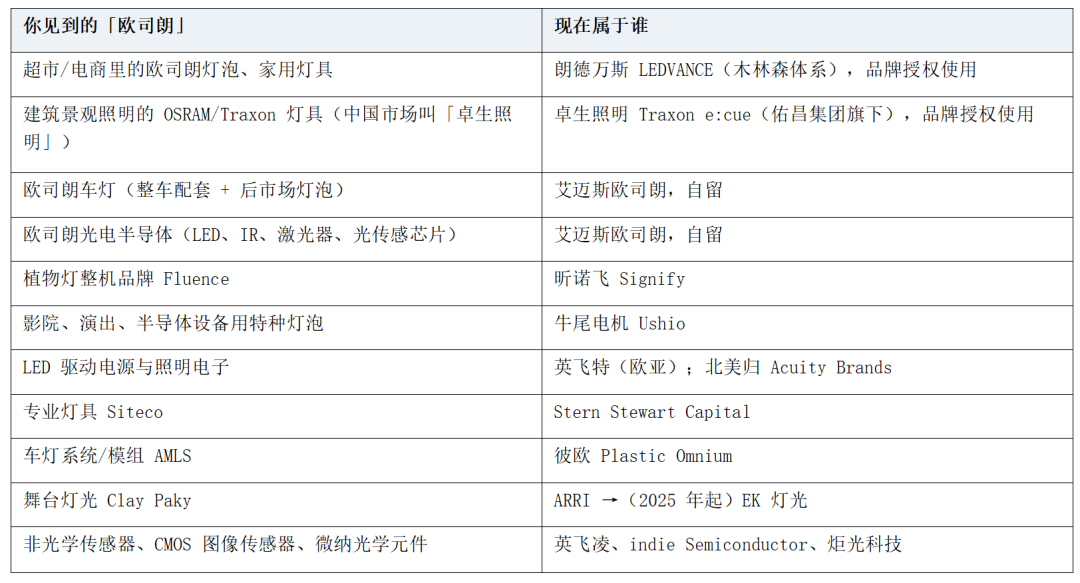
A crucial point often overlooked:OSRAM brand ownership has never been sold. All transactions involve< strong>“business plus brand usage rights”, with licensing fees providing steady income—even just for LEDVANCE, contracts stipulate up to €100 million. For the parent company, this represents long-term, stable brand licensing revenue.
VII. What Does This Decade-Long Restructuring Reveal?
First, the “Moore’s Law Trap” in the light source business is real.
As LEDs transformed lamps from durable goods into fast-moving consumer items, European manufacturers struggled to compete with Chinese supply chains on cost, making divestiture a rational choice. OSRAM wasn’t the first (Philips spun off its general lighting division into Signify), nor will it be the last.
Second, “semiconductorization” is one visible upgrade path for the industry. The same engineering and manufacturing capabilities, suppressed by price competition in the general lighting phase, surged to global leadership in niche markets like pixelated headlights and optical sensors once shifted toward automotive applications. The Q3 report on November 13 serves as a clear example: while the group-level adjusted results still show a small loss, optoelectronic semiconductors grew 9% YoY in the quarter, and adjusted profit margins rebounded to 19.2%. This decade suggests that future growth will come more from new uses of “light” than from the category of “lighting” itself.
Third, brand licensing is a proven business model. Sell the business, retain the brand, collect licensing fees—this is how OSRAM operates. Philips follows the same logic regarding branding: after spinning off its lighting business into Signify, Royal Philips retained ownership of the Philips trademark, while Signify paid for usage rights. The difference lies in approach and technology: OSRAM sells its business to third parties and rents out its brand to buyers, keeping the chips in-house; Philips lists its spun-off businesses, collects rent from the parent company, and sells the chips (Lumileds). Brands can be licensed out, but core technologies must remain under control—this principle applies fully only to OSRAM.
Fourth, for Chinese companies, this restructuring brought a significant share of European lighting industry assets. Mulinsen acquired the brand and distribution networks across 150 countries; Inventronics gained market share in Eurasian LED driver supplies; Juguang obtained micro-nano optics production lines; Youchang reclaimed business from a 40-year partner; EK purchased the stage lighting brand Clay Paky. Over the next decade, as ams-OSRAM continues deepening its work in AR glasses, optical interconnects, and robotic sensing, this buyer list will likely expand further.
A hundred years ago, OSRAM used osmium and tungsten to make filaments; today, it uses gallium nitride for pixels and gallium arsenide for bits.
The company remains the same—lamps have been sold; light stays in its own hands.
China Light
The official website of the China Association of Lighting Industry and a full-media platform for the lighting sector. We provide authoritative and timely lighting information while striving to be a growth partner for businesses. From brand promotion and channel expansion to consulting, talent training and participation in standards development, we provide comprehensive professional services to help businesses improve quality and efficiency and jointly advance the high-quality development of the lighting industry.
Business Contacts
仇纯 (Ms.): 158 6155 3579
顾君 (Mr.): 137 7157 5253