
2.1 billion, 795 million, 285 million… As of the end of September, these Street light and urban lighting projects were still in the bidding phase.
As September draws to a close, National Day is approaching. Across the country, more than a dozen cities are still spending money on the same thing: replacing streetlights.
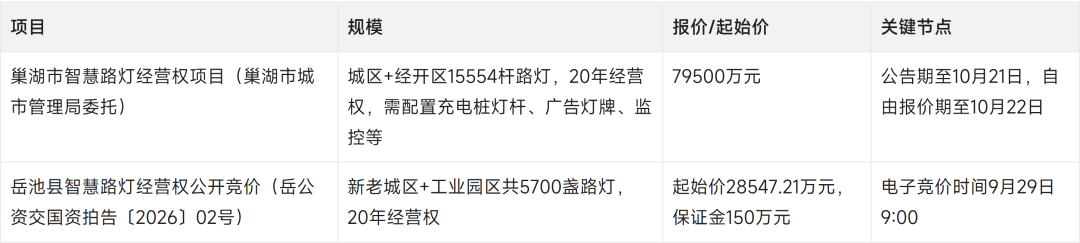
In Gangbei District, Guigang, Guangxi, the second phase of a 5.5G smart integrated new-energy streetlight project has an estimated total contract price of RMB 2.1 billion. In Chaohu City, Anhui, the 20-year operating rights for 15,554 streetlights start at RMB 795 million. In Yuechi, Sichuan, 5,700 streetlights are up for auction with a starting price of RMB 285 million. Adding to this, a wave of EMC‑managed renovation projects in Xinjiang, Jiangxi, Shanxi, Jiangsu, Shandong, and Tianjin have all issued public notices, signaling that the lighting‑project tender market in September has clearly opened up.
I. Streetlight Operating Rights Transfers
Both of these projects follow the approach of publicly auctioning off existing streetlight operating rights.
II. Streetlight Energy‑Saving Renovation + Energy Management
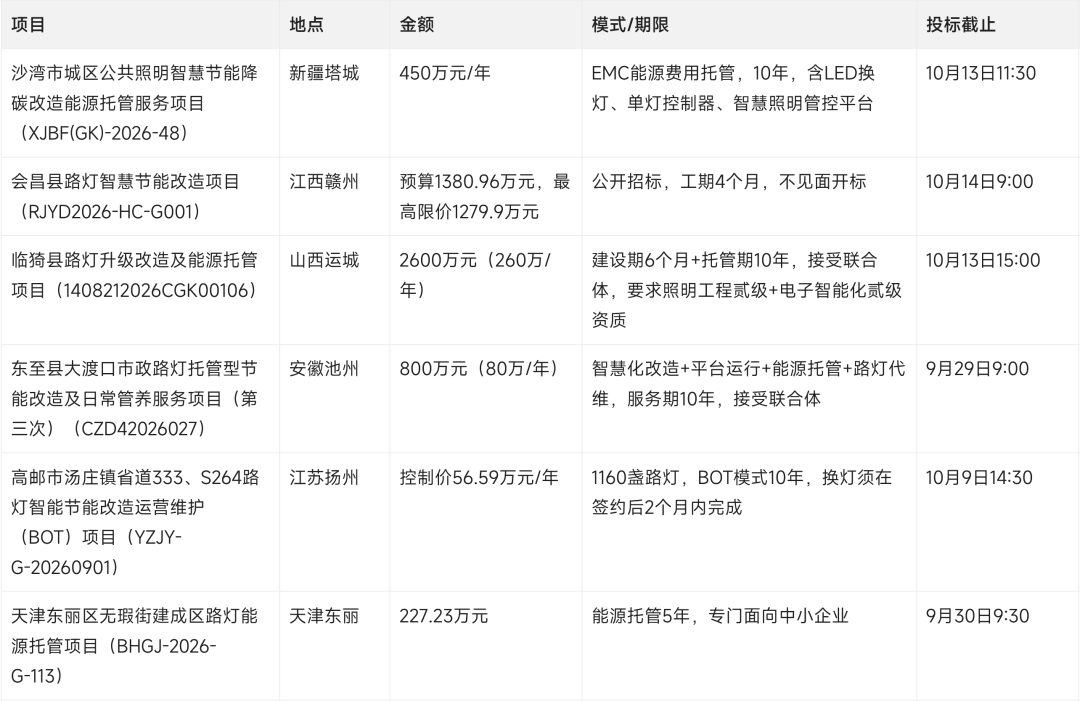
This category accounts for the largest number of projects, with a largely consistent model: replacing luminaires with LED units, installing individual lamp controllers, and integrating a smart lighting platform. The winning bidder manages operations for 8 to 10 years, paying electricity bills and handling maintenance, then handing over the assets at the end of the term.
III. Smart Streetlight and Smart Light Pole Construction & Equipment Procurement
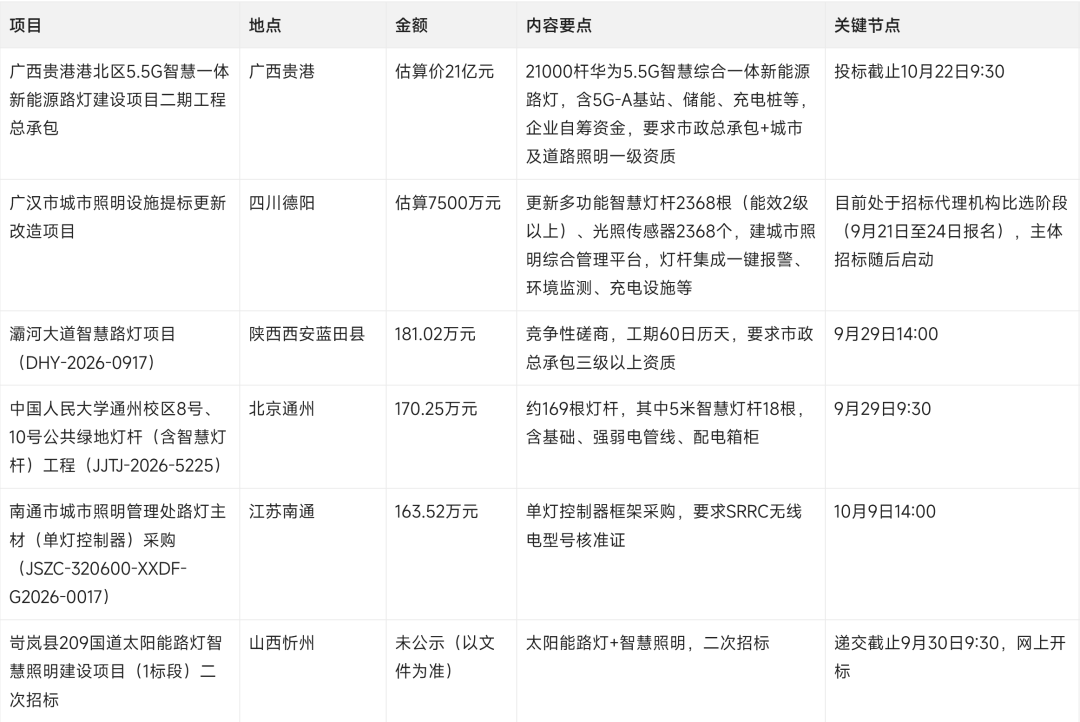
The largest single project this month is the second phase of the 5.5G smart integrated new‑energy streetlight construction project in Gangbei District, Guigang, Guangxi. Listed online on September 22, it carries an estimated price tag of RMB 2.1 billion. The plan calls for building 21,000 smart integrated new‑energy streetlights equipped with Huawei’s LampSite X 5.5G micro‑base stations—each pole standing 14 meters tall and incorporating modules for smart lighting, 5G‑A base stations, wind‑powered illumination, distributed energy storage, video surveillance, and charging services, along with a 10 kW generator set. The construction period spans 1,826 calendar days, with all funds self‑raised by the company. The procuring entity is Guangxi Haiyu Micro‑Electric New‑Energy Technology Development Co., Ltd.
The first phase of this project (23,000 poles, estimated at RMB 2.3 billion) was already tendered earlier; combined, the two phases exceed RMB 4 billion.
IV. Landscape Lighting and Nightscape Illumination
A Few Notable Signals
1. The RMB 2.1 billion Guigang project differs from typical government procurement: the procuring entity is a private enterprise, funding entirely self‑raised, with an estimated cost of about RMB 100,000 per pole. Its selling point lies in combining Huawei’s 5.5G micro‑base station, wind power, and energy storage. For such “new energy + communications + lighting” bundled streetlight projects, whether the business model can succeed hinges on whether revenue streams like 5G base‑station leasing and charging services can sustain operations. Companies considering this project should pay close attention to its actual implementation progress rather than focusing solely on the estimated price.
Furthermore, the company was established in April 2025 with a registered capital of RMB 19.13 million. It has no prior operating history or social insurance records, leaving significant uncertainty regarding its financial strength and ability to fulfill contractual obligations. From the perspective of the lighting industry, cautious observation remains warranted.
2. Transfers of operating rights are gaining momentum. With Chaohu’s RMB 795 million and Yuechi’s RMB 285 million auctions underway, governments are moving away from simply purchasing equipment and instead packaging existing streetlights as assets, offering 20-year operating rights to allow private capital to manage ancillary businesses such as EV charging stations, advertising, and surveillance. This presents opportunities for companies that have previously undertaken similar projects and possess operational expertise—but also entails heavy asset commitments and long payback periods, requiring meticulous financial planning before bidding.
3. Smart technology has become standard fare, no longer just an added bonus. For example, a RMB 75 million project in Guanghan plans to replace 2,368 multifunctional smart light poles, while Nantong separately allocated RMB 1.63 million to procure individual lamp controllers, indicating that demand for backend control systems and platform solutions continues to grow rapidly.
All the above information is sourced from public announcements posted on local public resource trading platforms and government procurement websites. Project details, qualification requirements, and timelines are subject to the original announcements and tender documents available on each platform. Before submitting a bid, be sure to log in to the relevant platform to verify the latest status, as some projects may experience delays, changes, or clarifications through Q&A sessions.
China Light
The official website of the China Association of Lighting Industry and a full-media platform for the lighting sector. We provide authoritative and timely lighting information while striving to be a growth partner for businesses. From brand promotion and channel expansion to consulting, talent training and participation in standards development, we provide comprehensive professional services to help businesses improve quality and efficiency and jointly advance the high-quality development of the lighting industry.
Business Contacts
仇纯 (Ms.): 158 6155 3579
顾君 (Mr.): 137 7157 5253