
Say goodbye to "the brighter, the better"! Urban lighting: using data to achieve the perfect illumination.
On September 28, 2025, the Ming Classroom "Era of Hong Liu" channel, in collaboration with Fudan University's Spectral Luminance Meter research group, hosted the "Luminance in Light Environments: Measurement, Interpretation, and Design Balance — Urban Lighting Edition" salon. Professor Yao Qi from Fudan University and Mr. Song Lei, Design Director at Sandi Optoelectronics, respectively interpreted the innovative logic behind balancing luminance measurement technology and landscape lighting from the dual perspectives of technological R&D and design practice.
Yao Qi: Drone-Based Light Environment Detection and Assessment Technology for Road Lighting
1. The Necessity of Technological R&D and Era Opportunities
●Industry Challenges:
Traditional detection relies on manual handheld devices, suffering from low efficiency (single-point measurement), poor accuracy (discrete data), and high costs (professional equipment priced at 100,000–300,000 yuan). Moreover, it cannot meet the precise monitoring demands for lighting energy consumption and carbon emissions under the dual-carbon goals.
●Era Opportunities:
The rise of the low-altitude economy (with an estimated market size of 1.5 trillion yuan by 2025) provides the hardware foundation for large-scale drone-based detection. The industry urgently needs low-cost, portable technical tools to promote widespread civilian applications.
2. Building a "Full-Chain Technical System"
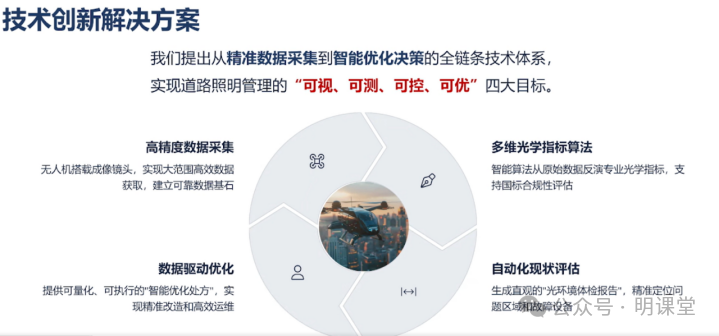
Objective: To achieve "visible, measurable, controllable, and optimizable" road lighting management, covering four core modules:
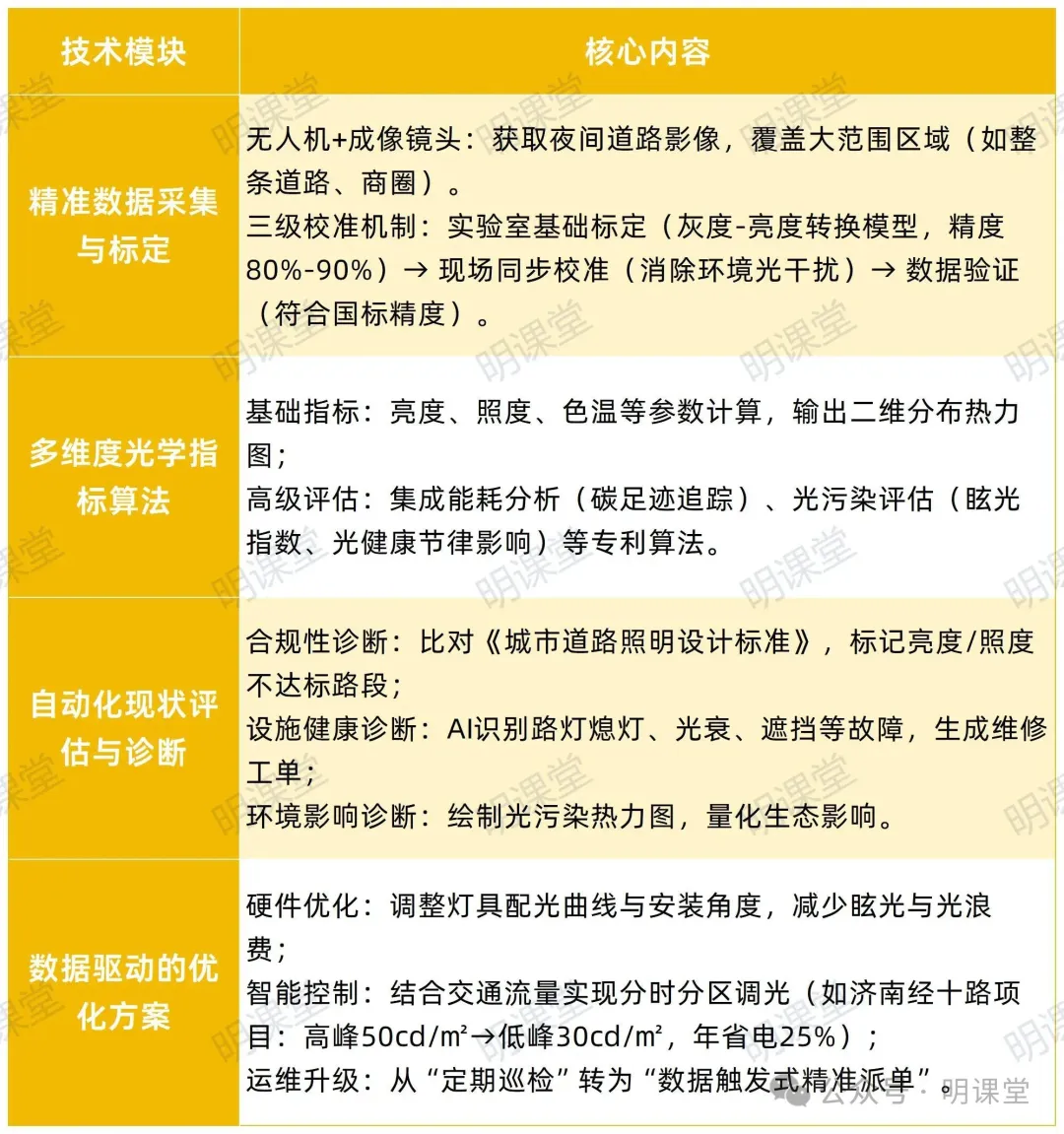
3. Technical Highlights and Application Extensions
●Innovation Highlights:
◇Global Analysis: Pixel-level luminance/illuminance analysis covering complex scenarios such as roads, building facades, and commercial districts;
◇Multi-Indicator Integration: Simultaneous output of over 10 indicators including luminance, illuminance, glare, and energy consumption, replacing traditional multi-device step-by-step testing;
◇Efficient Workflow: From data collection to report generation takes only minutes, improving efficiency by more than tenfold.
●Real-World Cases:
◇Applications in Shanghai's Xujiahui and The Bund commercial districts produced luminance distribution maps and energy consumption heatmaps, providing low-cost, precise, and rapid information on luminance and energy use to support intelligent control for green, energy-saving, and low-carbon initiatives.
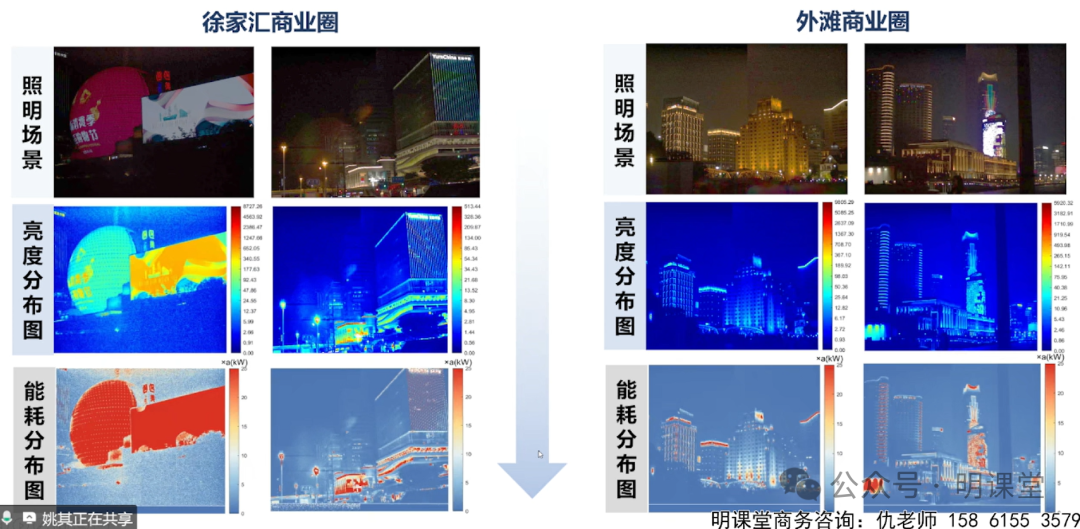
Applications in Shanghai's Xujiahui and The Bund commercial districts
◇Developed a mobile imaging luminance meter compatible with standard Android smartphones, achieving 70%-90% accuracy (meeting engineering requirements), supporting real-time monitoring and PDF report generation.
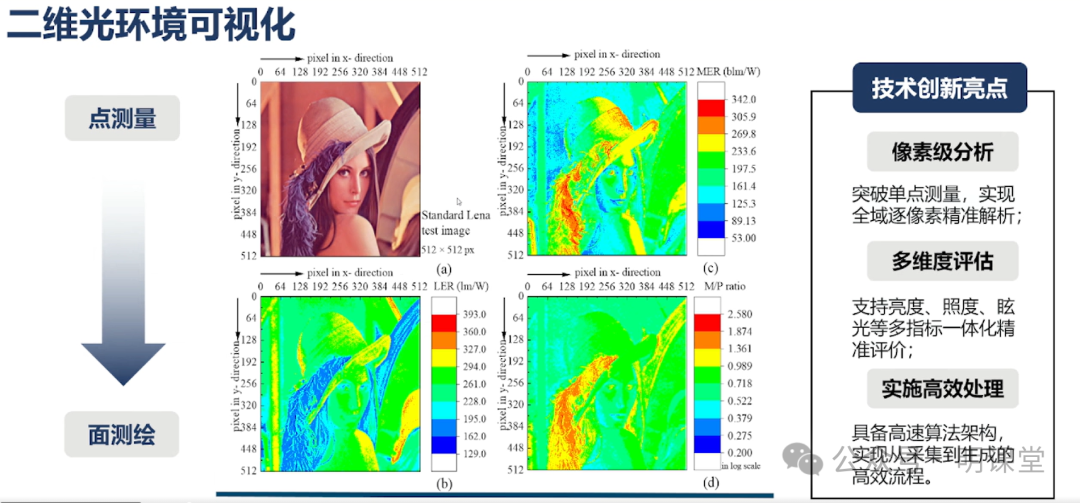
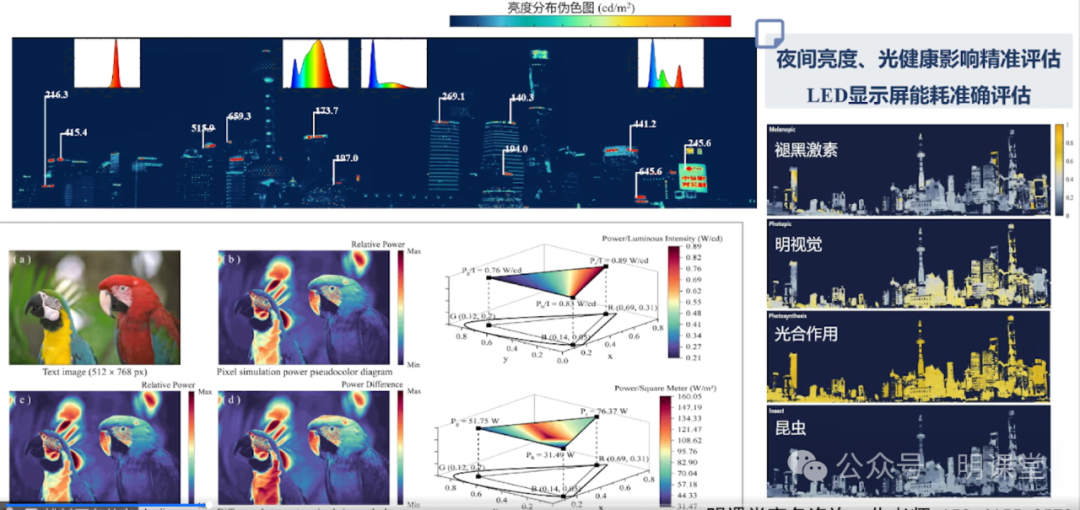
Light environment visualization
Song Lei: The Art, Technology, and Responsibility of Landscape Lighting
1. Design Philosophy: From "Brighter" to "Better"
●Core Proposition:
Shift from "pursuing brightness" to "pursuing quality," emphasizing the trinity of "the art of design, the wisdom of control, and the responsibility of prevention".
●Balancing Logic:
◇Function and Art: Reject "uncontrolled scattering"; respect architectural carriers through precise light projection (e.g., warm yellow light for historic buildings to highlight historical ambiance, cool white light for commercial complexes to emphasize technological sophistication).
◇Light Pollution Prevention: Strictly control upward light and eliminate glare, proposing nighttime light environment goals of "light and shadow, tension and relaxation," advocating for "dark sky protection" (such as Tibet's Dark Night Park model).
2. Pathways Integrating Art and Technology
●Design First
◇Carrier Adaptation:
Customize lighting narratives for different settings like historic buildings, commercial complexes, and parks (e.g., Zibo's Haidai Tower uses low-color-temperature light to highlight cultural heritage, while Qingdao's Fushan Bay Light Show integrates urban identity with commercial advertising).
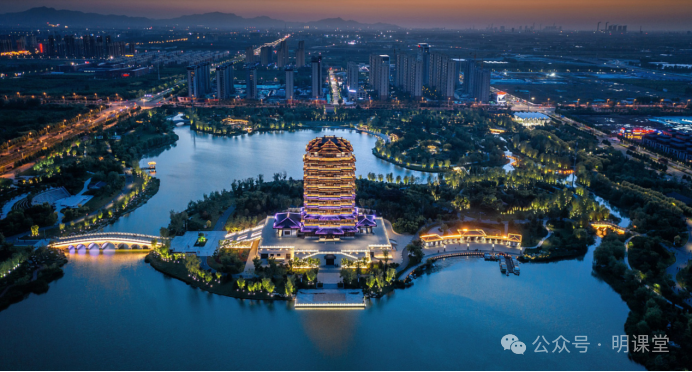
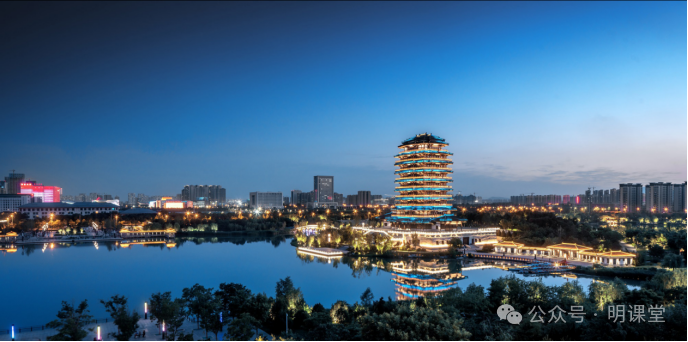
Zibo Haidai Tower lighting design
◇Parameter Control:
Regulate emotions through color temperature and color (e.g., 3000K warm light creates tranquility in ancient towns, while 4500K cool light showcases skyscrapers' technological flair).
●Practical Use of Low-Cost Detection Tools
◇Used Secondhand Huawei Phones:
"Every member of our company has a small phone. We buy those Huawei phones on Xianyu for just a few hundred yuan. Employees carry them around like professional equipment. When they go out, they take photos inside and outside, capturing the whole day—so convenient."
"In the past, when clients said 'not bright enough,' we could only argue. Now, using phones to capture on-site data and directly show them that 'luminance meets standards' is far more effective than empty talk."
●Smart Control and O&M Innovations
◇Dynamic Dimming:
Adjust lighting on demand based on pedestrian flow and time of day (e.g., Jinan's Jing Shi Road reduces luminance from 50 cd/㎡ to 30 cd/㎡ according to traffic volume, saving 25% annually on electricity).
◇Commercial Closed Loop:
Take Qingdao's Fushan Bay as an example: Commercial ads (Moutai, Dior, etc.) embedded within light shows help offset operation and maintenance costs, achieving the dual goals of "government image display + commercial revenue."
3. Real Project Cases
●Qingdao Fushan Bay Light Show:
◇Technical Implementation:
Adopting "media facade + smart control system" to enable time-sharing playback of urban imagery and commercial advertising, with annual O&M revenue covering costs.
◇Social Value:
Became Qingdao's signature nighttime tourism attraction, drawing an average of 30,000 visitors daily and driving a 15% increase in surrounding commercial district spending.
●Jinan Jing Shi Road Lighting Plan:
◇Luminance Balancing:
Through drone inspections and smartphone app calibration, reducing bidirectional ten-lane luminance from超标 values (70 cd/㎡) to national recommended levels (30–50 cd/㎡), resolving subjective disputes over "leaders judging brightness visually").
◇Smart O&M:
Combining drone patrols with AI fault identification, shortening repair response time from 48 hours to 4 hours and cutting O&M costs by 30%.
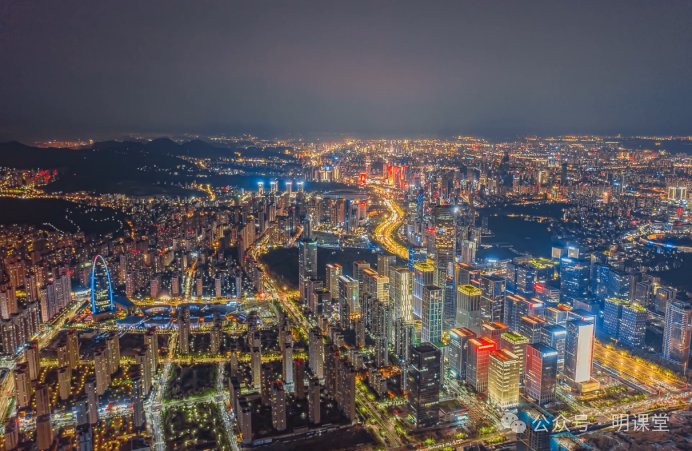
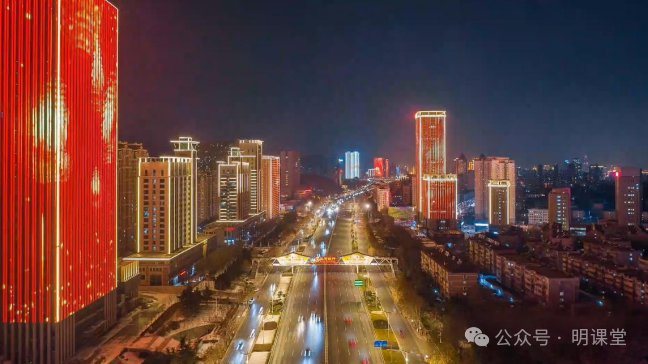
Jinan Jing Shi Road comprehensive lighting plan
Interactive Q&A
Q
What are the advantages and disadvantages of mobile spectral luminance meters versus traditional professional equipment in landscape assessment? Should ordinary design teams equip themselves?
Yao Qi:
●Core Differences:
◇Price: Traditional professional equipment (e.g., imaging luminance meters) costs 100,000–300,000 yuan, while mobile versions require only a few hundred yuan (secondhand Huawei phone + app), significantly lowering the barrier to entry.
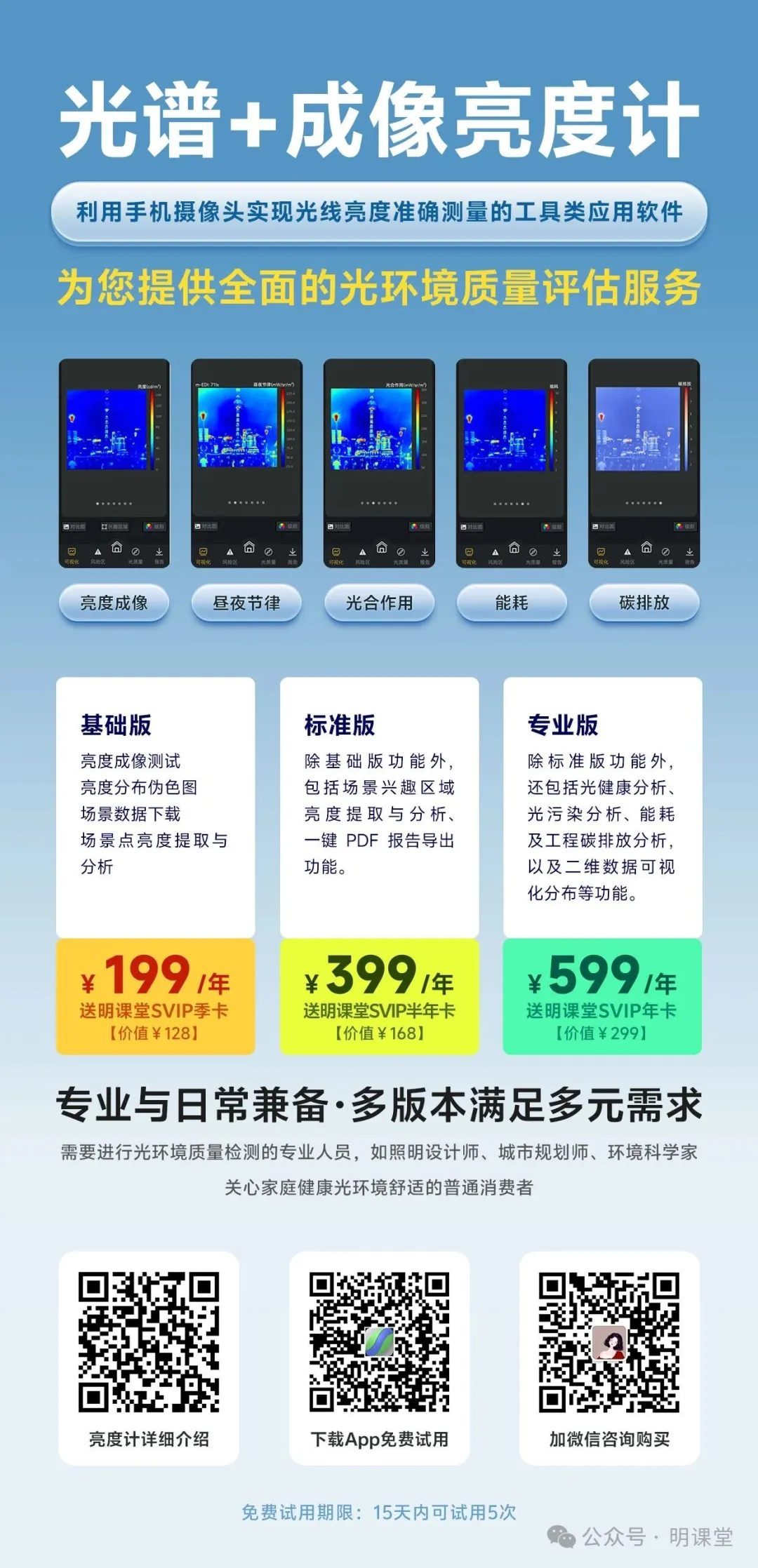
◇Accuracy: Under laboratory conditions, mobile calibration achieves 80%-90% accuracy; in real-world applications, device variability affects accuracy to 70%-90%, sufficient for engineering needs. (Human perception of luminance follows a logarithmic relationship; a 10% error is imperceptible to the human eye. For example, a household ceiling light surface brightness of 5000 cd/㎡ vs. a display screen at 300 cd/㎡—the difference is undetectable.)
◇Portability and Efficiency: Mobile versions support real-time shooting, data visualization (luminance heatmaps), and one-click PDF report generation, ideal for quickly responding to client needs on-site (e.g., instantly refuting subjective claims of "not bright enough").
●Conclusion: Small and medium-sized design teams are strongly advised to equip themselves, especially during economic downturns when communication efficiency can be improved (e.g., using data on-site to counter client subjective judgments of "not bright enough").
Q
What are some excellent cases of urban lighting O&M? How can sustainable O&M be achieved?
Song Lei:
●Core O&M Logic: Recoup O&M costs through market-based mechanisms to avoid complete reliance on government budgets, thereby forming a commercial closed loop.
Here's an example: Qingdao Fushan Bay. The success of Fushan Bay's light show O&M lies in avoiding waste—unlike many cities where installations are shut down after events. It broadcasts urban imagery daily and inserts commercial ads during idle periods—ads for Moutai, Honor of Kings, Dior, and public service announcements. Advertising revenue covers O&M expenses, achieving the dual goals of "urban image display + commercial revenue." Although this doesn't fully cover construction costs, it prevents the government from having to fund lamp repairs every day.
Another promising case is Wuxi Lighting Innovation. They've installed drone landing pads on lampposts integrated with food delivery services. Imagine this: McDonald's and KFC have lampposts nearby; JD.com and Meituan can rent these poles for drone takeoffs and landings. This creates a commercial closed loop for O&M, eliminating dependence solely on government funding.
These two models—one relying on advertising, the other on the low-altitude economy—both fundamentally solve the problem of funding.
Q
In dynamic scenarios (e.g., light shows, large screens), how should luminance thresholds be set to balance visual effects and energy consumption?
Yao Qi (Technical Perspective):
It's entirely achievable. Traditional glare indices differentiate indoor and outdoor settings, which is too complex. In fact, the core lies in contrast ratio. For example, if background luminance is 10 cd/㎡, lamp luminance should not exceed 100 cd/㎡; otherwise, a 100:1 ratio causes glare. We're now promoting a new algorithm incorporating a contrast model: lamps automatically dim when thresholds are exceeded, without requiring complex AI. It's like hospitals first performing B-ultrasound or CT scans (visual diagnostics) to determine the appropriate "dose" of light. Previously, smart control was guesswork; now, with data, we can precisely adjust lighting—dimming slightly before nightfall when skies aren't fully dark, further reducing brightness late at night when foot traffic declines—ensuring comfort while saving energy.
Song Lei (Practical Perspective):
The key in dynamic scenarios is "background luminance coordination." For instance, Qingdao Fushan Bay's light show consumes more power when displaying all-blue or solid-color scenes compared to those with light-and-shadow contrasts. We use smartphones to collect data and provide feedback to clients: "Look, this design can save 30% on electricity." Leaders initially doubt it, believing "lights consume the same amount whether on or off," but actual measurements reveal that content-based light-and-shadow contrasts indeed reduce energy use. Human perception of luminance is relative—for example, the sky brightness differs between 6 PM and 10 PM; keeping contrast ratios below 10:1 avoids glare. Using Dr. Yao's tools to measure data upfront allows designers to avoid "brightness for brightness's sake," ensuring both comfort and energy savings.
Q
What is the applicability and scenario boundaries of mobile versions in "acceptance scenarios"?
Yao Qi:
●Accuracy and Applicable Scenarios:
◇Mobile Versions: 70%-90% accuracy, suitable for on-site rapid testing, client communication, and routine inspections, especially for small and medium-sized design teams or O&M units (costing only a few hundred yuan).
◇Professional Equipment: Over 95% accuracy, suitable for lab calibration, project acceptance, and standard setting (e.g., national venues, airports, and other scenarios with extremely high accuracy requirements), but prohibitively expensive (100,000+ yuan), reserved for large enterprises or research institutions.
●Conclusion: Mobile versions can meet 90% of engineering scenario needs, while professional equipment serves as a "high-precision benchmark calibration tool," creating a complementary relationship between the two.
Conclusion
Luminance is the "language" of light environments; measurement is the "tool" for interpreting that language; design is the "art" of balancing competing demands.
Professor Yao Qi's team's technological R&D has advanced lighting detection from "single-point sampling" toward "global analysis," while Song Lei's practical cases demonstrate the industry's transformation path of "technology serving art, with art bounded by responsibility."
In the future, the lighting industry will continue upgrading from "quantifying light" to "qualifying light", injecting greater technological and humanistic value into urban nighttime light environments.
Disclaimer
This article was compiled by Ming Classroom based on the replay of the September 28, 2025 salon titled "Luminance in Light Environments: Measurement, Interpretation, and Design Balance (Urban Lighting Edition)."
The content aims to share information while maintaining neutrality. If any infringement issues arise, please contact us promptly; we will address or remove relevant content as soon as possible. Thank you for your understanding!
Click here for the course replay
China Light
The official website of the China Association of Lighting Industry and a full-media platform for the lighting sector. We provide authoritative and timely lighting information while striving to be a growth partner for businesses. From brand promotion and channel expansion to consulting, talent training and participation in standards development, we provide comprehensive professional services to help businesses improve quality and efficiency and jointly advance the high-quality development of the lighting industry.
Business Contacts
仇纯 (Ms.): 158 6155 3579
顾君 (Mr.): 137 7157 5253