
Seoul Semiconductor will begin mass production of rare-earth-free white LEDs.
Seoul Semiconductor’s subsidiary, Seoul Viosys, recently announced that it has jointly developed with Seoul Semiconductor the WICOP3 MicroLED chip technology, which emits white light without rare earths, and will begin mass production in the fourth quarter of this year. This technology breaks away from the traditional white LED’s reliance on rare earth materials; it achieves white light output without using rare earth phosphors such as yttrium aluminum garnet (YAG). The chip size can be as small as 10 micrometers, opening up new possibilities for next-generation lighting and micro-LED display applications.
Traditional white LEDs produce white light by coating a blue LED chip with rare-earth-containing phosphors. In contrast, WICOP3 requires no additional phosphors or Packaging processes—the chip itself can emit white light directly.
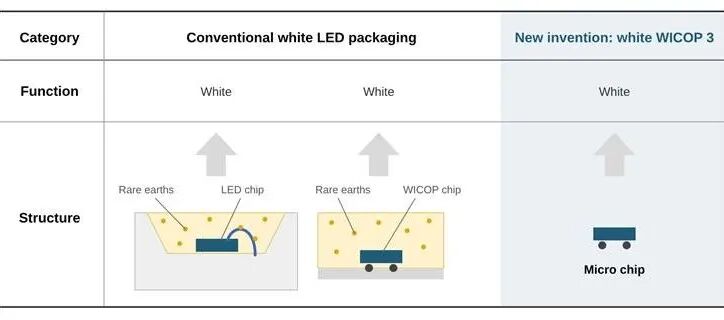
WICOP 3 (Image source: Seoul Viosys)
This technology can even achieve white light emission on ultra-small chips measuring 25 micrometers wide and 10 micrometers high. One micrometer equals one thousandth of a millimeter—so small that it is difficult to distinguish with the naked eye.
Seoul Viosys explained that, because it eliminates the need for rare earths and Packaging steps, manufacturing costs can be reduced to about half of those of conventional products. At the same time, it reduces the use of materials such as plastics and silicone resins, thereby lowering environmental impact. The first batch of mass-produced products has a luminous efficacy of approximately 100 lumens per watt (lm/W), with a target to increase this to 200 lm/W within the next two years.
Seoul Viosys expects this technology to be applicable in fields such as lighting and AR devices. Due to its tiny chip size, it can also be used in novel lighting solutions like wallpaper and embedded light sources in glass windows.
Seoul Viosys and Seoul Semiconductor plan to officially begin mass production of WICOP3 in the fourth quarter of this year, expanding supply based on existing customers. Going forward, they also intend to broaden partnerships in AR displays and AI optical communication to tap into new markets.
In addition, both Seoul Semiconductor and Seoul Viosys reported revenue growth in their Q3 earnings forecasts released on the 14th: Seoul Semiconductor’s consolidated revenue for Q3 was KRW 302.2 billion (approximately RMB 1.5 billion), up 17.6% year-on-year; Seoul Viosys reported revenue of KRW 228.5 billion (approximately RMB 1.14 billion), up 21.9% year-on-year.
Source: CINNO
China Light
The official website of the China Association of Lighting Industry and a full-media platform for the lighting sector. We provide authoritative and timely lighting information while striving to be a growth partner for businesses. From brand promotion and channel expansion to consulting, talent training and participation in standards development, we provide comprehensive professional services to help businesses improve quality and efficiency and jointly advance the high-quality development of the lighting industry.
Business Contacts
仇纯 (Ms.): 158 6155 3579
顾君 (Mr.): 137 7157 5253