
“Lighting Ushers in the City” Series, Part 3: Urban Renewal Projects—How to Elevate Lighting from a Supporting Role to a Core Element
In urban renewal projects, lighting works are often treated as a “minor ancillary component,” with limited budgets, difficult project approval, and little recognition. Take the lighting project in a city’s core district: starting from a small municipal maintenance task with a modest budget, it successfully transformed into a major city‑level benchmark through strategic policy alignment, value enhancement, and standardized application procedures. The project was approved with a total investment of approximately RMB 120 million, achieving a remarkable turnaround—from a supporting role to a key driver.
Part One
Breaking the Impasse: From “Repairing Streetlights” to a “Strategic Tool for Urban Development”
Initially, the project addressed routine issues such as aging streetlights, insufficient illumination, and unsafe wiring in the old城区—tasks that were considered low‑priority maintenance.
The team seized on three major local policy directions—improving people’s livelihoods, advancing smart new infrastructure, and promoting green, low‑carbon development—and repositioned the initiative. They transformed a simple lighting upgrade into a comprehensive urban renewal project integrating public‑service assurance, smart governance, and nighttime tourism, making it a cornerstone of urban revitalization.
This pivotal step was instrumental in securing over RMB 100 million in investment and getting the project listed among major municipal initiatives.
Part Two
The Core: Four Logical Pillars That Win Immediate Approval
1. Policy Alignment: Positioning at the Highest Level for Smooth Inclusion
By closely aligning with national goals for carbon neutrality and smart city development, the project turned streetlights into IoT‑enabled sensing nodes, integrating them into the city’s digital twin infrastructure—fully consistent with the priorities of major projects.
2. Data‑Driven Pain Points: Letting Facts Speak for Themselves
In older districts, less than 70% of streetlights remain functional, lighting power density exceeds standards, and fault response times exceed 48 hours. With these clear metrics laid out, the case for upgrading becomes compelling.
3. Value Enhancement: Beyond Lighting—Driving Economic Growth
By linking the project to nighttime economies, traffic safety, and cultural‑tourism integration, the initiative is expected to boost nighttime foot traffic in surrounding commercial areas by 30%, shifting its focus from mere infrastructure investment to an economic engine.
4. Financial Sustainability: Compliant, Stable, and Feasible
The project adopts a hybrid funding model combining special fiscal allocations, urban renewal bonds, and private‑sector operation and maintenance, ensuring adequate budgetary planning and robust financial feasibility assessments—eliminating any concerns during the approval process.
Part Three
Implementation: A Four‑Step Roadmap for Seamless Execution and Approval
1. Preliminary Assessment: Understand the Situation Before Taking Action
A joint task force comprising representatives from the Development and Reform Commission, Housing and Urban–Rural Development Bureau, and local subdistrict offices conducted surveys of 15 roads and 32 older residential communities, producing detailed lighting assessment reports.
2. Preparing for Inclusion: Engage First, Then Submit
On the municipal platform, preliminary data was entered, with project titles enriched by keywords like “smart” and “low‑carbon.” Early communication secured a unique project code.
3. Comprehensive Documentation: Submit Everything at Once, Avoid Revisions
All required documents—including a project proposal, feasibility study, letter of financial commitment, site‑planning approval, and environmental impact registration—were submitted in one go.
4. Expert Review and On‑Site Inspection: Convincing Experts with Tangible Results
A PPT presentation combined with real‑world comparisons, complemented by on‑site inspections involving all three parties, quickly led to project approval and investment authorization.
Part Four
Secrets to Success: Materials and Techniques for Passing on the First Try
1. Essential Documentation Checklist
Project inclusion application form with unified coding
Feasibility study report (including financial analysis and risk assessment)
Current condition assessment and renovation plan
Funding strategy and fiscal commitment
Planning, environmental impact assessment, and energy efficiency review approvals
Expert review opinions
2. Three Key Factors for Extra Credit
Telling a story with data: annual electricity savings of 2 million kWh and carbon emission reductions of 1,500 tons—clearly demonstrating both social and economic benefits.
Integration elevates standing: coordinating with cultural tourism, sponge city initiatives, and traffic optimization efforts to serve as the finishing touch in neighborhood revitalization.
Long‑term operational sustainability: 24/7 online monitoring and rapid response mechanisms ensure lasting results.
Part Five
Compliance Baseline: Follow the Rules for Higher Success Rates
Policy Anchoring: Align with national urban renewal strategies and local lighting plans, adhering to the “reserve pool–implementation pool” management framework.
Complete Requirements: Ensure compliance with planning regulations, clear project ownership, secure funding, and meet safety and environmental standards.
Regional Prioritization: Focus first on priority areas such as older residential neighborhoods, commercial districts, and waterfront spaces.
Lighting is not a minor ancillary element—it is a central pillar of urban renewal.
By transforming small‑scale maintenance projects into multi‑million‑yuan flagship initiatives, we can secure both funding and favorable policies while illuminating nightscapes and invigorating the nighttime economy, delivering substantial returns on modest investments and unlocking great value from seemingly small undertakings.
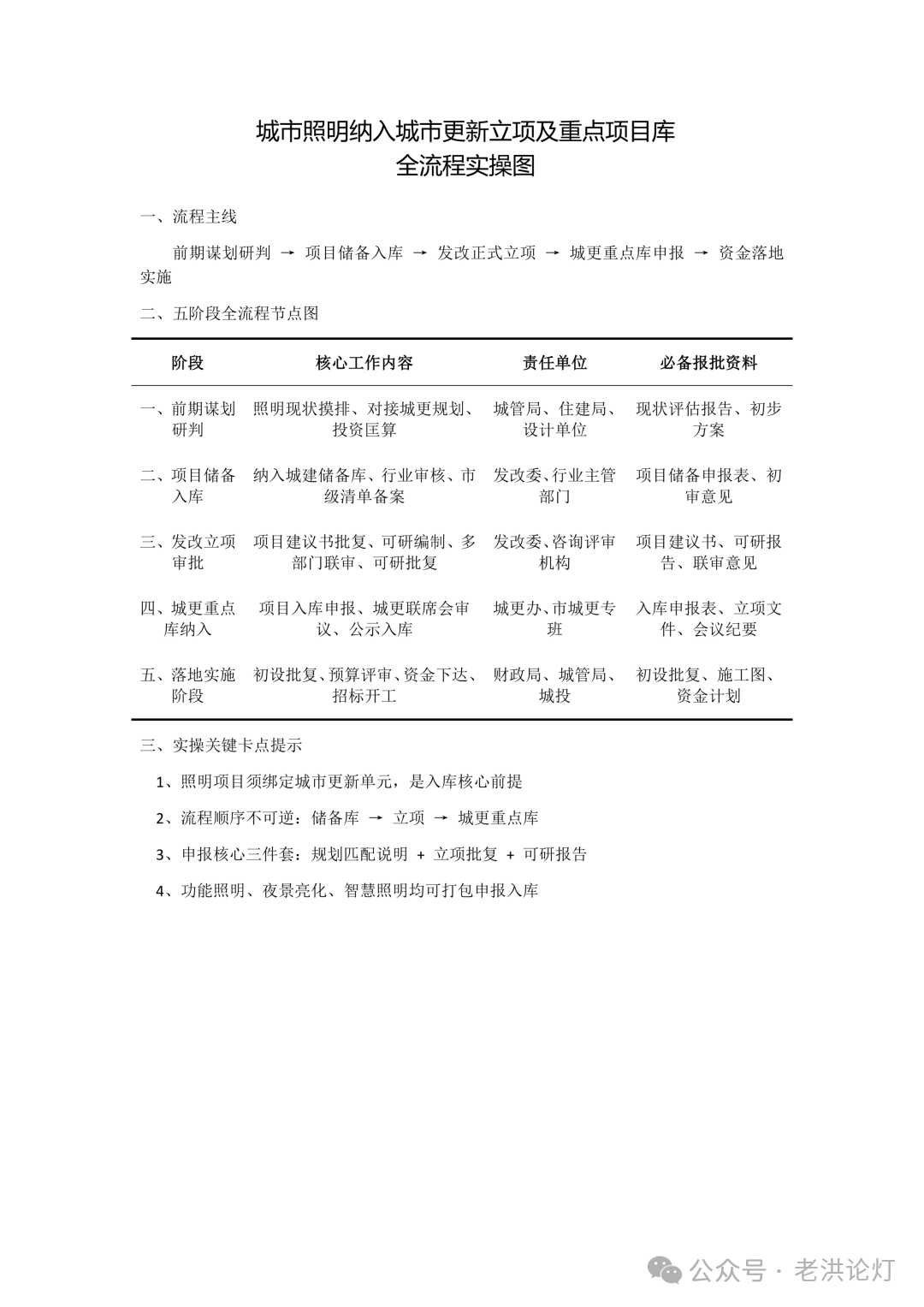
Appendix: Step‑by‑step flowchart for including lighting projects in urban renewal planning and the list of key projects
About the Author

Qian Zongming, Secretary General of the Jiangsu Provincial Lighting Society and Executive Dean of the Jiangsu Lighting Research and Design Institute
Has long been engaged in MBA teaching, as well as theoretical research and practical applications in lighting economics and the nighttime economy.
This article is sourced from the Jiangsu Provincial Lighting Society; author: Qian Zongming.
China Light
The official website of the China Association of Lighting Industry and a full-media platform for the lighting sector. We provide authoritative and timely lighting information while striving to be a growth partner for businesses. From brand promotion and channel expansion to consulting, talent training and participation in standards development, we provide comprehensive professional services to help businesses improve quality and efficiency and jointly advance the high-quality development of the lighting industry.
Business Contacts
仇纯 (Ms.): 158 6155 3579
顾君 (Mr.): 137 7157 5253