
Comprehensive Analysis of Healthy Lighting Standards: Core Parameters and Implementation Guidelines for Visual Light Quality + Non-Visual Physiological Effects
Definition of Healthy Lighting
Healthy lighting
Lighting that improves the quality of the light environment based on visual and non-visual effects, contributing to people's physical and mental well-being. (Source: GB 50034-2024)
Interpretation of the Definition
It refers to a lighting approach that optimizes the spectral distribution, spatial distribution, and temporal characteristics of the light environment, while simultaneously meeting visual functional requirements and non-visual physiological effects, thereby improving the quality of the human living light environment and promoting regulation of circadian rhythms, mood enhancement, and improved visual comfort.
The core framework must address:
• Visual-related factors (imaging function): spectral distribution, temporal distribution, and spatial distribution;
• Non-visual-related factors (non-imaging effects): photobiological safety, circadian rhythm regulation, and non-optical performance.
Core Technical Parameters – Basic Indicators for Visual Light Quality
1. Spectral, Temporal, and Spatial Distribution
● Spectral Distribution (light varying with wavelength):
Determines color temperature and color rendering; must cover the visible spectrum of 380–780 nm, with particular focus on controlling wavelengths at 435 nm (blue light hazard) and 490 nm (circadian effect);
● Temporal Distribution (light varying over time):
Manifests as flicker (frequency < 80 Hz, modulation depth ≤ 0.1%, IEEE 1789) and stroboscopic effect (80–2000 Hz, SVM ≤ 1, QB/T 5533);
● Spatial Distribution (light varying in space):
Affects illuminance, luminance, and glare; requires uniform coverage through luminaire photometric design (e.g., classroom lighting U0 ≥ 0.6, GB 50034).
2. Illuminance and Luminance
● Illuminance Metrics:
◇Horizontal Illuminance: Light intensity on a specific horizontal plane; for example, classroom lighting must maintain an average illuminance ≥ 500 lux (GB 50034);
◇Vertical Illuminance: Illuminance on a vertical surface; sports venues must ensure vertical illuminance ≥ 1000 lux in the main camera direction (JGJ 153);
◇Semi-cylindrical Illuminance: Used in road lighting for pedestrian face recognition, requiring ≥ 15 lux (CJJ 45).
◇Uniformity Requirements:
U0 (minimum/average illuminance): Generally ≥ 0.6 (e.g., offices);
U1 (minimum/maximum illuminance): To avoid localized over- or under-brightness, road lighting requires ≥ 0.4 (CJJ 45);
Uniformity Gradient (UG): Sports venue broadcast areas require ≤ 10% to prevent "zebra effect" (JGJ 153).
● Luminance Metrics:
◇Road Surface Luminance ≥ 1.5 cd/m² (CJJ 45), longitudinal uniformity ≥ 0.7 (CJJ 45);
◇Luminaire Surface Luminance: Reading desk lamps require遮光性 ≤ 2000 cd/m² (GB/T 9473) to avoid glare.
◇Luminance Uniformity: Wall-to-ceiling luminance ratio ≤ 3:1 to prevent visual fatigue.
3. Color Quality
● Color Temperature and Color Tolerance:
◇Correlated Color Temperature (CCT): Color characterization of white light sources; for example, classroom lighting recommends 3300K–5500K (GB 40070);
◇Color Tolerance (SDCM): Measures deviation between chromaticity coordinates and target values; indoor luminaires require ≤ Grade 3 (GB/T 24908).
● Color Rendering:
◇General Color Rendering Index (Ra) ≥ 80 (general spaces), ≥ 90 (art museums);
◇Special Color Rendering Index (R9) ≥ 0 (LED luminaires, QB/T 5533);
◇Color Maintenance Rate: After 6000 hours, chromaticity coordinate deviation ≤ 0.004 (DLC standard).
● Spatial Color Non-uniformity
◇Requirement: Blackboard lights within 10% of light intensity must have chromaticity coordinate deviation ≤ 0.007 (QB/T 5533) to avoid localized color bias.
4. Flicker and Glare Control
● Flicker and Stroboscopic Effect:
Core Definitions:
Flicker: Light fluctuations below 80 Hz perceptible to the human eye, measured by Modulation Depth (Mod%), which must be ≤ 0.1% (IEEE 1789);
Stroboscopic Effect: Light fluctuations between 80–2000 Hz causing visual illusions in moving objects, assessed using Stroboscopic Visibility Measure (SVM); classroom luminaires require ≤ 1 (QB/T 5533).
Testing Standards and Methods:
GB/T 42064-2022: Uses a flicker meter to measure pLstM index (short-term flicker value), requiring ≤ 0.1 under stable power supply;
QB/T 5920-2023: Captures rotating striped disks with a high-speed camera to calculate SVM values, simulating dynamic visual effects in real scenarios.
● Glare:
1. Discomfort Glare
◇UGR (Unified Glare Rating): Indoor lighting requires ≤ 19 (offices), ≤ 16 (classrooms) (GB 50034);
◇Measurement Method: Uses an imaging luminance meter to capture luminaire brightness distribution and calculates each light source's glare contribution within the field of view.
2. Disability Glare
◇TI (Threshold Increment for Disability Glare): Road lighting requires ≤ 10% (CJJ 45) to avoid impairing driving vision;
◇Cause: High-brightness light entering the eyes directly or reflecting off surfaces (e.g., smooth tables reflecting lamp light), mitigated through遮光设计 or reduced luminance contrast.
Core Technical Parameters – Key Requirements for Non-Visual Light Quality
1. Photobiological Safety
● Blue Light Hazard:
Definition:
Photochemical damage to the retina caused by blue light in the 400–500 nm range; infants' lenses transmit 3–4 times more blue light than adults', warranting special attention.
Categorization Standards (GB 44703-2024):
◇RG0 (No Hazard): Suitable for children's and adolescents' learning environments (e.g., classroom lamps, GB 55016);
◇RG1/RG2 (Low/Medium Hazard): Must label safe threshold illuminance levels (e.g., RG2 luminaires must warn "Avoid direct close-range viewing").
Blue Light Weighted Radiance (L_B) ≤ 100 cd/m² (measured 200 mm from the light source).
Controversy and Balance:
Moderate blue light can inhibit axial elongation of the eye (preventing myopia), requiring dynamic adjustment based on scenarios (e.g., high blue light outdoors during the day, low at night).
● Ultraviolet and Infrared Hazards:
◇Ultraviolet (UV):
UVC (200–280 nm): Germicidal but avoid direct exposure; leakage from 254 nm UV lamps coexisting with humans must be ≤ 5 μW/cm² (GB 28235);
Ozone Risk: Wavelengths < 240 nm decompose oxygen into ozone; indoor concentrations must be ≤ 0.16 mg/m³ (GB/T 18883).
◇Infrared (IR):
Thermal Hazards:: Bath heaters and warming lamps must control surface temperatures to prevent burns in infants (GB 7000.217); infrared weighted irradiance must be ≤ 100 W/m² (GB/T 20145).
● Photobiological Safety Standard Framework:
◇GB/T 20145 (equivalent to CIE 62471), GB 44703-2024 (mandatory requirements for lasers and incoherent light sources).
2. Circadian-Rhythm Healthy Lighting
● Non-Visual Photosensitive Mechanism:
◇IPRGC Cells (Non-imaging Photosensitive Cells in the Retina): Peak response wavelength 490 nm, regulating melatonin secretion and circadian rhythms;
◇Key Metrics:
EML (Equivalent Melanopic Lux): Represents circadian effects; offices require ≥ 250 lux during the day (ISO 8995-1 draft);
EDI (Equivalent Daylight Illuminance): Conversion relationship is EDI ≈ 1.103 × EML (CIE S 026:2018).
● International Standard Progress:
◇CIE S 026: Provides IPRGC response functions to support EML/EDI calculations;
◇North American WELL Standard: Residential nighttime EML ≤ 120 lux; hospital wards require dynamic color temperature adjustment (2700K–6500K).
◇Domestic Practice: Shanghai's "Healthy Lighting Technology Report" suggests adding morning high-color-temperature (5000K) periods in classrooms to enhance alertness.
● Technical Challenges:
◇Spectral Design: Balancing blue light hazard (435 nm) and circadian effect (490 nm), requiring chip wavelength tolerance ≤ 5 nm;
◇Cost vs. Energy Saving Conflict: Achieving 250 lux EML requires horizontal illuminance ≥ 1000 lux, conflicting with low-carbon goals; exploring localized directional lighting solutions.
3. Non-Optical Performance
● Noise Control:
◇Sources: Power supply inductor vibration during dimming (e.g., 100 Hz hum during deep dimming);
◇Limit Values: Elderly facilities ≤ 40 dB(A) (GB/T 50785); sensitive venues like concert halls ≤ 30 dB(A).
● Mechanical and Electrical Safety:
◇Mechanical Performance:
① Rounded edges of accessible parts ≥ 2 mm radius (GB 7000.1) to prevent scratches;
② Outdoor luminaires wind resistance ≥ Grade 12 (GB/T 30100);
◇Electrical Performance:
① Electromagnetic Compatibility (EMC): Radio interference ≤ 54 dBμV/m (GB 17743) to avoid disrupting medical devices;
② Electric Shock Protection: Landscape lights must use Class III luminaires (output voltage ≤ 25 V, GB 7000.1).
◇Thermal Performance:
① Color Drift Control: LED luminaires color temperature drift ≤ 500 K after 6000 hours (DLC V5.1) to prevent spectral shifts affecting circadian effects;
② Surface Temperature: Touchable parts ≤ 60°C (GB 7000.1) to prevent burns in children.
Comprehensive Technical Parameters and Standard Limits
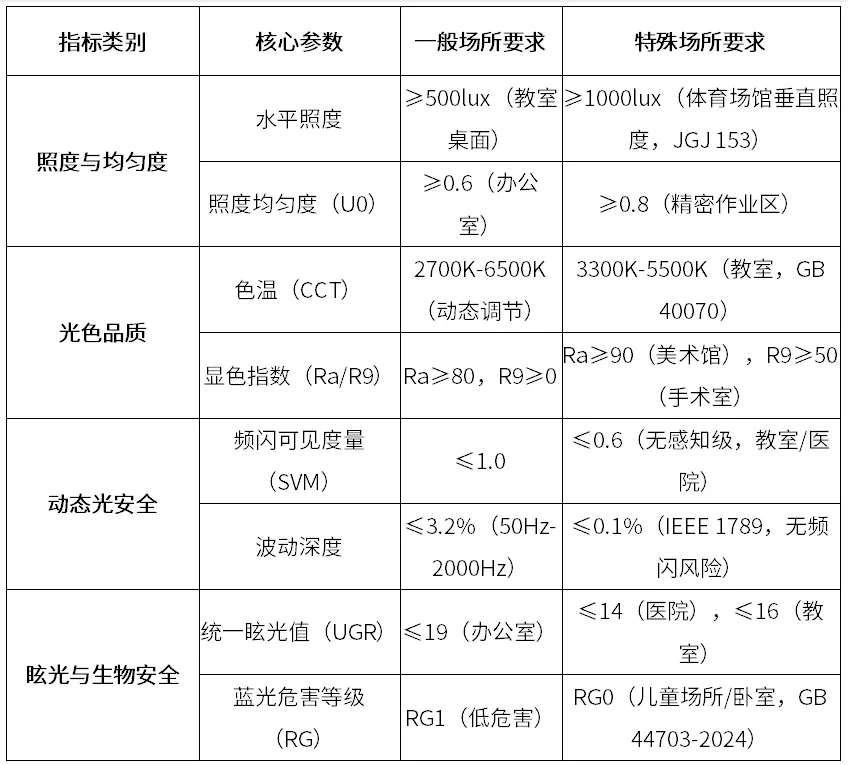
Implementation
Key Points for Standard Enforcement
1. Multi-Standard Collaborative Application
Visual Metrics:
◇GB 50034-2024 (architectural lighting), JGJ 153 (sports venues), CJJ 45 (road lighting);
Non-Visual Metrics:
◇GB 44703-2024 (photobiological safety), CIE S 026 (circadian lighting), WELL Standard (healthy buildings).
2. Corporate Practice Recommendations
End-to-End Compliance: From chips (e.g., KSF red phosphor enhancing R9) to systems (EMC filtering design) meeting standards;
Scenario-Based Solutions: Infants' rooms adopt low-blue-light (below 4000K) + RG0; offices integrate smart dimming (dynamic EML adjustment).
Note:
This article covers core concepts of visual and non-visual light quality, synthesizing GB 50034-2024, international CIE standards, and domestic industry practices, applicable to healthy lighting design and assessment for public buildings, residences, and special venues (e.g., hospitals, schools).
This article was compiled from:
1. Dr. Zhuang Xiaobo's Ming Classroom sharing session "Review of Advances in Light Quality Standards for Healthy Lighting – Visual Chapter" (click "Read Original" to revisit this salon) and the recap materials from two salons on "Review of Advances in Light Quality Standards for Healthy Lighting – Non-Visual Chapter";
2. The GB 50034-2024 standard.
To watch the replay, please click
Zhuang Xiaobo: "Review of Advances in Light Quality Standards for Healthy Lighting – Visual Chapter"
Disclaimer
The content of this article is intended solely for personal study and information sharing, maintaining a neutral stance.
If any infringement issues arise, please contact us promptly, and we will address or remove them as soon as possible. Thank you for your understanding!
China Light
The official website of the China Association of Lighting Industry and a full-media platform for the lighting sector. We provide authoritative and timely lighting information while striving to be a growth partner for businesses. From brand promotion and channel expansion to consulting, talent training and participation in standards development, we provide comprehensive professional services to help businesses improve quality and efficiency and jointly advance the high-quality development of the lighting industry.
Business Contacts
仇纯 (Ms.): 158 6155 3579
顾君 (Mr.): 137 7157 5253