
Technology Leads Commercial Innovation | Nine Ministries Issue a Document to Promote Technology-Driven Business Growth
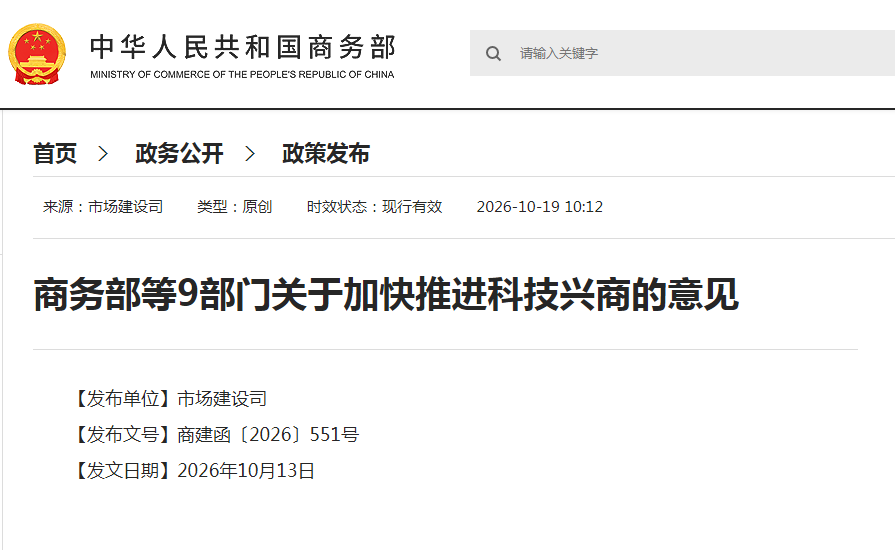
Recently, the Ministry of Commerce and eight other departments jointly issued the “Opinions on Accelerating the Promotion of Science and Technology‑Driven Commerce” (hereinafter referred to as the “Opinions”). The CPC Central Committee and the State Council attach great importance to scientific and technological innovation and expanding domestic demand. In a recent document, the CPC Central Committee and the State Council released the “Opinions on Developing New‑Type Productive Forces,” which lays out measures to promote the deep integration of technological innovation and industrial innovation. Further reading:Breaking News | CPC Central Committee and State Council Issue Top‑Level Design for New‑Type Productive Forces. As a key link connecting production and consumption, the commerce sector serves as an important pillar in building a robust domestic market. The newly released “Opinions” align with the requirements for developing new‑type productive forces, focusing on upgrading commodity consumption, enhancing circulation efficiency, and fostering innovative scenario‑based integration, thereby driving the digital and green transformation of the entire commerce value chain and providing strong support for constructing a powerful domestic market. Click “Read More” to view the full text of the “Opinions.”
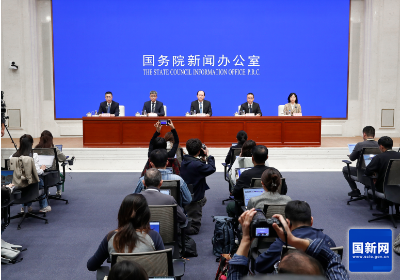
On October 19, the State Council Information Office held a press conference, during which officials from relevant departments outlined progress in accelerating science‑and‑technology‑driven commerce and set forth clear requirements and specific tasks for industrial transformation and upgrading.
Regarding the deepening of product supply iteration, Meng Yue, Director-General of the Market System Construction Department of the Ministry of Commerce, stated that by leveraging data from over 2,000 retail outlets nationwide, a digital supply information platform has been established. Through collecting and analyzing consumer demand, brand manufacturers have developed more than 650 new products, better meeting consumer needs. Currently, China’s consumer market is rapidly evolving toward a dual‑engine model driven by both goods and services. According to data from the National Bureau of Statistics, in the first three quarters, service retail sales grew 5.0% year‑on‑year, outpacing goods retail sales by 4.0 percentage points, while per capita spending on services accounted for 47.3% of total household consumption. This trend toward digitalization and service‑oriented consumption upgrades provides a practical pathway for transforming traditional manufacturing. The lighting industry can harness consumer big data across the upstream and downstream segments of the supply chain, deeply integrating healthy lighting environments with whole‑home smart ecosystems at the front end of product development, thus delivering precise offerings that meet consumers’ diverse demands for high‑quality illumination.
In terms of commercial scenario innovation, policies call for advancing embodied intelligence technologies in the commerce sector, expanding applications in areas such as home services and commercial logistics. Wei Wei, Director-General of the Science and Technology Department of the Ministry of Industry and Information Technology, noted that in the first half of this year, China saw over 400 models of humanoid robots launched, with production exceeding 40,000 units—projected to surpass 100,000 units by year‑end. Special initiatives for real‑world training are accelerating the validation and deployment of related products in warehousing, logistics, catering, and retail settings. Data from the National Bureau of Statistics show that as digital technologies like AI and big data drive service consumption toward personalized, immersive, and intelligent scenarios, online service retail sales grew 5.3% year‑on‑year in the first three quarters, while telecommunications and information services maintained double‑digit growth. Meanwhile, surging interest in cultural and tourism experiences has boosted retail sales of travel consulting and rental services, as well as cultural, sports, and leisure services, up around 10% YoY. As an essential component of commercial space infrastructure, intelligent lighting systems must achieve seamless interconnection with commercial service terminals, indoor navigation, and environmental sensing systems, leveraging dynamic luminous efficacy and deep spatial intelligence collaboration to comprehensively enhance the scenario‑based experience of brick‑and‑mortar commerce.
With regard to building a green, low‑carbon commercial ecosystem, policies emphasize supporting enterprises in using blockchain technology to calculate product carbon footprints and create low‑carbon consumption scenarios. Lighting manufacturers should actively embrace the green and low‑carbon transition trend, deepening green design and manufacturing throughout the product lifecycle and refining their carbon footprint accounting systems. They may also explore innovative service models such as energy performance contracting (EPC / EMC), offering efficient, energy‑saving lighting solutions to facilitate the green renovation of commercial buildings and public spaces, thereby gaining competitive advantages through cutting‑edge green technologies and service approaches.
The implementation of the science‑and‑technology‑driven commerce policy provides an effective lever for transforming the real economy. As an integral part of the real economy, the lighting industry should closely align with the requirements of new‑type productive forces, coordinating digital and green transformations to continuously strengthen its industrial foundation and improve supply quality. To put these policies into practice, empower industrial upgrading, and foster exchanges between supply and demand, during the upcoming 35th Ancient Town Lighting Fair—which opens tomorrow—the Market Circulation and Services Professional Committee of the China Lighting Fixture Association, together with Zhongshan Ancient Town Light City Expo Co., Ltd., will co‑host the “35th Ancient Town Lighting Fair Procurement and Supply Information Exchange Conference,” creating a professional platform for efficient matchmaking and in‑depth dialogue between buyers and suppliers in the lighting and decorative lighting sectors, while engaging in thorough discussions on optimizing the role of market participants in the lighting industry and promoting high‑quality sectoral development.
Source: China Lighting Fixture Association
China Light
The official website of the China Association of Lighting Industry and a full-media platform for the lighting sector. We provide authoritative and timely lighting information while striving to be a growth partner for businesses. From brand promotion and channel expansion to consulting, talent training and participation in standards development, we provide comprehensive professional services to help businesses improve quality and efficiency and jointly advance the high-quality development of the lighting industry.
Business Contacts
仇纯 (Ms.): 158 6155 3579
顾君 (Mr.): 137 7157 5253