
From exporting products to establishing a robust ecosystem — how the “Hundred-Million-Thousand” Project helps Zhongshan lighting companies co-build a global brand community
On November 11, the “Guzhen Lighting Expo Bright People Online” Salon, hosted by Zhongshan Guzhen Light City Expo Co., Ltd. and organized by China Light All-Media · Ming Classroom, held a new online session themed “From Product Export to Ecosystem Rooting — How the ‘Hundred-Thousand-Ten Thousand’ Project Helps Zhongshan Lighting Enterprises Build a Global Brand Community”.

The guest speaker for this session was brand export cross-border AI expert Mr. He Ziyun.
He is a co-founder of the Bay Area Digital Trade Cooperation Organization, CEO of Shiluxun Cross-Border, and rotating president of the Foshan Municipal Association for Promoting Digital Foreign Trade. With over 20 years of hands-on experience in home furnishing and building materials exports, he has visited more than 40 countries and participated in over 100 international trade shows, while his team has established operations in more than 10 countries. Although trained in bioengineering, he feels a professional affinity for the concept of “ecosystem.”
Starting from his own four generations of foreign trade experience and using real-world cases like smart toilets and smart curtains, he explained in great detail the logic, tools, and pitfalls involved as lighting companies transition from “selling products” to “building ecosystems.”
Four Generations of Foreign Trade, Five Levels of Sales Representatives
Teacher He Ziyun divided his foreign trade journey and industry evolution into four generations:
In the 1980s and 1990s, the first generation built trust with clients through letters and faxes; the second relied on trade fairs like the Canton Fair to secure orders; the third leveraged Alibaba, independent websites, and Amazon to connect digitally with customers;
and now, the fourth generation is the era of AI, short videos, and GEO (Generative Engine Optimization)—customer habits are shifting from “information search” to “describing pain points and demanding results directly,” with search entry points migrating from Google to AI engines like GPT and Perplexity.
He noted that foreign trade sales reps also have five levels: Level 1 focuses on securing orders, Level 2 stabilizes clients, Level 3 analyzes the market, Level 4 understands products and can make micro-innovations based on client pain points, and Level 5 anticipates trends.
Catching each turning point in traffic channel migration represents an opportunity for every generation of foreign traders.
Success Starts with Traffic, Sustainability Depends on Supply Chains
Teacher He Ziyun summed it up pragmatically: “Success starts with traffic, sustainability depends on supply chains, and advancement relies on technology.” Using Huawei’s “Iron Triangle” model as an analogy, he explained that for a business to succeed, three elements must be in place: Customer Relationship (AR), Solution (SR), and Delivery & Fulfillment (FR).
Acquiring traffic is no longer difficult—“as long as you dare to invest in advertising, traffic is readily available.” They once adapted domestic short video content for TikTok, YouTube, and LinkedIn, achieving tens of millions of views and tens of thousands of likes. However, the main issue was their teams weren’t prepared to handle the workload or fulfill delivery commitments to clients.
He also mentioned a well-performing company in Foshan that received numerous negative reviews overseas because, despite taking on many orders, they failed to properly root their ecosystem—a case of “forcing growth prematurely.”
GEO: Let AI “Speak” for You
One of the key focuses of this session was GEO. Teacher He Ziyun offered an analogy: back when Alibaba uploaded vast product specifications to its website, helping countless factories get discovered on Google—that was the SEO era. Now, his goal is to transform industrial belt factory solutions, qualifications, and case studies into a structured, trustworthy knowledge graph database that AI engines prioritize—presenting one-stop solutions in local languages to customers in the U.S., Southeast Asia, and the Middle East.
They’ve already established a pilot project in Malaysia: building a GEO infrastructure on an independent site, collaborating with around 10,000 local influencers to shape brand perception, and synchronizing structured technical documentation across networks to form an “Iron Triangle,” driving growth rates tenfold.
A customer initially asked them 30 questions via AI, then sent a detailed inquiry of 300–500 words describing their needs very thoroughly—“GEO moves pre-sales work upstream, improving labor efficiency and reducing operational costs.”
To achieve this, they’re transitioning their invested 1,400-person Philippine BPO center from a “call center” to BPS pre-sales services.
He also provided specific guidance on digital channels: California hosts a platform aggregating about 100,000 e-commerce businesses and 40,000 online curtain shops; offline in the U.S., there are another 10,000–20,000 building material stores and 40,000–50,000 curtain shops—these channels are closer to homeowners, designers, and contractors, precisely where lighting companies can enter.
As for identifying genuine demand, he recommends exploring overseas communities like Reddit to read user complaints—understanding the scenarios where customers encounter problems, what new product categories they need, and where existing products fall short—and then aligning branding and R&D strategies accordingly, advocating for “user- and consumer-oriented approaches rather than product-centric ones.”
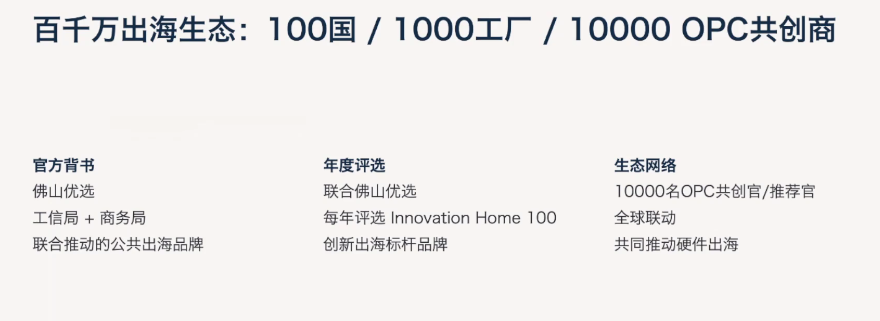
The “Hundred-Thousand-Ten Thousand” Project: 100 Countries, 1,000 Factories, 10,000 OPC Partners
Teacher He Ziyun calls this strategy the “Hundred-Thousand-Ten Thousand Project”: replicating the experience of rooting the U.S. market ecosystem in 99 other countries; connecting 1,000 factories; and cultivating 10,000 OPC co-creation partners.
At its core lies the belief that Chinese merchants hold the world’s most complete pan-home furnishing supply chain, but competition has shifted from “involution” within China to “involution” on the global stage.
During his presentation, he shared a lesson learned from smart toilets: one factory shipped tankless smart toilets at $200 and sold them for $600, only to face massive quality issues months later—many older U.S. homes lack sewer systems, so if a product fails, customers could sue for $100,000 in damages. “A single toilet may only earn fifty or sixty dollars, but ultimately it harms the reputation of the entire Chinese brand.” Products like flooring and furniture from Foshan have previously suffered anti-dumping penalties. Their counter-strategy? Develop $1,200 products with full certifications and built-in tanks to establish a baseline of quality first.
How exactly will this be implemented? He shared several proven pathways: since 2019, they’ve partnered with Dajian Cloud Warehouse to help factories gauge the scale of overseas orders early on; organized overseas buyer delegations—just last month they hosted a 100-person Brazilian purchasing group, and next year plan to invite 24 global buyer groups from Germany, Japan, the U.S., and other regions to visit Foshan and Zhongshan; collaborated with a Sichuan-based full-service design firm to execute a $4 million Las Vegas villa project featuring customizations across all categories, with an entire container shipped directly from the factory to the construction site.
Combining Midea Ruizhu’s practical experience exporting smart curtains, they’ve also developed an AI curtain system that automatically stores solar energy, requires no wiring, and adjusts light tracking and dimming based on local latitude, longitude, and weather data;
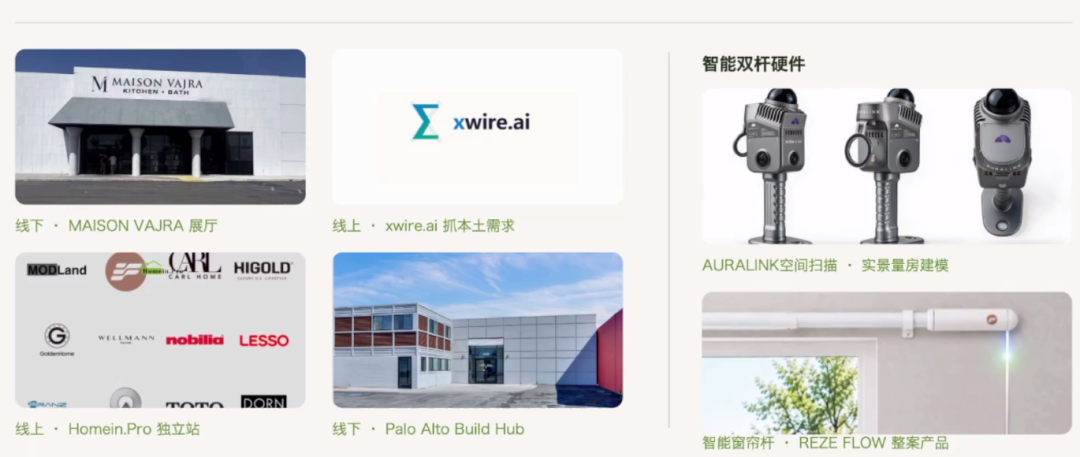
The Next Step: OMO Online-Offline Integration x Smart Dual-Rod Hardware
The two smart rods are quite intuitive—one connects to the Apple ecosystem for whole-house intelligence, while the other performs spatial scanning, enabling overseas builders to complete measurements in 10 minutes and replicate the居然之家 showroom online in 20–30 minutes, allowing overseas customers to decide whether to visit Foshan, Zhongshan, or Dongguan after viewing online.
Interactive Q&A
During the salon’s interactive segment, Teacher He Ziyun addressed several questions of greatest concern to lighting industry professionals.
Question: What conditions should individuals meet to go global? And how should we identify traffic turning points across different regions—Europe, the Americas, Asia, and Australia?
Answer: Language is no longer the biggest barrier; it’s best to truly understand the industry—“peers can communicate and build trust, which enables actual transactions. Many friends who perform well on short videos actually lack industry expertise; clients may feel you’re just directing them here without understanding their needs. Clients don’t want you to pamper them—they want you to understand them.” It’s crucial to thoroughly grasp standards and regulations in different countries, such as cUPC, CEC, and CA117 fire safety certification in the U.S.; he cited an example: an executive vice president of the Digital Trade Association used to be a designer for luxury homes. After accompanying an exhibition company to the Middle East, he secured 200,000 orders on his very first business trip at a trade fair, eventually establishing a local company and accumulating over 30 million in orders within a year or two—when knowledgeable individuals combine local resources and regulatory insights, ecosystem rooting becomes possible.
Question: For lighting enterprises choosing between group vs. individual overseas expansion, what are the differences in cost and risk?
Answer: I’ve tried various approaches, and going solo often carries significantly higher costs and risks. The value of collaboration lies in the four cornerstones of the ecosystem:
First is digital asset accumulation, consolidating pan-home furnishing content online to make Bay Area products easier for customers to find—our clientele are overseas middle-class consumers who prioritize functional and aesthetic value over mere price-performance ratio. Our distribution channels differ from those focused on cost-effectiveness and Walmart-style models; we target Costco, Target, and West Coast channels instead.
Second is channel sharing: once customers buy furniture from us, they’ll return to Zhongshan for lighting.
Third is resource symbiosis: only through collective efforts can we continuously understand customer pain points and improve our products, rather than simply transplanting product-oriented strategies overseas.
Fourth is human-machine collaboration, leveraging AI and efficiency tools to boost overseas expansion effectiveness. I’ve also learned painful lessons from solo ventures: one month, a single container’s rent alone reached 80,000 yuan; disorderly expansion leads to involution, price drops, and inventory devaluation—back when Global Easy Purchase had 10 billion yuan in inventory, 8 billion evaporated; building an independent site and hiring staff myself resulted in at least 1 million yuan in losses—a costly lesson.
Question: When selecting co-creation partners, what capabilities do you value most? Which types of enterprises are worth joining the co-creation system?
Answer: First is customization capability and rapid iteration. We’re somewhat like a “going-global version” of Shein—Shein’s customers show repeat purchase rates, whereas villa and luxury home buyers don’t. Therefore, we mainly partner with four types of channels, which I call the “Four Heavenly Kings”: local designers, builders, interior stylists (stagers), and brokers.
Our vision is a $400,000–$4 million luxury villa turnkey order, packing all categories into a single container shipped directly from the factory to the construction site. We provide factory teams with customer pain point data to ensure products genuinely solve these issues, rather than pursuing volume and competing solely on price-performance ratios. Overall, we seek factories that embrace green practices, intelligence, customization, and modularity.
Question: Within the co-creation system, competitors inevitably exist in the same category—will exclusivity be considered?
Answer: If we avoid focusing on price-performance ratios, opportunities for competitive conflict are rare. The “Hundred-Thousand-Ten Thousand” initiative spans 100 countries, 1,000 factories, and 10,000 OPC partners, implementing country-specific strategies and product-specific management, so clustering within the same category is inherently uncommon. To give a simple example: Procter & Gamble’s shampoo bottles feature three brands—Head & Shoulders, Rejoice, Pantene—are they competitors? Selling functional value, they ultimately converge toward basic infrastructure and market dominance, much like Walmart; yet Sam’s Club and Costco still thrive above it, because emotional and spiritual value will always spawn numerous brands, which can even collaborate with local cultures—for instance, Yinlefen’s apparel line could partner with Harvard, while others might team up with Stanford. For truly premium products, we even recommend acquiring small European brands—there’s a platform listing over 2,000 pan-home furnishing brands, some local companies with only thirty to fifty employees willing to be acquired—taking control of branding and distribution channels is the core asset of any enterprise. Thus, pricing must come first: avoid setting prices too low initially, ensuring sufficient margins for local dealers, channels, advertising, and design expenses.
Final Thoughts
From the evolution of four generations of foreign traders, to digital asset accumulation in the GEO era, and finally to the “Hundred-Thousand-Ten Thousand” OPC co-creation system, Teacher He Ziyun repeatedly emphasized one conviction: the nomadic era of overseas expansion has passed; what lies ahead is intensive cultivation—like farming, carefully managing irrigation, breeding, and planting, seamlessly integrating traditional craftsmanship with cutting-edge AI tools.
Having aspiration matters more than having ability, as he concluded with Yu Minhong’s classic story: besides eagles with wings reaching the pyramid’s summit, there are also snails that “climb slowly but never give up”.
Note: This article is compiled from the recording of Teacher He Ziyun’s November 11, 2026 presentation at Ming Classroom titled “From Product Export to Ecosystem Rooting — How the ‘Hundred-Thousand-Ten Thousand’ Project Helps Zhongshan Lighting Enterprises Build a Global Brand Community,” edited and published by Ming Classroom.
China Light
The official website of the China Association of Lighting Industry and a full-media platform for the lighting sector. We provide authoritative and timely lighting information while striving to be a growth partner for businesses. From brand promotion and channel expansion to consulting, talent training and participation in standards development, we provide comprehensive professional services to help businesses improve quality and efficiency and jointly advance the high-quality development of the lighting industry.
Business Contacts
仇纯 (Ms.): 158 6155 3579
顾君 (Mr.): 137 7157 5253