
MicroLED light‑transmission technology is emerging! ams OSRAM’s analog platform accelerates the design of high‑speed interconnects for AI data centers.
The explosive growth in AI demand has fueled massive investments in data center infrastructure. Whether it’s training cutting-edge large models or running inference workloads to power intelligent agents like ChatGPT and Claude, all require immense computational power.
AI data centers consist of networks connecting processors and storage devices. Currently, most links linking these computing systems rely on copper backplanes and cables. However, data centers today face a common and pressing challenge: both within servers and between them, network bandwidth urgently needs substantial improvement.
Technically speaking, the traditional approach has been to continually increase signal transmission frequencies in copper-based networks. Yet this method is approaching its physical limits: as transmission frequencies rise, per-bit energy consumption, heat generation, and system complexity all increase sharply. Consequently, the industry is actively seeking alternative solutions.
In response, ams OSRAM is developing a microLED-based optical transmission solution for high-bandwidth data transfer in AI data centers. Conventional high-bandwidth optical networks operate on a “fast-and-narrow” model, transmitting data at extremely high rates through a single fiber; by contrast, ams OSRAM adopts a “slow-and-wide” architecture, replacing a single high-speed, high-power laser transmitter with hundreds or even thousands of parallel‑operating microLED emitters.
This microLED array and its drive‑control technology have already been successfully commercialized on ams OSRAM’s EVIYOS™ platform, which is used in automotive lighting. This demonstrates that the company has overcome key challenges in manufacturing and co-packaging high-density microLED emitters with digital control circuits.
However, microLEDs designed for data communication differ significantly from those used in automotive lighting, both in performance specifications and implementation methods. At present, network equipment manufacturers eager to leverage microLEDs for innovation are still awaiting conclusive validation results to confirm how such systems perform under real-world data center operating conditions.
01
Simulation Model: Recreating Real-World Operating Conditions
Link Performance Under Real Conditions
To address this, ams OSRAM has developed a method capable of precisely validating industry‑specific requirements: the company has built a high‑precision system simulation model that can comprehensively evaluate the performance of microLED‑based communication links when driven by actual AI data streams.
ams OSRAM’s system-level model integrates time-domain, frequency-domain, and bit-error-rate simulations. It not only simulates the transmission characteristics of microLEDs, photodiodes, lenses, and various types of optical fibers, but also models transmit equalizers, drivers, receive equalizers, and amplifiers. In other words, this model fully covers all core components of the optoelectronic front end of an AI server’s optical data link.
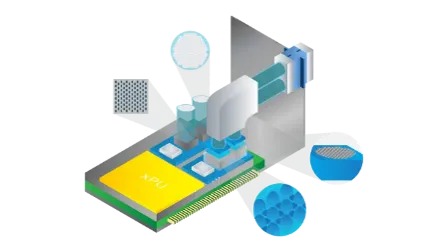
Figure: Balancing High Density and High Bandwidth: A MicroLED-Based Optical Data Transmission System
These device-level models combine measured microLED characteristic parameters with physical behavior models of other components, enabling comprehensive analysis of critical electrical and optical factors—such as microLED radiation distribution, photodiode responsivity, and chromatic dispersion and modal dispersion in optical fibers. On this basis, the simulation model can accurately output key performance indicators (KPIs), including bit error rate, per-bit energy consumption, and signal-to-noise ratio.
Users can flexibly calculate various KPIs based on specified operating conditions and component combinations—for example, the model can intuitively demonstrate how KPIs change when fiber length or type is altered; and when optimizing for a specific bit error rate target, users can also use the model to assess and balance trade-offs between performance and energy consumption.
The reverse-engineering capability is equally applicable: the model can also deduce the precise specification requirements each component in the link must meet, based on particular system optimization goals.
02
Ongoing Expansion: Highly Reliable Simulations
Enabling Precise Solution Validation and Optimization
Currently, the model’s functionality continues to expand, with plans to incorporate simulations of electrical and optical crosstalk between densely packed microLEDs and photodiodes, as well as thermal characteristics of packaged components.
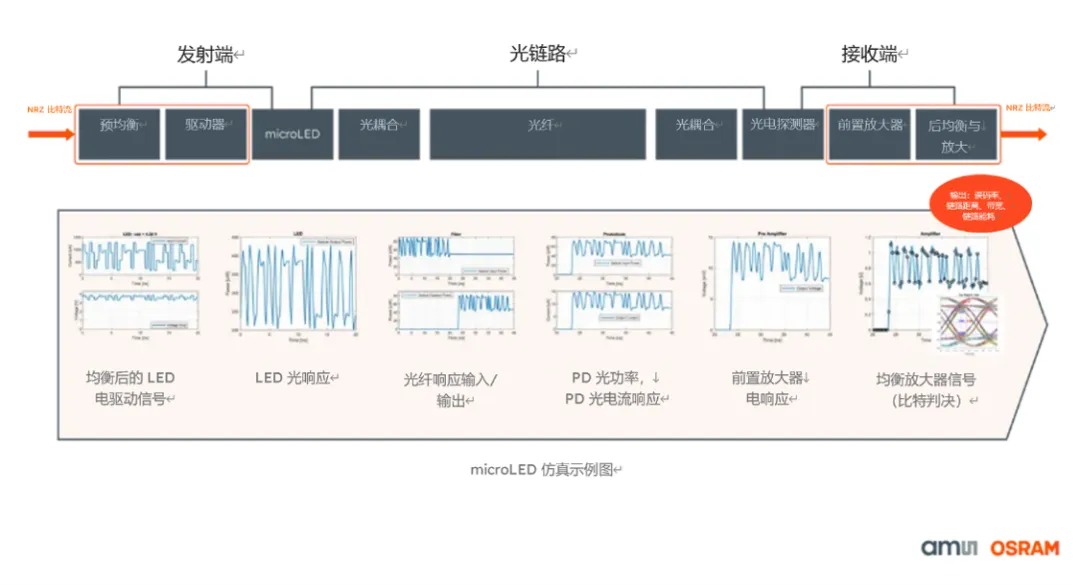
Figure: This simulation model can visually illustrate the system performance of each node along the signal chain.
For potential partners and customers—including network equipment manufacturers—this means that before investing in the design and manufacture of their first microLED‑based data interconnect hardware, they can rely on robust system-level link modeling to conduct precise solution validation and optimization.
With this simulation model, partners can precisely define technical requirements for each independent component in the data link, assess the supply capacity of necessary parts, and thoroughly verify the feasibility of the overall system design.
Source: ams OSRAM