
CCTV has exposed irregularities in the CCC certification of lighting products in Zhongshan, Guangdong—industry-wide scrutiny is truly upon us.
Hello everyone! On September 13, CCTV News exposed a major issue. The National Quality Inspection Team conducted an unannounced inspection in Zhongshan, Guangdong. During their undercover visit to several retail outlets—including Global, Ruifeng, and Qingfeng Lighting Accessories City—inspectors found numerous LED ceiling lights bearing certificates of conformity, yet lacking both the company name and address on their labels. Some LED office lamps bore the CCC mark but could not be matched to any specific model. What did the sales staff say? In their own words: “The certificate isn’t tied to a particular model—it’s a generic, one-size-fits-all certification.”
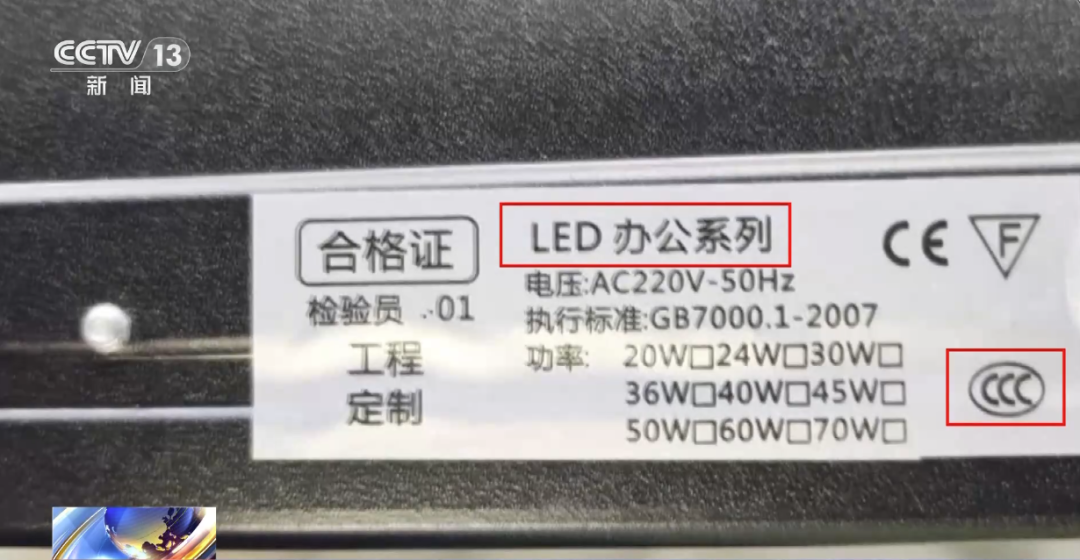
(Image source: CCTV News official account)
In the Yihu Lighting Processing Shop in Guzhen Town, inspectors opened 27 boxes of eye‑protective classroom lamps, all marked with the CCC logo, yet unable to produce valid certificates. The labels, certificates of conformity, and outer packaging all lacked the manufacturer’s name and address—classic “three‑no” products. At the scene, they also discovered 11 boxes of LED panel lights, each labeled with two different companies; one of them, “Zhongshan Heyi Lighting Fixture Factory,” turned out to be nonexistent—the company information was entirely fabricated.
The situation at the production end was even more alarming. Guangdong Yixun Lighting Co., Ltd., whose CCC certificate had already been revoked, continued mass‑producing and stockpiling finished goods in its workshop. Subsequent random inspections revealed that 18 out of 19 batches were non‑compliant, totaling 1,430 defective items. Despite the revocation of the certificate, production never stopped, and shipments kept rolling out.
Inspection experts put it bluntly: companies deliberately conceal their names and addresses to sever the traceability chain, evading liability for compensation and regulatory oversight after accidents. When lighting fixtures directly connect to 220 volts without valid certifications entering the market, it constitutes a violation of the law.
Today, Lao Hong would like to highlight three key points.
First, the ways businesses circumvent regulations are far more varied than you might imagine.
This time, the main violations fall into three categories:
Category 1 is “certificate substitution”—where Company A obtains a certificate, and Company B simply affixes it to its products, or where a single certificate covers multiple models that look similar but differ internally in critical components. However, the strict rule of CCC certification is “one certificate per product”: if the driver power supply, light source board, or insulating parts change, a new application is required. The CCC mark stamped on the exterior of such substituted products is, in essence, nothing more than an invalid printed label.
Category 2 is “revoked certificates, continued production.” Once a certificate is revoked due to failing random inspections, some manufacturers ignore the regulation and continue operations under new packaging and altered brand names.
Category 3 is “fake or borrowed certificates.” Traders use genuine certificate numbers while producing products whose model numbers, manufacturing facilities, and key components do not match. This “dual‑identity” phenomenon has already surfaced in public procurement projects and school purchases. Where does the loophole lie? Buyers often rely solely on photocopies of certificates, neglecting to verify certificate status, manufacturer details, and specific model numbers through official platforms.
Second, what lies at the root of this problem? Price wars driven by cutthroat competition have squeezed compliance out of the market.
A standard CCC certificate—from application and factory inspection to final approval—typically takes several months and comes with significant costs. When price competition reaches extreme levels, many small and medium‑sized enterprises begin treating compliance as an optional add‑on rather than a mandatory requirement.
But friends, where does this path ultimately lead? It results in “bad money driving out good.” Those who play by the rules face higher costs, while those cutting corners gain a temporary competitive edge. In the end, the entire industry ends up bearing the blame—and losing consumer trust.
Third, the winds have shifted completely, and a major compliance test has begun.
Starting January 1, 2026, the new GB/T 7000.1‑2023 safety standard for luminaires will become mandatory, requiring all existing certificates to transition to the updated version by the end of 2026 at the latest. On December 1, 2026, the “Key Industrial Products List for Online Sales” will take effect, mandating that online retailers selling lighting products also hold valid certificates. Regulatory oversight is expanding from offline to online, and certificate management is evolving from static to dynamic.
In 2025, the State Administration for Market Regulation conducted a spot check on the validity of CCC certificates, revoking 79 certificates—43 related to recessed luminaires, 25 fixed‑type fixtures, and 11 portable units. These figures corroborate findings from the Zhongshan undercover investigation: recessed lights, panel lights, and classroom lamps represent high‑risk areas where certificate‑product mismatches frequently occur, making channel verification a top priority.
Finally, Lao Hong wishes to emphasize: this CCTV exposé is not just about one company—it’s a comprehensive test for the entire industry. Small and medium‑sized manufacturers long reliant on “generic certificates” now face their toughest challenge, while those committed to compliance stand to gain real advantages amid regulatory reshuffling.
Operating in full compliance and safeguarding quality standards is the true starting point for sustainable, high‑quality development. When price wars drive prices below all reasonable limits, everyone loses. And when bad practices crowd out good ones, it’s not just individual companies that suffer—it’s the dignity of the entire industry.
Follow Lao Hong’s insights on lighting to illuminate your journey ahead.
About the author, Hong Bing:
Hong Bing currently serves as the Editor-in-Chief of China Light Network and Agricultural Lighting Network—the official websites of the China Illuminating Electrical Appliances Association—as well as Executive Dean of Ming Classroom. He also holds positions as Deputy Director of the Talent Training Committee of the China Illuminating Electrical Appliances Association, Secretary-General of the Agricultural Lighting Professional Committee of the same association, Secretary-General of the Lighting Alumni Association of Fudan University, and a Board Member of the Ecological Environment Alumni Association of CEIBS. He graduated from the Department of Light Sources and Lighting Engineering at Fudan University in 1991 and earned an MBA from CEIBS in 2003. Over the years, he has worked in R&D, product planning, and marketing at institutions including the China Building Materials Academy, Panasonic, GE, and OSRAM. In 2008, he received Siemens’ Global Top Plus Award and Siemens’ China Excellence Performance Award, and in 2009 founded China Light Network.
For more exciting content, please follow our official WeChat and video channels.
“Lao Hong on Lighting”
China Light
The official website of the China Association of Lighting Industry and a full-media platform for the lighting sector. We provide authoritative and timely lighting information while striving to be a growth partner for businesses. From brand promotion and channel expansion to consulting, talent training and participation in standards development, we provide comprehensive professional services to help businesses improve quality and efficiency and jointly advance the high-quality development of the lighting industry.
Business Contacts
仇纯 (Ms.): 158 6155 3579
顾君 (Mr.): 137 7157 5253