
From Performer to Creative Commander: A Guide to Upgrading the Skills of Lighting Designers in the AI Era
Highlights from the Latest Lighting Design AI Tools Salon
AI Tools Meet Lighting: A New Synergy
On February 10, 2026, the Guzhen Lighting Expo, in collaboration with China Light Network’s “Ming Classroom,” hosted the “Mingren Online” series. The event featured a captivating presentation by Mr. Gu Wenyi, an illumination designer at Difei Hotel Design Consulting (Shanghai), who brings 20 years of experience in lighting design and has contributed to multiple national lighting standard revisions. The session was moderated by Mr. Hong Bing of China Light Network.
Host: Hong Bing
AI Tool Evolution: From the “Classic Trio” to the Disruptive “Banana Ecosystem”
In this salon, Mr. Gu Wenyi focused on the groundbreaking advances AI has made in lighting design over the past year. He introduced the next-generation AI tool ecosystem centered around Nano Banana—commonly referred to as the “Banana”—a derivative of Google Gemini, along with a clear roadmap for how lighting designers can upgrade their skills in the age of AI.
Guest Speaker: Gu Wenyi
Mr. Gu noted that just one year ago, lighting designers’ AI toolkit was still stuck at the classic “GPT + Midjourney + Stable Diffusion” trio. However, by late 2025, Google’s Gemini model had launched the Nano Banana series, fundamentally reshaping the industry’s toolset logic.
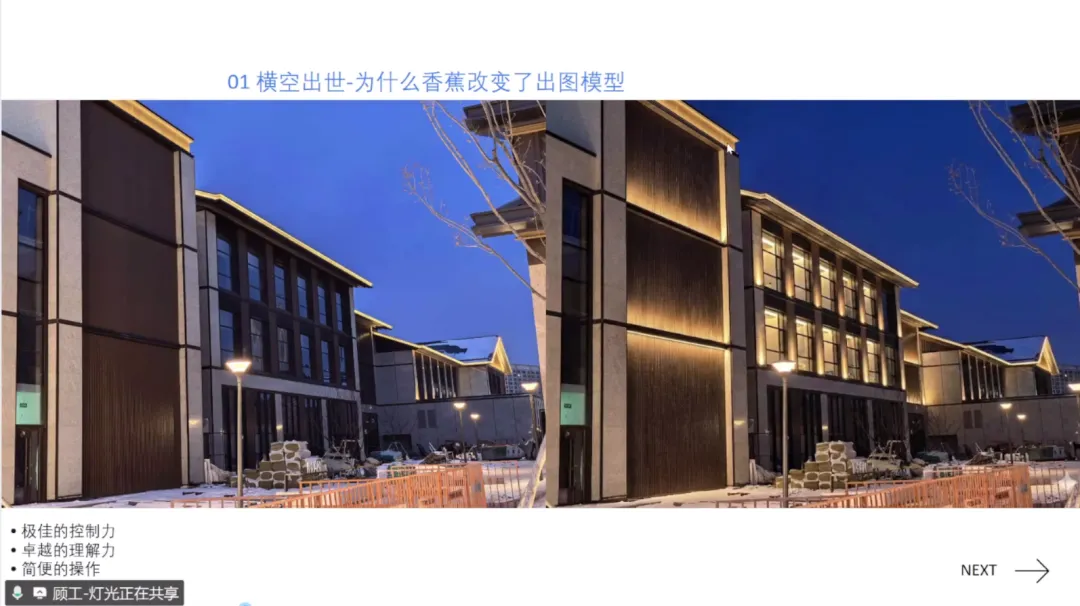
The Three Core Advantages of Banana
1. Exceptional Controllability
Unlike traditional AI-generated tools that often suffer from logical inconsistencies, Banana precisely understands architectural structures and lighting requirements. For example, when asked to create a scene where “wood-grain grilles on the left serve as wash lights, while glass curtain walls on the right provide wall‑mounted uplighting,” the resulting renderings not only feature coherent light-and-shadow dynamics but also autonomously incorporate appropriate aluminum panel lighting systems, while avoiding misprocessing areas without grilles. Its ability to interpret building structures far surpasses similar tools.
2. Superior Spatial Understanding
Banana first constructs a three-dimensional space before generating visuals, rather than simply stitching together images. For the same multi-functional space, it clearly distinguishes between variable zones and fixed structural elements. When producing lighting effects for different functional scenarios, fixed components like walls and ceilings remain highly consistent, ensuring spatial stability sufficient to meet commercial demands.
3. Extremely Low Operational Barrier
With its purely natural-language interaction interface, Banana eliminates the complex parameter-tuning processes typical of conventional tools. Tasks such as transitioning from day to night scenes or adding interior translucency effects can be accomplished through simple descriptions, yielding usable assets that, combined with basic Photoshop skills, dramatically boost productivity.
However, Mr. Gu also pointed out that Banana currently lags behind Midjourney in aesthetic creativity, with noticeable shortcomings in the artistic quality of generated characters and scenes. Therefore, Midjourney remains the preferred choice for creative output, whereas Banana excels in engineering‑driven, logically structured design implementation.
A Mature Workflow Around Banana
Today, the industry has established a complete tool system based on “basic generation + modular expansion”:
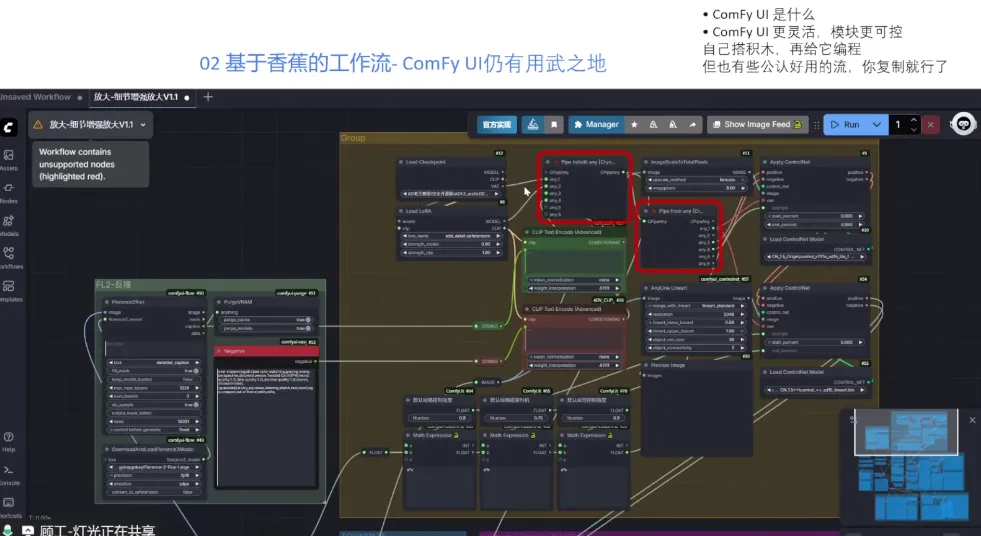
◆ ComfyUI Modular Workflow: Compared to the traditional Stable Diffusion WebUI, ComfyUI resembles a customizable “building-block” toolchain, supporting the invocation of multiple models in combination. Ordinary designers need not develop workflows themselves; they can directly reuse mature pipelines via platforms like Running Hub. The computational cost per single rendering is only about 0.3–0.5 yuan, and batch processing can bring the cost down to as low as 0.1–0.2 yuan per image.
◆ Full‑Process Capability Coverage: From initial prompt engineering and reference image input, through Banana’s generation of 2K base renders, to high‑resolution enhancement modules that refine curtain‑wall lines and optimize interior translucency details, followed by targeted Lora model fine-tuning and Chinese‑language label generation (using Qwen large models to avoid Chinese typos)—this workflow fully covers the entire process from rough sketches to commercial-ready images.
◆ Rise of One‑Stop Platforms: Integrated platforms like LoveArt have already enabled one‑stop operations for invoking Banana, performing high‑resolution enhancements, localized redrawing, and intelligent element editing. For instance, when applying logos to generated renderings, these platforms can automatically detect and adjust angles of building façades, eliminating the need for complicated Photoshop work and significantly lowering the technical barrier for entry-level design tasks.
Industry Trends: Upgrading Designer Skill Sets Amid AI Reconfiguration
Mr. Gu emphasized that the widespread adoption of AI tools has not diminished the value of designers; instead, it has raised the bar for their overall capabilities. The industry is shifting from being a “specialized screwdriver” to becoming a “versatile all‑purpose screwdriver.”
1. Lower Technical Barriers, Higher Value of Comprehensive Skills
AI has brought the technical thresholds for drawing, modeling, and other tasks down to unprecedented lows. Designers who once held advantages solely based on mastering a single specialized skill are now seeing their edge erode. In the future, designers with strong interdisciplinary generalist abilities will be more competitive: those who understand fundamental design standards, grasp client needs, tell compelling stories, make sound aesthetic judgments, and coordinate resources across various tools and stages.
Just as the boundaries between “front-end/back-end/product” roles in the internet industry are blurring, the lighting sector is also moving toward a task‑based working model: AI handles routine execution tasks, while designers focus on decomposing client requirements, coordinating resources, making strategic decisions, and—most importantly—cultivating empathetic communication with clients.
2. Decline of Renderings, Emotional Value Becomes Core Competitiveness
As AI‑generated renderings become increasingly prevalent, mere visual beauty alone is no longer enough to impress clients. Citing insights from a veteran video design studio, Mr. Gu remarked, “Renderings may fade, but audiovisual content will endure.” Future design presentations are shifting from static images to dynamic, story‑driven narratives:
◆ One architect used a single architectural drawing, leveraging AI to generate animated storyboards that narrated a couple’s journey from meeting to walking down the aisle and touring the entire project—winning over the client;
◆ In a home‑design proposal, incorporating a pet character into the animation—a simple detail of a cat leaping back and forth—was enough to seal the deal.
While AI can produce beautifully rendered frames, questions like why this particular frame is chosen, how to pace a 30‑second video, or how to evoke emotional responses through content—all these storytelling and memory‑building skills—are core competencies that AI cannot replicate.
3. Hybrid “AI + Handcraft” Workflows Become Standard
Mr. Gu cautioned against relying entirely on AI or rejecting it outright. Instead, mature designers should adopt a hybrid workflow of “AI‑assisted efficiency plus manual calibration”:
◆ AI takes on 80% of repetitive, foundational tasks, such as generating initial drafts, handling interior translucency, and producing batches of images;
◆ Designers retain control over 20% of critical steps, including decision‑making, aesthetic curation, detailed refinements, and manual adjustments for elements that don’t comply with design standards.
◆ Every designer should master basic tool operation—not needing to become a Photoshop expert—but at least understanding the logic behind each step and knowing how to correct AI‑generated errors; otherwise, they risk getting stuck at some stage.
Interactive Q&A Session
Practical Questions About AI Tools That Concern the Industry Most
During the salon’s interactive segment, Mr. Gu provided detailed answers to audience questions regarding practical applications:
Q: Is there any AI software capable of presenting dynamic renderings to clients?
A: Current workflows can easily achieve this: For architectural designs, using Banana to generate multiple perspectives from block diagrams; for lighting projects, starting with a base architectural map, extracting around ten satisfactory static images, then creating animated storyboards from these, and finally stringing them together with video tools to produce dynamic effects. The same logic applies to interior design: show AI a site plan to grasp the overall space, then generate content from different angles. With a bit of trial and error—and plenty of practice—you can usually meet your needs. Many well‑established prompt tutorials are available on Xiaohongshu for reference.
Q: Roughly how much would it cost to produce a 10‑second dynamic rendering?
A: If it’s just illustrative content, Banana can generate ten satisfying images and ten storyboards, plus the cost of video production—totaling just a few yuan. For commercial projects requiring higher precision, costs will naturally rise, but we recommend avoiding repeated iterations and instead using Photoshop to refine unsatisfactory parts—it’s more efficient and cost‑effective.
Q: What’s your take on Seedance 2.0—the latest video‑generation model from DouBao?
A: While AI video tools can indeed produce stunning visuals, perfectly suitable for personal enjoyment or open‑ended creative projects, lighting design faces numerous constraints related to architectural structure and regulatory requirements. Thus, the true value lies not in how beautiful the visuals are, but in what story you want to tell through the video. The workflow remains universal: AI writes the script → creates storyboards → generates visuals → produces the final video—ultimately, the outcome depends on the designer’s aesthetic sensibilities and storytelling prowess.
Q: How does Banana’s rendering compare to traditional 3D rendering in terms of light source angles and material fidelity?
A: Banana’s biggest strengths are speed and low cost, making it especially ideal for early project phases—before contracts are signed—when there’s no need to spend extensive time building models or setting up lighting setups. It quickly generates results to guide clients. Of course, in terms of professional precision, it can’t match traditional tools like 3DMAX or D5; while its light-and-shadow logic is generally sound, it often introduces unnecessary fixtures or minor detail errors. Therefore, we typically use Banana for initial drafts, select promising directions, and then refine details with Photoshop or import traditional tools for precise adjustments—combining both approaches yields the highest efficiency.
Q: For designers new to AI tools, which features should they start with? Any tips for avoiding pitfalls?
A: The most practical introductory feature is “day-to-night transition.” Banana’s internal translucency, sky, and background elements are already quite polished, saving substantial time on preliminary groundwork. Another frequently used function is high‑resolution enhancement, along with generating reference schematics. As for avoiding pitfalls, if you’re using Banana directly, ensure a stable, reliable internet connection. If that feels cumbersome, consider domestic integrated platforms like LoveArt, paying per use—try several tools to find the workflow best suited to your needs. Trial-and-error costs are minimal; even losing a dozen yuan won’t hurt—you’ll soon get the hang of it.
Q: Looking ahead, what direction will AI take in lighting design? And how can designers balance AI usage with nurturing their own creativity?
A: Today, AI’s creative capacity is already very strong. You can ask GPT or DouBao to generate twenty ideas at once, so the designer’s core competency is no longer “coming up with ideas,” but rather “selecting the right ones”: judging which concepts align with the project’s positioning, which will resonate with clients, and which can be implemented without issues. This decision-making ability hinges on your aesthetic sensibilities, understanding of client needs, and ability to manage project risks. AI provides you with more options; your job is to elevate the quality of your decisions, rather than getting lost in the mechanics of tool operation.
Q: Do you have any real‑world examples of how Banana has helped turn vague client requirements into precise solutions?
A: I worked on a hotel project where I initially developed a “sailboat” themed concept based on architectural documentation. But the client told me their narrative was actually about “egrets.” So I fed Banana the egret imagery provided by the client, clearly articulated my requirements, and it promptly generated a lighting scheme and storyline incorporating egret motifs. After a quick text adjustment, the result was ready to use. I then employed LoveArt to correct any textual errors, and the finished image could be directly inserted into the presentation. The entire process took less than an hour—whereas doing it manually from scratch would have taken at least two to three days. If I needed to present this solution tomorrow, the efficiency gain would be obvious.
Note: This article is compiled from the recording of Mr. Gu Wenyi’s February 10, 2026, presentation titled “Introduction to the Latest AI Tools in Lighting Design” at Ming Classroom, organized and published by Ming Classroom.
China Light
The official website of the China Association of Lighting Industry and a full-media platform for the lighting sector. We provide authoritative and timely lighting information while striving to be a growth partner for businesses. From brand promotion and channel expansion to consulting, talent training and participation in standards development, we provide comprehensive professional services to help businesses improve quality and efficiency and jointly advance the high-quality development of the lighting industry.
Business Contacts
仇纯 (Ms.): 158 6155 3579
顾君 (Mr.): 137 7157 5253