
Holiday Review: What’s the Lighting Industry Up to for the 2026 National Day and Mid-Autumn Festival?
The long holiday has come to an end, and as usual this Mid-Autumn Festival and National Day, Nightscape / Landscape lighting across the country has entered “holiday mode.”
In Shanghai, the lighting hours along the core areas of the Huangpu River have been extended until 11 p.m., with media architecture facades such as the Zendai Building, Shanghai Tower, and the Pudong Art Museum cyclically displaying National Day–themed visuals.
In Tianjin, key scenic spots along the Haihe River—including Jinwan Square, the Century Clock, the “Eye of Tianjin,” and the Tianjin TV Tower—have unveiled custom National Day lighting featuring a dynamic interplay of “China Red” and “Gilded Yellow.”
Changzhou has staged National Day–themed light shows at landmarks like the East Longitude 120 Scenic Tower, the Xiyinli City Gate, and the Cultural Plaza.
Hangzhou, Weihai, and other cities have also rolled out their own special arrangements.
Besides the longstanding tradition of urban Nightscape / Landscape lighting, this year’s holiday period has seen two noteworthy light‑and‑shadow projects that deserve close attention from the industry.
First is drone light shows, which have reached new heights in both scale and reach.
In Tongcheng, Hubei, 800 drones danced in formation alongside a biomimetic dragon; in Guilin, 2,000 drones painted Elephant Trunk Hill against the backdrop of the Li River; and similar spectacles unfolded in Jiujiang, Zaoyang, Kunming’s Dianchi Lake, and more. Among them, Yichang delivered the most breathtaking display: 5,000 drones illuminated the Three Gorges for four consecutive nights, drawing over 200,000 spectators on a single evening. The iconic scene of “Yangtze River dolphins leaping” went viral across the internet, with related topics garnering over 35 million views and short videos racking up roughly 220 million plays.
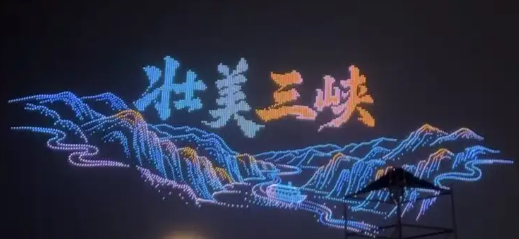
Yichang drone show (Image source: Sina)
It’s rare for a city’s light‑and‑shadow performance to spark spontaneous online discussion and secondary creations on such a massive scale. As the stage of light and shadow rises from the ground to thousands of meters above, the convergence of lighting with the low‑altitude economy and urban communication is opening up a previously unseen pathway.
Second, AI has truly stepped onto the light‑and‑shadow stage.
In late September, Signify brought a generative AI agent into the “VOIDSPACE” installation at the Shanghai International Light Festival. Visitors need not operate any dimming interfaces—simply express their emotions via a mini‑program, and the AI will compute in real time, using dynamic lighting effects to mirror their inner state.
In the past, creating emotionally layered light shows required professionals to painstakingly set parameters and write code for each element. Now, natural language and even emotions themselves can serve as “modes of dimming,” with the system translating them into a “light recipe” that drives real‑time illumination.
For landscape lighting and nighttime cultural tourism, this represents a profound shift in creative methodology—one that lowers the barrier to professional light design and makes “real‑time dialogue between people and light” a reality.
Examining the National Day examples reveals several tangible shifts within the industry.
Away from flashy buzzwords, these concrete implementations during this year’s National Day point to several visible trends shaping the lighting sector.
First, refined light control is replacing crude, indiscriminate lighting. With increasingly stringent regulations addressing light pollution, cultural heritage preservation, and green energy efficiency, the old approach of “the brighter, the better” and “stacking luminaires” is being phased out. Zone‑based, time‑specific dimming and precise light management are becoming essential requirements for high‑end projects.
Second, AI is evolving from “automatic execution” to “content generation.” Traditional AI‑driven lighting—scheduled on/off, fine‑tuned according to ambient conditions, or linked to fixed programs—is now standard practice, offering little competitive edge. The significance of this year’s Shanghai project lies in AI’s first appearance as a “real‑time creative tool,” shifting intelligent lighting from “passive maintenance” to “proactive creation.” This capability will become a key differentiator for next‑generation high‑end cultural tourism projects.
Third, light and shadow are moving from “beautiful to look at” toward “useful and functional.” Lighting is no longer merely an atmospheric embellishment—it actively empowers nighttime tourism economies, public‑space interactions, and urban cultural expression. The booming nighttime tours across the country during this year’s National Day are a vivid illustration of how “light” meets demand and creates value.
Fourth, integrated hardware‑software solutions are becoming mainstream. With lighting hardware, smart control systems, and creative content tightly interconnected, relying solely on “selling lights” or “doing engineering” is becoming increasingly difficult. Teams capable of delivering holistic solutions will enjoy a distinct advantage.
China Light
The official website of the China Association of Lighting Industry and a full-media platform for the lighting sector. We provide authoritative and timely lighting information while striving to be a growth partner for businesses. From brand promotion and channel expansion to consulting, talent training and participation in standards development, we provide comprehensive professional services to help businesses improve quality and efficiency and jointly advance the high-quality development of the lighting industry.
Business Contacts
仇纯 (Ms.): 158 6155 3579
顾君 (Mr.): 137 7157 5253