
杭州照明运维盘子放大,隧道灯具标准改为三级准入
A 15-year street lighting management contract worth RMB 134 million was signed for a street in Ningwei, Xiaoshan; another RMB 449 million project is pending in Binjiang, while a RMB 134 million maintenance tender for the main urban area opened on November 30. At the same time, the national standard for tunnel lighting fixtures came into effect, classifying luminous efficacy into three tiers: Tier A at 155 lm/W. Jucan plans to invest RMB 1.5 billion from its recent private placement into red and yellow light products.
01 This Issue’s Headline
Market: RMB 134 Million 15-Year Management Contract Signed for a Street in Ningwei, Expanding Hangzhou’s Lighting Operation & Maintenance Portfolio
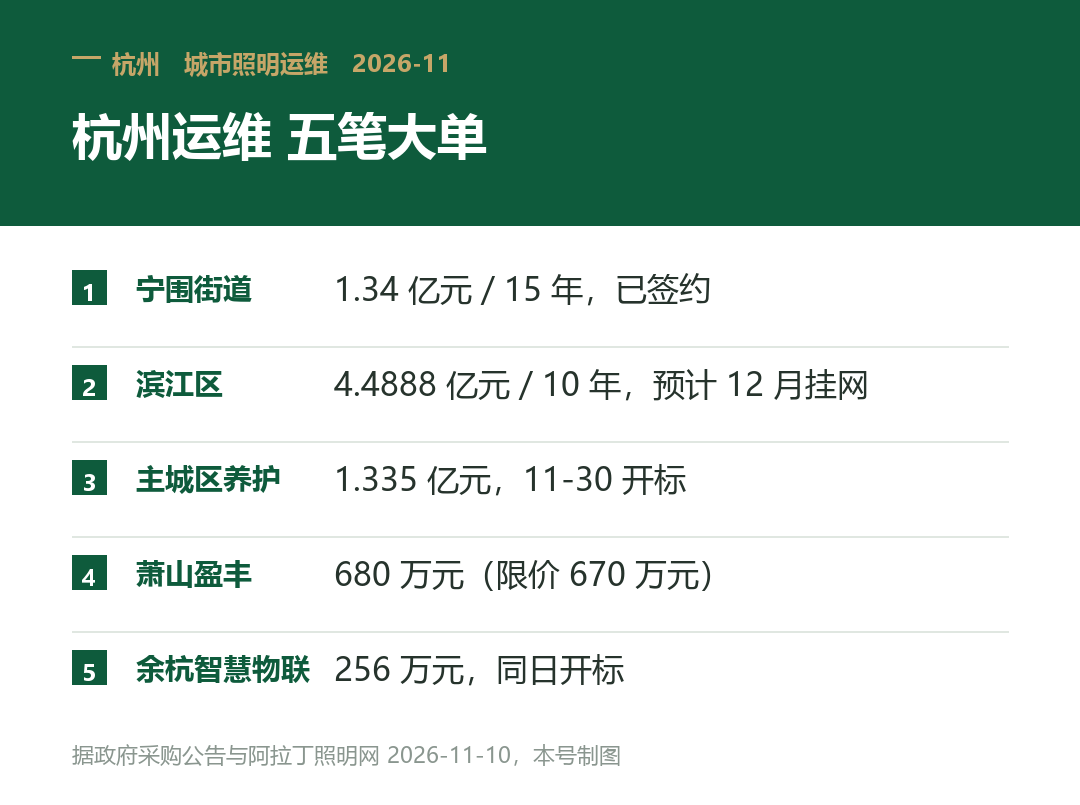
A consortium comprising Zhejiang Guannan Energy Technology Co., Ltd. and Hangshi Guannan Smart Energy (Hangzhou) Co., Ltd. won the bid for the comprehensive energy-cost management and full-lifecycle operation & maintenance integration project of all streetlights in Ningwei Subdistrict, Xiaoshan District. The contract value is RMB 134 million with a service period of 15 years, awarded by the Ningwei Subdistrict Office. Aladdin Lighting Network disclosed this result on November 10.
The model combines “management + operation & maintenance”: both electricity expenses and O&M services are undertaken together, enabling the subdistrict to complete energy-saving retrofits of existing streetlights without any upfront investment. On the operational side, a digital platform facilitates AI inspections, energy consumption monitoring, smart work orders, and dynamic dimming, controlling energy use through “one strategy per road, demand-based dimming.” Hangshi Group is the first municipally-owned state enterprise in Hangzhou to enter the Fortune Global 500, ranking 419th in 2026. Guannan Energy has previously implemented over 30 energy performance contracting projects, retrofitting more than 600,000 streetlights cumulatively.
Several other contracts are currently underway during the same period: a RMB 448.88 million, 10-year energy-saving renovation and energy management project for urban lighting facilities in Binjiang District, expected to be posted online in December; a RMB 133.5 million tender for main urban area streetlight maintenance (2027–2029), opening at 9:30 AM on November 30; and simultaneously, a RMB 6.8 million tender in Yingfeng Subdistrict, Xiaoshan (with a price cap of RMB 6.7 million) and a RMB 2.56 million tender for smart IoT upgrades to urban lighting facilities in Yuhang District.
Judgment
The fact that a single subdistrict can secure a 15-year, over-RMB 100-million contract indicates that managed services are no longer experimental but have become routine procurement for subdistricts. Combined, the Ningwei, Binjiang, and main urban area contracts exceed RMB 700 million. There are three practical paths forward: entering supplier databases via platforms, acting as subcontractors under local lead firms, or supplying only luminaires and controllers. The first two require early engagement—once Binjiang’s RMB 449 million announcement was released, the negotiation window closed immediately.
02 Policies & Standards
National Standard for Tunnel Lighting Fixtures Takes Effect on November 1: Luminous Efficacy Divided into Three Tiers, with Tier A at 155 lm/W
The “Performance Specification for LED Tunnel Lighting Fixtures” (GB/T 32481—2026) came into force on November 1, replacing GB/T 32481—2016. Issued on April 30, 2026, it falls under the purview of the SAC/TC 224 National Lighting Appliance Standardization Technical Committee. Drafting organizations include Zhejiang Sunshine Lighting and Hangzhou Huapu Yongming, two Zhejiang-based enterprises.
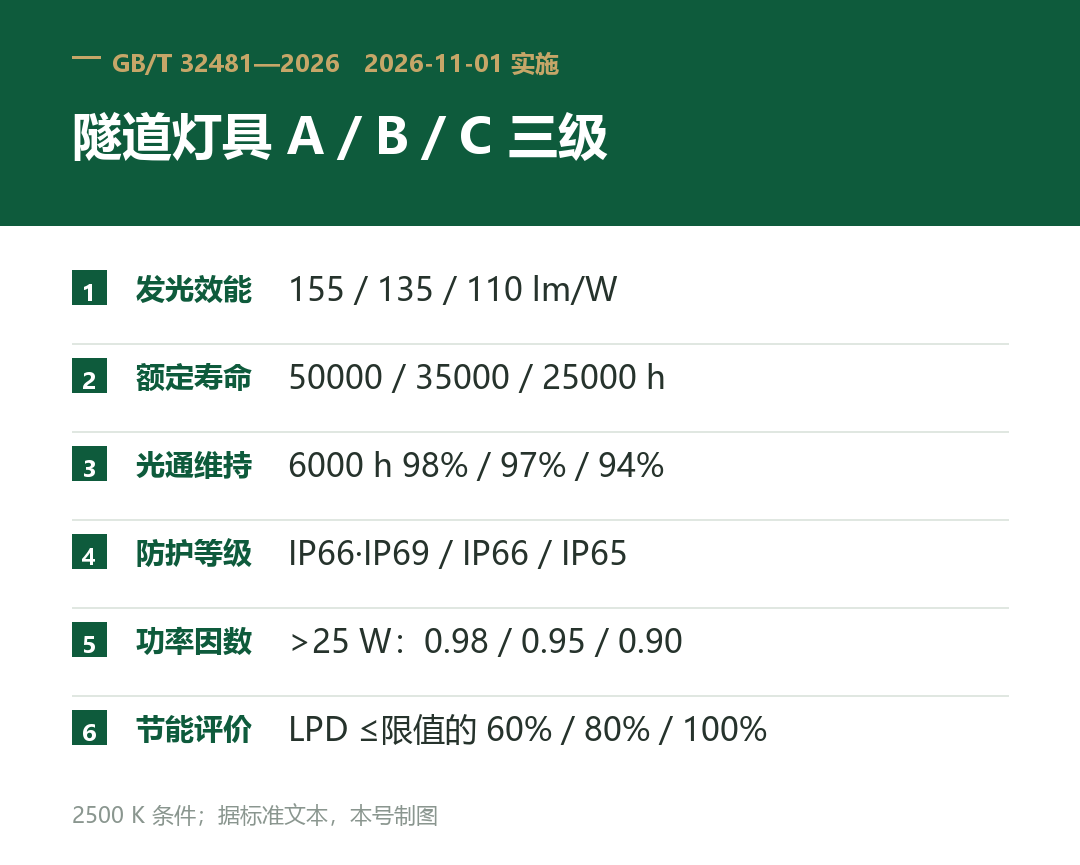
Unlike the classroom and road standards that also took effect at the end of October, this version first categorizes luminaires into Type A and Type B based on whether their LED modules explicitly comply with GB/T 24823—2024; Type A may undergo reduced testing for certain items. Performance is further divided into three tiers: A, B, and C. Under 2500K conditions, luminous efficacies are 155, 135, and 110 lm/W respectively; rated lifespans are 50,000, 35,000, and 25,000 hours; lumen maintenance after 6000 hours is 98%, 97%, and 94%; Ingress protection ratings are IP66/IP69, IP66, and IP65; corrosion resistance grades are WF1, W, and W; and when power exceeds 25W, power factor must not be lower than 0.98, 0.95, or 0.9. Efficacy values for other color temperature ranges are specified separately, with Table 4 of the original standard serving as the authoritative reference.
Judgment
Tunnels represent one of the few engineering lighting segments still experiencing volume growth in recent years. Following tiered classification, simply stating “compliant with GB/T 32481” in tender documents is insufficient; specifying either Tier A or Tier C becomes mandatory. Price differentials between the two tiers, coupled with variations in protection levels and salt-spray exposure durations, will first become apparent during evaluation for tunnel and underpass projects.
Policies: MIIT Publishes 46 Recommended National Standard Proposals, Including “Technical Requirements for Consumer Photovoltaic Lighting Products”
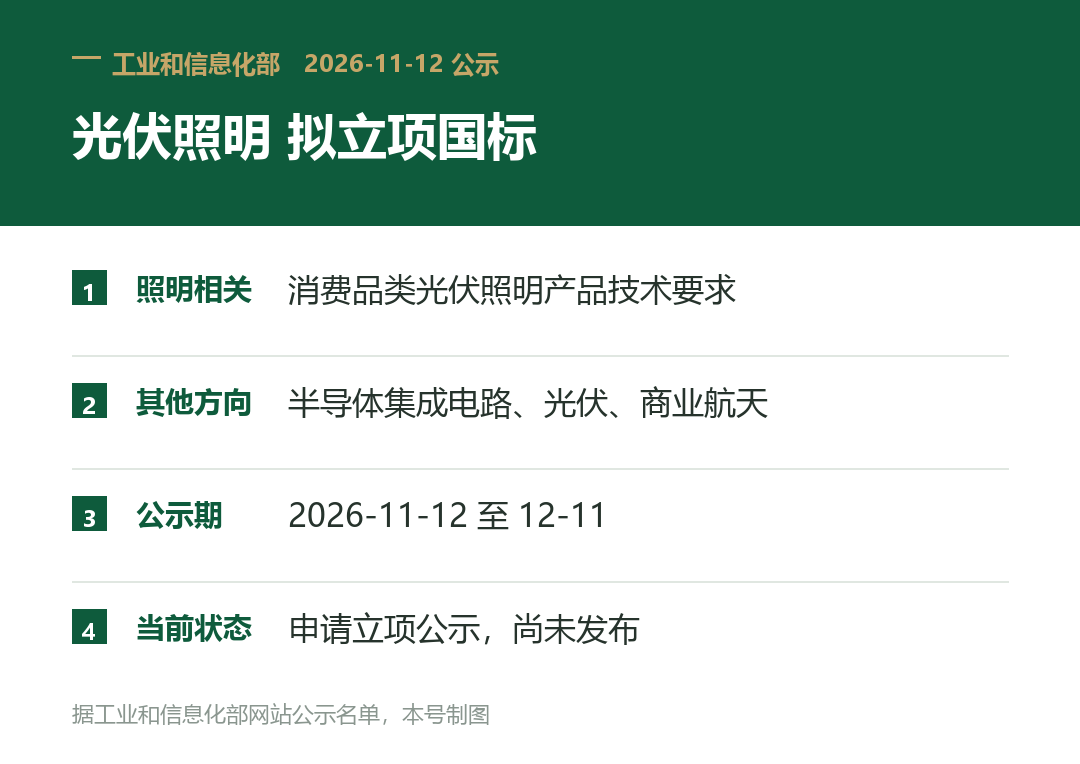
On November 12, the Ministry of Industry and Information Technology published a list of 46 proposed recommended national standards open for public comment until December 11. Directly relevant to lighting is the “Technical Requirements for Consumer Photovoltaic Lighting Products”; other included proposals cover “Test Methods for Semiconductor Integrated Circuit Fusion Vision Sensors” and “Technical Specifications for Photovoltaic Glass Covers Used in Commercial Space Applications,” among others.
Previously, photovoltaic lighting lacked unified technical requirements. Product forms vary widely, from garden lights to integrated solar luminaires, leading tenders to rely heavily on self-reported manufacturer parameters while acceptance testing lacks clear reference clauses. Although formal approval remains some distance away, stakeholders can submit feedback to the standards committee during the public comment period.
Judgment
Approval does not equal publication. The challenge with photovoltaic lighting lies in its fragmented product landscape; a single universal requirement may fail to adequately address both garden lights and integrated streetlights. Should a national standard eventually emerge, the initial beneficiaries may not be major manufacturers but rather reputable suppliers who have long been edged out by low-price bidders in tenders.
03 Technology & Industry
Technology: Jucan Allocates RMB 1.5 Billion Private Placement to Red and Yellow Light, Upstream Price Hikes Coincide with Expansion Plans
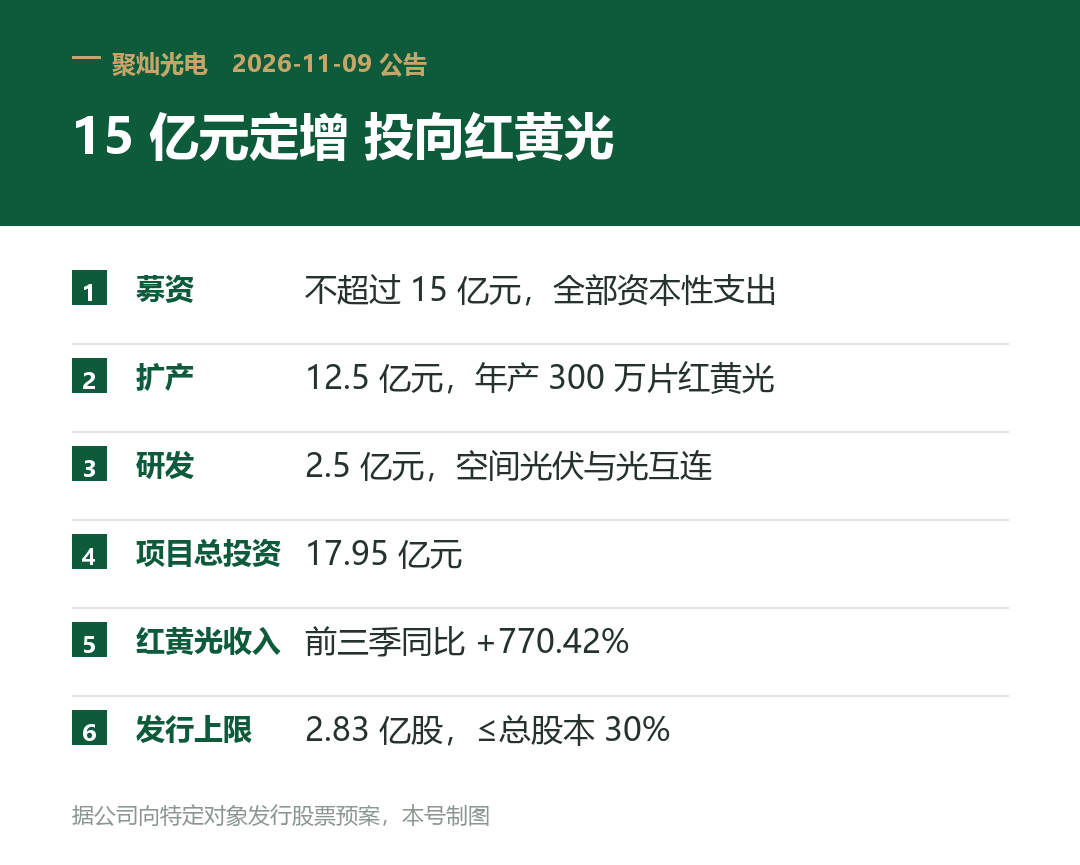
Jucan Optoelectronics disclosed on the evening of November 9 its plan to issue shares to specific investors in 2026, aiming to raise no more than RMB 1.5 billion entirely for capital expenditures. Of this, RMB 1.25 billion will fund an expansion and upgrade project producing 3 million high-performance red and yellow light epitaxial wafers and chips annually at its existing Suqian facility; RMB 250 million will establish a research and development center focusing on GaAs-based space photovoltaics and Micro LED optical interconnect chips. Total investment across both projects amounts to RMB 1.795 billion. The issuance cap is set at 283 million shares, not exceeding 30% of pre-issuance total share capital.
The company reported Q3 main business revenue of RMB 1.221 billion, up 20.58% year-on-year, with Q3 revenue reaching a record quarterly high of RMB 437 million. By product category, gallium nitride-based blue-green light grew by 8.20%, while gallium arsenide-based red and yellow light surged by 770.42%. Silver-mirror flip-chip products boast reflectance exceeding 97% and sell for 1.5 times the price of conventional counterparts.
Upstream pricing conditions are simultaneously shifting. According to Jiwei Consulting’s “2026 China LED Chip Industry Listed Companies Research Report” (as relayed by industry media on November 9), mainland Chinese manufacturers now hold approximately 53% of the global market share, with epitaxial wafer production capacity accounting for over 80%, and leading companies operating at utilization rates above 95%. The report concludes that the decade-long downward pricing trend has come to an end.
Judgment
With upstream prices rising and downstream municipal tenders pressing for cost reductions, gross margins in intermediate links are being squeezed from both ends. For Q4 through next Q1, quotation sheets should lock prices well in advance, especially for standard models with high packaging component ratios. During periods of price hikes, delivery timelines become more valuable than price itself; suppliers able to guarantee supply will enjoy a distinct advantage in the first half of next year.
04 Market & Applications
Market: Top Three EPC Bidders for Night Tour Projects Quoted Within 2% of Each Other; Haolaisi Wins Bid at RMB 48.90875 Million
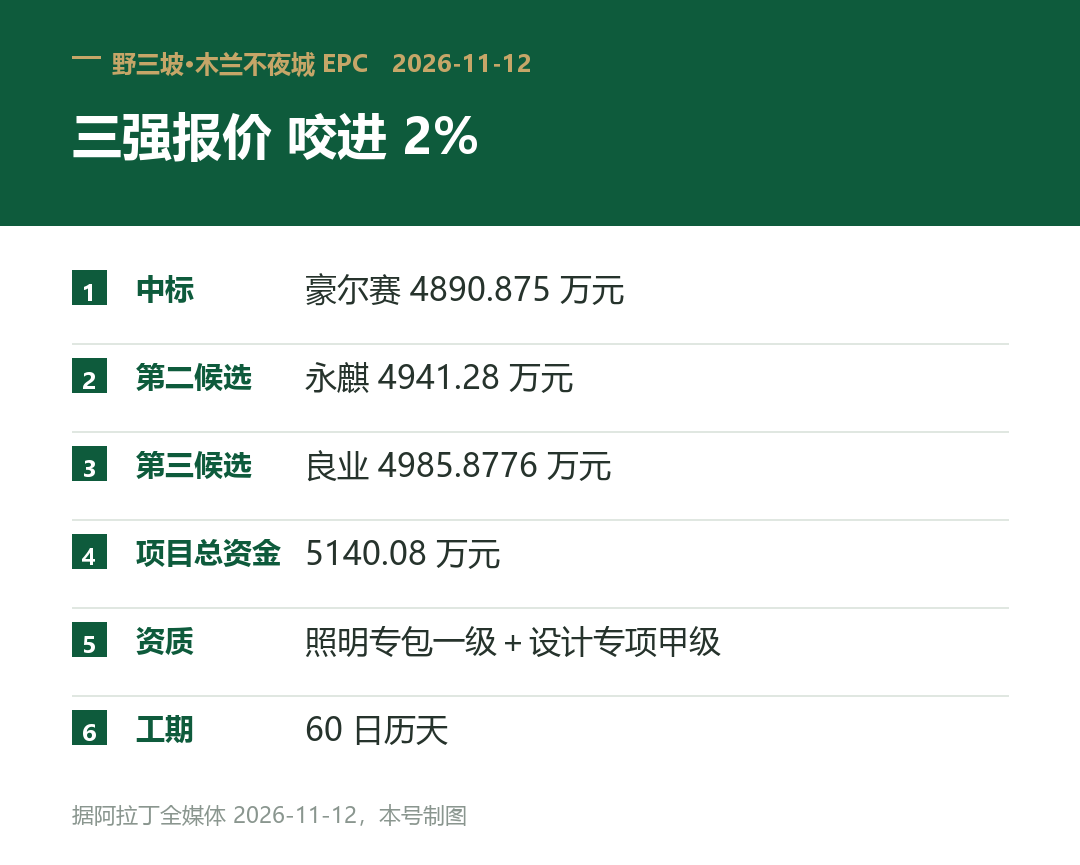
The results of the EPC tender for upgrading the night tour system at Bailishan Scenic Area in Yesanpo and Mulan Night City were announced on November 12. Haolaisi Technology Group won the bid at RMB 48.90875 million, including RMB 1.33375 million for design fees and RMB 47.575 million for construction costs. The total project budget is RMB 51.4008 million, with Chengdu Suojian Media Group as the procuring entity. Second-place contender Yongqi Technology quoted RMB 49.4128 million, while third-place candidate Liangye Technology offered RMB 49.858776 million; the gap between the three bids remained under 2%.
Qualification thresholds were stringent: Level-1 professional contracting for urban and road lighting projects, paired with Class-A specialized qualifications for lighting engineering design (or Class-A architectural qualifications), and requiring the project leader to hold a Grade-I constructor certificate. The construction period was set at 60 calendar days.
Judgment
The fact that the top three bidders clustered within a 95% range indicates that the premium era for Night City–style projects has ended, giving way to a phase focused on cost and turnover efficiency. A 60-day construction timeline implies that the supply chain must maintain ready stock; luminaire manufacturers cooperating with general contractors typically adopt a strategy of pre-stocking quotas combined with on-site support services rather than competing solely through bidding.
Market: Shenzhen Completes “One Axis, Two Bays, Three Zones” Night Scene Development, EMC Replaces 48,600 Luminaires
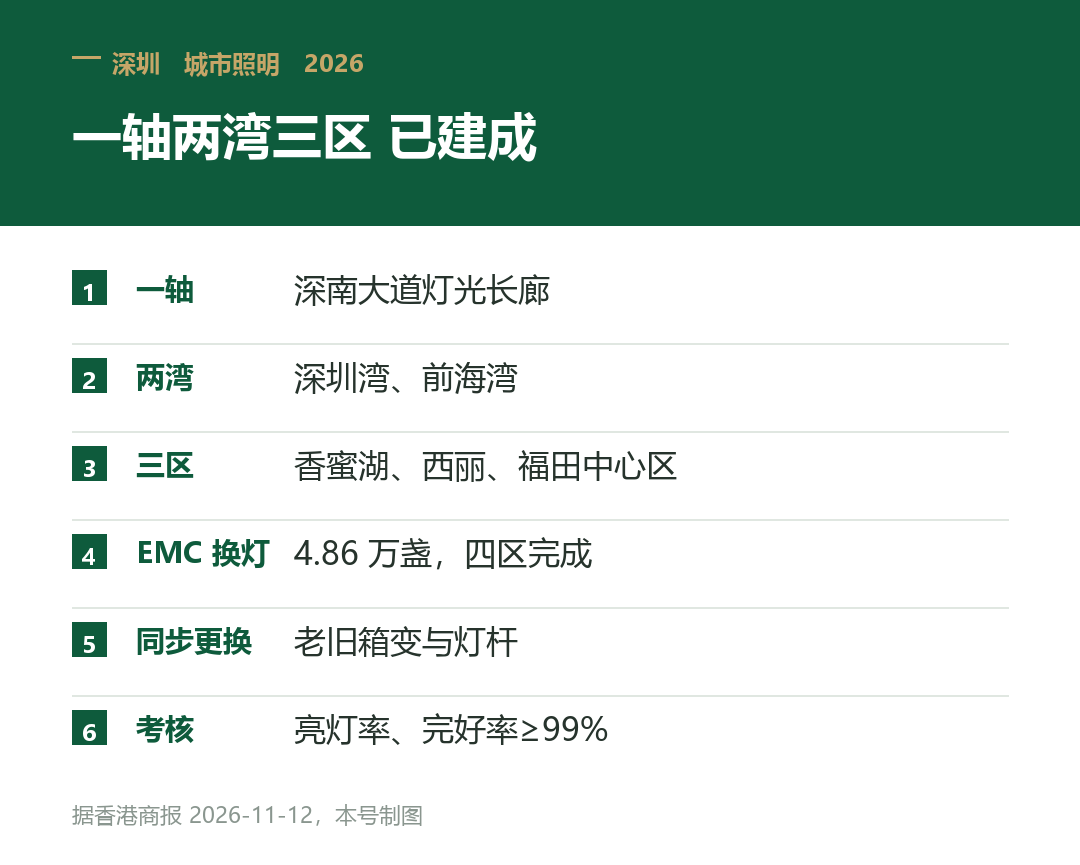
According to a Hong Kong Commercial Daily report on November 12, Shenzhen aligned with the “Shenzhen Urban Lighting Special Plan (2021–2035)” and completed the “One Axis, Two Bays, Three Zones” night scene development by 2026: a light corridor along Shennan Avenue, nighttime views of Shenzhen Bay and Qianhai Bay, and three zones centered around Xiangmi Lake, Xili, and Futian Central District; illumination and integrity rates stabilized above 99%. Simultaneously, a new round of streetlight energy-saving retrofits was carried out using an energy performance contracting model, replacing 48,600 LED luminaires across Futian, Luohu, Nanshan, and Yantian districts, concurrently swapping out aging transformer substations and lampposts.
Judgment
Expanding existing retrofits from “lamp replacement” to “lamp + substation + pole replacement” effectively packages power distribution and structural components together; setting a 99% illumination rate as a hard target will drive up精细化 management costs for contracted operators. Both of these developments are issues that the banks of the Qiantang River in Hangzhou will inevitably face sooner or later.
05 International Perspective
Market: Yongdian Lighting Attends Barcelona Global Smart City Conference, Representing Hangzhou in the Dedicated Zone
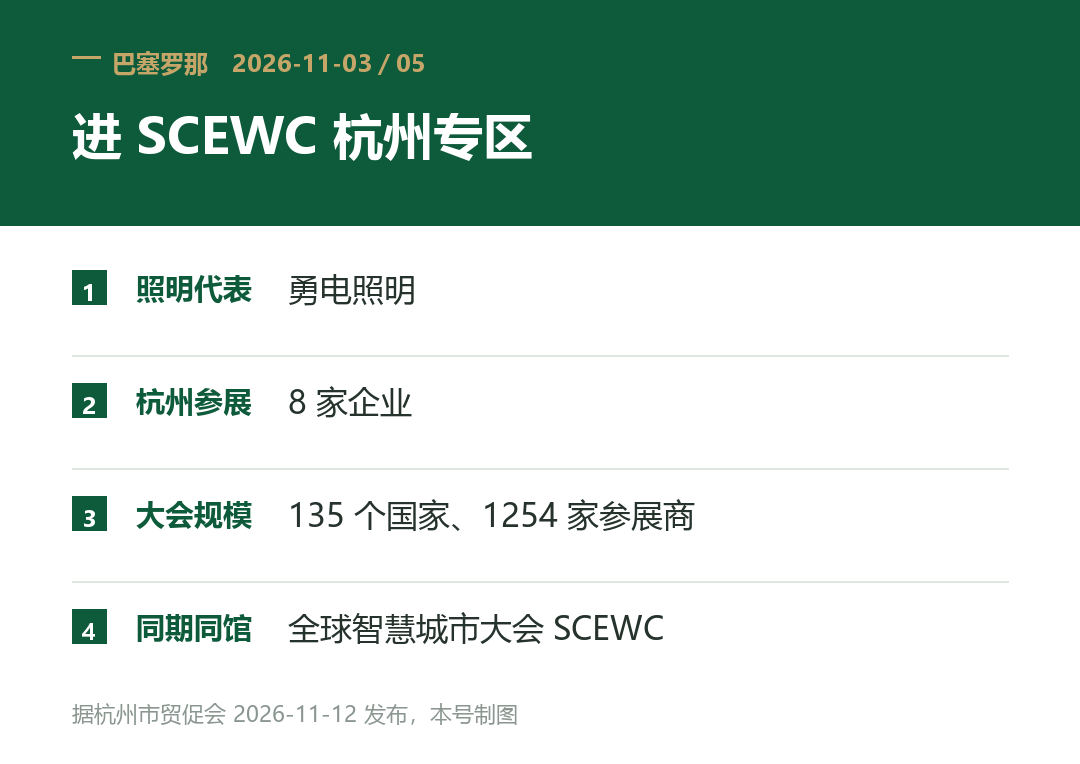
On November 12, the Hangzhou Municipal Council for the Promotion of International Trade announced that from November 3–5, Hangzhou would showcase its presence at the Barcelona Global Smart City and Cybersecurity Conference (held concurrently with the Global Smart City Expo SCEWC starting this year). Eight Hangzhou enterprises participated, with Yongdian Lighting listed as a representative in the smart city lighting sector. This edition of the conference covered 135 countries and featured 1,254 exhibitors.
Judgment
SCEWC represents the most concentrated gathering of municipal lighting decision-makers worldwide, making it rare for lighting companies to gain entry into the Hangzhou dedicated zone. European municipal projects demand CE, ENEC certifications plus photobiological safety reports; glare control and upward light emission are key review points—export qualifications are assessed annually, with supplementary measures taken only after orders arrive, leaving little time for preparation.
Technology: Signify Advances Its Lighting Management Platform Toward “Asset Operations,” Opens APIs for Solar Lighting
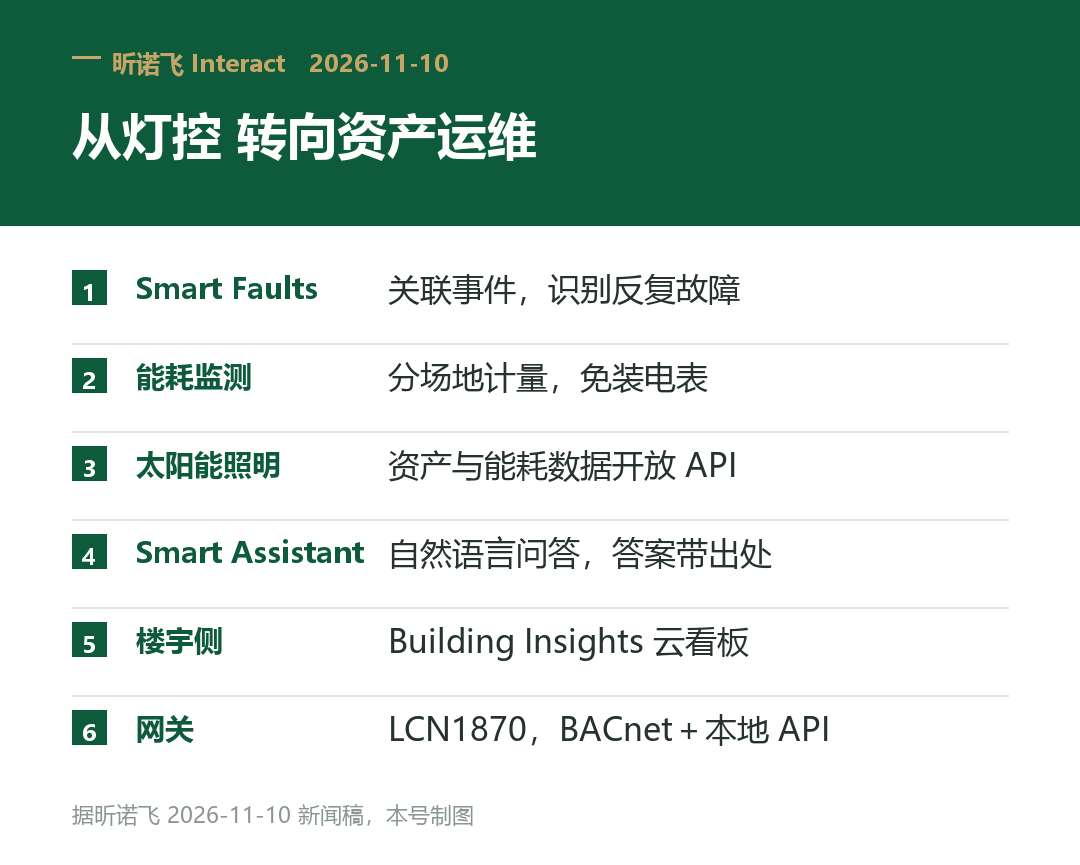
On November 10, Signify unveiled a batch of new features for its Interact platform in Eindhoven, Netherlands. The most practical addition is Smart Faults: linking multiple types of incidents to identify intermittent communication failures, unreported component replacements, recurring malfunctions, and abnormal energy consumption, automatically triggering follow-up actions to reduce unnecessary on-site visits and ensure accurate asset records. Also launched concurrently were site-specific energy consumption monitors for recreational sports venues (eliminating the need for additional meters), open APIs providing asset and energy data for solar lighting systems (compatible with urban management and asset administration platforms), and a Smart Assistant featuring natural language question answering with sourced responses.
Judgment
The competitive focus has shifted from “light control” to “faults and asset accounting.” Most domestic smart lamppost platforms remain stuck at “monitoring and control capabilities,” while truly labor-saving functions such as fault correlation, automated work orders, and asset depreciation tracking remain relatively underdeveloped. When clients begin using fault proactive discovery rates as acceptance criteria, this layer becomes a true watershed moment.
06 Academia & Industry
Academia: The Fourth China Lighting Science and Technology Conference Opens Today in Dongguan, Unveiling National Occupational Standards for Lighting Designers
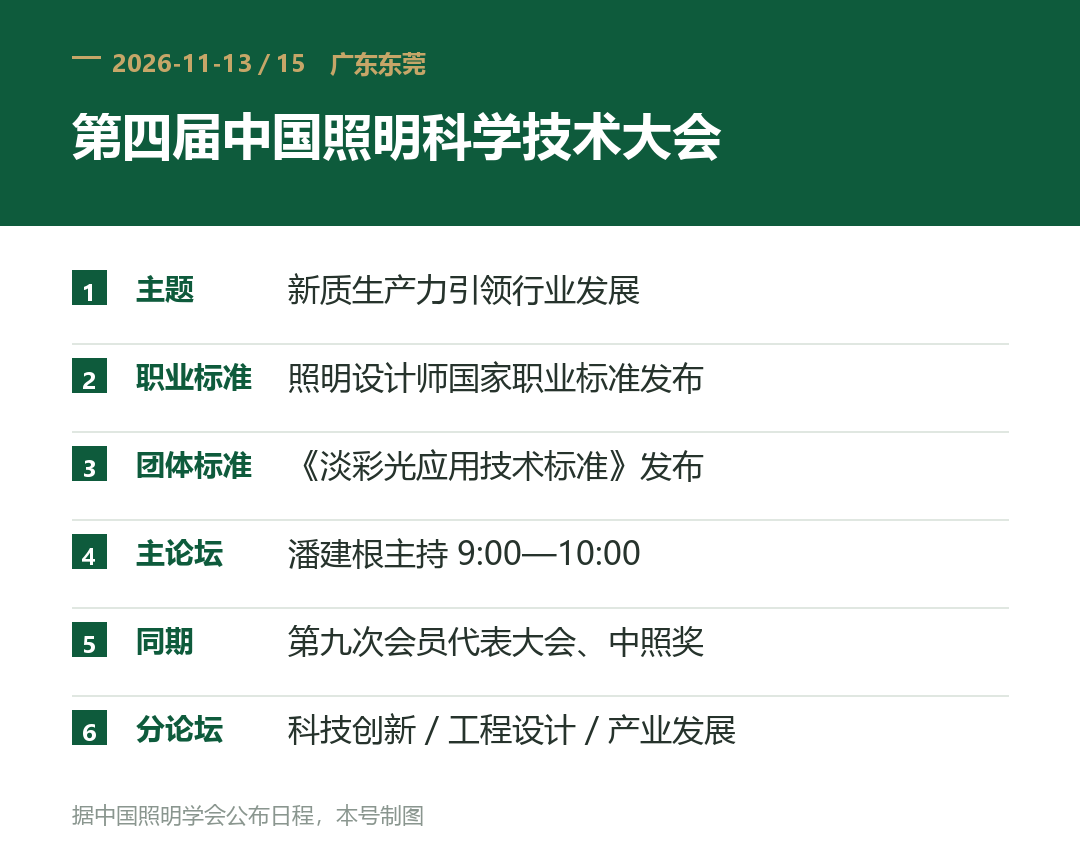
The Fourth China Lighting Science and Technology Conference, hosted by the Chinese Illumination Society, convened in Dongguan, Guangdong from November 13–15 under the theme “Leading the Future Development of the Lighting Industry with New Quality Productivity.” Concurrent events included the Ninth Members’ Congress, Board of Directors meeting, the 21st Zhongzhao Lighting Awards Ceremony, and a doctoral forum on cultivating young scientific talent.
At the main forum on the morning of November 14, the opening ceremony was presided over by Vice Chairman Gao Fei, with a speech delivered by Chairman Liu Zhenglei. During the event, national occupational standards for lighting designers and a series of vocational training textbooks were released, alongside certificates for the Decision-Making Advisory Expert Panel and Conference Partner Organizations. Mr. Pan Jiangen, Vice Chairman of the Chinese Illumination Society and President of the Zhejiang Illumination Society, attended as a guest speaker, chairing three keynote presentations from 9:00 AM to 10:00 AM: Vice Chair of the International Commission on Illumination and Tongji University professor Hao Luoxi on “The Future of Light and Humanity”; Nanchang University professor Wang Guangxu on “Advances in LED Dust-Free Lighting Application Technology”; and Huawei’s Wang Binbin on “Huawei’s Smart Park Building Intelligent Integration Solution and Practice.” From 10:00 AM onward, five sessions chaired by Vice Chairman Su Yaokang followed, including Tsinghua University professor Zhang Xin on “Artificial Intelligence Reshaping Lighting Design” and China Construction Lighting’s Yang Kejun on “Practical Exploration of Ultra-High-Rise Floodlighting Projects,” among others.
In the afternoon, the 21st Zhongzhao Lighting Awards were presented, accompanied by three parallel sub-forums on lighting technology innovation, lighting engineering design, and lighting industry development. At 5:20 PM, the “Standard for Pale Color Light Application Technology” was officially released.
Judgment
The national occupational standards for lighting designers represent the most noteworthy development of this session, as they will determine future training, assessment, and professional practice guidelines. Zhejiang members engaged in team capacity building should carefully compare their job requirements against the official text once it is made public—the significance of this document rivals that of any product standard.
07 Postscript Observations
This issue’s several threads converge on a common theme: capital is flowing toward “operations” and “existing assets.” A 15-year, RMB 134 million streetlight management contract was signed for a single street in Ningwei; a RMB 449 million project in Binjiang awaits announcement; and Shenzhen’s EMC has already replaced lamps, substations, and lampposts together. Incremental growth from new projects is limited, making operational rights over existing assets the primary battleground.
However, the threshold for securing operational rights does not lie in the lamps themselves. Signify pushes its platform toward fault correlation and asset record-keeping, while Shenzhen codifies a 99% illumination rate as a hard target—all pointing to the same underlying reality: clients are buying “clear baseline data, responsible management, and long-term savings,” not just a batch of lamps. This principle applies equally to design firms—presenting time-of-use dimming strategies, energy consumption calculations, and O&M interfaces in proposals proves far more valuable than merely producing a few extra renderings.
Upstream prices continue to rise, while downstream entities keep pressing for cost reductions. Only two survival strategies remain viable: locking in costs or turning services into barriers to entry.
Source: Zhejiang Illumination Society
China Light
The official website of the China Association of Lighting Industry and a full-media platform for the lighting sector. We provide authoritative and timely lighting information while striving to be a growth partner for businesses. From brand promotion and channel expansion to consulting, talent training and participation in standards development, we provide comprehensive professional services to help businesses improve quality and efficiency and jointly advance the high-quality development of the lighting industry.
Business Contacts
仇纯 (Ms.): 158 6155 3579
顾君 (Mr.): 137 7157 5253