
[Luminaire Design Analysis ③] The “Commander” of Light: Core Principles and Practical Applications of Luminaire Optical Design
Introduction:
Why can stage spotlights precisely illuminate a singer without affecting the audience? Why do streetlights evenly light up the road surface without causing glare for drivers? The answer lies in “optical design” — it acts like the “commander” of light, determining its direction, intensity, and distribution. In this article, we break down the core logic of optical design, from fundamental concepts to practical applications, helping you understand the secrets of “light control.”
I. Understanding Light’s Basic “Language”
To grasp optical design, first master these key terms.
Luminous flux (Φ): The total amount of light emitted by a source, measured in lumens (lm).
— A typical 10W LED bulb has a luminous flux between 600–900 lm, with 800 lm being a common benchmark;
Luminous intensity (I): Measures the concentration of light radiation in a specific direction, expressed in candelas (cd).
— Spotlight luminous intensity is very high (several thousand cd), while ordinary ceiling lights have only a few hundred cd in their main viewing direction;
Illuminance (E): Indicates how brightly an object’s surface is lit, measured in lux (lx).
— Living room lighting should be around 100–300 lx, while reading in a study requires at least 500 lx;
Luminance (L): Describes the brightness of a light source or surface, measured in candelas per square meter (cd/m²).
— Overly bright light sources (such as unshielded LED chips) can produce excessive glare;
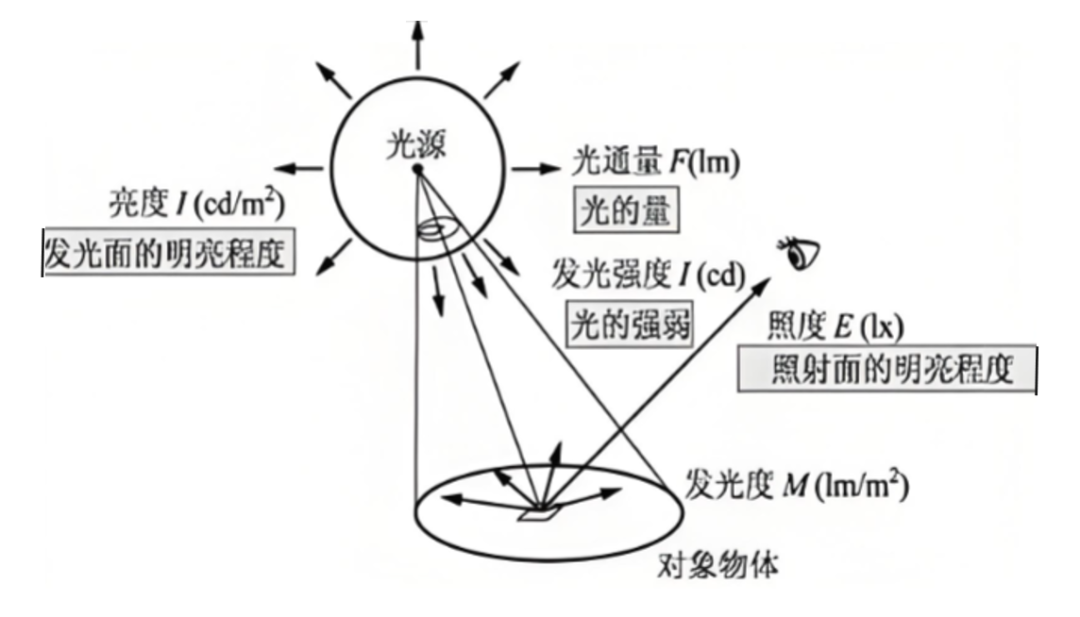
Illustration of luminous intensity, illuminance, and luminance
Color rendering index (Ra): Measures a light source’s ability to accurately reproduce the true colors of objects, on a scale from 0 to 100.
— Ra ≥ 80 is suitable for general lighting, while Ra ≥ 90 is ideal for shopping malls and art studios (to faithfully render product and artwork colors);
Color temperature (Tc): Refers to the “color hue” of light, measured in kelvins (K).
— 2700K produces warm yellowish light, 4000K offers neutral light close to natural daylight, and 6000K delivers cool bluish light.
Further Reading:
II. Light’s “Rules of Behavior”
The heart of optical design is harnessing the laws of physics to control the direction of light propagation:
Law of Rectilinear Propagation
Light travels in straight lines through uniform media.
— This principle underpins lamp light control (for example, reflectors in spotlights are designed according to rectilinear propagation to focus light effectively);
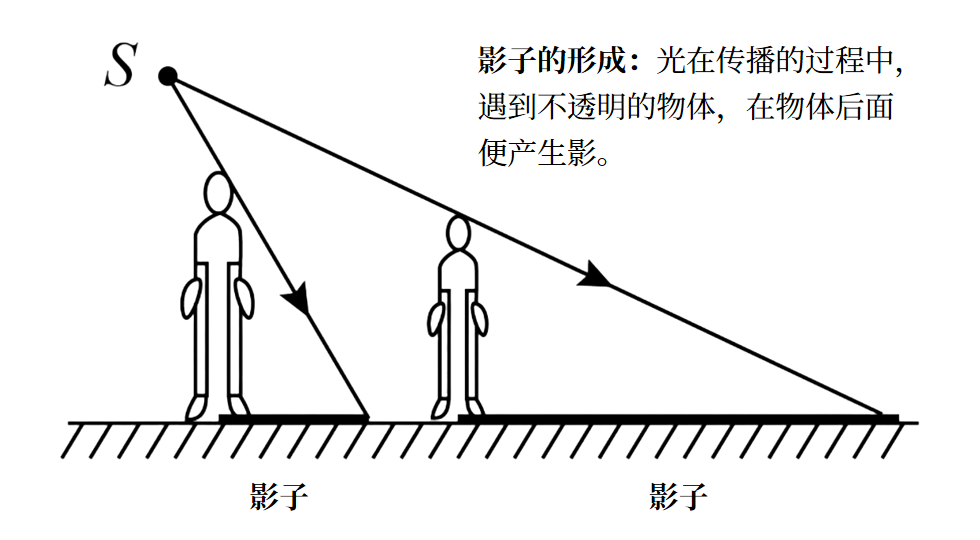
Phenomenon of rectilinear light propagation
Law of Reflection
When light strikes a surface, the angle of reflection equals the angle of incidence. Depending on the surface smoothness, there are two types of reflection:
Specular reflection (smooth surfaces reflect light directionally, such as polished aluminum shades on spotlights, which can precisely aim light at a target area),
Diffuse reflection (rough surfaces scatter light in all directions, such as frosted lampshades or sandblasted reflectors, producing softer, more evenly distributed illumination)
— Both forms are employed in lamp design;
Law of Refraction
When light passes from one medium (e.g., air) into another (e.g., glass), its direction changes — refractors (like lenses) exploit this law to converge or diverge light;
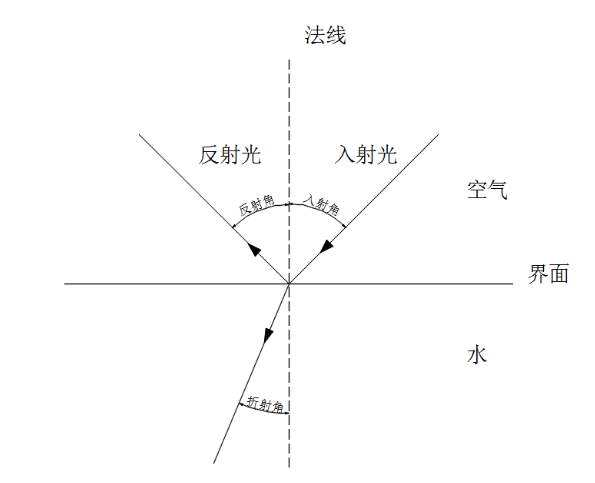
Refraction and reflection of light
Law of Total Internal Reflection
When light travels from a denser medium (e.g., glass) into a less dense medium (e.g., air) and the angle of incidence exceeds the critical angle, total internal reflection occurs.
Fiber optics and TIR-type LED lenses leverage this principle to efficiently guide light.
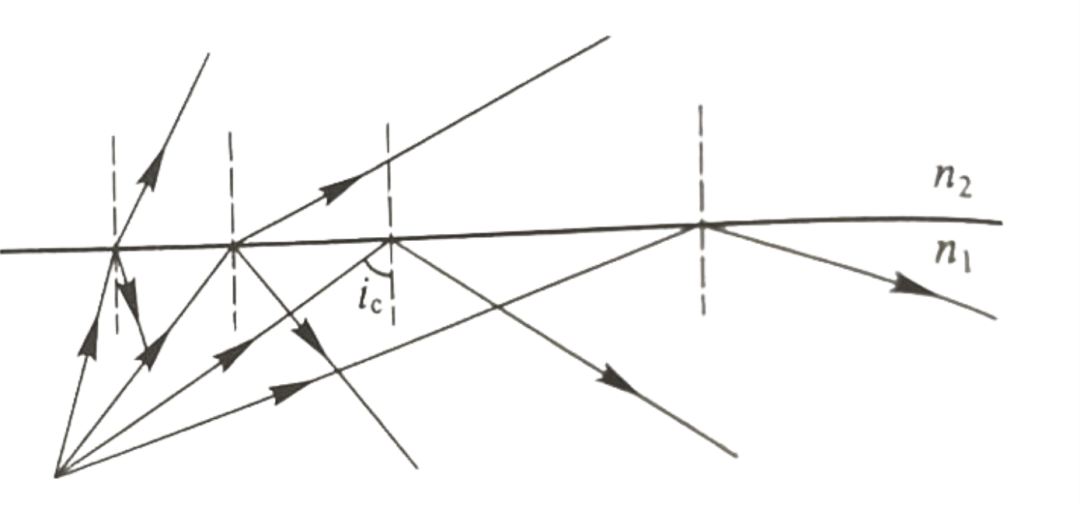
Total internal reflection of light
III. Decoding Luminous Intensity Distribution Curves: Light’s “Distribution Map”
Luminous intensity distribution curves are the “blueprints” of optical design, visually illustrating how light is distributed across different angles around a fixture.
3.1 What Is a Luminous Intensity Distribution Curve?
A curve that plots luminous intensity values at various angles in space, centered on the light fixture (typically presented in polar or Cartesian coordinates);
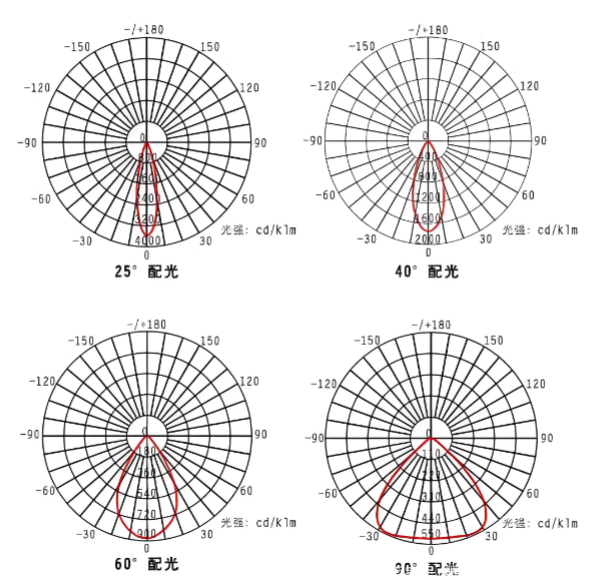
Luminous intensity distribution curve
3.2 Common Classification of Distribution Types
1. By Luminous Flux Distribution Across Hemispheres (the most basic and widely used classification system, adopted by both CIE and GB/T 50034 standards)
Direct type (90%–100% downward, highest efficiency but prone to shadows, e.g., downlights and industrial lamps)
Half-direct type (60%–90% downward, with some upward light, improving overall spatial brightness, e.g., pendant lamps with translucent upper sections)
Diffuse type (40%–60% in each hemisphere, providing the most even illumination but lower efficiency, e.g., milky glass globe bulbs)
Half-indirect type (60%–90% upward, mainly used for decorative ambiance, e.g., chandeliers with lampshades)
Indirect type (90%–100% directed toward the ceiling for reflection, producing the softest light but significant losses, e.g., light troughs and wall washers)
2. By Symmetry of Light Distribution
Axial symmetry (consistent light distribution regardless of angle around the fixture center, e.g., downlights and industrial lamps)
Non-symmetrical (uneven light distribution favoring one side, commonly seen in streetlights and long fluorescent fixtures)
3. By Beam Angle Size
Narrow beam (beam angle < 20°, e.g., spotlights, ideal for accent lighting)
Medium beam (20°–40°, e.g., track lights and downlights)
Broad beam (> 40°, e.g., ceiling lights and classroom lamps, suitable for general illumination)
Beam angle: The angle at which luminous intensity reaches 50% of its peak value (e.g., spotlight beam angles of 15°–30° are ideal for focused illumination, while ceiling light beam angles above 120° suit even lighting).
4. Special Classification for Road Lighting: Cut-off, semi-cut-off, and non-cut-off types (classified based on restrictions on upward light to prevent glare), along with bat-wing, rectangular, and elliptical shapes as typical distribution patterns;
How to Interpret Luminous Intensity Distribution Curves?
The sharper the curve, the more concentrated the light intensity (e.g., spotlights);The flatter the curve, the more evenly distributed the light intensity (e.g., ceiling lights).
Further Reading:
IV. The Logic of Achieving Just the Right Light Distribution
The goal of light distribution design is to "provide appropriate illumination where needed", avoiding conditions of "too bright" or "too dim":
4.1 Three Core Objectives of Light Distribution Design
1. Meet required illuminance levels (e.g., road lighting must reach ≥20 lx);
2. Ensure uniformity (illuminance differences within the same area ≤ 3:1, preventing uneven brightness);
3. Control glare (reduce harsh, glaring light, e.g., by adding light shields to streetlights).
4.2 Key Considerations for Different Scenarios

Note: Values marked with in the table represent industry-standard reference values for beam angles and shielding angles; beam angle definitions follow GB/T 24908, while minimum requirements for high-brightness LED shielding angles are recommended by GB/T 7000.1-2023.
Light distribution must also harmonize with color temperature to achieve optimal results:
Bedrooms and dining rooms benefit from 3000K warm light paired with broad beam distribution, creating soft, non-intrusive illumination;
Offices and studies thrive with 4000K neutral light combined with uniform distribution, enhancing concentration;
Workshops and outdoor spaces prefer 5000K+ cool light matched with narrow, focused beam distribution, improving task clarity.
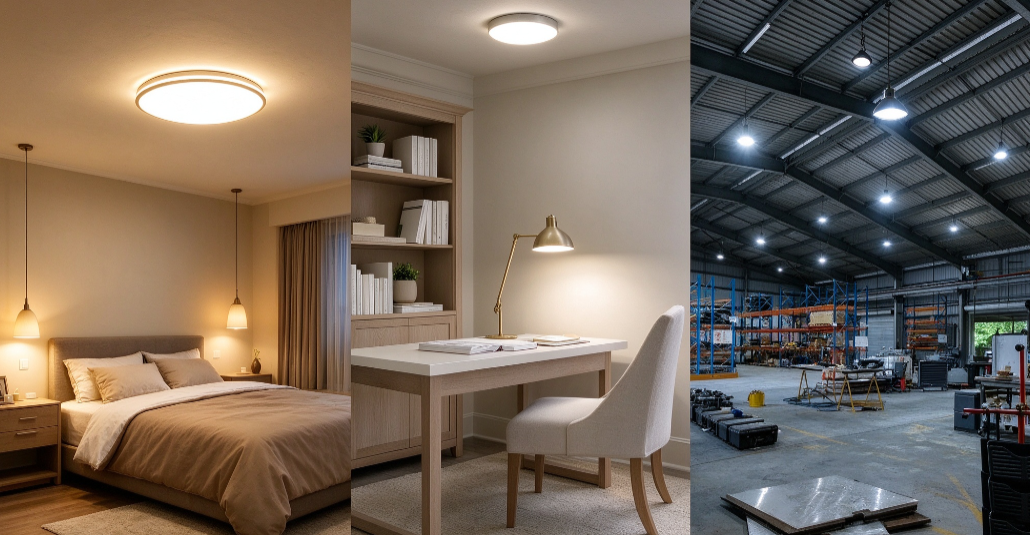
Image generated by DouBao
V. Three Core Components for Precise Light Control: Light’s “Commando Units”
The essence of optical design lies in using these components to alter light’s path and achieve precise control:
5.1 Reflectors: Light’s “Mirrors”
Reflectors are among the most commonly used light-control components (e.g., inner walls of spotlights and streetlights), whose primary role is to "redirect scattered light toward the desired area":
1. Material Selection
High-reflection materials (such as aluminum foil and electroplated metals), with reflectivity ≥85%;
Surface treatments: polishing (high reflectivity, ideal for focused beams) and sandblasting (diffuse reflection, suitable for even illumination);
2. Common Shapes and Functions
Parabolic reflectors: when an ideal point light source is placed at the focal point, they can redirect light into parallel beams, commonly used in searchlights and flashlights; however, real LEDs are extended light sources, so their beams inevitably spread somewhat;
Ellipsoidal reflectors: capable of converging light from the first focal point to the second, often employed in projection equipment and certain stage follow-spot lights;
Spherical reflectors: redirect light into a divergent pattern (e.g., ceiling light reflectors);
3. Design Considerations
The shape of a reflector must match the position of the light source (e.g., an LED chip should be placed at the focal point of a parabolic reflector to produce parallel beams).
5.2 Refractors: Light’s “Lenses”
Refractors (such as LED lenses and glass lampshades) change light direction through refraction, making them well-suited for precise light control:
1. Material Selection
Optical-grade materials (such as PMMA, PC, and glass), with transmittance ≥90%;
Requirements: heat resistance (for LED heat dissipation) and impact resistance (for outdoor use);
2. Common Types and Functions
Convex lenses: converge light (e.g., spotlight lenses, reducing beam angles);
Concave lenses: diverge light (e.g., ceiling light lampshades, increasing beam angles);
Fresnel lenses: thin and lightweight, yet highly effective at focusing light (e.g., LED streetlight lenses, minimizing fixture size);
Threaded lenses: evenly disperse light (e.g., daylight lampshades, preventing uneven brightness streaks);
3. Design Considerations
The curvature and texture of a lens should be tailored to specific light distribution needs (e.g., the spacing of threads on a threaded lens affects the degree of divergence).
5.3 Light-Shielding Devices: Light’s “Blinds”
The core function of light-shielding devices is to "control glare", preventing excess light from directly entering the eyes:
1. Common Types
Shields (such as arc-shaped shields on streetlights): block upward or lateral light to avoid glare;
Grilles (such as office grille lights): confine light within a specific angle (e.g., 60°), reducing direct glare;
Leaf-shaped shields (such as four-leaf shields on stage lights): precisely regulate the illuminated area (e.g., illuminating only a specific section of the stage);
2. Design Considerations
The angle of a light-shielding device must align with the luminous intensity distribution curve (e.g., grille angles ≤ 60° to prevent glare), while ensuring it does not compromise light efficiency (the shaded area should not be excessively large).
Conclusion
Optical design is the "core technology" of lighting fixtures, determining the effectiveness, comfort, and efficiency of illumination.
China Light
The official website of the China Association of Lighting Industry and a full-media platform for the lighting sector. We provide authoritative and timely lighting information while striving to be a growth partner for businesses. From brand promotion and channel expansion to consulting, talent training and participation in standards development, we provide comprehensive professional services to help businesses improve quality and efficiency and jointly advance the high-quality development of the lighting industry.
Business Contacts
仇纯 (Ms.): 158 6155 3579
顾君 (Mr.): 137 7157 5253