
Lighting is not an exhibit; it is a narrative conduit.
Introduction: The more lights are installed, the less impact they have on visitors. When “lighting up” becomes the end goal of investment, nighttime tourism is reduced to little more than a static backdrop. This article isn’t about how to install lights; it’s about how light can tell a story—why truly memorable nighttime experiences don’t rely on lights as something to simply “look at,” but rather as an invitation to “step into.”
Why Lighting Is Increasingly Struggling to Resonate
Over the past two years, one clear observation has emerged: the value of cultural‑tourism lighting as a product is diminishing.
This isn’t to say lighting is unimportant; rather, when its role is limited to “illumination + beautification,” functional lighting quickly gets commoditized and becomes increasingly interchangeable. The real challenge lies in lighting’s inherent inability to accomplish three key tasks—content expression, emotional storytelling, and fostering connections between hosts and guests. Unlike performing arts or cultural‑creative products, lighting rarely manages to craft a compelling narrative on its own.
How can we address this shortcoming? The core principle is simple: cultural‑tourism lighting shouldn’t stop at “illumination + beautification.” Instead, it must evolve from a mere medium of light and shadow into a narrative tool—transforming lighting from a static backdrop into a vehicle that carries meaning, evokes emotion, and bridges the gap between visitors (the subject) and the site’s culture (the object). Light delivers the story to the audience, while the audience brings the story into their hearts.
Unfortunately, very few projects in the industry have reached this level. Most designs remain stuck in the first two of three stages: focusing on technical parameters—stacking metrics like illuminance, color temperature, and power consumption; creating visually appealing scenes through light; or occasionally touching on culture and storytelling—but rarely going beyond these basics. At best, lighting is viewed merely as a “medium of light and shadow”; far too seldom does anyone see it as a narrative device, a conduit for emotional connection.
The following four case studies, mostly drawn from the author’s own work, aim to do just one thing: let the light speak.
01 Follow the Light and Shadow, Slowly Step Into a Story
As night falls, the old house by the water first fades into deep blue, then gradually regains its warmth through soft, golden light.
Red‑orange hues cascade up the walls toward the gray tiles, casting colorful reflections on the water; tree silhouettes glow with red and green halos, while LED strips beneath the railings softly illuminate the pathway. Rather than lighting everything, the light focuses precisely on the path beneath your feet. As someone walks along this trail, their pace slows, revealing the delicate contours of eaves, ripples on the surface, and the homesickness hidden within the glow.
In this moment, light isn’t a spectacle to be gazed at—it’s an emotion delivered right under your feet. It doesn’t rush to finish the story; instead, it invites you to enter it, leaving each subsequent step to your own journey.

Walking slowly along the light, the story unfolds on its own.
02 As You Walk, Light and Shadow Speak the Essence of This Place
From the old street by the water to the city by the river, the night takes on a completely different character.
Purple light spreads across building facades, outlining crisp geometric patterns—as if sketching the city’s own silhouette. On the spacious plaza, pedestrians stroll leisurely, boats moor gently on the water, and the distant skyline recedes into a faint, ethereal backdrop. Though it’s still night, though it’s still light, the atmosphere here feels entirely distinct—the warm reds of the old houses evoke nostalgia, while the purple glow of the facades points toward the future.
Light and shadow never simply copy others’ narratives; they speak only for this place: rural light encourages slowing down, while urban light beckons you to gaze into the distance. Only as you walk do you realize that it’s not the lights themselves that adorn this space—it’s the interplay of light and shadow that reveals its true essence.
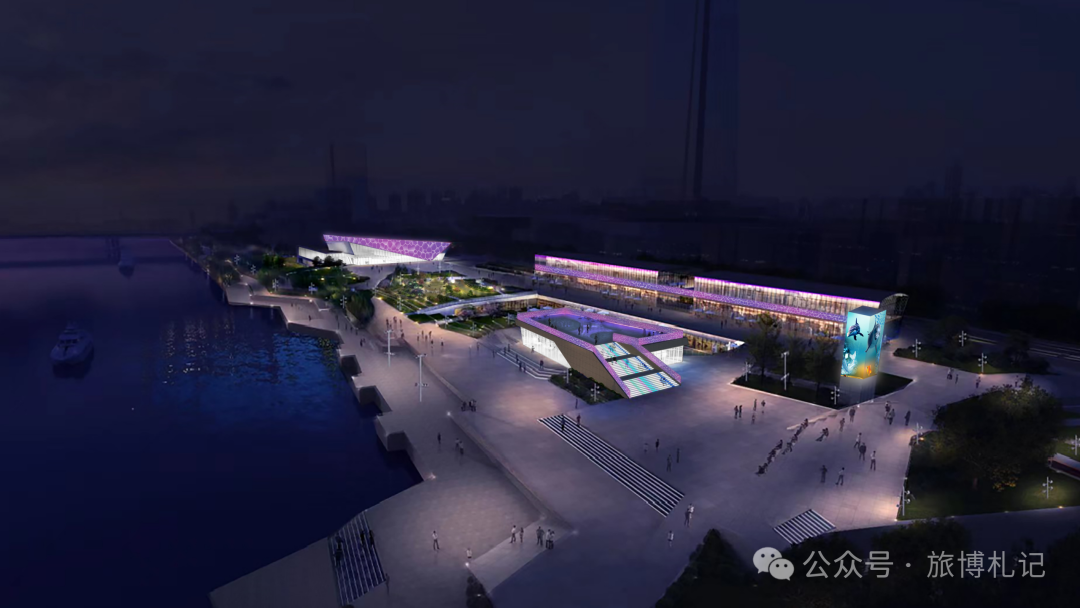
One warm hue, one purple shade—each captures the unique flavor of its own nocturnal world.
03 Other Lights Are for Check‑Ins and Photos; This One Makes Me Stop and Stare
A full moon hangs in the deep blue night sky, a solitary tree casts its shadow onto the water, and warm light spills from a pavilion across the long bridge. Boats drift along the river, scattering light into countless reflections, while distant villages glow faintly, as if whispering softly.
Here, no single light declares, “Come take a photo!” The boats sway gently, the moon moves slowly—no one hurries, no one calls out. And so you pause—not reaching for your phone, but simply staring, watching the light spread across the water and gather again, suddenly recalling a night from long ago.
Many nighttime attractions aim to make visitors “see”; this particular light seeks to make them “stay.” While other lights tell you, “This place is beautiful,” this one lingers, inviting you to linger a bit longer. The check‑in photo stays safely stored on your phone, but the moment of quiet contemplation remains etched in your heart.
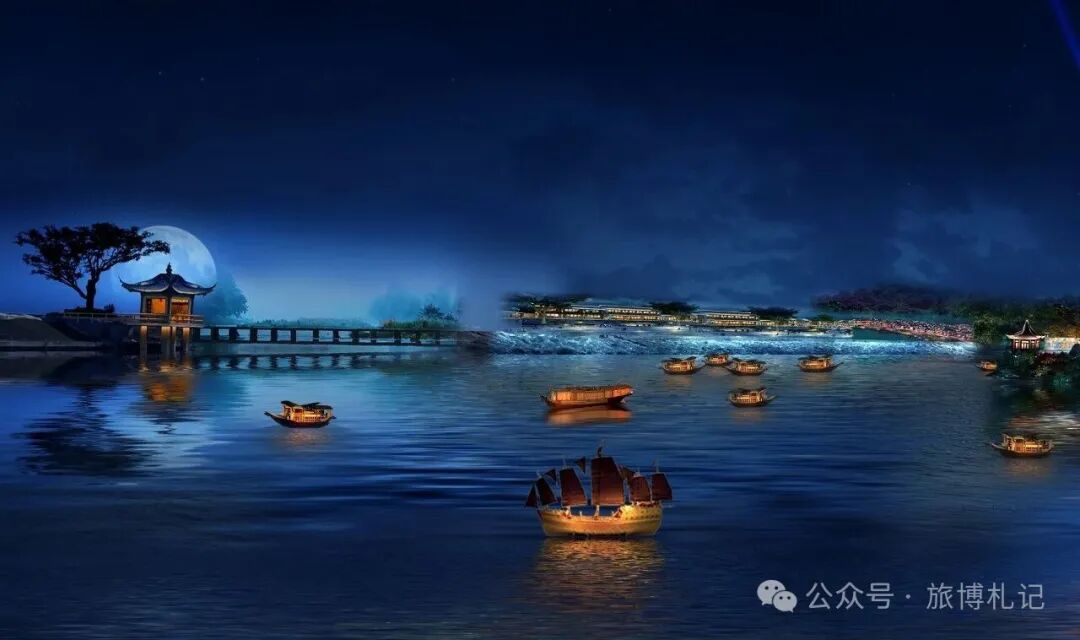
No one urges you to snap a photo—only the light keeps you company as you lose yourself in thought.
04 When the Lights Come On, It Feels Like You’ve Read the Story of This Place
By day, the neighborhood consists only of walls, tiles, trees, and a few quiet pavilions, bustling with people yet unnoticed by most.
At night, when the lights turn on, everything changes: vintage streetlamps line the lanes, cultural murals shimmer with flowing landscapes, costumed figures perform under the glow, and artificial rockeries, flowering plants, and pavilions recede into layers of depth. The story isn’t told—it’s illuminated. A place once unfamiliar suddenly feels like an open page of an old book, each beam of light landing perfectly on a sentence.
It turns out that understanding a place doesn’t require listening to explanations or consulting guidebooks; when the lights come on, the story unfolds all by itself. Standing there, you feel as though you’ve unlocked every secret of the past.
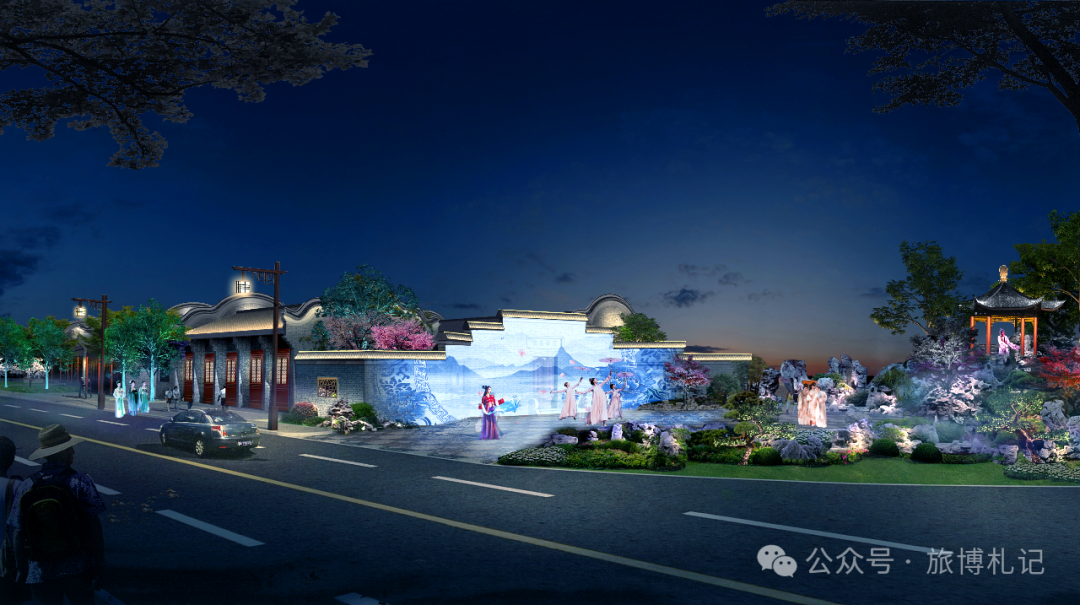
When the lights ignite, the story begins to speak on its own.
Not the End of Beautification, But the Beginning of Storytelling
Returning to our opening question: the true value of cultural‑tourism lighting lies not in how many lights are installed, but in how many people it retains.
When light starts to convey content, stir emotions, and connect hosts and guests, it ceases to be a mere embellishment of the night scene and becomes part of the story itself. What visitors carry away isn’t just photos on their phones—it’s the memories, thoughts, and moments of pause illuminated by the light.
Lighting has never been the final exhibit of cultural tourism; it’s a narrative pathway, carrying human feelings from the eyes straight to the heart. This is also the original intention behind our nighttime design approach: less “bright looks,” more “understanding upon entering.”
In your project, is the lighting focused on “beautification,” or on “storytelling”? Share your thoughts in the comments—what’s the most moving nighttime light experience you’ve encountered?
About the Author: Long‑time instructor of MBA courses in business administration and brand IP, researcher of theoretical frameworks, and practitioner of applied solutions; government think‑tank expert on high‑quality development of the cultural‑tourism Industry; senior creative leader in the cultural‑tourism night economy.
China Light
The official website of the China Association of Lighting Industry and a full-media platform for the lighting sector. We provide authoritative and timely lighting information while striving to be a growth partner for businesses. From brand promotion and channel expansion to consulting, talent training and participation in standards development, we provide comprehensive professional services to help businesses improve quality and efficiency and jointly advance the high-quality development of the lighting industry.
Business Contacts
仇纯 (Ms.): 158 6155 3579
顾君 (Mr.): 137 7157 5253