
Three departments have issued the new edition of the “Guidance Catalog for Building Carbon Emission Measurement Capabilities,” with numerous references to the lighting sector.
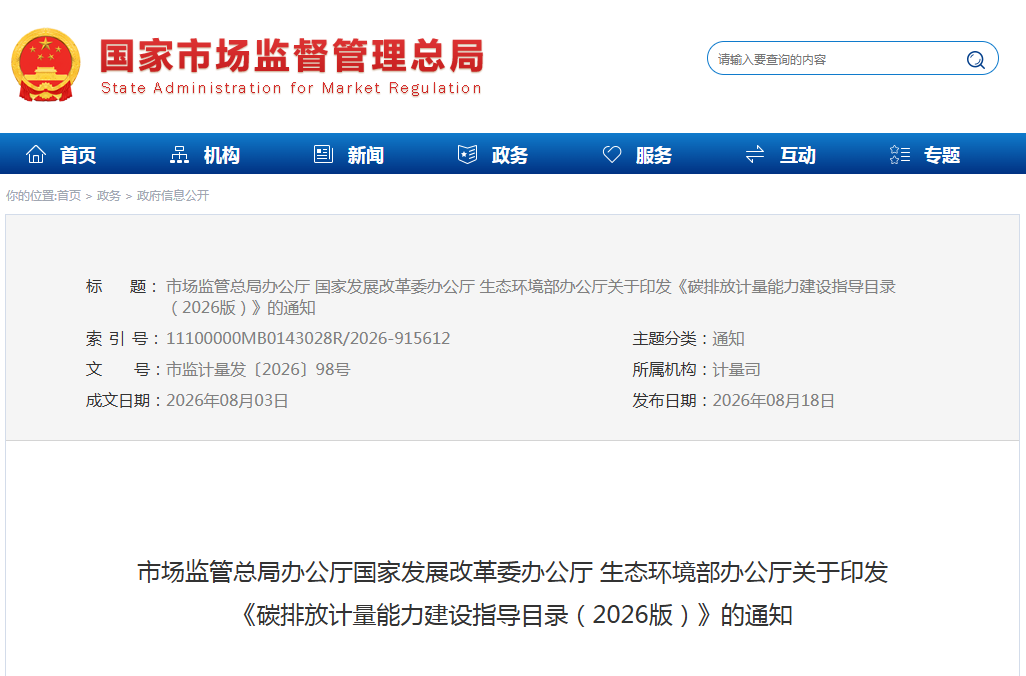
Recently, the State Administration for Market Regulation, the National Development and Reform Commission, and the Ministry of Ecology and Environment jointly issued the “Guidance Catalogue for Building Carbon Emission Measurement Capabilities (2026 Edition).” As an updated and upgraded version of the 2024 edition, the 2026 catalogue further strengthens and refines the national carbon emission measurement technical system, marking a new stage in China’s efforts to standardize, enhance precision, and systematize carbon emission measurement. This provides robust technical support for the green and low-carbon transformation across industries and injects strong momentum into the steady advancement of the nation’s goals of peaking carbon emissions and achieving carbon neutrality. The 2026 catalogue achieves comprehensive expansion of technical coverage and systematic optimization of the standards and specifications framework. It establishes a more systematic, complete, precise, and efficient carbon emission measurement technology framework, offering authoritative and unified technical guidance to metrology institutions at all levels, key enterprises, and entities implementing emission-reduction projects. This ensures, from the source, that carbon emission data are authentic, accurate, and traceable, effectively supporting the fine-grained accounting of corporate carbon emissions and product carbon footprints.
Analysis of the Catalogue’s Impact on the Lighting Industry
Supporting the Quantitative Implementation of CCER‑Based Lighting Emission‑Reduction Projects
The “Methodology for Voluntary Greenhouse Gas Emission Reduction Projects: Energy Saving in Road Tunnel Lighting Systems (CCER‑07‑001‑V01),” jointly released in January 2025 by the Ministry of Ecology and Environment and three other departments, marks a critical step forward for the national CCER trading market into the realms of public lighting and transportation energy efficiency. The current catalogue further aligns with this initiative at the measurement level, explicitly incorporating this methodology into its regulatory framework and designating AC energy meters and electrocarbon meters as core components of the measurement testing system. This provides metrology institutions with a unified basis for verifying energy savings and emission reductions in road tunnel and public lighting energy‑efficiency projects. With standardized, traceable metrological support, the emission reductions achieved through energy‑saving upgrades to road tunnels and street lighting can now be “measurable, reportable, and verifiable,” unlocking a crucial pathway for these projects to enter the CCER market and potentially boosting the enthusiasm of project owners to undertake lighting‑related energy‑efficiency renovations.
Standardizing Optical and Spectral Metrology
In two newly added parameters—“illuminance” and “ecosystem carbon sinks”—the catalogue explicitly lists the “Lighting Measurement Method” (GB/T 5700) as the corresponding testing standard. At the same time, it designates instruments such as the “Illuminance Meter” (JJG 245) and the spectral radiometer (JJF 1975) as key metrological standards for building carbon emission measurement capabilities. This establishes clear verification and calibration protocols for optical and light‑environment measuring devices used by third‑party testing agencies and corporate laboratories. Against the backdrop of peaking carbon emissions, the energy efficiency and carbon footprint of lighting products depend not only on electrical energy consumption but also on effective luminous output. A unified, high‑precision optical metrology system will provide valuable data support for lighting companies seeking low‑carbon product certification, green design assessments, and R&D initiatives, guiding the industry toward higher luminous efficacy, superior quality, and reduced energy use.
Enhancing the Photovoltaic‑Energy Storage‑Charging Measurement System
The catalogue has refined metrological standards covering solar simulators (JJF 1615), spectral responsivity (JJF 1655), total radiation meters (JJG 458), and techniques for testing energy conversion efficiency in storage systems. As outdoor lighting, rural illumination, and smart road lighting progressively evolve toward “photovoltaic‑storage‑direct‑flexible” solutions, solar‑powered streetlights, and microgrid applications, the degradation of photovoltaic modules and the efficiency of energy‑storage batteries have become central factors influencing project emission‑reduction outcomes. The catalogue’s enhancements to photovoltaic and energy‑storage metrology will encourage lighting companies to strengthen energy‑efficiency management and refined measurement practices within integrated “PV‑storage‑lighting” systems, laying the groundwork for improving the quality and securing low‑carbon certification of clean‑energy lighting products.
Against the backdrop of the nation’s comprehensive push to build a carbon emission measurement system and achieve the “dual carbon” goals, the China Lighting Fixture Association is closely following policy directions and continuously refining the industry’s low‑carbon standards framework. Jointly overseen by the China National Light Industry Council and the China Lighting Fixture Association, three group standards on the carbon footprints of lamps, light sources, and control devices have been officially released and implemented.Further Reading:Three New Standards Related to the Lighting Industry’s Carbon Footprint Officially ReleasedThese standards, based on the Life Cycle Assessment (LCA) methodology, unify methods for quantifying and calculating the carbon footprint of lighting products, filling a critical gap in the industry’s capacity for detailed carbon‑footprint evaluation. They provide enterprises with a scientific basis to navigate low‑carbon transitions and enhance market competitiveness, while also offering solid technical support for the national carbon‑footprint management system.
China Light
The official website of the China Association of Lighting Industry and a full-media platform for the lighting sector. We provide authoritative and timely lighting information while striving to be a growth partner for businesses. From brand promotion and channel expansion to consulting, talent training and participation in standards development, we provide comprehensive professional services to help businesses improve quality and efficiency and jointly advance the high-quality development of the lighting industry.
Business Contacts
仇纯 (Ms.): 158 6155 3579
顾君 (Mr.): 137 7157 5253