
Structural Transformation and Systemic Breakthrough in the Lighting Industry Amid Urban Renewal | Featured Article
Authors / Qian Zongming, Wu Tong
Jiangsu Lighting Society, Nanjing, Jiangsu
0 Introduction
Cities have never been static. As revealed by new economic geography, urban economies continuously evolve through the interplay of “centripetal forces” (agglomeration) and “centrifugal forces” (dispersion), with this dynamic equilibrium shaping both the spatial structure and economic vitality of cities. After decades of rapid outward expansion, Chinese cities are now entering a phase of urban renewal characterized by re‑agglomeration. At the heart of this stage lies not how many new buildings are constructed, but rather how existing urban spaces can generate greater value[1].
In 2025, the “Opinions of the General Office of the CPC Central Committee and the General Office of the State Council on Continuously Advancing Urban Renewal” explicitly set the goal of achieving improved urban functions and enhanced quality by 2030[2]. The proposals for the 15th Five-Year Plan further designate urban renewal as a key task in the new urbanization process[3]. The concentrated release of these policy signals marks a turning point for urban renewal. At this juncture, the lighting industry is entrusted with special expectations. Lighting serves as an entry point for urban renewal that is relatively cost‑controlled, delivers highly visible results, and resonates most strongly with residents’ daily lives. International research indicates that urban lighting is evolving from basic technical infrastructure into a strategic tool for sustainable renewal, energy efficiency, and the activation of public spaces. Consequently, lighting companies often fall into engineering‑oriented thinking, reducing urban renewal to large‑scale lamp‑replacement projects. Such an approach both underestimates the complexity of urban renewal and misjudges the heights the lighting industry could reach.
1 Threefold Value Reconstruction of the Lighting Industry in the Context of Urban Renewal
The deeper logic of urban renewal lies in re‑exploring the value of urban density. Density matters because it determines both transaction costs and output quality: lower transaction costs and more frequent interactions lead to stronger wealth creation. Essentially, urban renewal involves systematically restoring and enhancing the triple dimensions of production, consumption, and living.
1.1 Updating Production Models: From “Deindustrialization” to “Industrial Optimization”
In the past, urban renewal often leaned toward “deindustrialization,” converting old industrial buildings into commercial or residential uses. Today, policy increasingly emphasizes “industrial‑to‑industrial” and “industrial‑to‑M0 (new‑type industrial land)” conversions—preserving and upgrading industrial functions within existing urban spaces. For the lighting industry, this means that lighting needs in industrial parks and science‑tech parks are no longer limited to simply illuminating factory floors; instead, they require smart lighting systems tailored to complex scenarios such as R&D offices, flexible manufacturing, and exhibition‑and‑interaction spaces.
1.2 Updating Consumption Patterns: From “Goods” to “Experiences”
In China, service consumption accounts for only 18% of GDP, far below the U.S. figure of 44%[4]. Urban renewal explicitly targets the service‑consumption sector, calling for the development of complete consumer ecosystems integrating goods, experiences, and services. For lighting, this implies that commercial lighting should go beyond merely illuminating products—it must shape consumer emotions, extend dwell times, and drive purchase conversions through thoughtful light‑environment design.
1.3 Updating Lifestyles: From “Having a Place to Live” to “Making Cities Places People Want to Stay”
The ultimate aim of urban renewal is people. Renovation of older residential neighborhoods, revitalization of historic districts, and enhancement of public spaces all seek to make cities warmer and more inclusive. Lighting plays a low‑threshold yet highly perceptible role as a vital public‑service tool: the brightness, color temperature, and uniformity of a streetlamp directly affect pedestrians’ sense of safety and comfort at night. Research shows that updating public lighting in historic districts requires balancing energy efficiency improvements with nighttime landscape preservation—a balance that significantly influences public acceptance of renewal projects.
2 Local Variations in Policy Implementation and Typological Analysis of Corporate Practices
Despite the increasingly refined policy framework, urban renewal exhibits marked disparities in local implementation. Taking Jiangsu Province as an example, the southern region (Nanjing, Suzhou, Wuxi) has taken the lead, with active participation from private capital in industrial and commercial renewal projects, while central and northern Jiangsu rely more heavily on government funding and energy‑management models. These differences impose distinct requirements on market strategies for lighting companies.
Based on practices across multiple cities in Jiangsu, we can categorize the ways lighting firms engage in urban renewal into four types (Table 1).
Table 1 Four Typical Models of Lighting Companies’ Participation in Urban Renewal
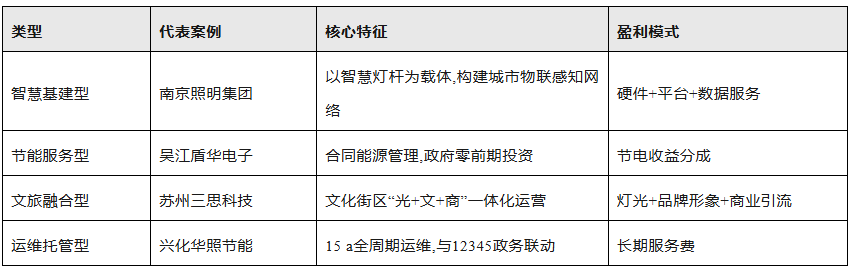
Smart Infrastructure Type
Nanjing Lighting Group
Utilizing smart light poles as carriers to build an urban IoT sensing network
Hardware + Platform + Data Services
Energy‑Saving Service Type
Wujiang Dunhua Electronics
Contractual energy management with zero upfront government investment
Profit sharing based on electricity savings
Cultural‑Tourism Integration Type
Suzhou Sansi Technology
Integrated operation of cultural districts featuring “light + culture + commerce”
Lighting + Brand Image + Commercial Traffic Generation
Operation‑Maintenance Outsourcing Type
Xinghua Huazhao Energy Saving
15‑year full‑cycle O&M, linked with the 12345 government hotline
Long‑term service fees
These four types are not mutually exclusive; rather, they reflect different stages in the evolution of corporate capabilities. Most companies start with the energy‑saving service model and gradually advance toward smart infrastructure or cultural‑tourism integration.
3 Structural Challenges Facing the Lighting Industry’s Transformation in the Context of Urban Renewal
Beyond optimistic market narratives, lighting companies participating in urban renewal confront three commonly underestimated challenges. These three challenges overlap, forming structural barriers that impede industry transformation.
3.1 Funding Challenges: A Structural Mismatch Between Return Cycles and Capital Patience
Urban renewal projects typically feature large investments, long timelines, and slow returns. Take the contractual energy‑management model as an example: companies must initially shoulder the full cost of replacing luminaires and deploying smart control systems, then recover their expenses and achieve profitability over the next 5–8 years through electricity‑saving revenues. For lighting firms whose core business is manufacturing and accustomed to cash‑on‑delivery payment terms, this capital‑locking pressure far exceeds traditional order‑based operations.
A deeper issue lies in the lack of appropriate financial instruments. Currently, specialized financial products targeting urban renewal remain immature; green bonds and real estate investment trusts carry high application thresholds, making it difficult for small and medium‑sized lighting enterprises to access low‑cost, long‑term financing. In practice, most contract‑energy‑management projects depend on company‑owned funds or short‑term loans, creating a risk of maturity mismatch between short‑term funding and long‑term project durations. For instance, a company in Wujiang, Jiangsu, invested over 30 million yuan in an LED energy‑saving retrofit project, with an estimated payback period of seven years. Although the project ultimately succeeded, the company faced severe cash‑flow pressures during implementation, even having to scale back other business lines to stay operational. This case highlights the real cost of the contractual energy‑management model: not every enterprise possesses such extended “burning‑money patience.”
3.2 Institutional Challenges: Gaps in Regulations and Fractures in Policy Coordination
China currently lacks a dedicated “Urban Renewal Law.” Urban renewal projects involve planning adjustments, changes in land use, property rights confirmation, fire‑safety inspections, and other steps. Without a unified legal framework, these projects often encounter ad hoc approval hurdles, leaving companies facing significant uncertainty about timelines and increased risks in early-stage investments.
The “Notice on Further Measures to Support Urban Renewal Actions,” jointly issued by the Ministry of Natural Resources and the Ministry of Housing and Urban-Rural Development in 2026, introduced innovative policies such as a five‑year flexible transition period, partially easing coordination issues. However, implementation varies considerably across local jurisdictions. Surveys reveal inconsistent interpretations of the same policy among different cities in Jiangsu, forcing companies expanding across regions to repeatedly adapt to differing approval customs, thereby driving up transaction costs. Moreover, lighting installations during renovation projects involve construction phases such as road excavation, pipeline relocation, and pole integration, requiring coordination among municipal authorities, traffic management, telecommunications, and power utilities. In the absence of a legally mandated coordinating mechanism, even a small streetlamp replacement project can become mired in a “nine‑dragon governance” dilemma. Local standards like Zhuhai’s “Smart Urban Management Road Lighting Facility Coding Specifications” (DB4404/T84‑2025) represent institutional efforts to address such cross‑departmental coordination challenges[5].
3.3 Capability Challenges: The Cognitive and Organizational Gap Between “Selling Lamps” and “Selling Services”
Traditional lighting companies excel in manufacturing and distribution, with supply chain management, cost control, and channel development as their core competencies. Yet urban renewal demands additional capabilities such as system integration, platform development, data analysis, long‑term operations, government liaison, and public relations. This capability gap is the fundamental reason why many companies see opportunities but struggle to secure orders.
At the cognitive level, numerous lighting firms view urban renewal as an upgraded version of streetlamp procurement tenders, still adhering to conventional bid‑supply‑warranty models while overlooking the project side’s genuine need for end‑to‑end lifecycle services. The result is often winning on technical specifications but losing points on service proposals.
At the organizational level, traditional lighting companies are structured around manufacturing and sales, lacking dedicated teams for long‑term operations, data analysis, or government affairs. Even when some firms recognize the need for transformation, organizational inertia and talent shortages make change exceedingly difficult. For example, a midsize lighting company in Jiangsu, unable to provide a smart control platform or long‑term O&M plan during a renovation project for an old residential neighborhood, was ultimately replaced by a competitor from the telecommunications sector. This case illustrates that competitors in the lighting industry are no longer confined to peers but include cross‑industry players skilled in system integration.
As shown above, these three challenges exhibit certain systemic interconnections (Table 2). When addressing them, a comprehensive, integrated approach is advisable.
Table 2 Systemic Interconnections Among the Three Challenges

Funding Challenges
Long return cycles, lack of financial tools
Institutional gaps exacerbate funding risks
Companies hesitate to invest; projects struggle to generate revenue
Institutional Challenges
Lack of regulations, difficulty coordinating departments
Insufficient capabilities to handle complex approvals
High transaction costs, uncertain progress
Capability Challenges
Cognitive biases, organizational disconnects
Funding and institutional challenges reinforce each other
Companies miss critical windows for transformation
4 Systemic Breakthrough: A Four‑Stage Leap from Products to Ecosystems
Based on the above analysis of challenges, the true breakthrough for the lighting industry does not lie in patching up existing business models, but in a systematic leap forward. This article proposes a four‑stage pathway—from product to service, then to platform, data, and finally ecosystem (Figure 1)—with each stage corresponding to distinct value propositions, capability requirements, and profit models.
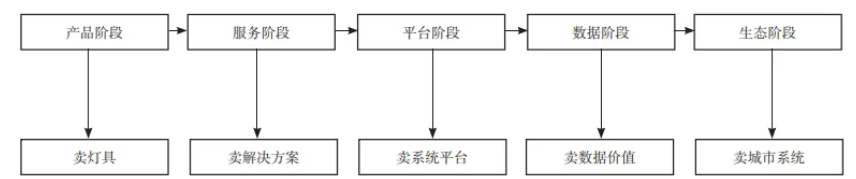
Figure 1 Schematic Diagram of the Lighting Company’s Four‑Stage Leap
4.1 Stage One: Product → Service
Shift from selling individual luminaires to offering integrated services encompassing “design + product + installation + maintenance.” Contractual energy management and energy‑leasing models exemplify this stage, with the key being the establishment of long‑term service awareness and contractual capacity. For instance, Xinghua City in Jiangsu launched a public lighting energy‑leasing project in 2025, assigning one lighting company responsibility for 15 years of full‑cycle O&M. The company managed everything from luminaire replacement to smart platform construction and fault response, without requiring any upfront government funding. Upon completion, the smart platform connected with the 12345 government hotline, enabling citizen‑reported repairs to be addressed within two hours and fixed within 24, handling over 600 cases annually, with a stable illumination rate exceeding 98%. The project’s breakthrough lay in securing a 15‑year service contract, which provided the company with steady long‑term cash flow while helping the government achieve its “burden‑reduction” goals. More importantly, the company evolved from a mere “lamp‑repairer” into a public‑service operator ensuring continuous operation, gaining invaluable experience in cross‑departmental collaboration.
4.2 Stage Two: Service → Platform
Once a company’s maintained lighting infrastructure reaches a certain scale, it can build a smart lighting management platform, enabling remote monitoring, fault alerts, energy‑consumption management, and data collection. The platform serves not only as an efficiency tool but also as a deeply integrated “digital interface” with government agencies. For example, Zhangjiagang City installed nearly 2,000 multifunctional light poles, integrating lighting, surveillance, broadcasting, meteorological sensors, and electric‑bike charging stations, with select pilot sites even equipped with 5G micro‑stations. A company undertook the construction and operation of the city‑level smart lighting management platform, connecting over 33,000 LED streetlamps to enable multi‑use and data sharing. The platform automatically adjusts surrounding streetlamp brightness according to school evening study schedules, providing services to emergency management, environmental monitoring, and smart transportation departments. In this case, the platform’s capabilities enabled the company to shift from project‑based to operational‑based work. No longer relying on sporadic equipment sales, the company generated stable income through platform services while accumulating valuable data assets that laid the groundwork for further value creation. This practice aligns with the broader trend of smart lighting systems, leveraging sensor networks and dynamic adaptation technologies to achieve precise, flexible light management.
4.3 Stage Three: Platform → Data
As one of the most widely distributed and reliably powered infrastructures in urban areas, lighting facilities naturally possess strong data‑collection advantages. Pedestrian heat maps, environmental monitoring data, traffic‑flow information—all can support urban decision‑making. Developing data‑service capabilities represents a crucial step in shifting the company’s focus from cost center to value center. For example, Nanjing Lighting Group deployed multifunctional smart light poles in the Southern New Town and Hexi Olympic Sports District, integrating HD cameras, millimeter‑wave radar, 5G micro‑stations, and environmental monitoring modules (PM2.5, temperature/humidity, noise). Each pole housed an edge‑computing module, providing low‑latency computing power and 24‑hour charging support for autonomous delivery vehicles. Through its smart streetlamp management platform, Nanjing Lighting Group achieved remote monitoring, fault‑heat map generation, and on‑demand dimming. Even more groundbreaking was the data‑service component: the group supplied pedestrian‑vehicle flow heat maps to traffic authorities, occupancy‑warning alerts to urban management, and nighttime footfall trend analyses to commercial entities. Revenue from these data services began contributing to profits, transforming lighting facilities from cost‑driving assets into money‑making resources.
4.4 Stage Four: Data → Ecosystem
The highest‑level leap sees lighting companies becoming pivotal nodes within the city’s digital ecosystem. By opening API interfaces, lighting facilities connect with transportation, security, environmental protection, and commercial systems, evolving from functional components into integral parts of the urban operating system. For example, Nanjing Lighting Group spearheaded the formation of the “Nanjing Metropolitan‑Level IoT Sensing System Innovation Consortium,” collaborating with Zijinshan Laboratory, Southeast University, and six other institutions to drive upstream and downstream innovation. The group ceased being merely an operator of lighting facilities and became a participant in setting urban IoT sensing standards and co‑designing data‑exchange protocols. This ecological positioning grants it irreplaceable competitive advantages in subsequent urban renewal projects.
The four‑stage leap does not occur automatically; each stage requires specific capability accumulation and favorable external conditions (Table 3).
Table 3 Stage Requirements for the Four‑Stage Leap
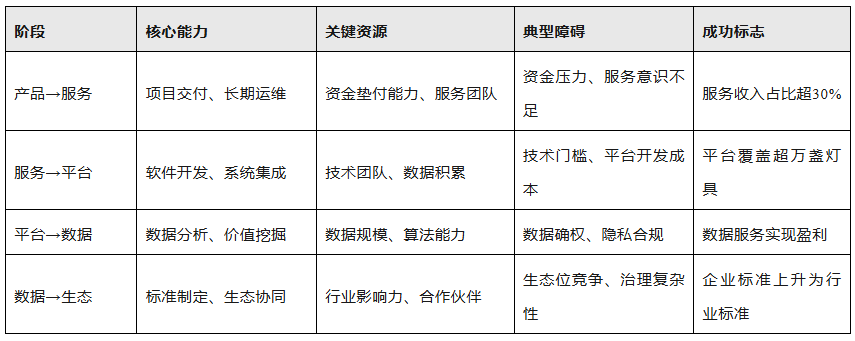
Product → Service
Project delivery, long‑term O&M
Funding‑advancing capacity, service team
Funding pressures, insufficient service awareness
Service revenue accounting for over 30%
Service → Platform
Software development, system integration
Technical team, data accumulation
Technical thresholds, platform development costs
Platform coverage of over ten thousand luminaires
Platform → Data
Data analysis, value extraction
Data scale, algorithmic capabilities
Data rights confirmation, privacy compliance
Data services achieving profitability
Data → Ecosystem
Standard setting, ecological coordination
Industry influence, partnerships
Ecosystem competition, governance complexity
Company standards rising to industry standards
5 Conclusion
Urban renewal has opened a historic window for China’s lighting industry. Yet the true value of this window depends not on order size, but on whether companies can accomplish profound functional reinvention. From “light providers” to “urban vitality operators,” the value anchor of lighting enterprises is undergoing a fundamental shift. The article’s core conclusions can be summarized in three points: (1) Urban renewal has transformed the lighting industry’s needs—from equipment replacement to system‑wide services. The model of profiting solely from product price differentials is becoming obsolete; companies capable of delivering integrated services spanning design, installation, platform, O&M, and data will command premium pricing. (2) The triple challenges of funding, institutions, and capabilities are intertwined, forming structural barriers that constrain industry transformation. Breaking through any single dimension alone will prove insufficient; companies must systematically reconstruct their capability frameworks and business models. (3) The four‑stage leap—from product to service, then to platform, data, and finally ecosystem—is a viable path to transformation. Successful cases demonstrate that starting with contractual energy management, gradually building platform and data capabilities, and ultimately integrating into the city’s digital ecosystem constitutes a proven strategy.
Based on these conclusions, the following recommendations are offered: (1) Actively engage with policy chains; deeply participate in local urban renewal master plans and strive to become technical supporters of pilot projects. Companies are encouraged to dispatch representatives to local urban renewal think tanks to gain early access to project information and policy trends. (2) Build composite capabilities: on top of manufacturing strengths, strengthen modules such as system integration, platform development, and government affairs. Small and medium‑sized enterprises may bridge capability gaps through collaborations with technology firms and universities. (3) Choose an appropriate starting point for the leap: SMEs can begin with contractual energy management or regional O&M outsourcing, gaining experience before advancing toward platform‑based operations. Blindly pursuing “leapfrogging” may反而 increase risks. (4) Adopt a long‑term mindset: urban renewal is a protracted battle lasting about ten years, not a quick order‑driven sprint. Companies should prepare financially, stockpile talent, and restructure their organizations to accommodate long‑term commitments.
References
[1] Fujita M., Krugman P., Venables A. J. Spatial Economics: Cities, Regions, and International Trade [M]. Translated by Liang Qi. Beijing: China Renmin University Press, 2013.
[2] Xinhua News Agency. Opinions of the General Office of the CPC Central Committee and the General Office of the State Council on Continuously Advancing Urban Renewal [EB/OL]. (May 15, 2025) [June 15, 2025]. https://www.gov.cn/zhengce/202505/content_7023880.htm.
[3] Xinhua News Agency. Recommendations of the CPC Central Committee on Formulating the Fifteenth Five-Year Plan for National Economic and Social Development [EB/OL]. (October 23, 2025) [June 15, 2025]. https://www.gov.cn/gongbao/2025/issue_12386/202511/content_7047415.html.
[4] National Bureau of Statistics. China Statistical Yearbook 2025 [M]. Beijing: China Statistics Press, 2025.
[5] DB4404/T84‑2025 Smart Urban Management Road Lighting Facility Coding Specifications [S].
Qian Zongming

Director of the Digital and Night‑Tourism Economy Research Center at the Jiangsu Provincial Innovation Economy Research Base, Secretary-General of the Jiangsu Lighting Society, and expert on nighttime tourism economics at the Jiangsu Department of Culture and Tourism. He has long been engaged in MBA teaching and theoretical research on lighting economics and night‑tourism economics.
This article was published in the journal “Light Source and Illumination”.