
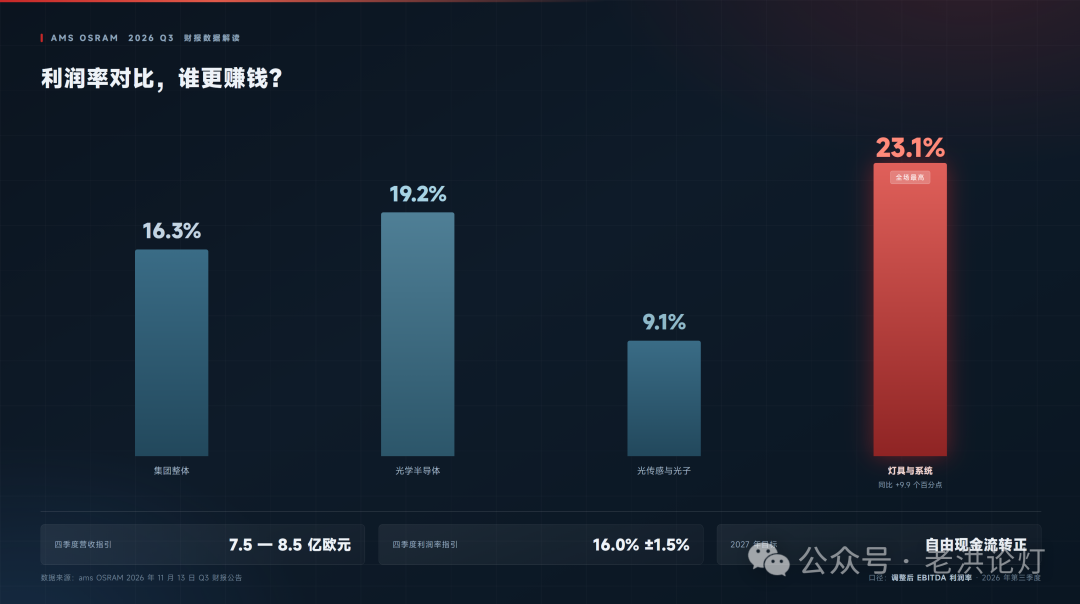
ams OSRAM Q3 Earnings Report: The lighting division’s profit margin is 4 percentage points higher than that of the chip division.
Ams Osram’s latest Q3 financial report shows: the Luminaire division posted an adjusted operating margin of 23.1%, nearly 4 percentage points higher than Optical Semiconductor.
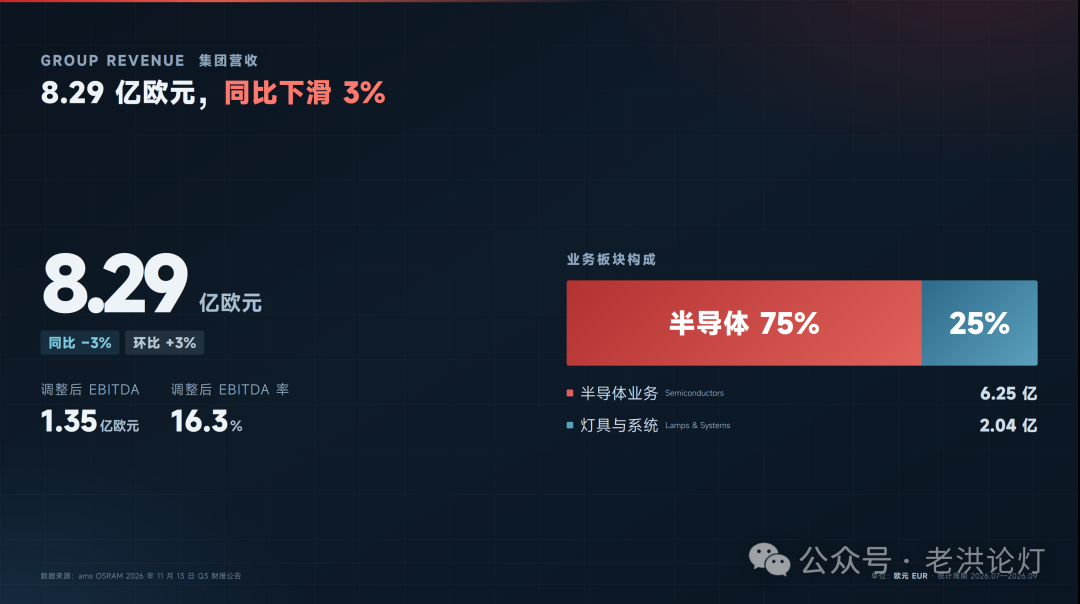
Q3 results released on November 13: Revenue €829 million, up 3% quarter-over-quarter but down 3% year-over-year; Adjusted EBITDA €135 million, margin 16.3%.
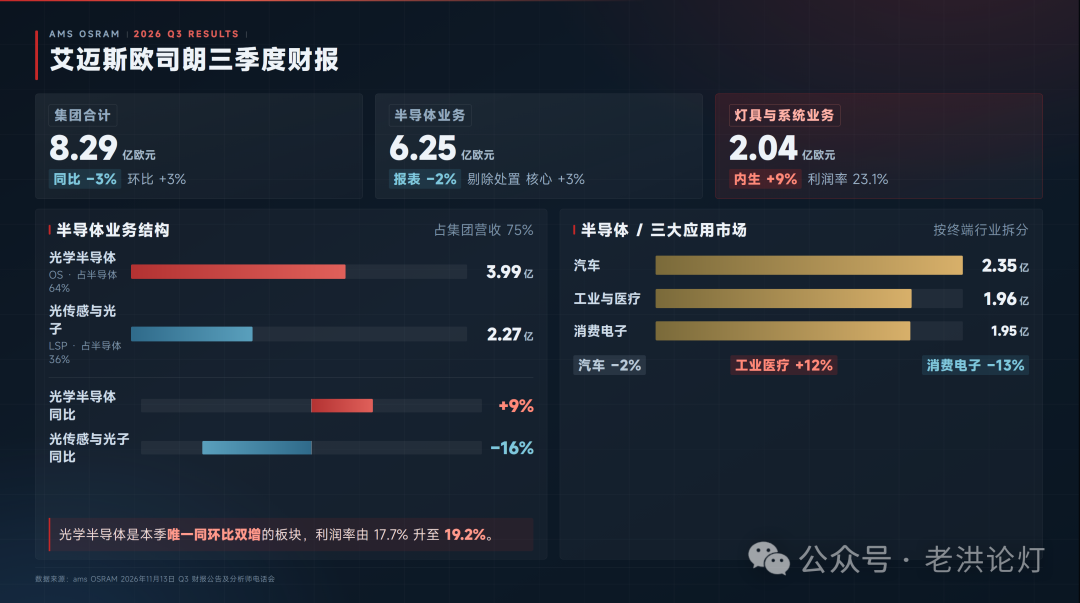
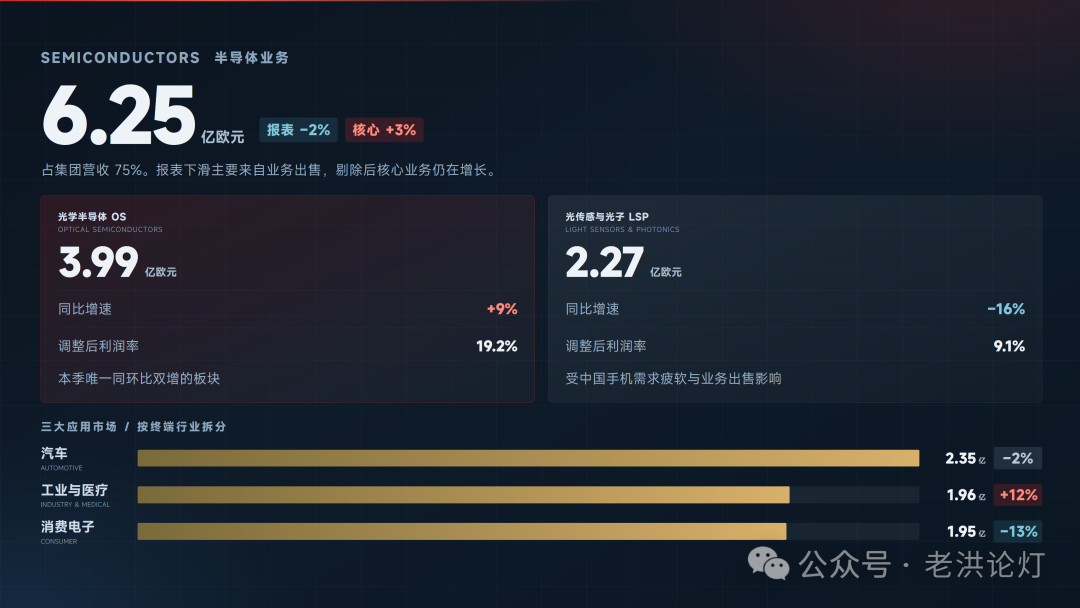
The three business segments:
Optical Semiconductor €399 million, up 9%, margin 19.2%;
Light Sensing €227 million, down 16%, margin 9.1%—this includes near-zero-margin contract manufacturing for Infineon;
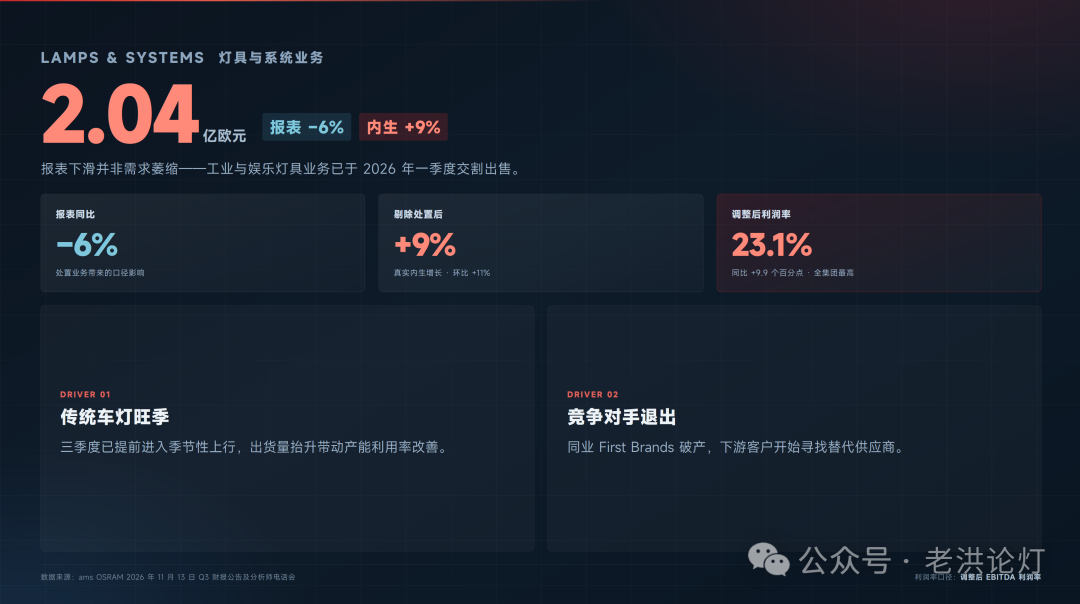
Traditional Automotive Luminaires €204 million; excluding divested businesses, up 9%, margin 23.1% (compared to just 13.2% in the same period last year).
In terms of profitability, the Luminaire segment wins.
Old Hong highlights four points.
First, this 23.1% isn’t just a result of shedding underperforming assets. This year they sold Entertainment & Industrial Luminaires to Japanese firm Ushio and non-optical sensors to Infineon. The divested segment generated roughly €170 million in revenue in 2024—it was a profitable high-end specialty light source—and Ushio paid €114 million. The company prioritized cash to reduce leverage. Margins improved, with reports citing increased shipments and better factory efficiency; Adjusted EBITDA reached €47 million, up 66%. Three-quarters of OSRAM’s revenue now comes from chips—the company is no longer just a lighting firm.
Second, why are automotive lights so valuable? Because they represent certification-driven business. Once an automaker locks in a supplier through IATF 16949, AEC-Q102, PPAP, and other standards, that relationship lasts five to seven years. My deepest takeaway from reviewing test reports: certification isn’t a barrier—it’s pricing power. Those who pass earn prices embedded in contracts; those who fail can only compete on price at trade shows.
Third, don’t be fooled by the 16.3% figure. Reported net profit of €319 million relies on one-time gains from asset sales; stripping out disposals, transformations, and M&A, Adjusted Net Profit still shows a loss of €35 million. When analyzing OSRAM’s financials, always look at Adjusted figures first, then Net Profit—reverse the order and you’ll reverse your conclusions.
Fourth, AI optical interconnects remain within reach for industry observers but not manufacturers. An 850nm thin-film micro VCSEL achieving 32Gb/s at 0.25 pJ/bit has been adopted into Credo’s SRMO standard and active optical cable demos; as for Micro LED CPO, the company itself projects commercialization between 2029 and 2030, with zero commercial revenue today. This path demands Epitaxy, Wafers, and Packaging—not assembly. Positioning AI lighting as a selling point may work, but it cannot serve as a viable exit strategy.
Chinese optoelectronics executives should remember one thing: your competitors have changed. Infineon took over sensors, Ushio handles specialty lights, and Credo is setting the rules for next-generation optical interconnects.
Lights aren’t losing value—they’re becoming cheaper, while certified, standardized, and designated products remain highly valued. Automotive lights, marine lights, medical lights—all follow this logic.
One question: which of your current businesses are truly locked-in?
Follow Old Hong’s insights on lighting to illuminate your path forward!
About the Author, Hong Bing:
Hong Bing currently serves as Editor-in-Chief of China Light Network & Agricultural Lighting Network—the official websites of the China Illuminating Electrical Appliances Association—Executive Dean of Ming Classroom, Executive Vice President of the Beijing Illuminating Electrical Appliances Association, Deputy Chairperson of both the Talent Training Committee and the Agricultural Lighting Professional Committee under the China Illuminating Electrical Appliances Association, Executive Deputy Chairperson of the Fudan University Alumni Lighting Alumni Association, and Board Member of the CEIBS Ecological Environment Alumni Association. He graduated from Fudan University’s Department of Light Sources and Lighting Engineering in 1991 and earned an MBA from CEIBS in 2003. Over his career, he has worked in R&D, product planning, and marketing at institutions including the China Building Materials Academy, Panasonic, GE, and OSRAM. In 2008, he received Siemens Global Top Plus Award and Siemens China Outstanding Performance Award, and founded China Light Network in 2009.
For More Exciting Content, Please Follow Our Official WeChat Account / Video Channel
“Old Hong on Lighting”
China Light
The official website of the China Association of Lighting Industry and a full-media platform for the lighting sector. We provide authoritative and timely lighting information while striving to be a growth partner for businesses. From brand promotion and channel expansion to consulting, talent training and participation in standards development, we provide comprehensive professional services to help businesses improve quality and efficiency and jointly advance the high-quality development of the lighting industry.
Business Contacts
仇纯 (Ms.): 158 6155 3579
顾君 (Mr.): 137 7157 5253