
Brief on China's Lighting Industry Export to Belt and Road Countries
A research report titled “The Belt and Road Initiative: High-Quality International Economic Cooperation,” released during the Belt and Road Forum for International Cooperation held in January this year, points out that jointly building the Belt and Road is an international public good originating from China yet belonging to the world, and serves as an important practical platform for building a community with a shared future for mankind. The Outline of the 15th Five-Year Plan also calls for promoting high-quality development of the Belt and Road Initiative. As an important export-oriented industry deeply integrated into the global supply chain, the lighting sector demonstrated strong resilience and vitality during the 14th Five-Year Plan period amid the deepening advancement of the Belt and Road Initiative, while also facing both opportunities and risks. Standing at this new starting point, we must remain confident and forge ahead to create a new landscape of high-quality Belt and Road cooperation. (This article provides a brief overview of China’s lighting exports to Belt and Road countries from 2022 to 2026; more detailed analysis will be published in the China Lighting journal issued by the China Illuminating Engineering Society in 2026.)
I. Stable Foundation of Foreign Trade Under Pressure
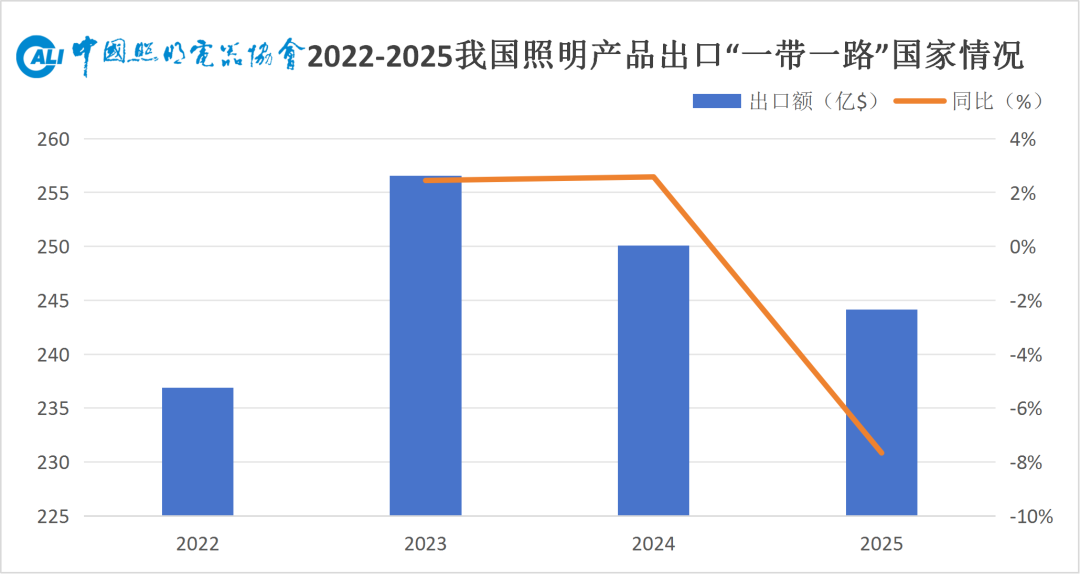
Facing a severe and complex external environment, China has leveraged its complete industrial system and robust manufacturing support capabilities to continuously deepen economic and trade cooperation with Belt and Road partner countries, enabling lighting foreign trade to maintain strategic stability and establish a solid base despite fluctuations. As an important component of China’s electromechanical product exports, the global supply chain position of lighting products has been steadily consolidated. According to relevant trade statistics, during the first three years of the 14th Five-Year Plan—2022 to 2024—the total value of China’s lighting exports to Belt and Road countries showed a steady upward trend, rising from US$24.412 billion in 2022 to US$25.654 billion. Entering 2025, affected by adjustments in the international supply chain and cyclical fluctuations in overseas inventories, the annual total value of lighting exports reached US$23.688 billion, down 7.66% year-on-year (YoY); however, the overall scale remained among the highest in history, fully demonstrating the strong risk-resistance and resilience of China’s lighting foreign trade in navigating market cycles.
The strategic importance of Belt and Road partner countries in China’s overall lighting export landscape has increased year by year. The share of China’s lighting exports to Belt and Road countries in the nation’s total lighting exports has risen significantly and consistently: from 38.93% in 2022 to 44.42% in 2023, 45.73% in 2024, and further climbing to 47.47% in 2025. This continuously growing global share clearly proves that the Belt and Road market has become a solid ballast and core growth pole for China’s lighting foreign trade.
II. Evolution of the Export Portfolio Over Four Years
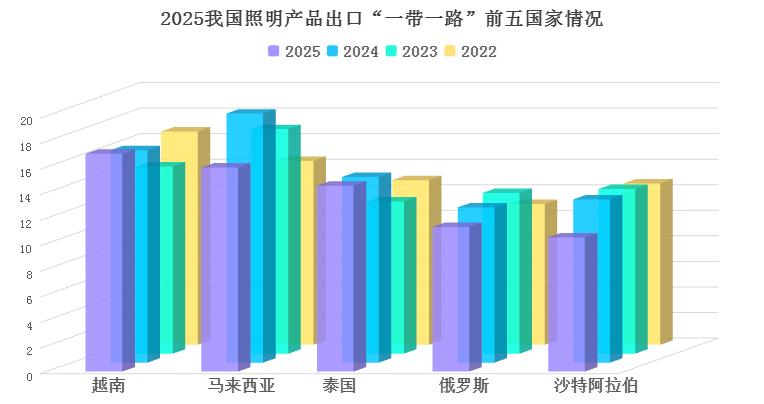
Note: The chart shows the top five destinations for China’s lighting exports to Belt and Road countries in 2025.
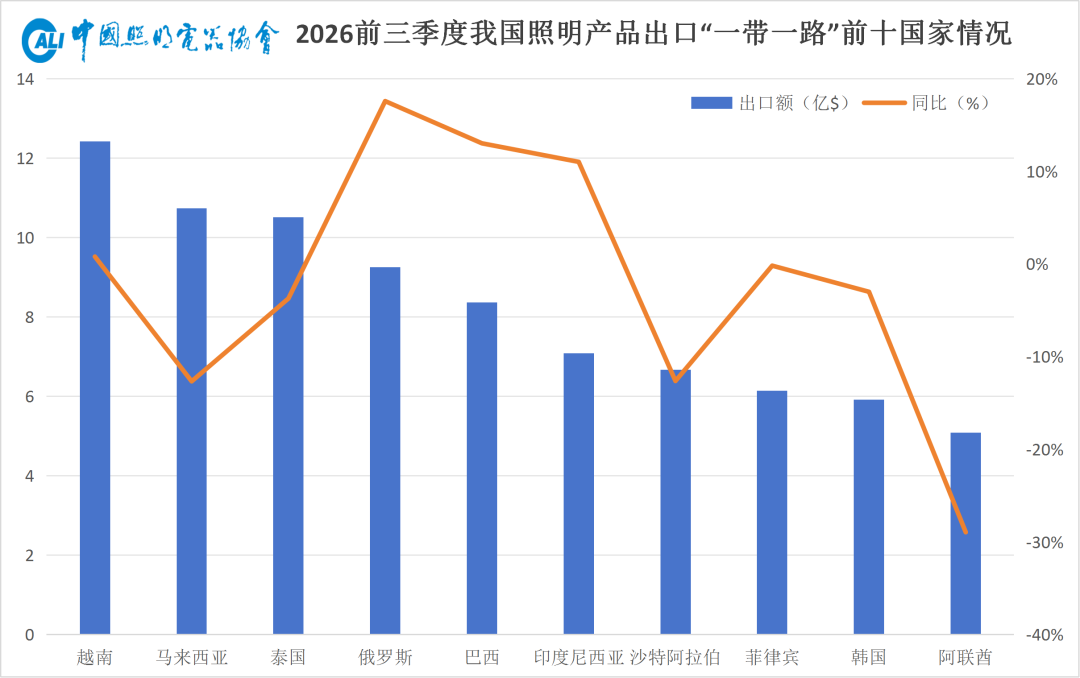
Between 2022 and 2025, the group of the top ten countries receiving China’s lighting exports under the Belt and Road Initiative remained highly stable. Vietnam and Malaysia continued to hold the first two positions, while Thailand, Saudi Arabia, Russia, and the United Arab Emirates firmly maintained their places within the top six. In the first three quarters of 2026, regional structural differentiation became pronounced, with traditional hubs remaining resilient: Vietnam stayed firmly in first place with exports totaling US$1.243 billion, up 0.79% YoY; exports to Russia reached US$925 million, surging 17.58% YoY; Brazil recorded lighting exports of US$837 million during the same period, a significant increase of 13.02% YoY; Kazakhstan stood out with lighting exports climbing to US$471 million, up a remarkable 34.40% YoY. These high-growth highlights effectively offset the pressure caused by temporary adjustments in some traditional Middle Eastern re-export markets—for example, the UAE’s lighting exports fell to US$510 million in the first three quarters of 2026, down 28.95% YoY. The shifts in the export portfolio reflect the irreplaceable advantages of China’s lighting manufacturing sector, including its complete global supply chain and economies of scale. Traditional hubs such as Southeast Asia and the Middle East continue to absorb Chinese production capacity thanks to established logistics networks and re-export benefits. Meanwhile, these changes are also the inevitable result of dual drivers: policy dividends and market demand. Emerging markets like Brazil in Latin America and Russia have seen steady growth, largely due to substantive breakthroughs brought about by enhanced policy coordination and smoother trade flows under the Belt and Road framework.
For a long time, European and American markets have been key destinations for China’s lighting exports. In the early stages, before deep regional policy alignment with the Belt and Road was established, the structure of lighting export markets was relatively concentrated. Following the implementation of the initiative, bilateral and multilateral institutional benefits effectively reduced trade barriers. For partner countries, direct access via the China-Europe Railway Express and the New International Land-Sea Trade Corridor has introduced cost-effective Chinese infrastructure lighting, municipal lighting, and green energy-saving products, strongly supporting local industrialization and urbanization processes. For China, the market structure has undergone optimization and transformation, successfully establishing ASEAN, the Middle East, Eurasia, and Latin America as stable foundations for foreign trade, effectively hedging against fluctuations in traditional U.S. and European markets and propelling lighting foreign trade toward balanced, diversified, and sustainable high-quality development.
III. Green Low-Carbon and High-End Intelligent Manufacturing: Coexisting Opportunities and Risks
In long-term foreign trade practice, China’s lighting exports along the Belt and Road have exhibited distinct structural characteristics. While embracing broad development opportunities, they also face challenges stemming from global supply chain restructuring and external trade restrictions. On one hand, industrial synergy creates new growth momentum. Electrical lighting devices for motor vehicles maintained steady growth, reaching US$1.825 billion in 2025, up 6.78% YoY, marking consecutive years of positive growth and fully demonstrating the comprehensive competitive advantages of China’s automotive industry chain and lighting manufacturing working together to expand overseas, as well as new opportunities for further development. On the other hand, uncertainties in the external environment and risks arising from supply chain restructuring cannot be ignored. Exports of other lamps and lighting fixtures powered solely by Light-emitting Diode (LED) sources continued to expand, reaching US$1.015 billion, a substantial year-on-year increase of 12.27%, following a 37.5% YoY rise in 2024. LED modules achieved US$317 million in exports in 2025, up 27.73% YoY, while parts exports for LED modules surged by 80.38% YoY. These figures reflect the rapid overseas expansion of China’s lighting manufacturing sector in Belt and Road countries and regions, further driving the outward flow of production capacity.
During the 14th Five-Year Plan period, lighting manufacturers accelerated industrial relocation to Southeast Asia and other regions, focusing on labor-intensive and basic assembly links. In the long run, this poses new challenges to maintaining China’s pivotal position in the lighting supply chain. Faced with pressures from compliance requirements and rising costs associated with traditional production capacity and intermediate goods exports, further elevating and consolidating the high-end and green levels of China’s lighting industry remains a crucial direction and measure for sustaining global competitiveness in the lighting market. In response to these external challenges, China’s lighting industry should steadfastly implement the strategy of “domestic and international dual circulation,” guiding China’s lighting exports toward a new stage of high-quality development characterized by advanced technology and brand leadership.
Looking back at the 14th Five-Year Plan, China’s lighting industry delivered an impressive performance in the grand practice of Belt and Road construction, achieving comprehensive leaps in the quality, structure, and effectiveness of foreign trade development. Today, confronted with complex and volatile overseas markets, China’s lighting exports are accelerating their shift from competing on price to competing on technological content and brand value. Looking ahead, amid a new round of scientific and technological revolution and industrial transformation, China’s lighting industry will consolidate its supply advantages and hub position in the global lighting market through increasingly diversified products and services.
Source: China Illuminating Engineering Society
China Light
The official website of the China Association of Lighting Industry and a full-media platform for the lighting sector. We provide authoritative and timely lighting information while striving to be a growth partner for businesses. From brand promotion and channel expansion to consulting, talent training and participation in standards development, we provide comprehensive professional services to help businesses improve quality and efficiency and jointly advance the high-quality development of the lighting industry.
Business Contacts
仇纯 (Ms.): 158 6155 3579
顾君 (Mr.): 137 7157 5253