
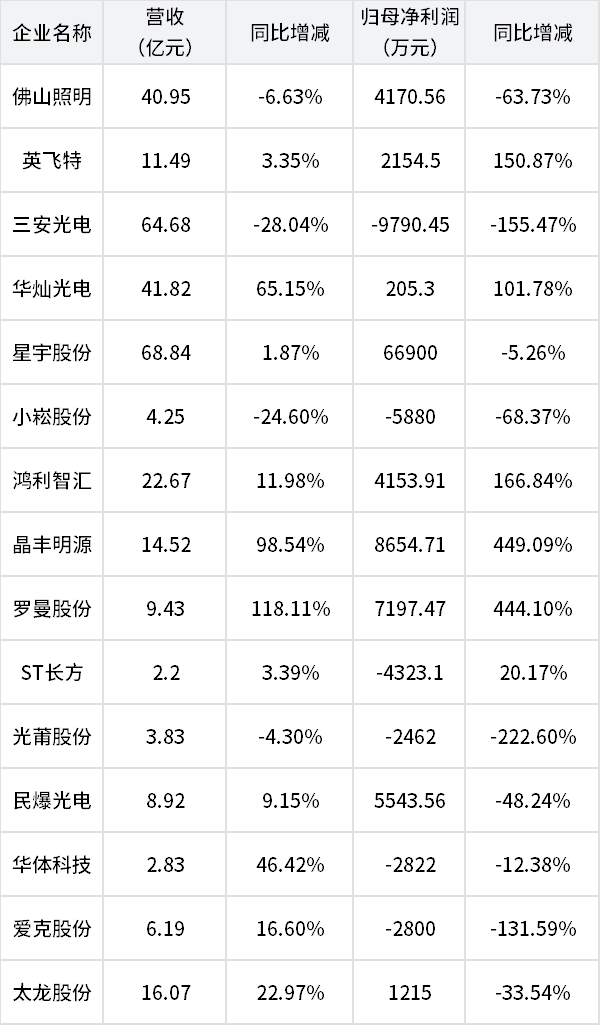
A comprehensive review of the 2026 interim reports from 15 LED companies, including Sanan, Foshan Lighting, and HC Semitek.
In the first half of 2026, companies in the lighting industry and its supply chain delivered highly differentiated results.
Foshan Lighting
On August 25, Foshan Lighting released its 2026 semi-annual report, reporting revenue of RMB 4.095 billion for the first half of the year, down 6.63% year over year; net profit attributable to shareholders was RMB 41.7056 million, a decrease of 63.73% compared with the same period last year.
Regarding the performance changes, Foshan Lighting stated that the primary factors were a decline in gross margin, increased foreign exchange losses, and lower profits at its subsidiaries.
By product category, general lighting products generated RMB 1.611 billion in revenue, up 3.55% year over year; LED packaging and component products recorded RMB 949 million, down 16.64%; automotive lighting reached RMB 945 million, down 6.76%; and trading and other products brought in RMB 590 million, down 12.97%.
Enfit
Enfit’s 2026 semi-annual report shows that during the reporting period, the company achieved operating revenue of RMB 1.149 billion, up 3.35% year over year; net profit attributable to shareholders was RMB 21.545 million, a remarkable 150.87% increase, marking a turnaround from loss to profit.
The company adheres to a strategy focused on key customers and global expansion, continuously deepening business integration and optimizing internal management, resulting in steady operational recovery.
From a revenue perspective, the core LED driver power supply segment generated RMB 898 million, up 2.43%, continuing to serve as a revenue anchor. Sales volume grew by 16.37%, and market share continued to expand. The LED module business also performed strongly, generating RMB 159 million, up 15.11%, with the transformation toward smart lighting and system solutions gradually bearing fruit.
On the channel side, both distribution and direct sales models worked in tandem: distribution revenue rose 5.93%, while direct sales increased by 3.15%, steadily enhancing global market coverage.
San'an Optoelectronics
In the first half of 2026, San'an Optoelectronics reported revenue of RMB 6.468 billion, down 28.04% year over year; net profit attributable to shareholders stood at -RMB 97.9045 million, a 155.47% decline compared with the same period last year.
Specifically, the LED epitaxial chip business generated RMB 3.103 billion, up 11.81%; LED application products brought in RMB 1.683 billion, up 17.62%; while integrated circuit products recorded RMB 1.268 billion, down 15.40%.
During the reporting period, the company actively expanded high-value-added offerings in niche areas such as Mini/Micro LED, automotive lighting, commercial aerospace, and plant lighting, increasing the proportion of premium product revenue and driving steady growth in the LED business. Micro direct-display products continued to supply leading domestic and international customers, with Micro-MiP commercial large-screen market share steadily rising. Development of Micro ADB LED chips for automotive headlights progressed smoothly, with strategic collaborations underway and sample validation ongoing. Meanwhile, the company continued advancing research and production lines for Micro LED applications in PHUDs, smartwatches, AR displays, and other fields, while also conducting collaborative verification projects with multiple clients in the Micro LED optical interconnect sector.
HuaCan Optoelectronics
HuaCan Optoelectronics reported revenue of RMB 4.182 billion in the first half of the year, a substantial 65.15% increase year over year; net profit attributable to shareholders reached RMB 205.3 million, reversing last year’s loss of RMB 115 million—a 101.78% year-over-year improvement.
HuaCan stated that it is simultaneously pursuing “value-based marketing,” leveraging capacity expansion to strengthen market penetration and optimize product and customer structures, thereby boosting profitability. At the same time, the company continues to enhance technology, refine lean management practices, and reinforce back-office capabilities, achieving notable results in product enhancement, cost reduction, process optimization, and improved labor efficiency—factors that have contributed to overall operational improvements.
The company has established a dedicated team focusing on developing and industrializing future-oriented strategic R&D projects, including Micro LED chip manufacturing processes and related transfer technologies, as well as GaN power devices. It maintains close collaboration with upstream and downstream partners, domestic and international enterprises, universities, and research institutes. Looking ahead, HuaCan is proactively positioning itself in advanced product technologies and market applications, aiming to build stronger competitive advantages through technological innovation.
Xingyu Shares
Xingyu Shares announced its 2026 interim report, showing operating revenue of RMB 6.884 billion, up 1.87% year over year; net profit attributable to shareholders was RMB 6.69 billion, down 5.26%.
Leveraging its vertical integration advantage in automotive lighting manufacturing, Xingyu maintained modest revenue growth despite pressure on passenger car domestic sales. However, rising raw material costs and weaker-than-expected sales of certain vehicle models led to a slight decline in profitability. At the same time, the company continued to deliver high dividends to shareholders and accelerated the development and deployment of smart lighting and perception-integrated systems.
The report also highlighted the company’s ongoing digital transformation efforts, integrating management systems to improve operational efficiency. Additionally, it strengthened new technology R&D, striving to become a leading supplier of smart lighting and perception-integrated systems.
Xiaosong Shares
Xiaosong Shares released its 2026 semi-annual report, reporting operating revenue of RMB 425 million, down 24.6% year over year; net profit attributable to shareholders shifted from a loss of RMB 34.93 million last year to a loss of RMB 58.80 million this year, a 68.37% year-over-year decline.
Among these, the home appliance business faced intensified market competition, generating RMB 293 million in revenue, down 34.41%. Sales of rechargeable lighting fixtures and rechargeable AC/DC fans both declined significantly: revenue from rechargeable lighting fixtures fell to RMB 72.72 million, down 30.75%, while revenue from rechargeable AC/DC fans dropped to RMB 12.40 million, down 45.91%. These businesses were impacted by macroeconomic conditions, climate factors, and heightened competition, resulting in reduced order volumes.
Furthermore, in September 2025, Xiaosong increased capital into Songguo Culture, expanding into the film and television sector. During the reporting period, the film and TV business generated RMB 132 million in revenue, accounting for 31.02% of total revenue.
However, on August 26, Xiaosong issued an announcement stating that its board of directors had approved the “Proposal Regarding the 2026 Semi-Annual Report and Its Summary.” Nevertheless, Director Xu Chi voted against the proposal, citing significant concerns regarding major risk disclosures, accounting estimates and impairment provisions, revenue recognition methods, and data accuracy—issues he deemed insufficient to ensure the report’s authenticity, accuracy, and completeness. Consequently, he cast a dissenting vote.
Hongli Zhihui
Hongli Zhihui released its 2026 semi-annual report. During the reporting period, the company achieved operating revenue of RMB 2.267 billion, up 11.98% year over year; net profit attributable to shareholders reached RMB 41.5391 million, a 166.84% increase.
In the first half of the year, the LED semiconductor packaging business generated RMB 1.698 billion in main business revenue, accounting for 74.92% of total operating income, with a gross margin of 13.86%; meanwhile, the LED automotive lighting business brought in RMB 493 million, representing 21.73% of total revenue, with a gross margin of 11.46%.
The announcement indicated that the primary driver of revenue growth during the reporting period was an increase in order volume. In the LED semiconductor packaging segment, the company focused on high-efficiency, COB, RGB color light, DOB, plant lighting, and smart lighting—high-margin, high-performance sub-segments—continuously optimizing its customer base and product portfolio. Notably, filament products enjoyed abundant orders, with order sizes hitting record highs. The company also successfully onboarded a new international OEM client, smoothly fulfilling its first large-power product order. Additionally, its self-developed CHIP packaging products found applications in drone indicator lights, humanoid robot optoelectronic components, and other emerging scenarios, precisely capturing the benefits of the low-altitude economy and the rapid growth of the humanoid robotics industry.
In the LED automotive lighting business, the company secured designated qualification for multiple new vehicle model headlight products during the reporting period, covering front headlights, rear combination lamps, ambient lights, signal lights, and other full-category offerings—laying a solid foundation for subsequent mass production and sustained performance gains.
Jingfeng Mingyuan
Jingfeng Mingyuan reported operating revenue of RMB 1.452 billion in the first half of 2026, up 98.54% year over year; net profit attributable to shareholders reached RMB 86.5471 million, a 449.09% increase.
Throughout the first half of the year, the company continuously optimized its product mix and supplemented its lineup of charging and other power management chips through the acquisition of Yichong Technology, resulting in a significant boost to overall sales revenue.
Currently, the company offers five product lines: LED lighting driver chips, AC/DC power chips, motor control driver chips, high-performance computing power chips, and charging/power management chips—all of which saw year-over-year revenue growth.
Notably, LED lighting driver chips benefited from supply chain integration, improving gross margins by 3.35 percentage points; AC/DC power chips entered the supply chains of major household appliance brands like Gree, Midea, TCL, as well as small appliance brands such as Joyoung, Xiaomi, and Leifen; in the first half of the year, the company generated approximately RMB 403 million in sales of charging and other power management chips.
Luoman Shares
Luoman Shares reported operating revenue of RMB 943 million in the first half of the year, up 118.11% year over year; net profit attributable to shareholders reached RMB 71.9747 million, a 444.10% increase. The company attributed the revenue surge primarily to growth in its urban lighting segment, alongside robust development of its AI computing power business, leading to an overall expansion in revenue scale.
In the urban lighting segment, the company implemented an integrated “design + technology + operations” business model. Projects such as Shanghai Haichang Ocean Park and Bozhou Wohe Night Tour were successfully launched, taking advantage of the 2026 World Artificial Intelligence Conference to complete supporting services for the “Smart Oriental Tide Toward the World” themed light show. Overseas operations also progressed steadily, particularly in Riyadh.
In the AI computing power segment, the company anchored itself firmly along the domestic path of intelligent computing power development, running a smooth integrated business model. Its controlling subsidiary, Wutong High-Tech, passed the China Quality Certification Center audit for the first time, earning ISO 20000 certification for IT services in the AI field and ISO 27001 certification for information security management.
Additionally, in the digital intelligence source and digital entertainment segments, the company won several project bids.
ST Changfang
In the first half of 2026, ST Changfang/Changfang Group reported operating revenue of approximately RMB 220 million, up 3.39% year over year; net profit attributable to shareholders remained at a loss of RMB 43.2310 million, though the loss narrowed slightly, a 20.17% year-over-year improvement.
The company noted that despite weak demand in the lighting market, high product standardization, and intense price competition squeezing profit margins, it maintained relatively rapid growth in portable energy storage products, driven by the growing popularity of outdoor lifestyles and rising emergency preparedness needs, leading to continuous expansion of the portable energy storage market.
Business-wise, mobile lighting applications and other electronic products generated RMB 183 million in revenue, down 1.64% year over year; patch-type LED business brought in RMB 27.71 million, up 76.89%, with improved gross margins compared with the previous year—largely due to the company’s strategic adjustments, focusing on high-efficiency, high-value-added orders and optimizing product structure. Domestically, revenue expanded but gross margins came under pressure; overseas, high-margin businesses contracted but profitability improved, creating complementary dynamics between the two markets.
Guangpu Shares
Guangpu Shares announced its 2026 semi-annual report, reporting operating revenue of RMB 383 million, down 4.3% year over year; net profit attributable to shareholders stood at a loss of RMB 24.62 million, down 222.6% year over year.
The performance decline was mainly attributable to employee stock ownership plan-related payment expenses and exchange rate fluctuations—payment expenses totaled RMB 17.1215 million, while foreign exchange losses amounted to RMB 12.0013 million. Meanwhile, the appreciation of the Renminbi put pressure on the company’s overseas revenue and profits.
During the reporting period, the company intensified its efforts to expand into the field of optoelectronic integrated sensing, planning to extend optoelectronic integrated packaging technology into the realm of optical communications. Additionally, the company continued ramping up R&D investments in smart lighting and flexible circuit boards, enriching its product portfolio and driving technological innovation.
Minbao Optoelectronics
Minbao Optoelectronics reported operating revenue of RMB 892 million in the first half of the year, up 9.15% year over year; net profit attributable to shareholders stood at RMB 55.4356 million, down 48.24% year over year.
Minbao Optoelectronics stated that, building on the steady growth of its LED lighting business, it strategically acquired Xiazhi Precision to expand into the PCB drill bit industry, establishing a dual-business layout encompassing LED lighting and PCB drill bits. The company emphasized that acquiring Xiazhi Precision would help accelerate its strategic transformation toward high-end precision manufacturing, allowing it to fully capitalize on the growth dividends brought by the rapid development of the AI industry and the PCB drill bit sector.
Huatite Technology
Huatite Technology reported operating revenue of RMB 2.83 billion in the first half of 2026, up 46.42% year over year; net profit attributable to shareholders stood at a loss of RMB 28.22 million, down 12.38% year over year, with the loss further widening.
Huatite Technology noted that, while it continued expanding its business in charging stations and energy storage product manufacturing and sales, overall operating revenue still grew. However, its lithium mining processing business suffered from volatile market conditions, resulting in current-period losses.
To mitigate the impact of broader economic downturns, the company focused on tapping market potential and refining its market layout around its annual business objectives. Leveraging its brand strengths, technological expertise, talent pool, and R&D capabilities in smart streetlights and their application scenarios, Huatite ensured stable corporate development amidst fierce market competition.
Aike Shares
Aike Shares reported operating revenue of RMB 6.19 billion in the first half of the year, up 16.6% year over year; net profit attributable to shareholders stood at a loss of RMB 0.28 million, down 131.59% year over year, with the loss further widening.
Aike Shares stated that, during the reporting period, its new energy vehicle business and charging station operations performed well. New energy vehicle production and sales maintained positive growth, with market penetration rapidly increasing. Conversely, its traditional lighting segment faced downward pressure, with weakening demand leading to declining performance. In response, the company adopted a “shrink frontlines, focus on high-end” strategy to contain losses.
Tailong Shares
Tailong Shares announced its 2026 interim report, reporting operating revenue of RMB 16.07 billion, up 22.97% year over year; net profit attributable to shareholders stood at RMB 12.15 million, down 33.54% year over year.
Tailong Shares’ main business revenue is centered on semiconductor distribution, supplemented by commercial lighting, while actively transitioning toward innovative tech-driven enterprises. During the reporting period, commercial lighting generated RMB 180 million in revenue, down 8.71% year over year. Tailong Shares stated that it will continue cultivating the high-end commercial lighting segment, strengthening core advantages such as smart lighting solutions, to achieve steady growth.