
Just now! Two major LED giants have announced price adjustments—could another wave of price hikes be on the horizon for the lighting industry?
Just now! Signify announced that it will raise product prices starting October 1, and Unilumin Technology has followed suit with a price adjustment. With leading companies hiking prices one after another, how long will this wave of price hikes last? And how should downstream manufacturers respond?
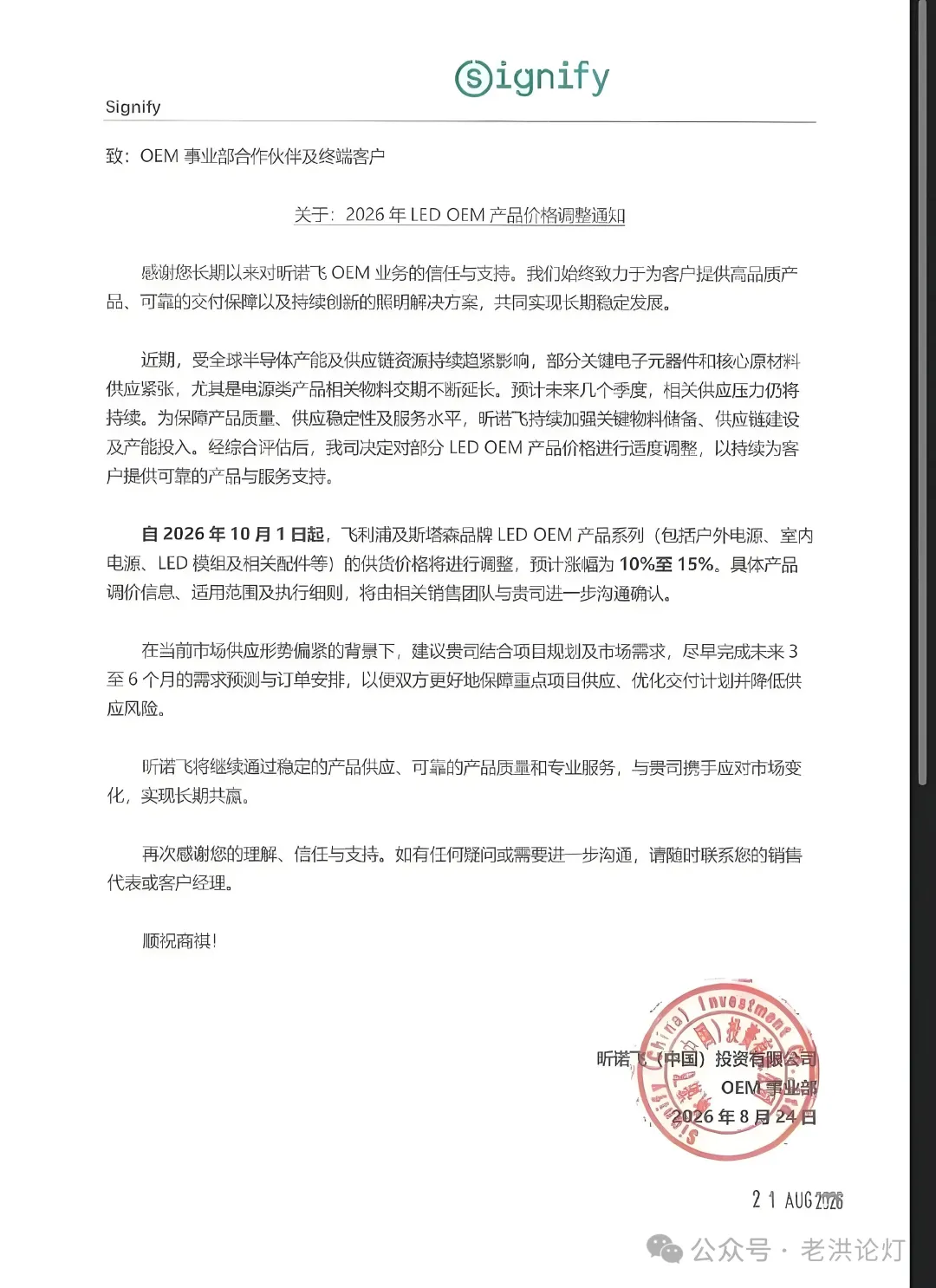
Recently, Signify issued a price‑adjustment notice, announcing that, effective October 1, 2026, it will adjust the prices of its Philips and Stylus brand LED OEM product lines, covering outdoor power supplies, indoor power supplies, LED modules, and accessories, with increases expected to range from 10% to 15%. The company cited ongoing global semiconductor capacity constraints and tightening supplies of electronic components—particularly prolonged lead times for materials required for power products—as well as tight supplies of key raw materials, all contributing to mounting cost pressures.
Meanwhile, Unilumin Technology also announced that, beginning September 5, it would implement moderate price increases across its product lines. This marks the latest in a series of price adjustments Unilumin has made since 2026.
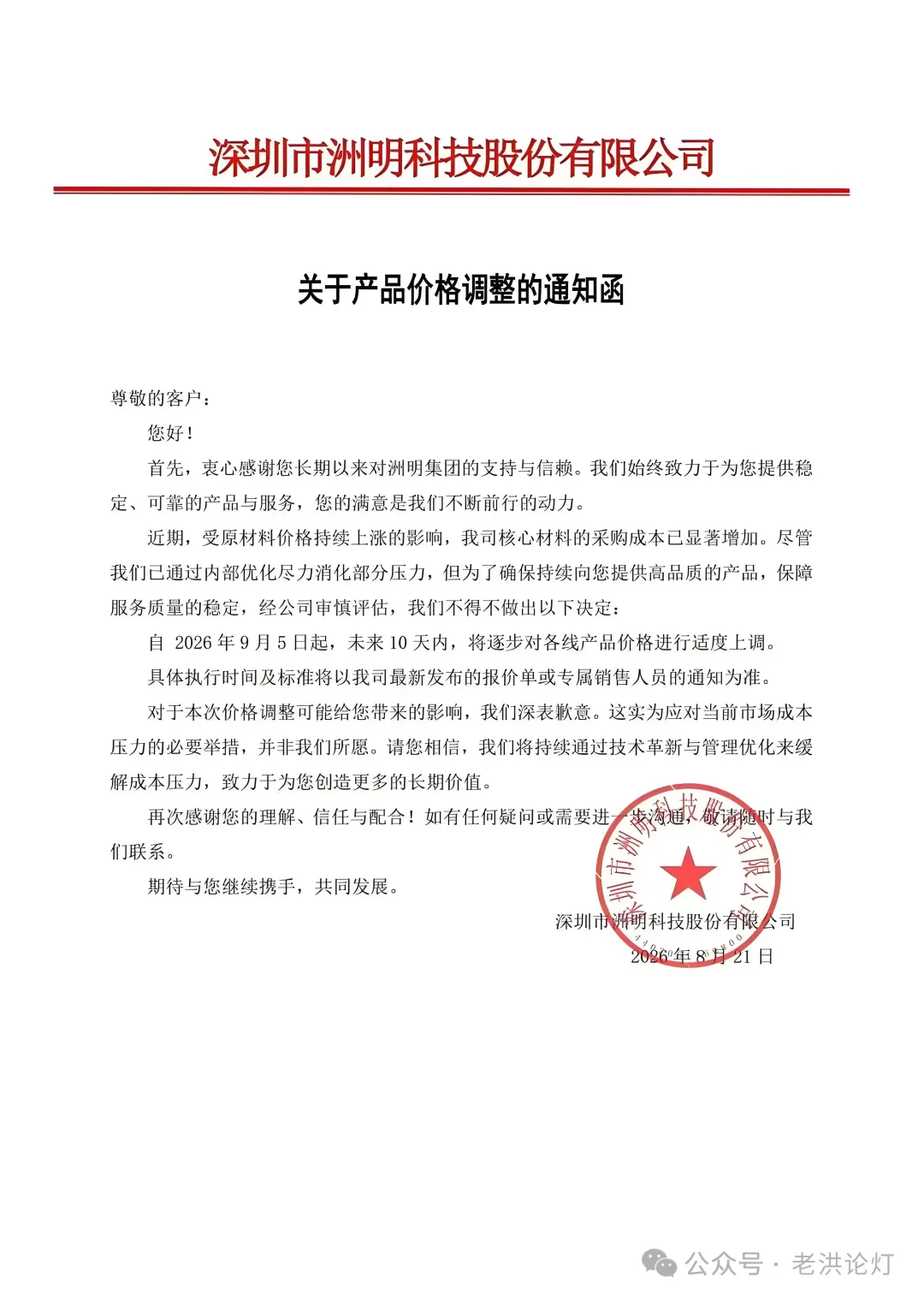
The back-to-back price hikes by these two industry leaders signal that the wave of price increases is spreading throughout the sector.
In its notice, Signify also specifically advised partners to complete demand forecasts and place orders for the next three to six months as soon as possible, ensuring supply for priority projects and mitigating risks. This reminder indirectly underscores that upstream supply shortages are unlikely to ease in the near term, meaning downstream companies must secure their supplies well in advance.
According to Lao Hong, the successive price hikes by Signify and Unilumin indicate that this round of increases stems not merely from isolated cost fluctuations at individual firms, but rather from structural supply constraints affecting the entire upstream segment of the value chain. Limited semiconductor capacity, extended lead times for critical components, and sharp year‑to‑date rises in bulk commodity prices such as silver and copper have all driven up manufacturing costs, with these pressures cascading through the supply chain to finished lighting products. With leading companies taking the lead, smaller and midsize manufacturers are likely to follow, prolonging the ripple effect across the entire chain.
In addition, Lao Hong noted that Signify has provided a relatively generous transition period—spanning from the release of the notice to the official implementation date of October 1—significantly longer than in previous pricing cycles. This gives partners ample time to stock up while allowing downstream customers to lock in orders ahead of time, thereby easing inventory and production scheduling pressures upstream. For distributors and system integrators, the pressing question right now is whether—and if so, how much—to stock up before the price hike takes effect, a decision that hinges on their ability to accurately anticipate future market demand.
Do you agree with Lao Hong’s perspective? Feel free to share your thoughts in the comments.
Follow “Lao Hong on Lighting” to illuminate your path forward!
About the author, Hong Bing:
Hong Bing currently serves as Editor-in-Chief of China Light Network and Agricultural Lighting Network—the official websites of the China Illuminating Electrical Appliances Association—Executive Dean of Ming Classroom, Deputy Director of the Talent Training Committee of the China Illuminating Electrical Appliances Association, Secretary-General of the Agricultural Lighting Professional Committee of the same association, Secretary-General of the Lighting Alumni Association of Fudan University, and a board member of the Ecological Environment Alumni Association of CEIBS. He graduated from the Department of Light Sources and Lighting Engineering at Fudan University in 1991 and earned an MBA from CEIBS in 2003. Over the years, he has held roles in R&D, product planning, and marketing at institutions including the China Building Materials Academy, Panasonic, GE, and OSRAM. In 2008, he received both the Siemens Global Top Plus Award and the Siemens China Excellence Award, and in 2009 founded China Light Network.