
Inspection Team’s Surprise Visit to the Lighting Distribution City: Some Stores Illegally Affix CCC Labels, While the Products Are Actually “Three-No” Luminaires.
In late July, the Office of the National Leading Group for Coordinating and Promoting Quality‑Driven Development, together with relevant member units, launched quality inspection activities for the first time.
Zhongshan, Guangdong, known as the “Capital of Chinese Lighting,” is home to key industrial hubs such as Guzhen, Henglan, and Xiaolan, accounting for over 60% of China’s residential lighting sales. However, during unannounced inspections at several major lighting‑accessories markets, the inspection team found that some small businesses and retail outlets continue to illegally sell “three‑no” products and use counterfeit or forged certifications.
Some companies are misusing 3C certification
Selling “three‑no” products
Based on leads gathered, the quality inspection team arranged for experts, posing as consumers, to conduct undercover visits at selected shops in Zhongshan’s Global Lighting Accessories City, Ruifeng Lighting Accessories City, and Qingfeng Lighting Accessories City. A reporter accompanied the team’s experts to document the situation on site.
At one lighting‑accessories store, inspectors discovered that many LED ceiling lights on display carried certificates of conformity but lacked the manufacturer’s name and address on their labels.
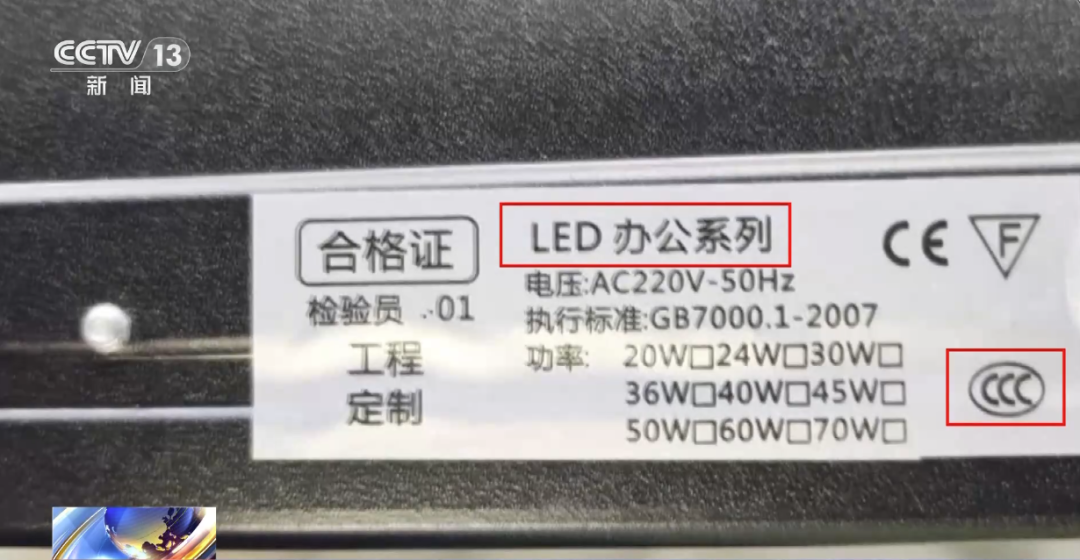
At another store, inspectors found an LED luminaire bearing only a certificate of conformity, labeled as part of the LED office series. Although it bore the CCC mark, it did not specify a model number, and its power ratings ranged from 20W to 70W—nine different values listed. A sales representative explained, “The certificate isn’t tied to any specific model; it’s a generic, cross‑model certificate.”
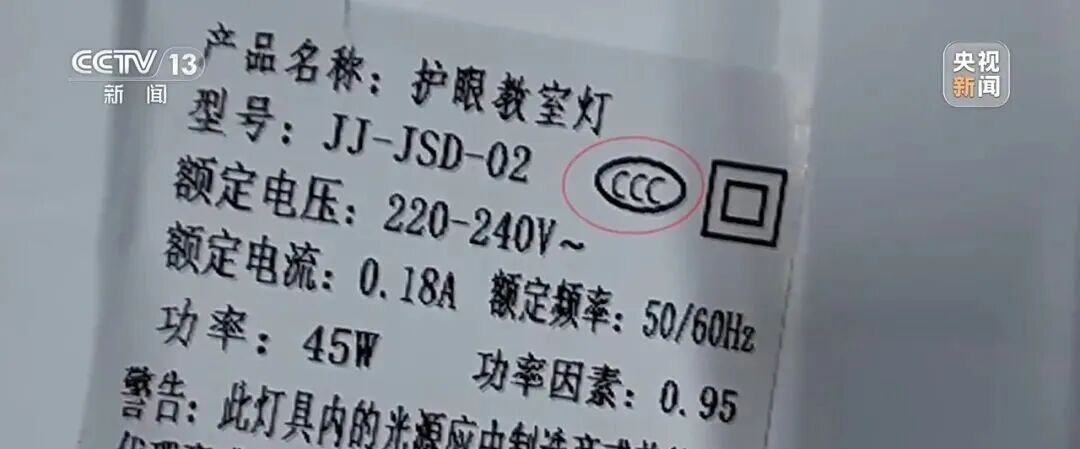
At the Yihu Lighting Processing Shop in Guzhen Town, Zhongshan, inspectors opened 27 cartons of products labeled as eye‑protective classroom lamps. Although the product labels displayed the CCC mark, the company could not provide valid certification, and neither the labels, certificates, nor outer packaging indicated the manufacturer’s name or address—classic “three‑no” products.
Subsequently, the inspection team uncovered similar issues in 11 cartons of LED panel lights. These products lacked both a manufacturer’s name and valid CCC certification, and the packaging even bore the names of two different companies simultaneously. Upon checking the National Enterprise Credit Information Publicity System, they found that the purported “Zhongshan Heyi Lighting Fixture Factory” does not exist, raising suspicions of using a false corporate identity.
Meanwhile, another inspection team, acting on tip-offs, visited Guangdong Yixun Lighting Co., Ltd. The company’s CCC certificate had previously been revoked by the certifying body. Yet inside the factory’s production workshop, workers were still assembling lamps in bulk, and some finished products remained stored in the warehouse.
According to national regulations, once a company’s CCC certificate is revoked, related products may no longer be manufactured or sold. An official at the scene stated that the company is currently reapplying for CCC certification.
Concealing information to evade after‑sales oversight and liability
Local authorities have initiated investigations into the parties involved
The reporter learned that Zhongshan law enforcement officers have conducted random inspections of products linked to Guangdong Yixun Lighting Co., Ltd., collecting a total of 19 batches for testing. Of these, 18 batches comprising 1,430 items were found to be non‑compliant. Local authorities have issued administrative penalty decisions, confiscating the non‑compliant lamps and imposing fines.
Inspection experts noted that some producers and operators deliberately conceal critical information to sever traceability chains and avoid post‑sale accountability. “For example, once products are sold or quality issues arise, without clear manufacturer details, it becomes difficult to trace back to the responsible entity—this is essentially self‑defensive behavior aimed at evading responsibility.”
Experts emphasized that lighting fixtures operate directly on 220V mains voltage. To safeguard public health and safety, the state has established a mandatory product certification system. Any lighting products listed in the mandatory certification catalog entering the market without proper certification constitute violations of the Certification and Accreditation Regulations and infringe upon consumers’ legitimate rights and interests.
Currently, the inspection team has forwarded its findings to Zhongshan authorities, who have initiated investigations into all implicated parties and swiftly launched a targeted campaign to improve lighting product quality while rigorously cracking down on quality‑related violations.
▌ Source: CCTV News WeChat Official Account