
Green, Smart, and Integrated: The 15th Five-Year Plan Offers New Opportunities for the Lighting Industry
The “15th Five-Year Plan” planning framework has been fully implemented, with multiple national-level plans sending clear market signals to the lighting industry from various perspectives.
Carbon Peak Action Plan: “Green Lighting” Designated as a Key Energy-Saving and Carbon-Reduction Project in the Building Sector
On July 5, 2026, the State Council issued the “15th Five-Year Plan for Carbon Peak Action,” which, among other national-level initiatives during this period, explicitly mentions “lighting”—“implementing green lighting measures” and “supporting the replacement and phase-out of inefficient lighting equipment in key venues such as public institutions, public buildings, transportation hubs, and roads, while promoting high-efficiency LED lighting and integrated smart control systems, and deploying pilot “light–storage–illumination” integrated systems tailored to local conditions.”Further ReadingHigh Efficiency, Smart Technology, Light–Storage–Illumination—Key Words for the Next Phase of Green Lighting Development in the 15th Five-Year Plan
Urban Renewal Plan: Comprehensive Scenarios Ranging from Streetlights to Residential Communities
On May 22, 2026, the State Council released the “15th Five-Year Plan for Urban Renewal,” which, through the implementation of 14 major projects—including the renovation of 115,000 old residential communities—comprehensively drives upgrades across all scenarios, from smart streetlights on municipal roads to health-focused lighting within neighborhoods.Further Reading“Real Money” Continues to Flow into Urban Renewal—What New Opportunities Can the Lighting Industry Seize?
Beautiful China Plan: Diverse Governance Requirements Beyond Green Lighting
(This image was generated by DouBao AI)
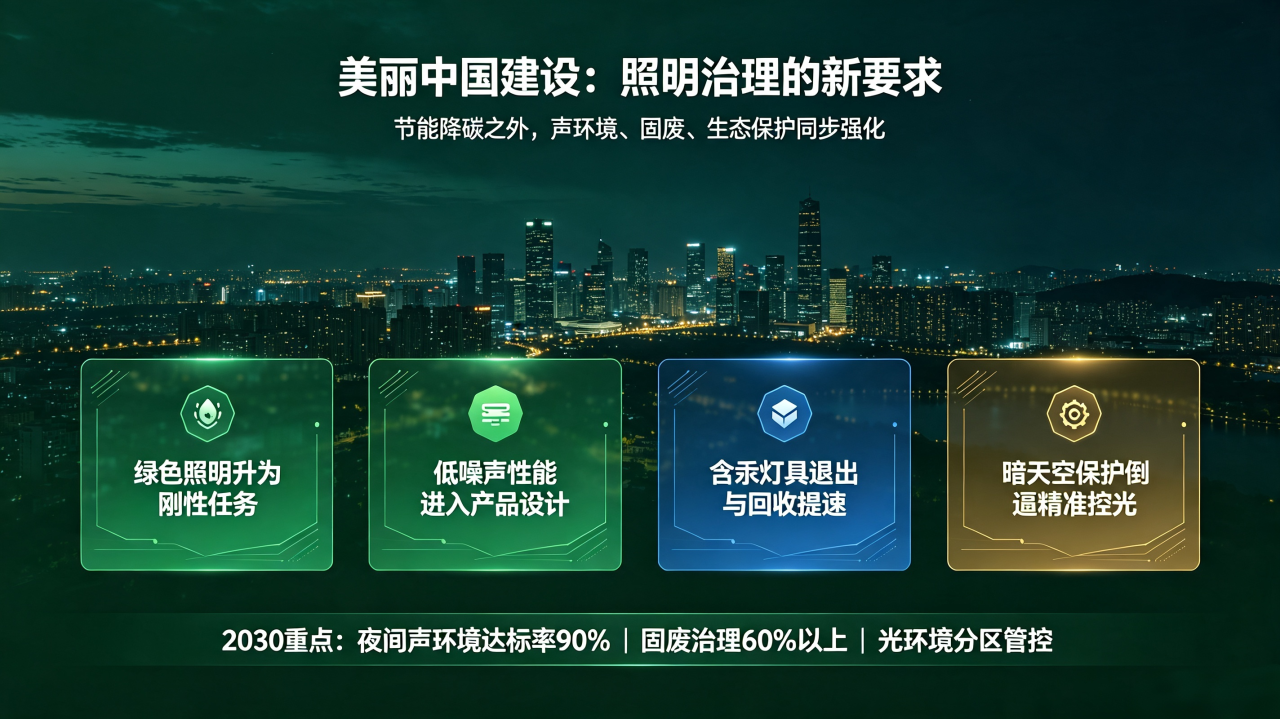
Compared to urban renewal, which emphasizes a construction‑oriented approach, the “15th Five-Year Plan for Building a Beautiful China” sets forth more diversified requirements for urban and rural living environments from a governance perspective. For the lighting industry, these demands extend beyond energy conservation and carbon reduction to encompass sound environment management, solid waste treatment, ecological protection, and other dimensions, shifting the sector’s role from simply “providing light” to “integrating into governance.”
Green lighting has officially been incorporated into key projects for achieving carbon peak, making full lifecycle carbon footprint management an essential task for companies. Sound environment regulations require nighttime noise levels to meet standards at 90% of locations by 2030, with outdoor luminaire noise levels becoming critical design and procurement criteria. Controls on solid waste and heavy metals are accelerating the phase-out of mercury‑containing luminaires, while dark sky protection efforts and the dedicated chapter on light pollution prevention in the Environmental Protection Code are working in concert to push outdoor lighting toward precision illumination and zone‑based management.
Tourism Powerhouse Plan: Nighttime Tourism Sparks New Opportunities in Cultural and Tourism Lighting

The expansion of cultural and tourism consumption scenarios has opened up new growth opportunities for the lighting industry. The “15th Five-Year Plan for Building a Tourism Powerhouse” projects that by 2030 domestic travel will reach 8.3 billion trips, inbound tourism will hit 190 million visits, and nighttime tourism consumption will be systematically promoted. It calls for locally tailored events such aslantern festivals and temple fairs,light and shadow shows, andnighttime water tours, bringing direct policy benefits to the lighting sector.
The plan outlines two main development pathways. First, “strengthening and revitalizing tourist attractions”—upgrading lighting infrastructure is designated as a priority in scenic area renovations, spurring rapid growth in niche segments like smart lighting and interactive light displays. Second, “expanding space for marine tourism”—establishing amarine tourism belt with distinctive destinations, listing places likeHailing Island in Guangdong andLiandao in Jiangsu as key areas for cultivation, and driving growth in emerging markets such asmarine lighting andcruise ship lighting. From land to sea, from day to night, the plan creates diverse market opportunities for the lighting industry.
Sports Powerhouse Plan: Rigid Demand for Professional Venue Lighting
On July 22, 2026, the General Administration of Sport of China issued the “15th Five-Year Plan for Building a Sports Powerhouse,” projecting that by 2030 per capita sports facility space will reach 4 square meters, and the total scale of the sports industry will exceed 7 trillion yuan, directly boosting demand for professional and smart lighting systems in stadiums, fitness trails, and other venues.
Healthy China and Disease Control Plan: Health Becomes a Mandatory Requirement
The Healthy China and disease control plans elevate the “health” dimension of lighting to a new level. The “15th Five-Year Plan for National Health” aims for an average life expectancy of 80 years by 2030, with roughly 40% of the population regularly engaging in physical exercise. As a result, lighting needs increase in public spaces such asfitness centers and sports parks, while specialized facilities likehospitals, disease control centers, and biosafety laboratories face pressure to upgrade their lighting systems.
New Power System Plan: Technological Momentum from the Energy Side
If the health plan focuses on “end‑use applications,” then the new power system plan provides macro‑level impetus from the “energy infrastructure” side. The “15th Five-Year Plan for Building a New Power System” projects that by 2030 electricity will account for 35% of final energy consumption, driving the continued replacement of traditional light sources with efficient LEDs; supporting a charging network capable of serving over 110 million electric vehicles will spur demand for charging station and parking lot lighting; and substations, converter stations, and other power facilities will also require dedicated and intelligent lighting systems.
Civil Aviation Development Plan: High Barriers and High Value in Aviation Lighting
(This image was generated by DouBao AI)
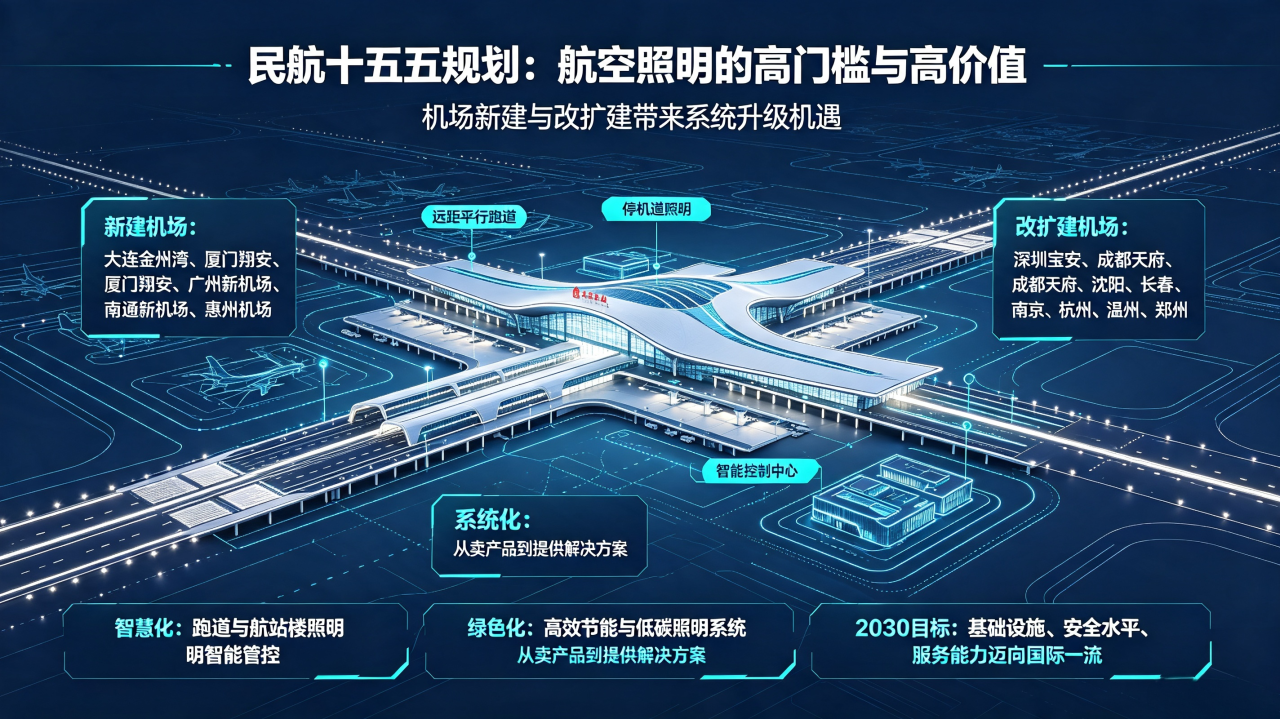
The civil aviation development plan is pushing airports and onboard lighting toward comprehensive upgrades to LED and smart technologies. The “15th Five-Year Plan for Civil Aviation Development” calls for airport infrastructure to lead the way toward world‑class standards by 2030, specifically naming newly built airports such asDalian Jinzhou Bay, Xiamen Xiang’an, and Guangzhou New Airport, as well as hub airports undergoing expansion or renovation likeShenzhen Bao’an and Chengdu Tianfu.
Airport construction and expansion represent direct policy dividends for the lighting industry. There is strong demand for smart lighting solutions in terminal buildings, aprons, runways, and other areas. Although entry barriers are high and safety standards stringent, the large project scale and high added value make this sector a crucial opportunity for the lighting industry to transition from “selling products” to “providing system solutions.”
In summary, lighting has become deeply embedded in national strategies such as urban renewal and green transformation. Regulations are in place, and systemic changes have begun. For the industry, the key lies in understanding these plans, defining its position, and leveraging light to support modernization and enhance people’s quality of life—this is the new mission entrusted to lighting professionals by our times.
Fulfilling this mission requires a professional platform that brings together industry expertise and connects policies with the market. From March 30 to April 2, 2027, the “Shanghai International Exhibition on Architectural and Engineering Lighting,” completely revamped through years of solid collaboration under the auspices of the China Lighting Fixture Association, will be held at the Shanghai New International Expo Center. With the theme “Light Builds Deep Integration,” the exhibition will deeply integrate indoor and outdoor architecture, cultural and tourism landscapes, and building intelligence, comprehensively constructing a new ecosystem of “architecture + lighting + design.” Concurrently, a series of industry exchange events themed around “urban renewal” will be launched, focusing intensively on key areas such as architectural floodlighting, nighttime cultural and tourism economies, and the creation of outdoor public spaces. Using the exhibition as a medium and conferences as bridges, this event marks a pivotal step for the lighting industry—from “understanding the plans” to “putting them into action.”
China Light
The official website of the China Association of Lighting Industry and a full-media platform for the lighting sector. We provide authoritative and timely lighting information while striving to be a growth partner for businesses. From brand promotion and channel expansion to consulting, talent training and participation in standards development, we provide comprehensive professional services to help businesses improve quality and efficiency and jointly advance the high-quality development of the lighting industry.
Business Contacts
仇纯 (Ms.): 158 6155 3579
顾君 (Mr.): 137 7157 5253