
Zhang Tian: With water as the soul, he uses light and shadow to sculpt a poetic living space in Dubai villas.
On June 30, the “Fudan Light” salon was successfully held under the guidance of the Fudan University Alumni Association’s Lighting Alumni Chapter, organized by China Light Network·Ming Classroom, and supported by Zhejiang Qicheng Electrical Appliance Co., Ltd. The event was hosted by Hong Bing, Secretary-General of the Fudan University Alumni Association’s Lighting Alumni Chapter and Editor-in-Chief of China Light All-Media.

Guest Speaker: Zhang Tian
On this occasion, we invited Zhang Tian, a Fudan alumnus, founder of B.Z Design, and a National First-Class Lighting Designer, to share his comprehensive experience based on the Villa33 project in Dubai, UAE. This project won the IAA Muse Platinum Award in the United States and also received an Excellence Award at the Fudan Lighting RuiChuang Awards.
Design Theme: Centered on “Water”
Located deep in the desert, Dubai faces severe water scarcity. In local culture, water symbolizes life, flow, and abundance—key elements that form the core creative concept of this project. Drawing inspiration from five types of water states—ocean, lake, raindrop, ripple, and waterfall—the designer integrates the dynamic aesthetics of natural water bodies into the architecture, using lighting to recreate four distinct visual moods: shimmering waves, cascading waterfalls, tranquil deep waters, and misty veils. By transforming light into flowing water, the design creates an exclusive aquatic light sanctuary within an arid space.
Design Philosophy: Beyond Light—It’s About the Human Experience
Zhang Tian emphasized that when communicating with overseas clients, there is no need to overwhelm them with complex technical specifications. Instead, establishing a shared understanding around four key dimensions—light and nature, interplay of light and shadow, light and atmosphere, and intelligent light sources—is sufficient.
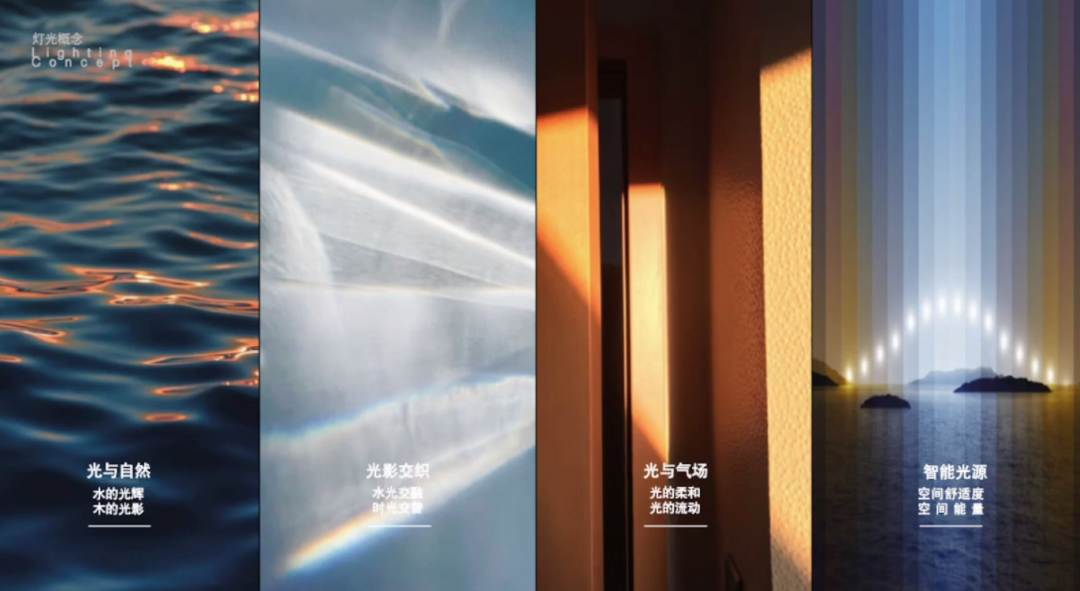
“Light does not directly alter objects; rather, it reshapes the overall spatial atmosphere, thereby changing how people interact with their surroundings.” In villa design, the fusion of water reflections, tree shadows, and lighting imbues the space with natural vitality.
Four Core Design Principles
1. Coexistence of Functionality and Artistry
Basic functional light sources such as downlights and light strips, when combined with tree shadows and water features, can equally deliver artistic expression—there is no need to separate the two.
2. Balanced Uniform Illumination with Strict Control of Light–Dark Ratio
The typical illumination ratio for indoor spaces ranges from 1:3 to 1:5. Higher contrast ratios like 1:5 or 1:10 create stronger dramatic effects but also increase potential risks. For private residences, the owner’s subjective preferences should be the primary criterion for evaluation.
3. Maintaining Orderly Ceiling Lighting Layout
A cluttered arrangement of luminaires can produce a stifling impression. Lighting plans should follow the logic of spatial zoning rather than being tied to movable furniture. In stable areas such as bedrooms, detailed placement can be further refined.
4. Whole-House Smart Solutions for Living Comfort
Smart systems do not aim for complicated protocols; instead, they focus on scenario-based control, adapting to various daily activities such as home life, entertaining guests, and leisure.
Light and Shadow Interpretation: Multi‑Scene Layered Lighting Implementation Plans
Teacher Zhang Tian explained the full-space lighting strategy using hand-drawn sketches and real‑world nighttime renderings. His team is currently leveraging AI to assist with rendering, boosting efficiency. The specific lighting modes for each space are as follows:
1. Living Room
• Bright Mode: Uniformly washes the entire wall surface, creating an open and welcoming everyday living environment.
• Guest‑Receiving Mode: Dimms the surrounding area, focusing light on the central seating zone, with color temperature adjusted to 4000K to suit formal interactions.
2. Home Theater
Does not adopt a completely dark design; retains soft light strips and decorative lamps as ambient lighting to prevent eye strain in dark environments. Users can switch between movie-watching and party lighting modes.
3. Dining Room & Bar Area
Layered dimming achieves progressive mood transitions: uniform illumination for meals, reduced brightness late at night to create a relaxed bar atmosphere, complemented by ambient lighting on illuminated marble countertops.
4. Kids’ Area
Throughout the space, uses indirect, non‑direct protective lighting sources. Large embedded light panels simulate natural daylight, matching the outdoor natural light. Art pieces and collectibles are uniformly highlighted from above to avoid high blue light and strong glare.
5. Stairs & Entryway
Adopts coordinated sets of fixtures in the same style to create symmetrical order. Sensor‑activated lights illuminate floors evenly, layer by layer, preventing safety hazards caused by delayed activation of trendy stair lights. Homecoming and departure lighting patterns gradually turn on and off, adding a sense of ritual to daily routines.
6. Gym & Walk-in Closet
In the gym, vertical wall lights help reduce glare from exercise equipment. The walk-in closet is equipped with human‑sensing, layered interior lighting for easy access to clothing.
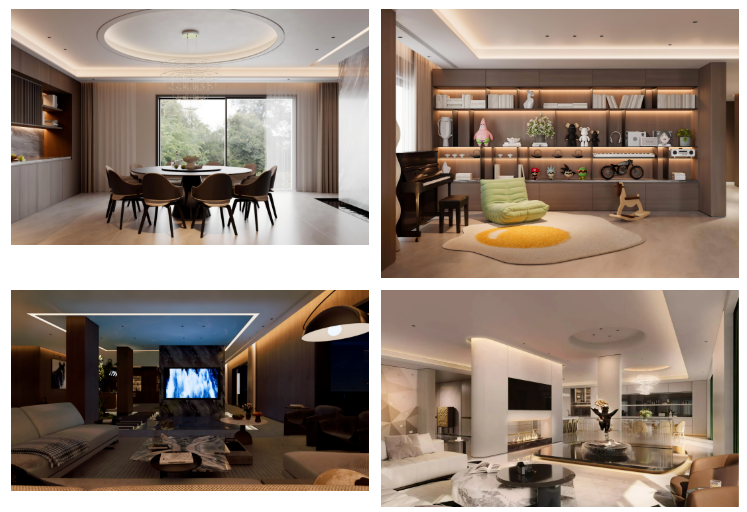
Materializing Water: Four Practical Techniques for Capturing Different Water States Through Light
Addressing the core theme of “water,” Zhang Tian broke down the lighting implementation details for various water scenes, emphasizing that underwater light strips must be securely fastened with waterproof and anti‑electric leakage measures:
1. Shimmering Waves
Install horizontal light strips below the waterline, paired with small‑angle, high‑intensity spotlights to create fine, sparkling glimmers as the water ripples.
2. Still Waters / Misty Veils
Lower overall brightness and color temperature, employing broad‑beam underwater lights inspired by Aman resort pool designs to evoke a serene, hazy ambiance.
3. Cascading Waterfalls
Arrange dynamic, gradient colored lights in layers, with alternating beams of light and shadow to simulate the multi‑layered flow of falling water.
4. Spatial Expansion through Creative Reflection
Reflect water‑like light patterns onto the ceiling, spreading flowing water effects across the entire surface to amplify the sense of spaciousness and relaxation.
Key Points for On‑Site Construction
The industry standard “30% design, 70% commissioning” applies here. While fixture installation itself is straightforward, on‑site light adjustment and fine-tuning take considerably more time. For high‑end villas overseas, borderless recessed downlights are preferred. In desert regions like Dubai, outdoor luminaires must meet strict requirements for wind resistance, dust protection, and temperature tolerance. It is advisable to choose well‑established major brands with robust warranty systems to minimize future maintenance costs.
Interactive Q&A Session
During the Q&A segment, Teacher Zhang Tian provided detailed answers to audience questions:
Q: Under Dubai’s unique desert conditions, what special design considerations apply to outdoor villa lighting regarding luminaire selection and sand/dust protection?
A: Outdoor luminaires must meet basic standards for wind resistance, dust protection, and structural stability. Priority should be given to products from manufacturers with strong after-sales service and comprehensive warranties to avoid excessive post‑installation support consuming valuable resources for new projects. Considering Middle Eastern homeowners’ social needs in courtyards, dynamic projection lights can be added to accommodate outdoor party scenarios—this approach is equally applicable to similar large‑scale villa projects in Syria.
Q: When creating light and shadow works themed around “water,” how can you differentiate the atmospheric moods of rippling waves, misty veils, and cascading waterfalls through beam angles, color temperatures, and dynamic lighting?
A: For rippling waves, use low‑lying light strips combined with small‑angle, high‑intensity spotlights to achieve a flickering effect. For still waters and misty veils, lower brightness and color temperature, employing broad‑beam underwater lights to create a gentle, soothing ambiance. For waterfalls, layer dynamic colored lights and interweave beams to simulate the multi‑layered flow of water. The essence of lighting design lies in aligning light intensity with the size of the water feature and its intended usage scenario.
Q: In overseas high‑end villa projects, how can lighting design effectively collaborate with architects, landscape designers, and interior designers?
A: International collaboration often faces three major challenges: time differences, language barriers, and differing aesthetic sensibilities. Formal communication typically relies on email, supplemented by hand‑drawn light‑shadow diagrams and translation tools to facilitate bilingual coordination. Early on, all team members should agree on core objectives: target clientele, overall style, spatial context, and material‑light expressions. Proactive involvement in lighting planning, coupled with visual communication methods, makes consensus-building much easier.
Q: Among the many projects undertaken by B.Z Design, besides Villa33 introduced tonight, which other distinctive projects have left a lasting impression?
A: The presidential palace project in a small overseas country stands out. Local preferences lean heavily toward decorative lighting, prompting the team to repeatedly adjust master‑lighting schemes to align with regional aesthetics. High‑end fashion boutiques and outdoor commercial stores can customize constellation‑themed lighting, significantly boosting foot traffic and customer dwell time after installation. Luxury hotels can collaborate with top interior design firms like HBA to create dozens of partitioned, independent lighting scenes. Compared to purely profit‑driven projects, designs that genuinely empower commercial spaces bring greater creative fulfillment.
END
Note: This article is compiled from the audio recording of Teacher Zhang Tian’s presentation titled “A Comprehensive Analysis of the Villa33 Lighting Design Case in Dubai, UAE,” delivered on June 30, 2026, at Ming Classroom. The content has been edited and published by Ming Classroom.
China Light
The official website of the China Association of Lighting Industry and a full-media platform for the lighting sector. We provide authoritative and timely lighting information while striving to be a growth partner for businesses. From brand promotion and channel expansion to consulting, talent training and participation in standards development, we provide comprehensive professional services to help businesses improve quality and efficiency and jointly advance the high-quality development of the lighting industry.
Business Contacts
仇纯 (Ms.): 158 6155 3579
顾君 (Mr.): 137 7157 5253