
Secured a massive 588-million-yuan contract! Has this veteran license‑holding company successfully transformed itself through computing power?
Big news! A long-established lighting company has landed a massive 588 million yuan order for computing equipment!
From nightscape and landscape lighting to AI computing power—what enables this lighting firm to cross over into new markets? And can its transformation path truly succeed?
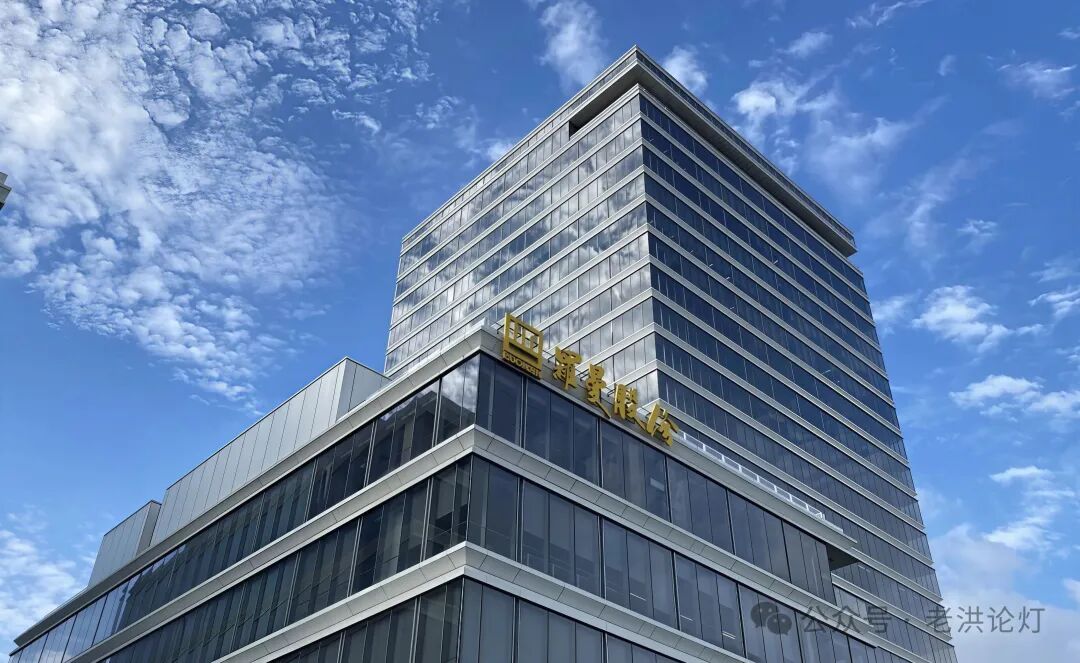
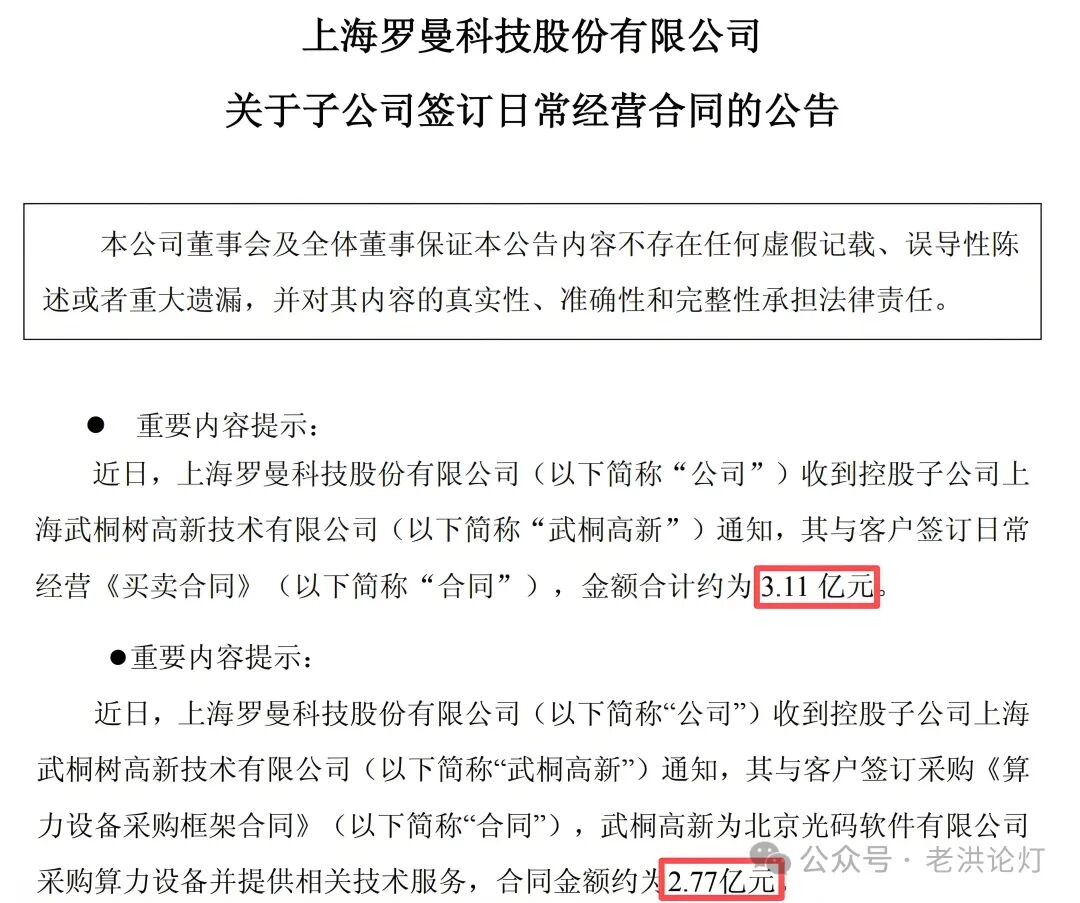
On October 7, Roman Shares announced that its controlling subsidiary, Wutong High-Tech, recently signed two contracts for computing equipment totaling approximately 588 million yuan. This marks another major deal secured by Roman Shares since entering the AI computing power sector.
Public records show that Roman Shares originally focused on landscape lighting design and engineering construction, listing on the Shanghai Stock Exchange’s main board in 2021. In recent years, facing growth bottlenecks in the traditional lighting market, the company embarked on a strategic transformation. In September 2025, it acquired approximately 40% of Wutong High-Tech’s equity for 196 million yuan in cash, officially stepping into the AI computing power field. Currently, Wutong High-Tech has established computing infrastructure across multiple regions in China and developed end-to-end cloud–edge–device inference solutions.
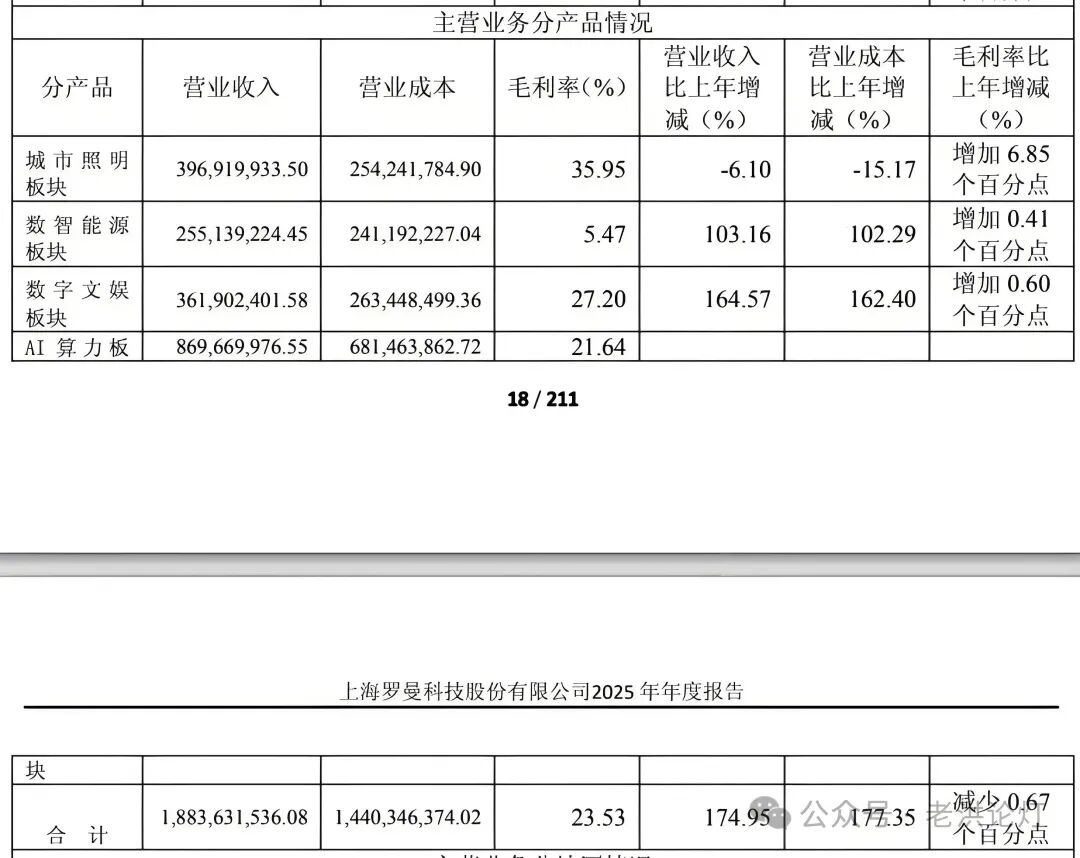
Performance metrics already indicate early success from this transformation. By 2025, AI computing revenue had surpassed that of traditional urban lighting. In the first half of 2026, the company reported 943 million yuan in revenue, up 118.11% year-on-year (YoY), with net profit attributable to shareholders reaching 71.97 million yuan, a remarkable 444.10% increase YoY. The company attributes this robust growth primarily to expanded urban lighting operations and the profit contributions from its newly added computing business segment.
Old Hong believes Roman Shares’ transformation offers a valuable case study for traditional lighting companies. Over the past two years, the lighting industry has faced mounting pressure, with conventional engineering lighting and landscape illumination shrinking steadily, prompting many firms to seek second growth drivers. Rather than chasing fleeting trends, Roman Shares leveraged its existing strengths—strong government and corporate client networks, as well as project‑turnkey expertise—acquiring complementary technological capabilities through mergers and acquisitions to enter the emerging computing infrastructure space. This strategy of “building on core competencies while expanding outward” proves far more pragmatic than the approach adopted by companies that merely jump onto bandwagon concepts.
Old Hong also notes that Roman Shares’ transition is not without risks. The computing power sector is capital‑intensive, with volatile supply chains, and uncertainties remain around order fulfillment, acceptance testing, and revenue realization. For lighting firms, venturing into computing power means confronting entirely new technical systems, customer bases, and competitive landscapes. Whether the project management expertise honed in lighting engineering can be successfully applied to computing infrastructure remains to be seen. Only time will tell if this path holds promise—and it warrants continued attention from the industry.
Do you agree with Old Hong’s perspective? Feel free to share your thoughts in the comments.
Follow “Old Hong on Lighting” to illuminate your journey ahead!
About the author, Hong Bing:
Hong Bing currently serves as Editor-in-Chief of China Light Network and Agricultural Lighting Network—the official websites of the China Lighting Electrical Appliances Association—as well as Executive Dean of Ming Classroom, Executive Vice President of the Beijing Lighting Electrical Appliances Association, Deputy Chairperson of both the Talent Training Committee and the Agricultural Lighting Professional Committee under the China Lighting Electrical Appliances Association, Executive Deputy Chairperson of the Fudan University Alumni Lighting Club, and a Board Member of the CEIBS Ecological Environment Alumni Association. He graduated from Fudan University’s Department of Light Sources and Lighting Engineering in 1991 and earned an MBA from CEIBS in 2003. Throughout his career, he has worked in R&D, product planning, and marketing at institutions including the China Building Materials Academy, Panasonic, GE, and OSRAM. In 2008, he received Siemens Global Top Plus Award and Siemens China Outstanding Performance Award, and in 2009 founded China Light Network.
For more exciting content, please follow our official WeChat account or video channel
“Old Hong on Lighting”
China Light
The official website of the China Association of Lighting Industry and a full-media platform for the lighting sector. We provide authoritative and timely lighting information while striving to be a growth partner for businesses. From brand promotion and channel expansion to consulting, talent training and participation in standards development, we provide comprehensive professional services to help businesses improve quality and efficiency and jointly advance the high-quality development of the lighting industry.
Business Contacts
仇纯 (Ms.): 158 6155 3579
顾君 (Mr.): 137 7157 5253