
Collector’s edition! A must-read for lighting professionals: standards, challenges, and practical guidelines for Photobiological safety testing.
On September 22, the “Guzhen Lighting Expo – Mingren Online” salon, hosted by Zhongshan Guzhen Light City Expo Co., Ltd. and organized by China Zhi Guang All-Media · Ming Classroom, kicked off online.
This session featured Dr. Yang Xiong, Deputy Director of the Optoelectronics Research Institute at Hangzhou Yuanfang Optoelectronics Information Co., Ltd., who delivered a special presentation titled “Photobiological Safety Measurement Techniques and Practices.”
The course covered risks associated with optical radiation safety, domestic and international standards systems, practical measurement challenges, and real-world engineering cases. It also addressed frequently asked industry questions on-site, providing a comprehensive overview of key photobiological safety considerations in luminaire R&D, testing and certification, and project selection.
Background
In today’s era of widespread adoption of healthy lighting, photobiological safety is no longer an optional add-on—it has become a mandatory foundational requirement for product IPOs and real-world applications. Ultraviolet, blue light, and infrared radiation emitted by various luminaires, laser devices, and smart lighting products can all pose potential risks to human eyes and skin. Standardized assessment of these photobiological hazards is crucial for ensuring product safety and mitigating compliance risks.
Drawing on current application scenarios across multiple settings, Dr. Yang Xiong analyzed the prevalent safety risks associated with modern light sources. Today, high-power road lighting, automotive laser headlights, LiDAR systems, medical aesthetic treatment lamps, stage and venue lighting, and other equipment are widely deployed. Some invisible light emissions cannot be directly perceived by the human eye, and relying solely on the natural protective mechanisms of blinking or avoidance is insufficient to prevent harm—often resulting in irreversible damage. This underscores the critical importance of professional, precise photobiological safety testing.

Light Safety in Automotive Lighting and Perception
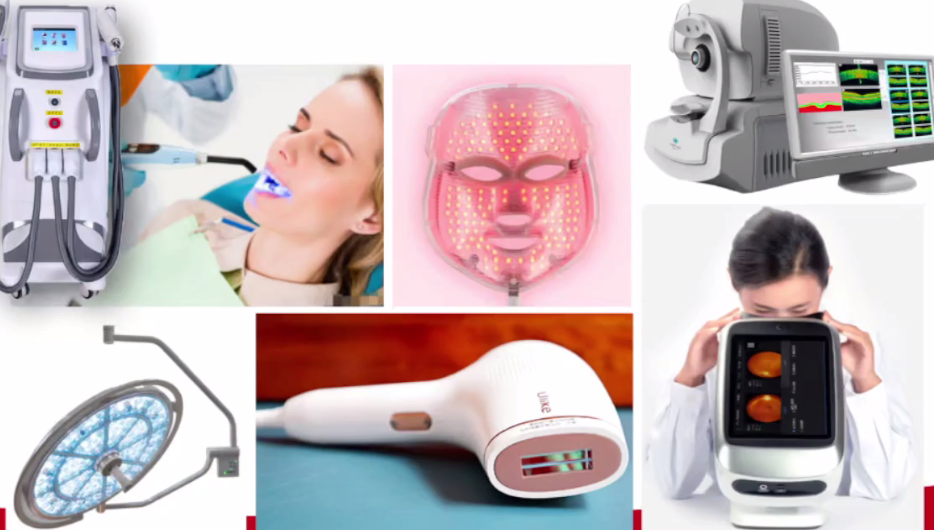
Light Health in the Medical Field
Among them, laser light sources, due to their highly collimated beams and concentrated energy density, pose significantly higher risks than ordinary lighting sources and are therefore a primary focus of industry testing.
Standards System:
How Different Light Sources Fit into the Framework
During the presentation, Dr. Yang Xiong systematically dissected the industry’s common photobiological safety standards framework, clarifying the compliance basis for different types of light sources.
Conventional Incoherent Light Sources, including LED lights, halogen lamps, and other standard luminaires, are classified into four risk levels—from RG0 to RG3—according to IEC 62471 series (domestically aligned with GB/T 20145-2006).
Coherent Light Sources Such as Lasers follow IEC 60825.1 (domestically equivalent to GB 7247.1), graded from Class 1 to Class 4 based on hazard severity. Furthermore, the mandatory national standard GB 44703-2024, “General Requirements for Optical Radiation Safety,” establishes a unified baseline for evaluating all light sources, while the GB/T 30117 series provides specific measurement methodologies.
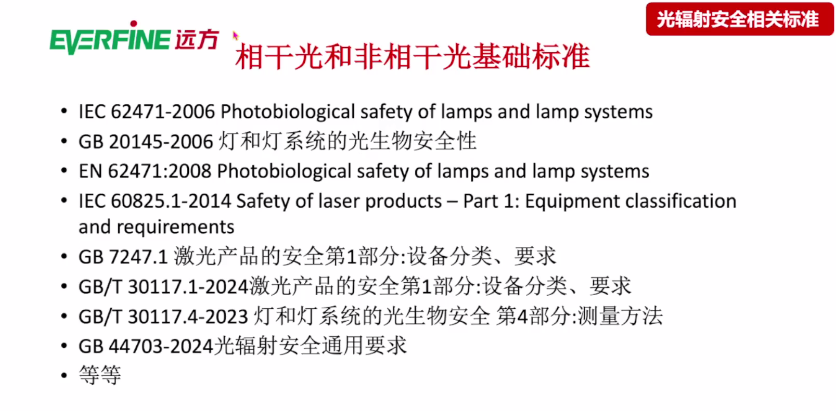
Standards Related to Optical Radiation Safety
For actual luminaire usage scenarios, the new edition of IEC 62471-7 breaks away from the limitations of single absolute-value assessments, adopting a comprehensive approach that considers illuminance ratios to determine hazard levels. This better reflects real-world conditions and effectively avoids misjudgments such as “exceeding limits numerically but being safe in practice.”
This same principle extends to the automotive sector—automotive laser headlights, DLP projection modules, and similar components must comply with IEC 60825-1, IEC 62471-5, and IEC 62471-7, aligning with domestic standards like GB 4599-2024, “Automotive Road Lighting Devices and Systems.”
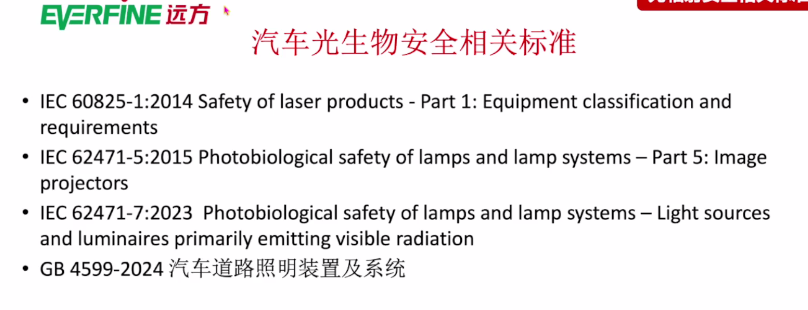
Standards Related to Optical Radiation Safety
The medical field demands even more meticulous standards. The GB 9706 series covers specialized requirements for home-use light therapy, infant phototherapy, surgical and diagnostic laser devices, among others. YY 9706.257-2021 addresses non-laser light-based equipment used in therapeutic, diagnostic, and cosmetic procedures, while YY/T 1534-2017 provides methods for classifying and testing the optical radiation safety of medical LED devices. From shadowless lamps and UV therapy units to cold-light endoscopes, each category has its own dedicated standard.
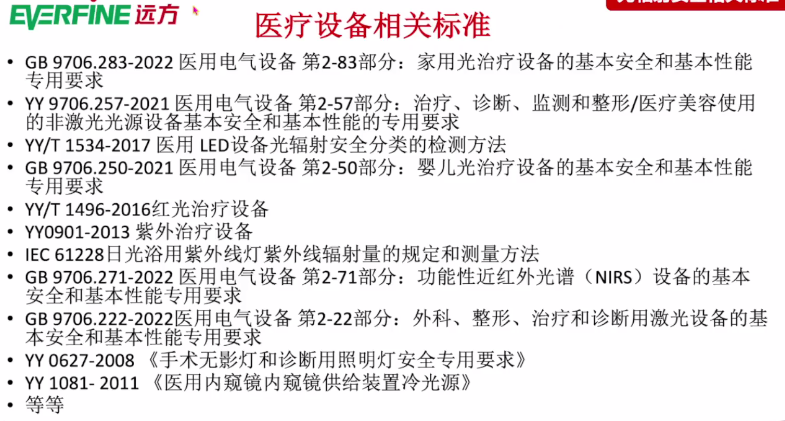
Standards Related to Optical Radiation Safety
Ophthalmic instruments are benchmarked against ISO 15004-2 (protection against light hazards), complemented by YY 0065 slit-lamp microscopes, YY 0673 refractors, YY/T 0634 fundus cameras, and YY 1296 surgical microscopes—comprehensive standards covering ophthalmic diagnostic equipment.
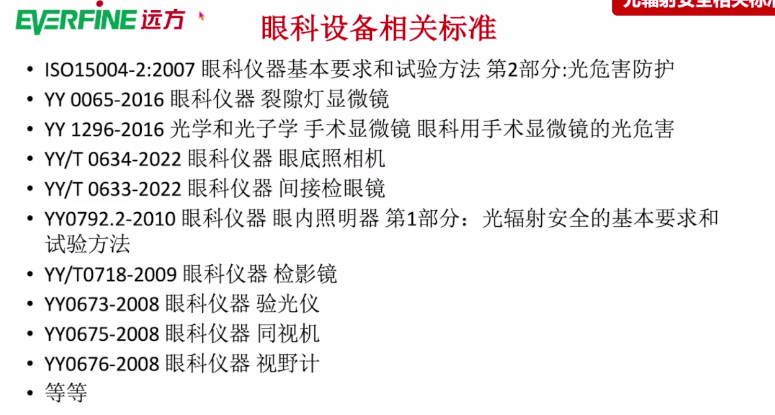
Standards Related to Optical Radiation Safety
The display sector also operates under its own system: projection products adhere to IEC 62471-5, blue light hazard assessments may reference IEC TR 62778, wearable displays follow GB/T 42750 and GB/T 41265, and home laser display systems are governed by GB/T 38248 and GB/T 38246—setting clear safety boundaries for screens, AR/VR, and other emerging products.
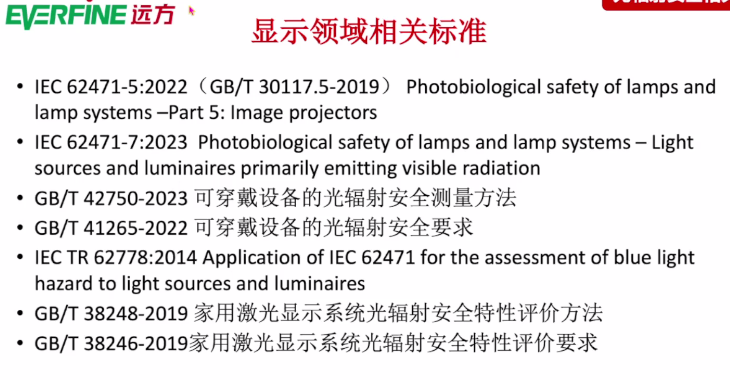
Standards Related to Optical Radiation Safety
Thus, photobiological safety evaluation adopts a structure of “one horizontal axis and multiple vertical axes”—with basic standards forming the horizontal backbone and specialized standards for each sub-field serving as the vertical pillars. During R&D and testing, establishing the base level first and then applying detailed rules accordingly ensures a clear path toward compliance.
Practical Challenges,
Where Exactly Lie the Difficulties?
Addressing the industry’s common concerns about practical testing difficulties, Dr. Yang Xiong provided a focused analysis:
Challenges in Achieving Precision in Ultraviolet Spectral Measurements
Ultraviolet radiation has extremely stringent standard limits, making it the category with the lowest tolerance for error. Even slight wavelength deviations or stray light interference can artificially inflate ultraviolet readings, leading to misclassification of originally RG0‑exempt products as RG1 or RG2 risk levels. Ultraviolet testing places exceptionally high demands on instrument precision; ordinary spectrometers struggle to mitigate stray light issues. In industry practice, dual monochromator spectrometers effectively suppress stray light and ensure wavelength accuracy, offering an excellent solution to address spectral distortion and guarantee reliable test data.
Challenges in Locating Apparent Light Sources and Identifying Areas of Maximum Hazard
Many luminaires exhibit a mismatch between their apparent light-emitting form (apparent source) and their physical shape—especially multi‑LED arrays, irregularly shaped emitting surfaces, and small point‑source lights—resulting in highly uneven brightness distributions. Manual visual inspection often leads to positioning errors, making it difficult to precisely pinpoint the true areas of maximum radiation hazard. This can cause overoptimistic test results and overlook potential safety risks, becoming a frequent source of hidden errors in industry testing.
Challenges in Selecting Appropriate Geometric Parameters for Measurement
IEC 62471 sets clear specifications for testing distance, observation field of view, and sampling aperture. If the aperture is improperly matched, the field of view is skewed, or the testing distance is not standardized, the calculated irradiance and luminance values will be directly affected, likely resulting in inconsistent rating outcomes for the same luminaire across multiple tests. Particularly for large‑area luminaires and narrow‑angle light emitters, properly matching geometric parameters is a critical prerequisite for ensuring test reproducibility.
Special Testing Challenges for Pulsed Light Sources
The conventional testing logic for continuous light sources cannot be directly applied to pulsed light products. Testing pulsed light requires precise synchronized triggering and high‑speed time-domain sampling to capture dynamic parameters such as pulse width, frequency, and duty cycle. Using standard testing methods may easily lead to underestimation or overestimation of radiant energy—this is a typical technical challenge encountered when testing smart strobe lights and pulsed fill‑light fixtures.
Challenges in Equipment Calibration and Dynamic Linearity
Photobiological safety testing spans an enormous range, covering everything from faint household lighting to ultra‑bright searchlights and laser sources. If equipment lacks sufficient range, exhibits linear accuracy deviations, or fails to provide effective traceability of measured values, test data for high‑ and low‑power luminaires may become distorted, leading to inaccurate ratings—a fundamental issue that laboratories must carefully manage when setting up testing systems.
To address these multiple technical challenges, a comprehensive, stable optical radiation safety measurement system typically integrates high‑precision spectral radiometers, specialized optical receiving attachments, multidimensional automatic adjustment turntables, pulse‑synchronized acquisition modules, and intelligent analysis software. This configuration effectively tackles common industry problems such as manual positioning errors, parameter selection mistakes, and difficulties adapting to special light sources, enabling automatic identification of maximum hazard zones, standardized geometric parameter matching, compatibility testing for both continuous and pulsed light sources, and intelligent grading of risk levels—thereby significantly enhancing the compliance, reproducibility, and traceability of test results.
To help practitioners intuitively grasp the relationship between standards and practical operations, Dr. Yang Xiong shared several real‑world case studies:
A high‑power offshore xenon searchlight—under close‑range testing, its extreme illuminance placed it at the RG3 high‑hazard level; however, as the testing distance increased, the hazard rating correspondingly decreased, demonstrating the direct impact of testing distance on risk assessment.
Automotive halogen headlights and DLP projection modules—although some indicators exceeded the threshold, the new ratio‑based evaluation rules allowed them to meet compliance requirements, clearly illustrating the scientific rigor and practical utility of the updated standards.
Interactive Q&A Session
During the salon’s interactive segment, industry peers raised practical questions regarding routine testing and product development, and Dr. Yang Xiong provided actionable answers:
1. Ultraviolet spectral measurement is a core testing challenge—what key points should be kept in mind during actual operation?
Answer: Humans are particularly sensitive to ultraviolet radiation, and the standard limits for UV are extremely low—typically around 0.01 to 0.001 watts per square meter. Exceeding even slightly can result in non‑compliance and affect product sales, so accuracy is paramount. There are two key operational considerations:
First, ensure wavelength accuracy—a deviation of just 0.1 or 0.3 nanometers can alter the limit and produce different results.
Second, eliminate stray light—other wavelengths can bleed into the UV band and raise noise levels. It is recommended to use a dual monochromator spectrometer, which effectively suppresses stray light.
2. How can we determine whether a photobiological safety test report labeled RG0 is valid?
Answer: To verify the results, the most reliable approach is to have a professional institution conduct a retest using specialized equipment. If you’re familiar with the standards, you can perform a simple validation yourself—knowing the wavelength, limit, and radiation level allows you to calculate whether there’s an exceedance. For example, many laser pointers on the market are labeled as Class 3R, indicating controllable hazards; however, some manufacturers emphasize brightness and label them as Class 3B, significantly increasing the risk. Understanding these classifications helps you assess which categories are dangerous and which are safe.
3. How should we standardize photobiological safety testing for lamps with reflectors, integrated multi‑light sources, and dimmable fixtures?
Answer: The key lies in assessing how the light source affects people during actual use. When a lamp with a reflector or multiple light sources is turned on simultaneously, light enters the eyes at once—this is precisely when the risk is highest. We need to evaluate the highest‑risk operating condition and confirm that the device remains safe under those circumstances—regardless of how it’s used. Therefore, lamps with reflectors should be tested together with their reflectors, and multi‑light sources should be tested collectively—unless there’s a mechanism ensuring they never illuminate at the same time. Dimmable lamps should be tested at their maximum output.
Conclusion
The entire salon comprehensively covered the core knowledge system of photobiological safety in the lighting industry—from theoretical principles and technical challenges to real‑world case studies and on‑site Q&A. It became clear that photobiological safety rating is far from a simple labeling exercise; the choice of standards, testing conditions, sample status, and equipment precision all ultimately influence the final test results.
For professionals engaged in luminaire R&D, testing and certification, and engineering design, thoroughly understanding standard logic and meticulously controlling operational details is essential for avoiding compliance risks and creating safe, high‑quality lighting products.
Note: This article is compiled from the recording of Dr. Yang Xiong’s thematic presentation, “Photobiological Safety Measurement Techniques and Practices,” delivered on September 22, 2026, at Ming Classroom, and published by Ming Classroom.
China Light
The official website of the China Association of Lighting Industry and a full-media platform for the lighting sector. We provide authoritative and timely lighting information while striving to be a growth partner for businesses. From brand promotion and channel expansion to consulting, talent training and participation in standards development, we provide comprehensive professional services to help businesses improve quality and efficiency and jointly advance the high-quality development of the lighting industry.
Business Contacts
仇纯 (Ms.): 158 6155 3579
顾君 (Mr.): 137 7157 5253