
Ams Osram Announces First-Half Results, Betting on Micro LED and AI-Enabled Optical Interconnects
On August 4, ams OSRAM, a supplier of optical and sensor solutions, announced its financial results for the second quarter and first half of 2026.
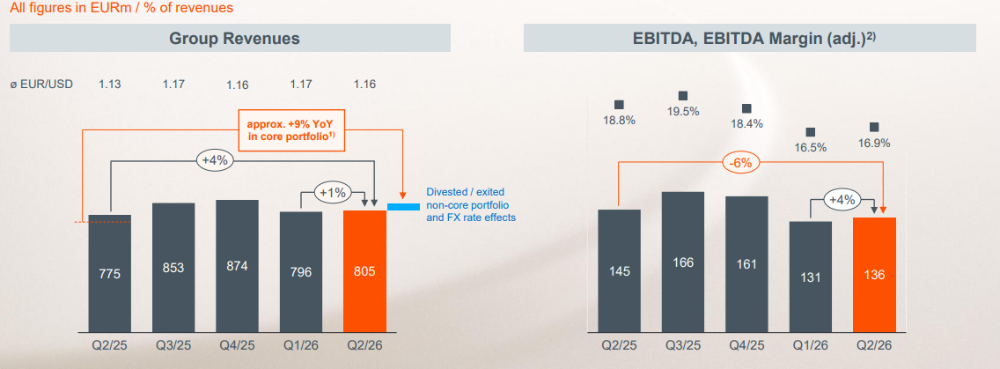
In the second quarter, the Group reported revenue of €805 million (approximately RMB 6.266 billion), up 4% year over year and 1% quarter over quarter, landing at the upper end of the guidance range. Adjusted EBITDA reached €136 million, corresponding to a margin of 16.9%, also hitting the top of the forecast range.
In the first half, Group revenue totaled €1.601 billion (approximately RMB 12.462 billion), essentially flat compared with the same period last year. Adjusted EBITDA stood at €267 million, with a margin of 16.7%.
By business segment, the Optical Semiconductor (OS) division generated €364 million in Q2 (approximately RMB 2.912 billion), up 6% year over year and 11% quarter over quarter. Driven by strong demand from both automotive and industrial markets, this segment posted comprehensive improvements, reflecting both seasonal trends and structural gains.
Adjusted EBITDA for this division was €65 million, an 18% increase from €55 million in the previous quarter. However, the adjusted margin declined to 17.7% from 22.9% a year earlier, primarily due to unfavorable currency movements and elevated raw material costs.
The CMOS Sensors and Specific Application Integrated Circuits (CSA) division reported €257 million in Q2 (approximately RMB 2.056 billion), up 7% year over year and 14% quarter over quarter. Growth was fueled by a seasonal rebound in consumer‑related businesses and robust performance in non‑optical sensor segments—though the latter was transferred to Infineon on July 1, with ams OSRAM continuing to provide foundry services.
Adjusted EBITDA for this division surged to €42 million, a 75% jump from €24 million in the prior quarter, with an adjusted margin of 16.3%.
The Lighting and Systems (L&S) division recorded €184 million in Q2 (approximately RMB 1.472 billion), down 4% year over year and 25% quarter over quarter, largely reflecting the impact of selling off entertainment and industrial lighting businesses, which are no longer consolidated into the financial statements.
Adjusted EBITDA for this segment reached €34 million (approximately RMB 272 million), up 16% year over year, while the adjusted margin improved to 18.3%, a 3.1 percentage point increase compared with the same period last year—demonstrating enhanced profitability despite a contraction in operations.
Three Business Divestitures in Six Months Raised Approximately €700 Million
A Clear Path Toward Deleveraging
During the first half of the year, ams OSRAM executed an intensive asset‑management strategy. On March 2, the company completed the sale of its entertainment and industrial lighting businesses to Japan’s Ushio for €114 million, transferring approximately 500 employees to Ushio—a milestone marking the first step in implementing the group’s debt‑reduction plan.
In May, ams OSRAM signed an agreement with U.S.-based indie Semiconductor to divest its CMOS image sensor business for €40 million, with closing expected within the year.
Additionally, on July 1, the company sold its non‑optical analog/hybrid signal sensor business to Infineon for €570 million. This business generated roughly €220 million in revenue in 2025, with about 230 employees joining Infineon, under a multi‑year supply agreement between the two companies.
Collectively, these three transactions have raised approximately €700 million, with around €660 million already received. As of the end of June, the company’s net debt stood at €1.288 billion, significantly lower than the €1.57 billion recorded at the same time last year.
Breakthrough Achieved in Micro LED Chips for AR Glasses
While steadily shedding traditional businesses, ams OSRAM is fully committed to advancing its “Digital Photonics” initiative.
Effective July 1, ams OSRAM established a dedicated Digital Photonics business line and rebranded its CMOS Sensor and ASIC divisions as Light Sensors and Photonics (LSP).
In the AR smart glasses sector, the company has achieved several key milestones in preparing its self‑developed RGB light engine based on Micro LED arrays for mass production in Q2, meeting lightweight design requirements for everyday wear.
ams OSRAM anticipates that each pair of smart glasses could contribute component value ranging from €50 to €100. The company is currently supplying various components to existing smart‑glass products and forecasts substantial growth in the smart‑glasses market by 2030.
Entering AI Data Centers with “Slow-and-Wide” Optical Interconnects
AI optical communications represent another cornerstone of ams OSRAM’s Digital Photonics strategy. Targeting next‑generation AI data center architectures, the company is developing high‑parallelism optical interconnect solutions based on miniature light‑emitting arrays—known as the “slow-and-wide” architecture—offering advantages in energy efficiency, thermal management, reliability, and system scalability.
In the first quarter, ams OSRAM signed a development agreement with a leading AI photonics customer and showcased a prototype; following progress on the transmitting side in Q2, the company officially launched full‑scale product development for the receiving end of the Micro LED array system.
Furthermore, ams OSRAM unveiled a Micro LED optical transmission simulation platform capable of modeling key link components—including Micro LEDs, photodetectors, optical fibers, lenses, and drivers—to evaluate critical metrics such as bit error rate (BER), energy consumption per bit, and signal‑to‑noise ratio across the entire system.
As ams OSRAM continues to ramp up its digital photonics initiatives, the company projects third‑quarter revenue between €770 million and €870 million. For the full year, ams OSRAM expects its guidance to remain broadly unchanged, with slight revenue declines attributable to ongoing business divestitures and a weaker U.S. dollar. By fiscal year 2027, the company aims to return to positive free cash flow.
Source: LEDinside
China Light
The official website of the China Association of Lighting Industry and a full-media platform for the lighting sector. We provide authoritative and timely lighting information while striving to be a growth partner for businesses. From brand promotion and channel expansion to consulting, talent training and participation in standards development, we provide comprehensive professional services to help businesses improve quality and efficiency and jointly advance the high-quality development of the lighting industry.
Business Contacts
仇纯 (Ms.): 158 6155 3579
顾君 (Mr.): 137 7157 5253