
Sanan Optoelectronics, MLS, Leda and other listed LED companies have released their 2025 performance results!
The overall environment of the lighting industry in 2025 is complex, market competition has intensified, and corporate operations are generally under pressure. Recently, Sanan Optoelectronics, MLS, Leda, Sanxiong Aurora, Chenfeng Technology and others disclosed their 2025 annual reports, with many companies experiencing a decline in performance or even turning from profit to loss.
Sanan Optoelectronics
On April 24, Sanan Optoelectronics disclosed its 2025 annual report. The report shows that the company achieved revenue of 17.949 billion yuan in that year, an increase of 11.45% compared to the same period last year; net profit attributable to the parent company was a loss of 353 million yuan, a year-on-year decrease of 239.70%, while the net profit for the same period in 2024 was 253 million yuan, with performance turning from profit to loss; non-recurring net profit attributable to the parent company changed from a loss of 511 million yuan at the same time last year to a loss of 828 million yuan, with the loss amount further expanding.
In the fourth quarter, the company's revenue was 4.132 billion yuan, a year-on-year (YoY) decrease of 2.8%; net profit attributable to the parent company showed a loss of 442 million yuan, a YoY decrease of 7881.5%.
The company's operating business did not undergo any major changes in 2025 and continues to focus on the research, development, production, and sales of compound semiconductor materials and devices.
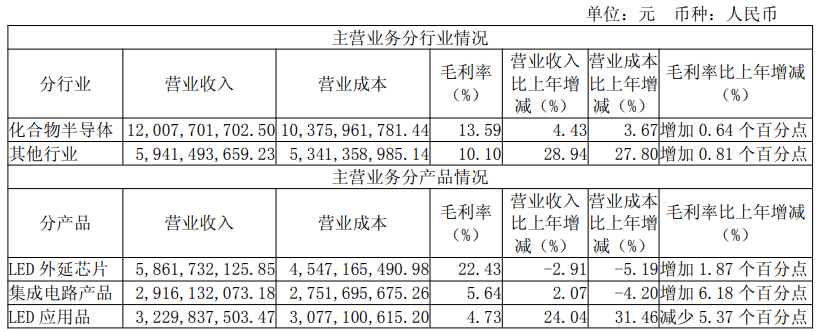

Among them, the LED epitaxy chip business generated revenue of 5.862 billion yuan, a year-on-year (YoY) decrease of 2.91%, with a gross margin of 22.43%, an increase of 1.87 percentage points compared to the same period last year. The LED application products business generated revenue of 3.230 billion yuan, a year-on-year (YoY) increase of 24.04%, with a gross margin of 4.73%, a decrease of 5.37 percentage points compared to the same period last year.
The year-on-year (YoY) decline in LED chip revenue is mainly due to the company extending its industry chain by producing some chips directly into modules for external sales, resulting in a reclassification of business categories; the year-on-year (YoY) increase in LED chip gross margin is mainly driven by an increased proportion of high-end products; the year-on-year (YoY) decline in LED application product gross margin is mainly due to decreased profitability of LED automotive lights and modules.
The integrated circuit product business generated revenue of 2.916 billion yuan, a year-on-year (YoY) increase of 2.07%, with a gross margin of 5.64%, an increase of 6.18 percentage points compared to the same period last year, mainly due to the increased sales scale and improved profitability of RF foundry services, filters, and optical technology businesses.
Specifically, during the reporting period, the company's sales volume of high-end LED products continued to grow. The company has been continuously advancing its technological accumulation and market expansion for high-end LED products in key application areas such as artificial intelligence, automotive, and commercial aerospace. This provides support for increasing the proportion of high-end products and further consolidates the company's position in the global LED industry.
Mini LED chips have been widely adopted in TVs, monitors, laptops, automotive displays, VR and other fields. The company has become a key solution provider for Mini RGB wide-color-gamut TV backlighting to leading domestic and international customers, with shipments continuing to grow. Micro LED chips maintain growth momentum in the medium-to-large display segment, and MiP products are being supplied in volume to domestic and overseas customers, steadily expanding market share.
In high-speed optical interconnect applications for AI data centers, the company has engaged in deep collaboration with entities such as Tsinghua University and China Mobile in the fields of Micro LED optoelectronic devices and high-speed optical communications, jointly promoting R&D and application verification of related technologies. Micro LED products have been sampled to leading domestic and international enterprises for module assembly verification.
在车用LED领域向国内外知名车企及Tier 1客户供货量持续增长,并持续拓展ADB、HUD、交互屏、自动驾驶等应用场景,具备向客户提供全套解决方案的能力。
Works closely with leading enterprises in the horticultural lighting sector both domestically and internationally, with performance indicators such as thermal steady-state for high-current products reaching international leading levels; Infrared LED has achieved rapid growth in markets such as security surveillance, facial recognition, sensor detection, and healthcare, while continuously expanding applications in emerging markets including wearable devices, industrial robots, industrial visual inspection, and vehicle anti-fatigue driving monitoring; Ultraviolet LED continues to grow in application areas such as anti-counterfeiting detection, nail care, 3D printing, electronic packaging, printing, biological monitoring, plant growth, sterilization, and medical treatment, while also expanding into new applications like medical aesthetics and semiconductor exposure machines; High-power flip-chip and ultra-vertical products continue to expand their customer base domestically and internationally, leveraging their leading advantages in key indicators such as luminous efficacy, reliability, and advanced technology.
In 2025, Anrui Optoelectronics secured a total of 22 new project nominations, continuing to achieve mass production supply for new vehicle models from brands such as Chery, Dongfeng Nissan, and General Motors, while further increasing its supply share among customers including General Motors, Nissan, Li Auto, and Changan Automobile. Anrui Optoelectronics made breakthroughs in winning DLP (Digital Light Processing) headlight projects from multiple automakers, with the shipment proportion of headlights and ambient lights continuing to rise.
MLS
木林森发布年报,2025年实现营业收入174.39亿元,同比增长3.13%;归属于上市公司股东的净利润为-14.77亿元,同比下降495.21%。
After years of deep cultivation and global layout, MLS has built a complete optoelectronic industry chain covering LED chips, LED packaging, applications, brands, and channels. The headquarters focuses on LED packaging and global strategic management, serving as the core hub of the industry; LEDVANCE specializes in overseas high-end general lighting and smart lighting businesses, covering mainstream markets in Europe and America; MLS Lighting deeply cultivates the domestic lighting market, achieving comprehensive channel penetration; meanwhile, it supports global R&D centers and production bases, responsible for core technology breakthroughs and the manufacturing of full categories such as LED devices and luminaires, forming an integrated industry ecosystem capability of "R&D—LED chips—LED packaging—applications".
During the reporting period, the Company continued to deepen its strategic layout across the entire LED industry chain, focusing on coordinated development throughout the chain. It steadily advanced the integration of upstream and downstream resources and the optimization and upgrading of production capacity, improved its global industrial layout and supply chain system, and strengthened core technology R&D and vertical supporting capabilities. The Company actively enhanced operational quality and efficiency through measures such as product optimization and business structure adjustment.
The changes in the company's operating performance were mainly affected by changes in the market environment in 2025, rising costs, and downstream demand falling short of expectations. The operating performance of overseas acquired subsidiaries did not meet expectations. Based on the results of goodwill impairment tests conducted by appraisal agencies for these subsidiaries, and following the principle of prudence, significant goodwill impairment provisions have been made.
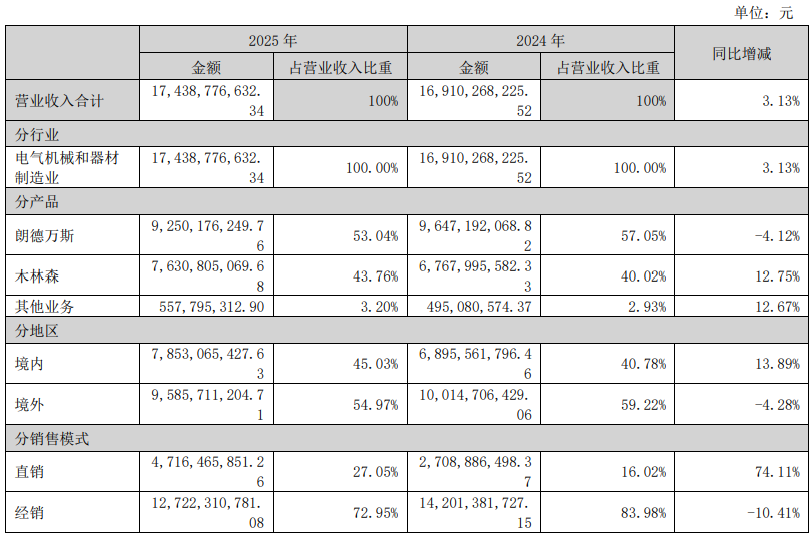
From a product perspective, LEDVANCE generated revenue of RMB 9.250 billion, a Year-on-year (YoY) decrease of 4.12%, with its share of total Revenue declining from 57.05% in 2024 to 53.04%; meanwhile, MLS brand revenue reached RMB 7.631 billion, marking a significant Year-on-year (YoY) increase of 12.75%, with its share rising to 43.76%, becoming the core driver supporting Revenue growth; other business revenue amounted to RMB 558 million, a Year-on-year (YoY) increase of 12.67%, accounting for 3.20%.
区域层面,境内收入78.53亿元,同比增长13.89%,占总营收比重从40.78%提升至45.03%;境外收入95.86亿元,同比下滑4.28%,占比降至54.97%,境外业务的疲软态势明显。
此外,公司高度重视自动化与智能化的投入,建立了规模庞大的智慧化工厂,采用先进的自动化设备,实现了智能化、自动化的生产线。通过技术改造和设备迭代,公司大幅提升了生产效率和品质。
未来公司发展将立足主业基本盘,依托“木林森 + 朗德万斯” 双品牌开展的全球化照明业务运营,通过多元产业链形成周期互补,实现主业稳健经营与盈利质量提升。
LITEON
In 2025, LITEON achieved revenue of 6.868 billion yuan, a year-on-year (YoY) increase of 0.90%; net profit attributable to shareholders of the listed company was 209 million yuan, a year-on-year (YoY) decrease of 50.09%.
On a quarterly basis, the company's fourth-quarter revenue was 1.92 billion yuan, up 3.0% year-on-year; net profit attributable to the parent company was 81.25 million yuan, down 41.5% year-on-year.
According to available data, LITEON's main businesses are lighting and Internet of Things (IoT). The company's main products include lighting products and accessories, IoT products and accessories, and other products. Starting from smart lighting, the company entered the IoT field; its products and services cover homes, enterprises, and diverse scenarios, gradually building an intelligent world of interconnected things.
LITEON analysis indicates that during the reporting period, the decline in net profit attributable to the parent company was mainly due to a decrease in gross margin, an increase in asset impairment losses, and increased financial expenses caused by exchange rate fluctuations.
Looking back at 2025, the company's external business environment was complex and volatile, presenting unprecedented challenges. In response to this difficult operating environment, the company adopted the annual work guideline of "Let numbers speak in 2025," adhered to the strategy of "dual main businesses of brand OEM and domestic-international dual circulation," further optimized its global business layout, and solidly advanced digital transformation.
To cope with uncertainties in the international trade environment such as additional tariffs imposed by the United States, the company began accelerating the "Transit via Thailand" strategy in April 2025. The first phase of the Thailand production base has been successfully expanded and achieved stable operations in the third quarter. Although short-term capacity ramp-up brought certain cost and management pressures, this layout significantly enhanced the resilience of the company's global supply chain and effectively hedged against some trade risks. In the future, the company will continue to promote capacity release from the Thailand base.
In recent years, the company has continued to advance its own brand building. In 2025, revenue from own-brand business reached 878 million yuan, accounting for 12.95% of total main business revenue. In 2025, overseas brands intensified market expansion through cross-border e-commerce channels; Chinese brands focused on building high-end original design Luminaire brand "Ledarin - One Light, One World" and the eye-care health-focused "Ledarin" brand; the company extended the "Eye-Care Technology" accumulated in the education lighting field to home scenarios, launching smart eye-care lamps and large street lights, which have been widely recognized by consumers.
From the perspective of business structure, lighting products and accessories remain the company's core revenue source, accounting for 63.86% of main business revenue; IoT products and accessories account for 25.22%, maintaining steady growth. Although overall revenue saw a slight increase, the company's profit margin was squeezed due to multiple factors including intensified market competition and raw material cost fluctuations, resulting in a year-on-year decline in gross margin.
The company has always adhered to innovation-driven development through R&D. In 2025, R&D investment reached 327 million yuan, maintaining high-intensity input. In terms of core technologies, the company has built an algorithm model system covering imaging, sound, and optics, including key security monitoring technologies such as facial image recognition, mobile human shape detection, and sound recognition, which have been successfully applied to smart monitoring and sensing products.
In terms of expense control, the company demonstrates strong operational resilience and refined management capabilities. Total management, sales, and R&D expenses decreased by 76.8934 million yuan year-on-year. Among them, the sales expense ratio was 7.43%, a decrease of 0.33 percentage points year-on-year; the management expense ratio was 9.44%, a decrease of 0.14 percentage points year-on-year. The R&D expense ratio was 4.77%, a decrease of 0.85 percentage points year-on-year.
Sanxiong Aurora
Sanxiong Aurora achieved revenue of 1.805 billion yuan in 2025, a year-on-year decline of 13.12%; net profit loss was 43.4959 million yuan, representing a year-on-year decline of 190.45% compared to the same period last year's profit of 48.0869 million yuan.
Regarding the decline in net profit, Sanxiong Aurora stated that it stems partly from the year-on-year reduction in revenue, and is also influenced by factors such as fierce market competition. The company's comprehensive gross margin decreased by approximately 3.53 percentage points year-on-year, falling from 32.71% in the same period last year to 29.18%.
The application areas of Sanxiong Aurora products cover commercial lighting, office lighting, industrial lighting, home lighting, outdoor lighting, etc.; they possess integrated comprehensive service capabilities for outdoor lighting projects from scheme design, product supply, construction, installation and commissioning to project handover. The company has strong brand and market advantages in professional lighting fields such as commercial lighting and engineering lighting.
Among them, commercial lighting is the company's core business, accounting for nearly 80% of total revenue. In 2025, the company's Commercial Division carried out comprehensive adjustments and optimizations. For example, the national market regional division of the Commercial Division was adjusted from 7 areas to 4 major areas; regional offices were adjusted to 38, with lower-output offices downgraded to liaison offices, and the Beijing, Shanghai, Guangzhou, and Shenzhen offices listed as headquarters' strategic direct-managed offices...
In terms of product strategy, closely following the healthy, smart, energy-saving, and ecological development direction of the lighting industry, we continuously optimize the product matrix and scenario adaptation, vigorously promote the scenario-based implementation of smart lighting systems, successfully implemented smart lighting projects such as China Mobile IoT and China Resources MixC Life during the reporting period; deepened the linkage between the high-end brand Boker and the HarmonyOS ecosystem.
During the reporting period, the company integrated real estate, commercial chain, industrial lighting, and large contractor businesses into key account business, achieving good market results. Specifically, the company strengthened business expansion in emerging niche fields such as new energy and intelligent manufacturing, with industrial lighting sales revenue achieving year-on-year growth; large contractor business typically acquires orders through centralized procurement projects and strategic cooperation forms. During the reporting period, the company established deep cooperative relationships with top customers such as China Merchants Shekou, Huazhu Hotels, and Suzhou Gold Mantis, with the number of strategic customers growing by 160% year-on-year, and large contractor business sales revenue achieving year-on-year growth of 160%; commercial chain and real estate businesses achieved slight year-on-year growth.
Regarding home lighting (including hardware channels), during the reporting period, the company merged the Home Division and Hardware Project Department to establish the Consumer Division. The Consumer Division mainly focused on organizational transformation and stable business development. The national market regions were adjusted from 6 areas to 4 major areas, with area managers coordinating multi-organizational joint operations across channel management, investment promotion, empowerment, proactive marketing, whole-house decoration, and innovative businesses... During the reporting period, the Consumer Division newly developed 67 dealers, built over 300 new home sales terminals, and developed more than 4,000 hardware sales terminals, further optimizing the sales channel system. In 2025, affected by lighting market demand and industry trends, the company's home lighting sales revenue (including hardware channels) decreased by 18.82% year-on-year.
Furthermore, the company's domestic e-commerce business remained in a downward adjustment phase in 2025, with the e-commerce business scale accounting for a small proportion of the company's revenue scale. Due to multiple factors including fierce industry price competition and the implementation of stricter risk assessments, the company's outdoor landscape business sales revenue decreased by 21% year-on-year in 2025.
During the reporting period, the company comprehensively promoted internal organizational optimization and adjustment based on the new organizational structure planning scheme. After a series of adjustments, the number of first-level organizations decreased by 6, second-level organizations decreased by 24, and other levels of organizations also underwent corresponding optimization and adjustment. According to
In addition, Sanxiong Aurora adhered to the '1+N' channel strategy externally to develop and optimize channel construction, focusing on sales terminal coverage in blank areas and blank sub-sectors; through empowerment training, it continuously strengthened the professional level and service guarantee capability of the marketing system.
Chenfeng Technology
Chenfeng Technology's annual revenue for 2025 was 1.129 billion yuan, a year-on-year decrease of 10.78%; net profit attributable to parents was 22.0422 million yuan, a year-on-year increase of 173.96%; non-recurring net profit attributable to parents showed a loss of 11.41 million yuan.
Among them, in the fourth quarter, the company's revenue was 255 million yuan, a year-on-year decrease of 24.3%; net profit attributable to parents changed from a loss of 2.89 million yuan at the same time last year to a loss of 2.43 million yuan, with the loss amount decreasing; non-recurring net profit attributable to parents changed from a loss of 5.16 million yuan at the same time last year to a loss of 18.57 million yuan.
During the reporting period, there were no significant changes in the company's operating business. The company's main businesses include the R&D, production, and sales of lighting structural component products, as well as the development and operation of incremental distribution networks, wind power, photovoltaic, and energy storage power stations. The company has long been deeply engaged in the fields of green energy saving and new energy power services, forming a mature and stable business pattern of dual main businesses running in parallel and developing synergistically: 'lighting structural component manufacturing + new energy power comprehensive services'.
Regarding the lighting business segment, the decrease in main business revenue and costs was mainly due to the disposal of the subsidiary Hongyi Electronics, which led to a reduction in the sales volume of printed circuit boards, and a decrease in the sales volume of LED bulb heat sinks, lamp cap/holder products, and metal parts for luminaires in the lighting segment. To optimize the business structure and focus on core main businesses, the company disposed of this non-core subsidiary. Affected by weak downstream demand and the disposal of the subsidiary, the lighting business segment achieved operating revenue of 893 million yuan, a year-on-year (YoY) decline of 18.77%.
The company's two core products, LED bulb heat sinks and lamp cap/holder products, accounted for 60.60% of the main business revenue, with no significant change in structural concentration; domestic sales accounted for 79.59% and foreign sales for 20.41%, with regional distribution remaining stable.
Facing the dual pressures of industry downturn and rising costs, the company continued to optimize the product structure of its lighting business, strictly controlled various cost expenses, steadily promoted internal operations management to improve quality and efficiency, and focused on high-quality customers and high value-added product businesses. Relying on years of accumulated high-quality customer resources and mature production and manufacturing capabilities, it ensured steady business operations.
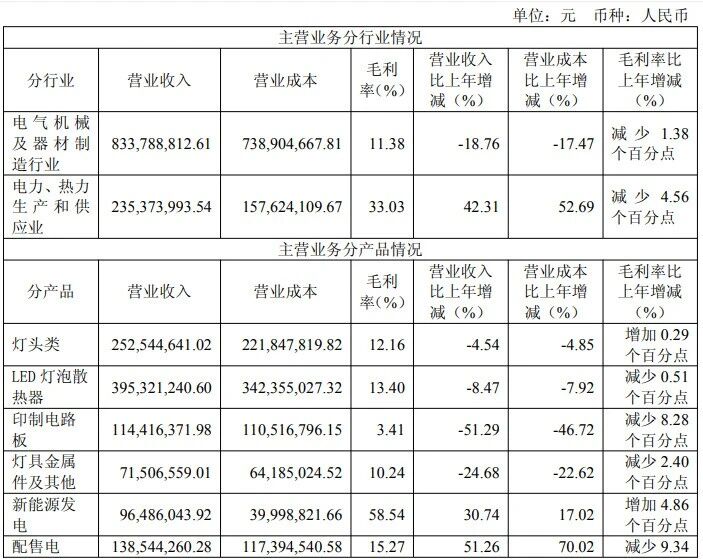

Regarding the new energy business segment, during the reporting period, the company deepened its engagement in regional new energy power generation and incremental distribution network businesses, continuously improved its business layout, steadily promoted project reserves, implementation, and operation management, and orderly advanced the quality improvement and efficiency enhancement of existing projects. In 2025, the new energy business segment achieved operating revenue of 236 million yuan, a year-on-year (YoY) increase of 42.21%, becoming a core performance growth segment for the company.
During the reporting period, the company completed the acquisition of 94.2752% equity in Liaoning Beiwang Xinneng, aiming to further optimize the governance structure and enhance the core competitiveness of its new energy business.
China Light
The official website of the China Association of Lighting Industry and a full-media platform for the lighting sector. We provide authoritative and timely lighting information while striving to be a growth partner for businesses. From brand promotion and channel expansion to consulting, talent training and participation in standards development, we provide comprehensive professional services to help businesses improve quality and efficiency and jointly advance the high-quality development of the lighting industry.
Business Contacts
仇纯 (Ms.): 158 6155 3579
顾君 (Mr.): 137 7157 5253