Back to news

Major Tariff News! One Year of Tariffs: Back to Square One Overnight?

Source: 中国之光网 Views: 4599

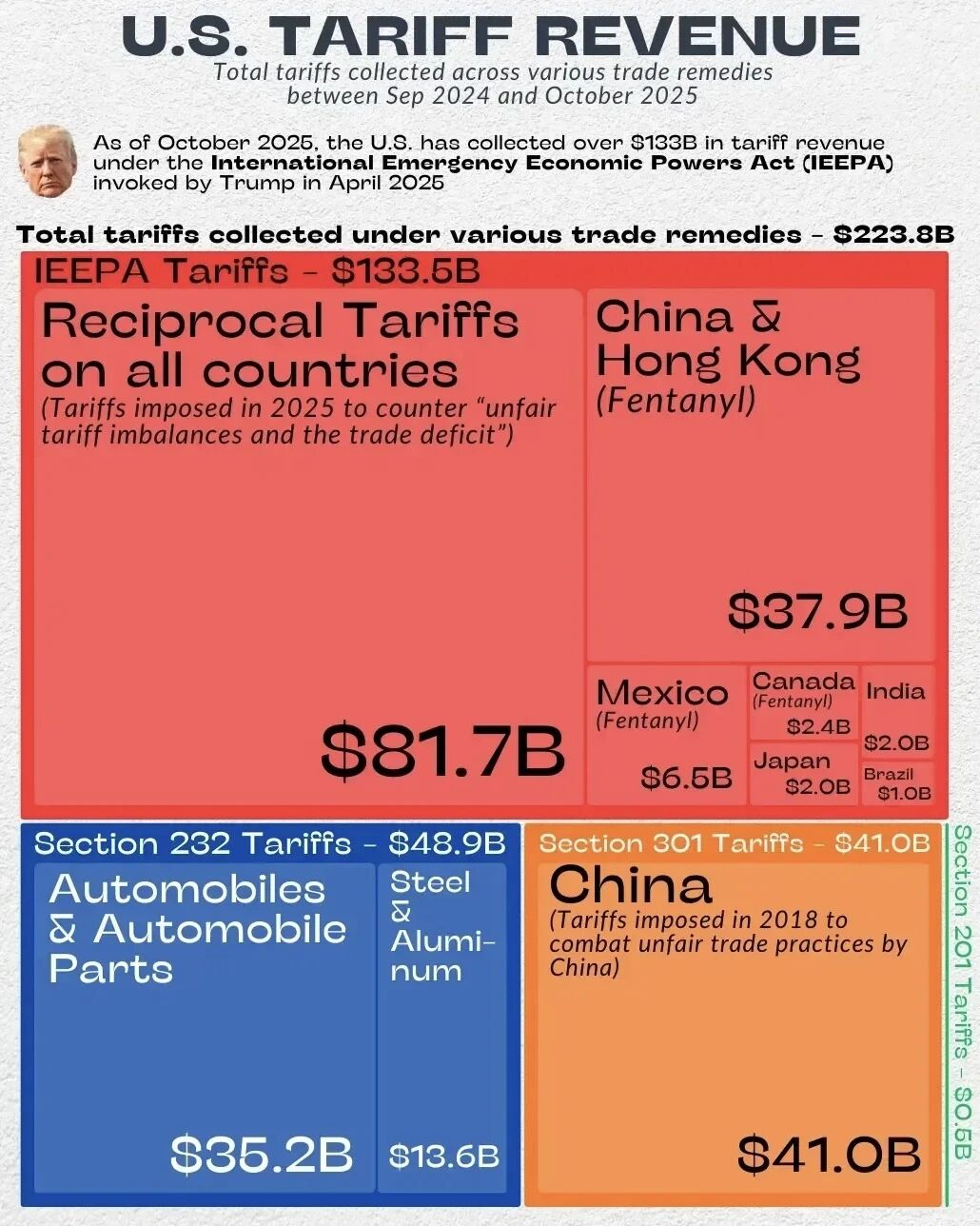
On February 20, Eastern Time, the U.S. Supreme Court ruled in a 6:3 vote that a series of tariff policies implemented by U.S. President Trump in 2025, including IEEPA tariffs and reciprocal tariffs, were unconstitutional. The ruling emphasized that the U.S. Constitution grants the power to levy taxes to Congress, and the International Emergency Economic Powers Act (IEEPA) does not authorize the President to impose tariffs. This decision means that the "IEEPA tariffs" and "reciprocal tariffs" measures promoted globally by the current U.S. administration will be revoked, and it may be necessary to refund up to $175 billion in collected taxes.


在美国最高法院裁决公布数小时后,特朗普立即援引1974年《贸易法》第122条,对全球各国商品加征10%的关税,2月24日生效,为期150天(至2026年7月24日)。快速完成关税政策 “换法续征”。


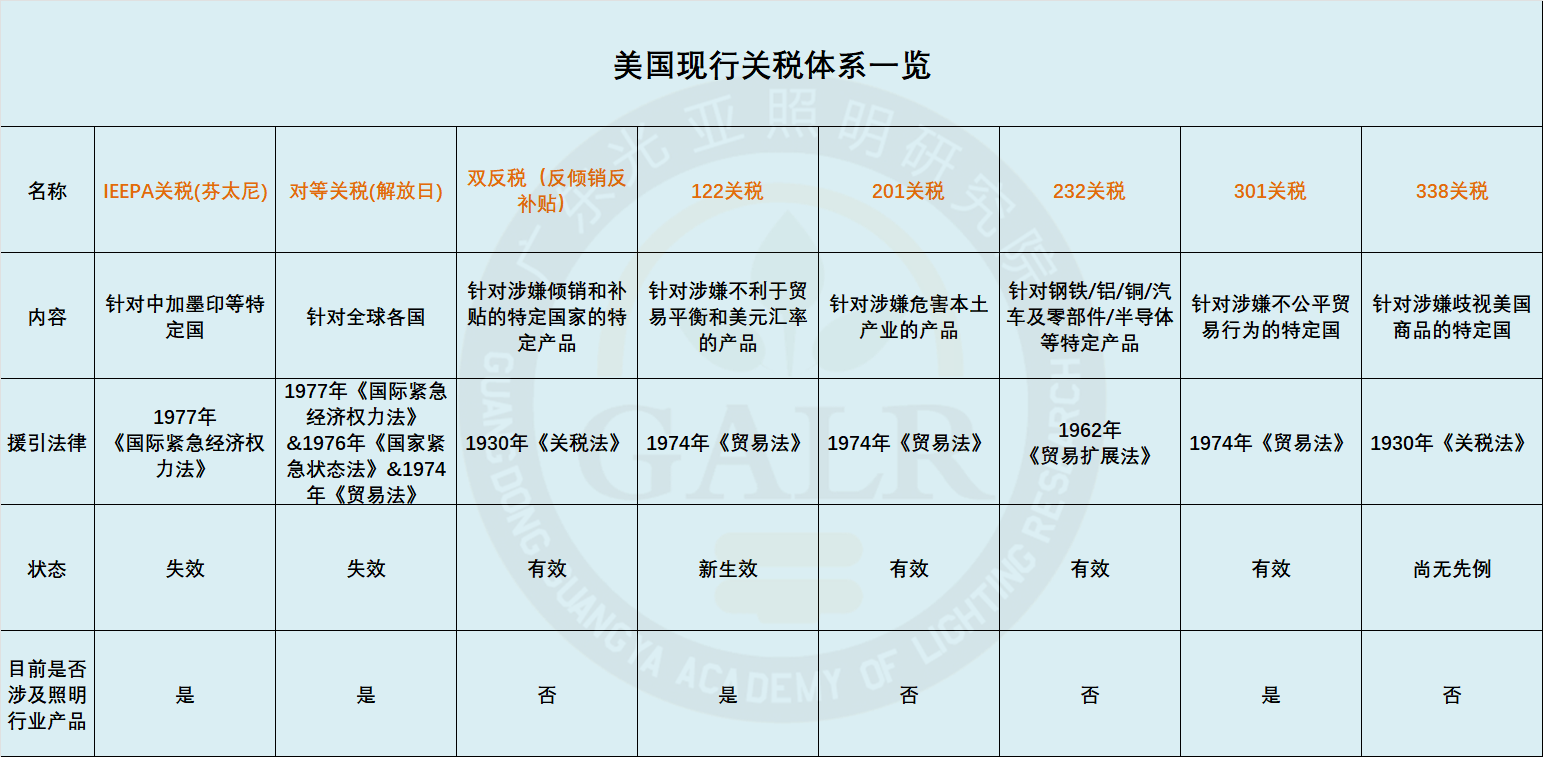
一、哪些关税撤销,哪些关税依然有效?


Terminated tariffs:


1. 2025 IEEPA tariffs targeting China, Canada, Mexico, India, etc. (i.e., Fentanyl tariffs):

Tax rate10%-25%


2. 2025 reciprocal tariffs targeting all countries (i.e., Liberation Day tariffs):

Tax rate10%-40%


(Termination of collection time: 00:01 EST on February 24, 2026, corresponding to 13:01 CST on February 24, 2026.)

Tariffs still in effect:


1. 2025 Section 232 tariffs on steel, aluminum, copper automotive parts and other products:

Tax rate 10%-100%

Note: Section 232 and Section 122 tariffs are not cumulative.


2. 2019 Section 301 tariffs targeting China:

Tax rate 7.5%-100%


3. 2017 Section 201 tariffs targeting photovoltaics:

Tax rate 15%-35%


4. Anti-dumping (AD) and countervailing duties (CVD) on different products in different years:
Tax rates vary

Newly effective tariffs:


1. 2026 global tariffs on all countries: tax rate 10%
(Start of collection time: February 24, 2026, 00:01 Eastern Time, corresponding to February 24, 2026, 13:01 Beijing Time.)
Note: Regarding Trump's claim on social media that the 122 tariff has been raised to 15%, as of the time of publication no official document has been signed detailing the effective date . That is, the 15% tariff currently does not meet the conditions for effectiveness and remains at the level of Trump's "slogan-style threat" .

Original URL:
https://www.whitehouse.gov/presidential-actions/2026/02/imposing-a-temporary-import-surcharge-to-address-fundamental-international-payments-problems/

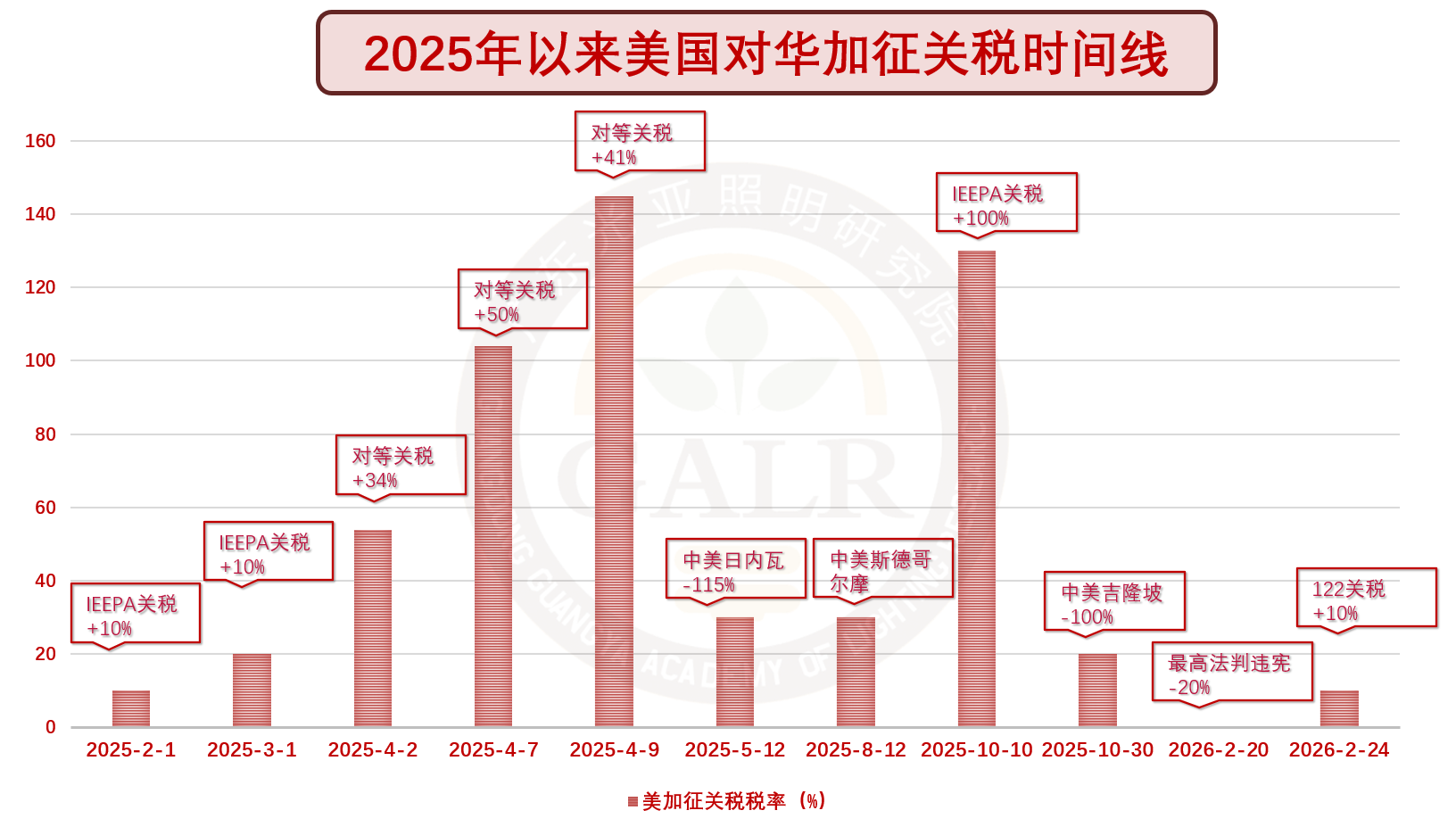
In summary, for China, the 20% tariff imposed in 2025 (10% under IEEPA + 10% reciprocal) has expired, and a new 10% tariff is now being implemented; this is equivalent to an overall reduction of 10% in the tariff level.


微信图片_2026-02-24_153903_617.png

(Click to view larger image)


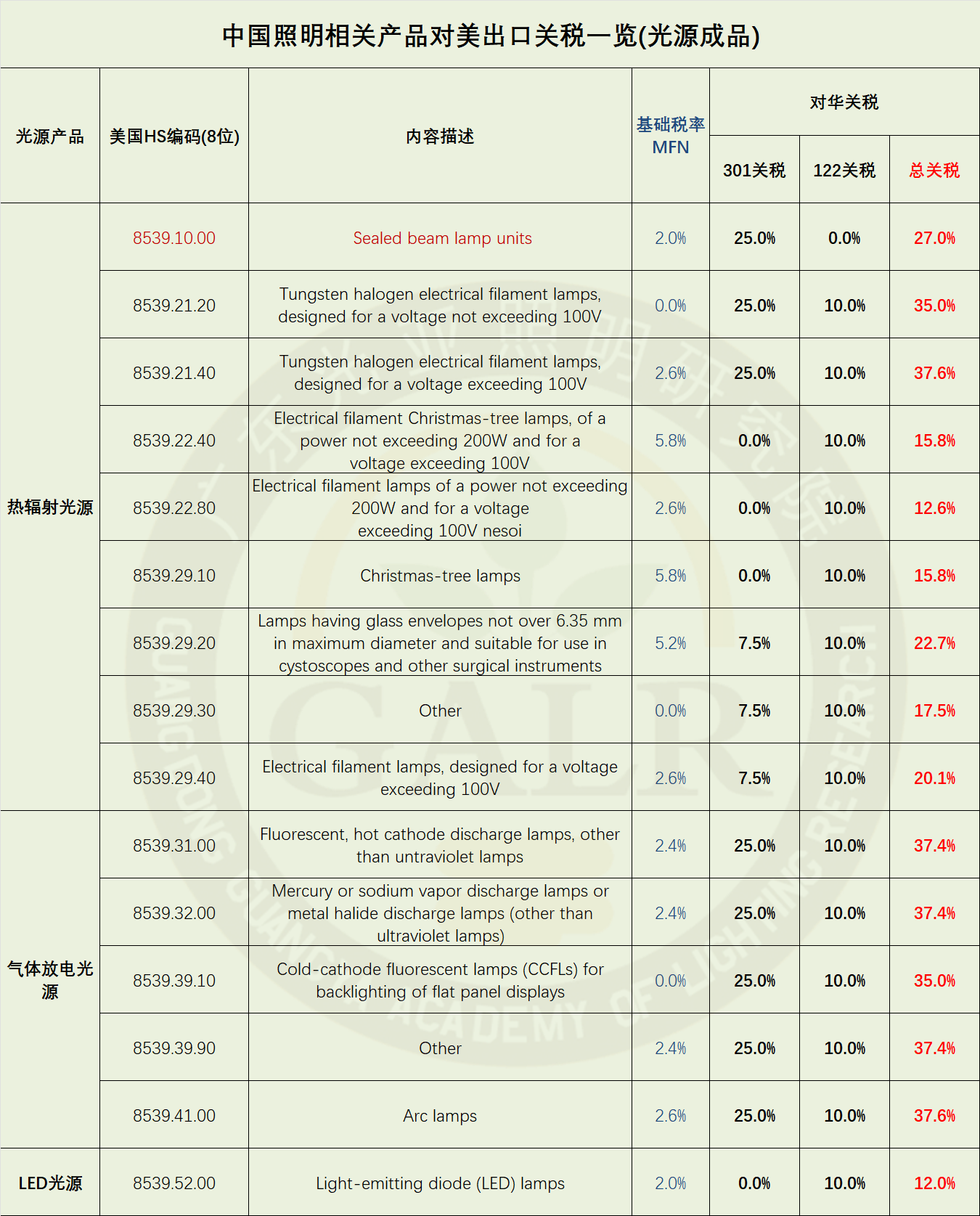
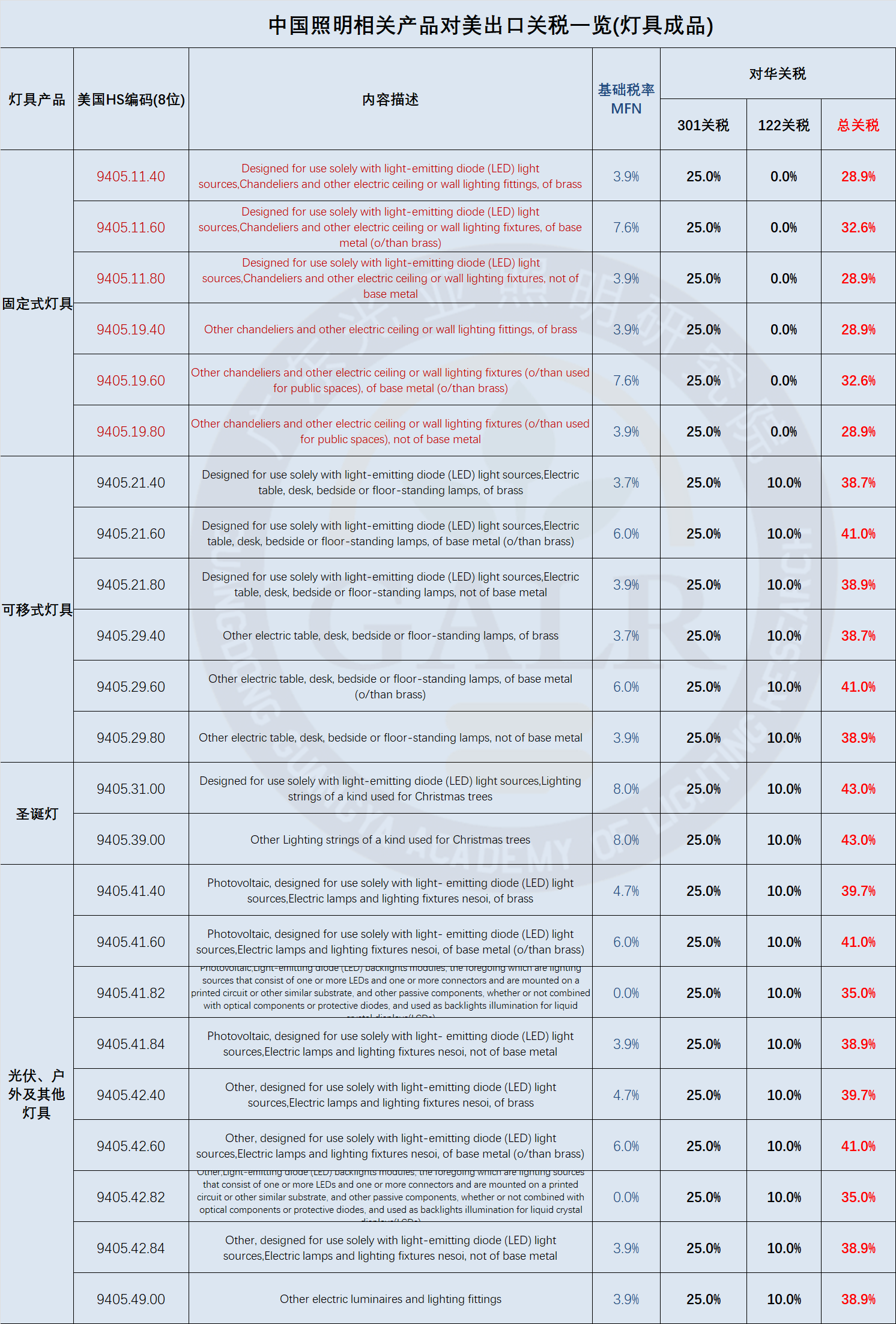
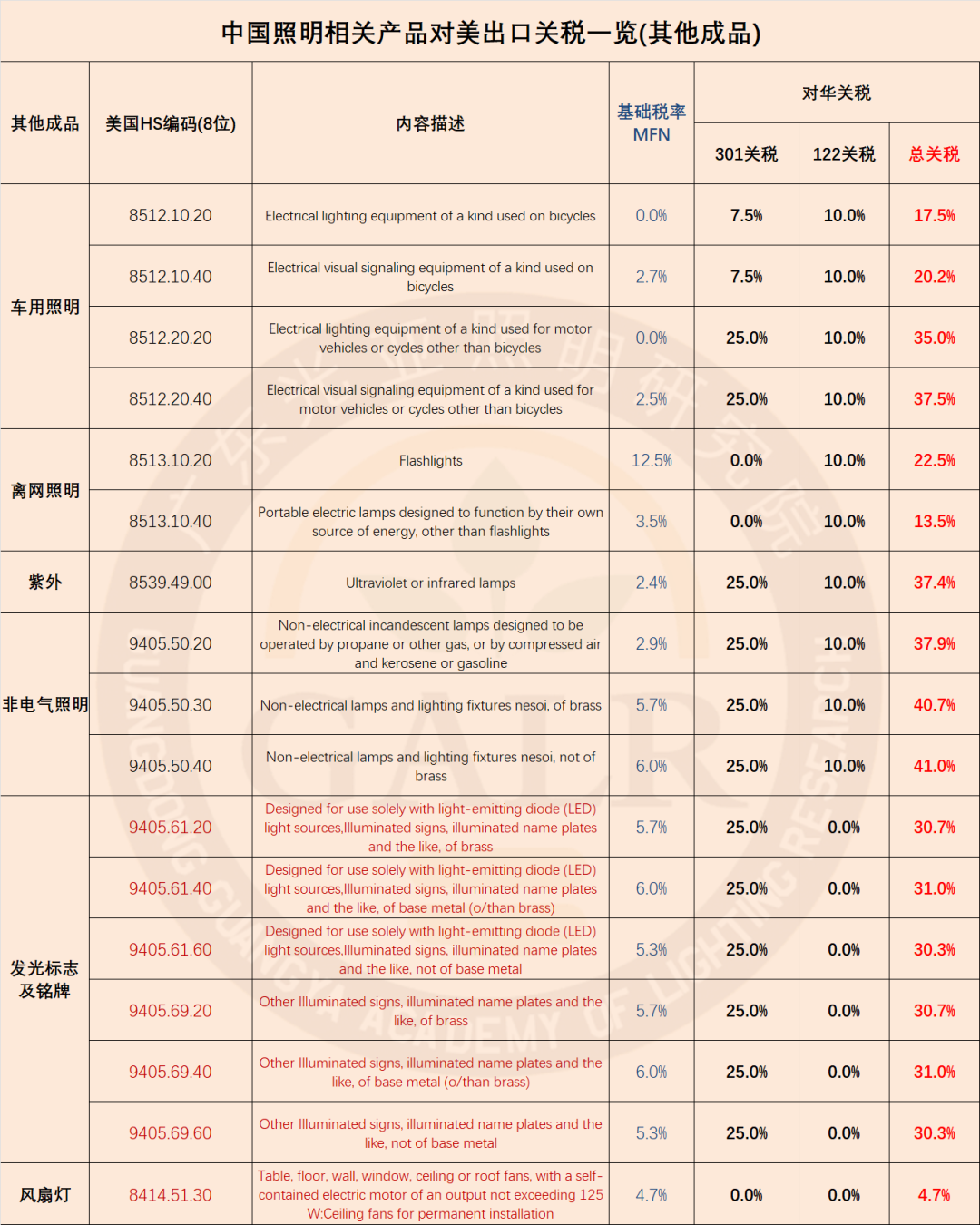
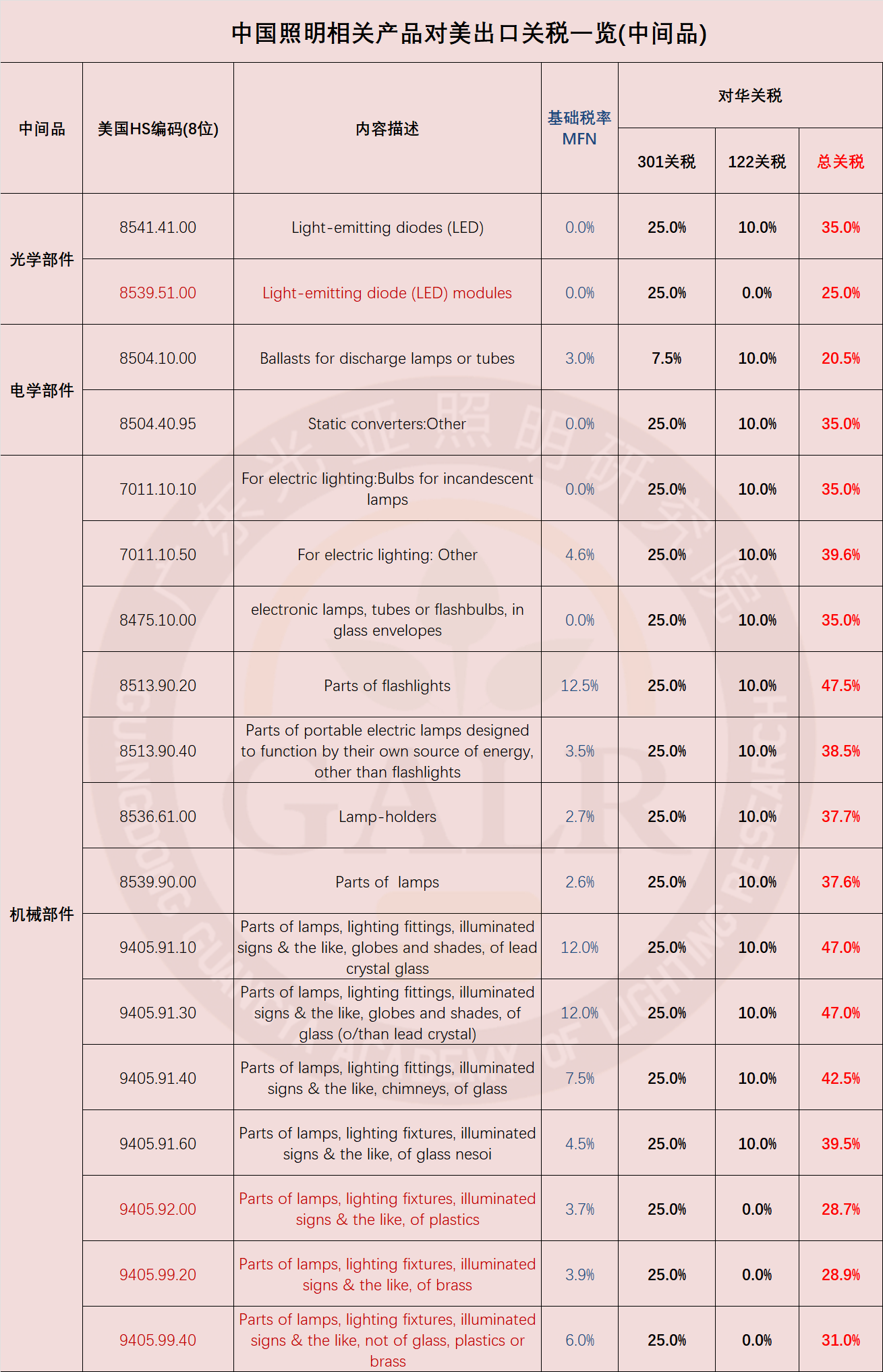
Overview of current U.S. tariffs, with the simultaneous cancellation of the 10% IEEPA tariff and the 10% reciprocal tariff, the tariffs currently applicable to Chinese lighting products exported to the U.S. are limited to Section 301 tariffs (7.5%-25%) and Section 122 tariffs (10%).

II. What will be the tariff rate for Chinese lighting product exports to the US?

微信图片_2026-02-24_153912_825.jpg

(Click to view full size image)


微信图片_2026-02-24_153923_323.png

(Click to view full size image)


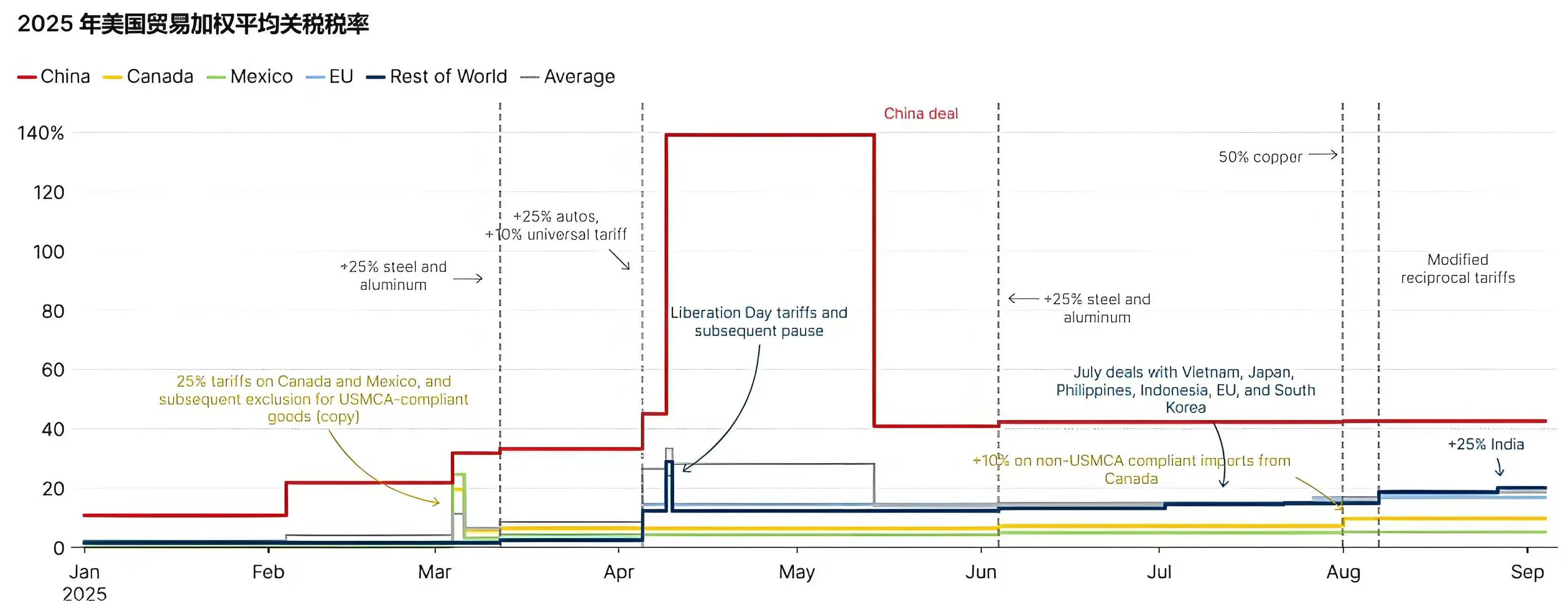
One cycle per year, the Trump 2.0 tariff rate has returned to the same 10% as early February last year. The story seems to have returned to the starting point, but the world is vastly different.


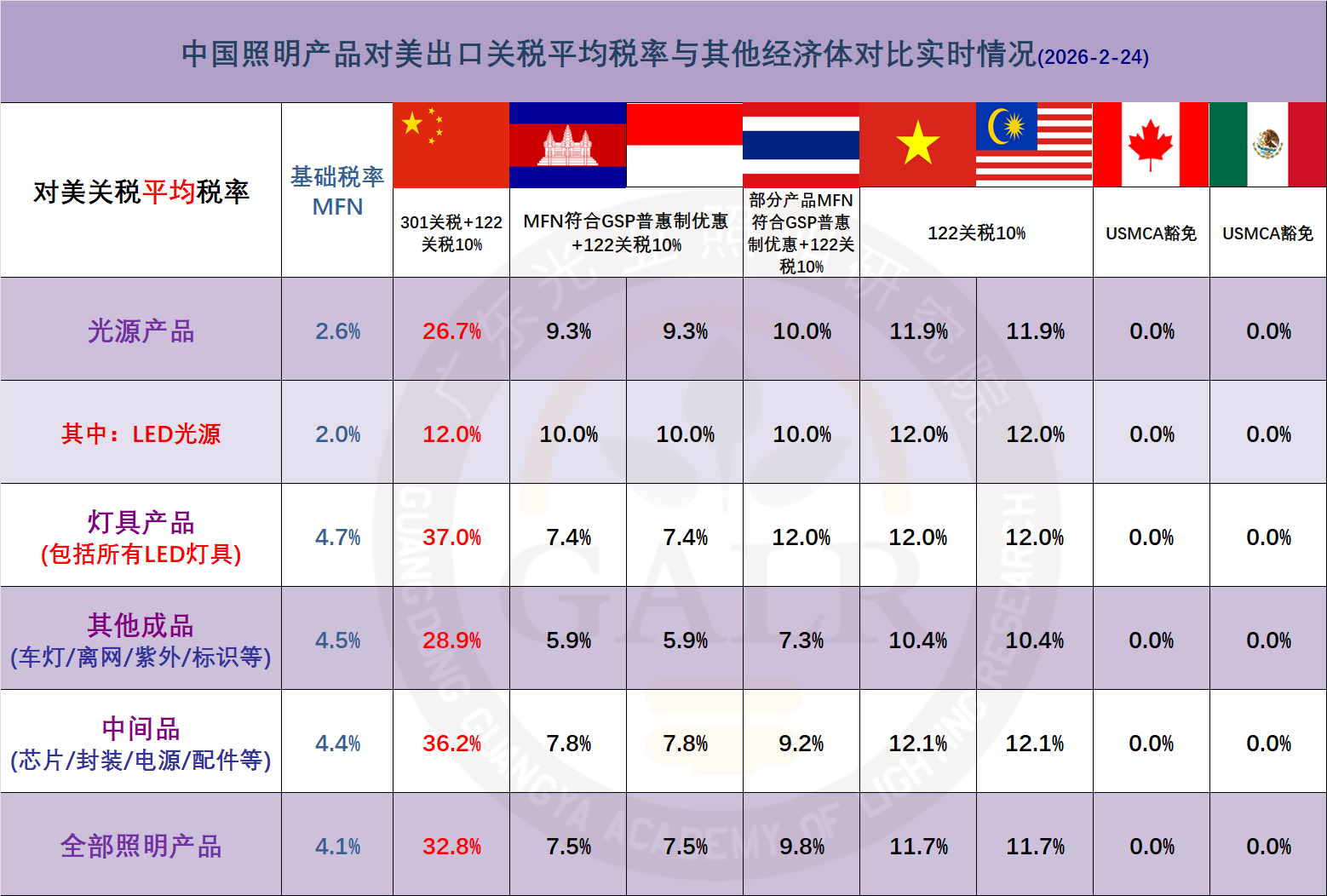
Let's also look at the real-time average tariff rate for Chinese lighting product exports to the US (2026-2-24)

微信图片_2026-02-24_153934_025.png

(Click to view larger image)


微信图片_2026-02-24_153943_425.png

(Click to view larger image)


微信图片_2026-02-24_153951_522.png

(Click to view larger image)


图片

(Click to view larger image)


微信图片_2026-02-24_154010_345.png

(Click to view larger image)


Note: HS codes marked in red fall within the scope of this round's Section 122 tariff exemptions.

Let's examine the tariffs on lighting products exported to the United States. Given that the 10% IEEPA tariff and the 10% reciprocal tariff have been immediately rescinded, the remaining tariffs imposed on the lighting industry are the 7.5%-25% Section 301 tariffs added during Trump 1.0 in 2018-2019, as well as the upcoming 10% Section 122 tariff. In short, the average tariff rate for Chinese lighting product exports to the U.S. has dropped significantly to 32.8%, compared to April last year. At current rates, the tariff on LED light sources from China is basically aligned with those from Southeast Asian economies; however, the tariff on LED luminaires from China remains more than 25% higher than that of other economies. The tariff differential pattern that everyone is concerned about has not changed significantly compared to before, even if it may subsequently rise to the Section 122 tariff cap of 15%.

It should be noted: When interviewed, U.S. Trade Representative格里尔 stated that although the reciprocal tariff has been cancelled, despite the new Section 122 tariff rate being lower at only 10%, the bilateral trade agreements already signed must still be fulfilled. Previously, the United States had reached trade agreements with multiple countries to determine tariff rates, including the EU (15%), Cambodia (19%), Indonesia (19%), Malaysia (19%), Thailand (19%), Philippines (19%), Vietnam (20%), Japan (15%), Pakistan (19%), South Korea (15%), and the UK (10%). These agreement tariffs are all higher than the current 10% prevailing tariff, and the outlook for fulfilling these trade agreements remains unclear.

III. What is the impact on China's lighting exports?

Given that the change in tariff rates caused by this event results in limited variation in tariff differentials, the overall impact is not significant. Currently, Chinese enterprises, whether domestic or overseas, can maintain their respective production capacities for the US market, compounded by Trump confirming his visit to China in April, sending a signal of easing trade relations between China and the US. However, it must be recognized that the competition between China and the US retains characteristics of inevitability, long-term nature, and complexity. At the same time, the momentum of global economic recovery remains fragile, and the uncertainty and fragmentation risks in the trade environment remain strong. Lighting exports will continue to be affected by multiple factors including demand, tariffs, exchange rates, and prices.

微信图片_2026-02-24_154020_138.png

(Click to view large image)


微信图片_2026-02-24_154027_312.png

(Click to view large image)


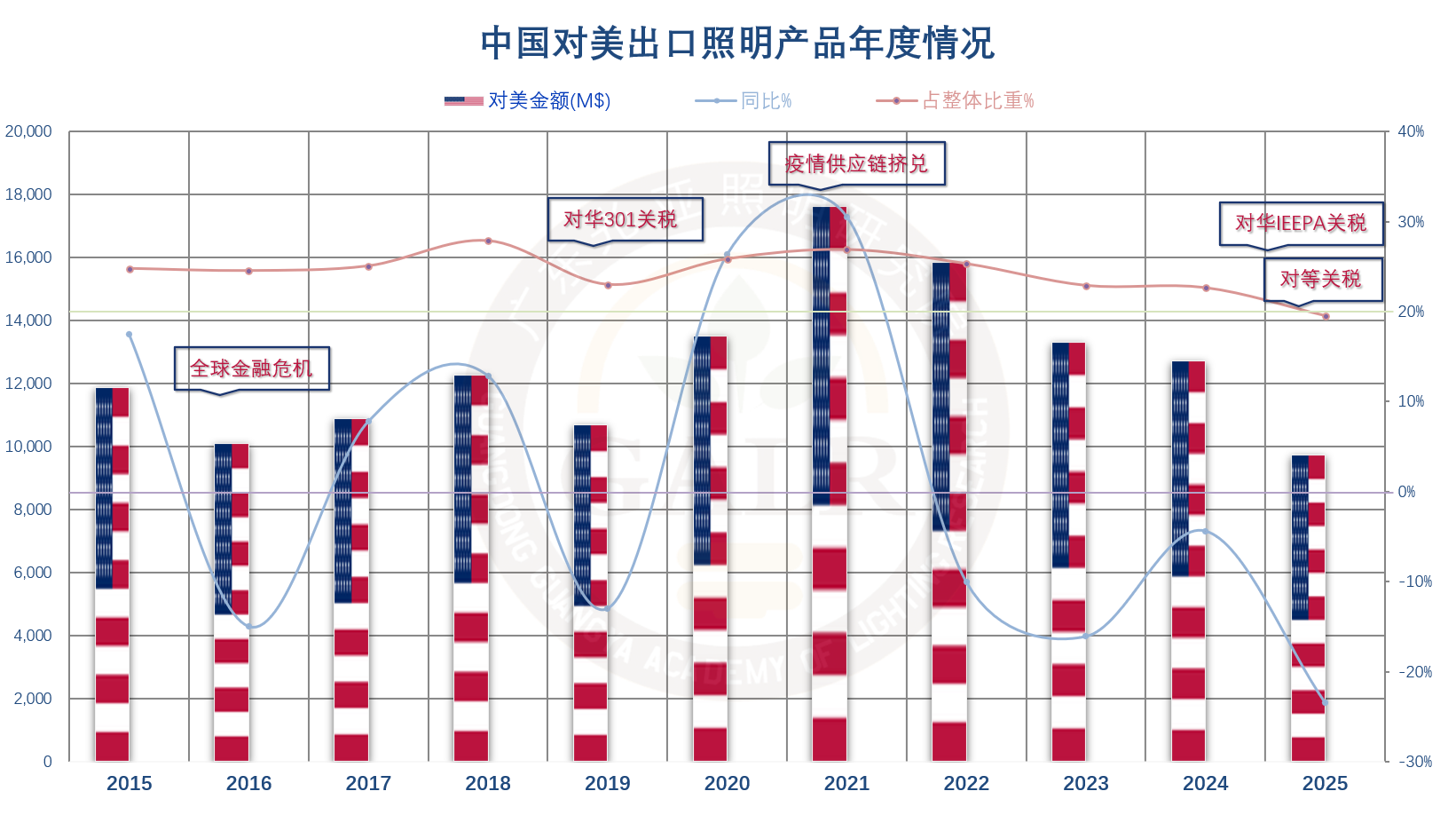
From the perspective of Chinese exports, in 2018 before the previous round of Section 301 tariffs were imposed, exports to the US once accounted for nearly 30% of China's total lighting product exports. Exports to the US once reached a peak of $17.6 billion (in 2021). Last year, cumulative lighting product exports to the US totaled only $9.8 billion, falling below the $10 billion threshold, representing a year-on-year decline of 23.4%. The share of total exports dropped to below 20%.

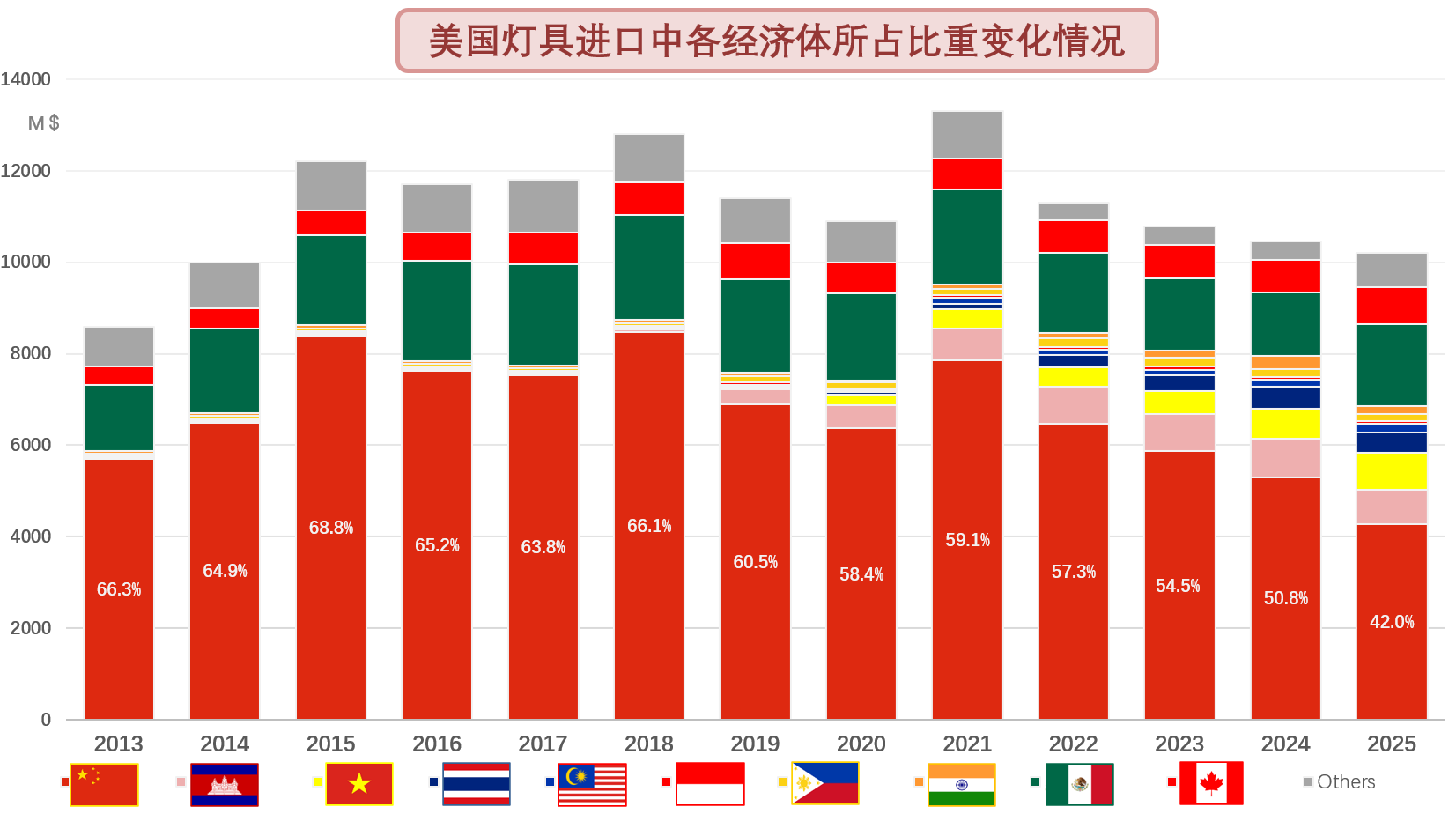
从美国进口角度看,中国占美国灯具进口额比重在10年间从近七成的高点下滑至42%,此消彼长之下,东南亚诸国的比重从此前的1.5%上升至近1/4。

Although a 10% tariff rate may seem like "returning to square one" overnight, after the intense global restructuring of 2025, the obstacles that tariff fluctuations have caused to international trade, the damage to trade rules, the constraints on global supply chains, and the drag on global economic recovery have already occurred. The China-U.S. economic and trade relationship has been profoundly reshaped, so it is not advisable to be overly optimistic about future exports to the United States.

微信图片_2026-02-24_154036_202.jpg

(Click to view larger image)


Will the collected billion-dollar tariffs be refunded and how? If US customers benefit, export enterprises also gain indirectly.


IV. What will the foreign trade situation for lighting be like in 2026?

Based on Trump's first year in office, ' America First' + 'Unilateralism' are the main strategies, with disrupting the existing order to exchange for short-term gains as the main means. In the field of economy and trade, revitalizing US manufacturing, tough trade policies and high tariffs remain its main line. Even if temporarily stepping back on tariffs due to unfavorable midterm election prospects, it cannot be ruled out that they may return later. In today's world full of black swans, anything is possible.

The rebalancing from globalization to regionalization and bloc-based structures is a confirmed trend. The reality that the global economy remains in struggle is unavoidable, while deteriorating terms of trade, rising protectionism, and intensifying geopolitical conflicts serve as long-term constraints. In the current phase of stock competition within the industry, K-shaped divergence is significant. Previously, most companies experienced growth amid incremental expansion; now, only enterprises with core competitiveness in technology, production, market, capital, management, and even business models have the opportunity to survive and develop.

This article forecasts the foreign trade situation for the lighting industry in 2026. Despite deepening protectionism, geopolitical conflicts, and further restructuring of the supply chain, external demand remains weak overall, compounded by pressure from a weakening US dollar. However, considering that US tariffs have temporarily entered a dormant phase, production capacity and supply chain spillover have stabilized, China's manufacturing resilience and supply chain advantages, and continuous upstream inflation forcing downstream price support, among other factors. Without the intervention of major black swan events, the author, who unfortunately saw predictions of a bleak outlook for four consecutive years come true, believes that export conditions for the lighting industry this year will be significantly better than last year.

Author of this article


Wen Qidong

GALR (Guangya Lighting Research Institute) Executive Vice President and Chief Researcher

International Commercial Lighting Federation CILCA Executive President

Deputy Director of the Low-Carbon Lighting Research Center, China Society for Urban Studies (CSUS)


China Light

The official website of the China Association of Lighting Industry and a full-media platform for the lighting sector. We provide authoritative and timely lighting information while striving to be a growth partner for businesses. From brand promotion and channel expansion to consulting, talent training and participation in standards development, we provide comprehensive professional services to help businesses improve quality and efficiency and jointly advance the high-quality development of the lighting industry.

Business Contacts

仇纯 (Ms.): 158 6155 3579

顾君 (Mr.): 137 7157 5253

Copyright Notice

Articles sourced from China Light are copyrighted. Please cite the source when reposting; otherwise legal responsibility may be pursued.

Reposted articles do not represent China Light’s endorsement of their views or positions.

For copyright, authenticity or other issues, please call 0510-85188298. We will handle them promptly.