
CES 2026 Lighting Innovation Guide: AI Reshapes Light and Shadow, Coexistence of Health and Aesthetics
Introduction:
CES 2026: The Global Debut of China's Lighting Power
CES (Consumer Electronics Show), as the "barometer" of the global technology Industry, has been the launchpad for breakthrough technologies and innovative products since its inception in 1967, hailed as the "Spring Festival Gala" of the tech world.
CES 2026 will be held in Las Vegas from January 6 to 9 (Pacific Time), with an exhibition area exceeding 2.6 million square feet, gathering 4,177 exhibiting companies (EqualOcean on-site statistics), covering nine core areas including AI, digital health, and smart hardware. The official slogan "Innovators Show up" accurately summarizes the core value of this grand event.
The most notable change at this year's exhibition is the comprehensive upgrade of Chinese companies from "quantity participation" to "quality leadership." According to authoritative sources such as the organizers, Huatai Securities, and NetEase News, there are 942 Chinese participating companies, accounting for about 22%, continuing to rank as the world's second-largest participating country (with the US leading at 1,325 companies).
In the lighting sector, Chinese companies have also broken away from the "supporting role" positioning. Shenzhen Zhiyan Technology (Govee), BroadLink, and Beijing Gewu Shiji Technology showcased core achievements such as AI lighting, healthy lighting, and connected lighting in the main exhibition area, competing with international giants and becoming an important source of global light and shadow technology innovation.
Among them, Shenzhen Zhiyan Technology's Govee brand seized industry focus by building a smart ceiling lighting ecosystem, while Beijing Gewu Shiji Technology's health-monitoring lighting won innovation awards. These breakthroughs not only demonstrate the technical strength of Chinese lighting companies but also mark China's entry into the global first tier in the "AI + Lighting" integration track.
Below, we will combine highlights from the exhibition site to break down the four core trends in lighting technology: "AI empowerment, health advancement, scenario reconstruction, and ecosystem synergy."
01
AI-led interaction revolution:
From “passive response” to “active understanding”
The most significant breakthrough at this year's CES lies in the deep integration of AI technology with lighting, no longer limited to simple voice control, but achieving full-chain intelligence of "intent recognition - dynamic adaptation - scenario co-creation".
ShenzhenGovee's AI creation engine from Zhiyan Technology sets the benchmark — its released AI Lighting Bot 2.0 has evolved into a "light and shadow designer," where users only need to input text commands (such as "create a morning mist atmosphere in a rainforest"), and the system can automatically generate lighting solutions including color temperature, brightness gradients, and dynamic effects, working with the Ceiling Light Ultra's 616-pixel LED matrix to present delicate light and shadow animations on the ceiling.
Even more noteworthy is the DaySync adaptive system, which learns user schedule data and fine-tunes light temperature every 15 minutes (ultra-wide range of 1000K-10000K), precisely matching the human circadian rhythm. Experimental data shows it can reduce sleep onset time by 23%.
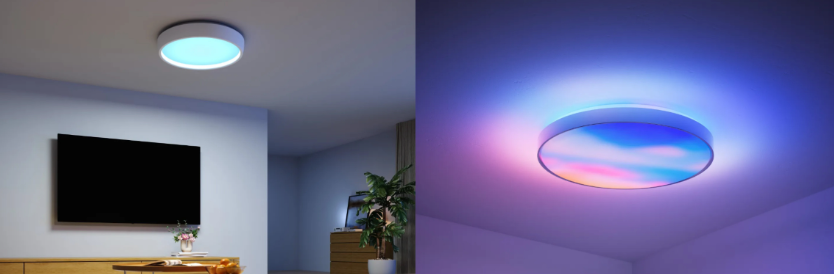
Sky Ceiling Light (left) and Ceiling Light Ultra (right) (Image source: The Verge)
The Sky Ceiling Light simulates daylight, providing an important supplement for windowless rooms. Its color temperature is adjustable between 2700K and 6500K, with a maximum brightness of 5200 lumens at 6500K.
According to The Verge, the Ceiling Light Ultra is described as "the industry's first ceiling light truly built as a creative canvas." It features 616 RGB LEDs, supporting user-customized lighting creations. In the corresponding Govee App, users can input text descriptions, and the AI Lighting Bot 2.0 generates corresponding lighting scenes to project onto the light.
BeijingGewu Technologybrings a more industry-disrupting surprise — as a Chinese company that exhibited only one product yet became the "Award King" of this CES, its globally debuted Sleepal® AI Sleep Lightswept three innovation awards in Digital Health, Accessibility & Longevity, and Smart Home, becoming a benchmark product across multiple fields. This product completely breaks the limitations of traditional sleep monitoring, innovatively achieving "non-contact, non-intrusive monitoring": without wearing any devices or physical contact, it accurately captures core sleep data such as breathing rate and chest movement through a built-in high-frequency millimeter-wave radar (detection accuracy up to 0.1mm), paired with self-developed AI algorithms to determine sleep stages. Even more noteworthy is that its algorithm accuracy has surpassed mainstream wearable devices, addressing universal sleep health needs and achieving a breakthrough in "spatial environmental-level AI perception".
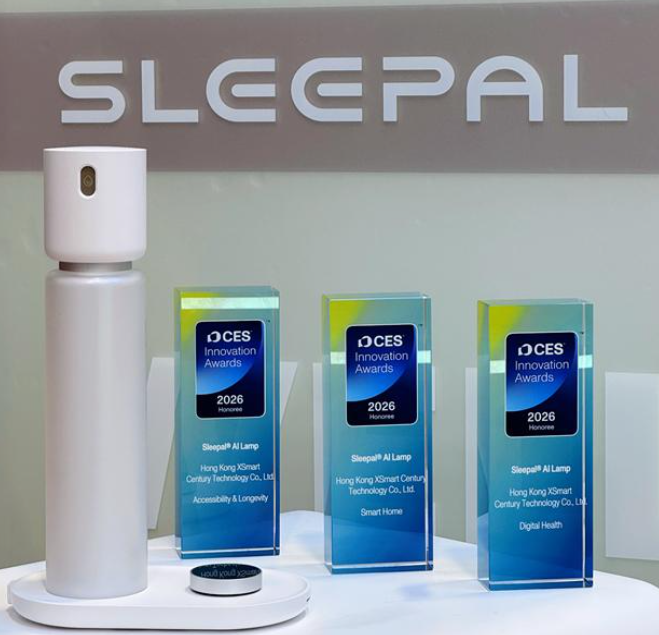
Image source: Zaker
在实际应用中,Sleepal® AI 睡眠灯可智能适配不同睡眠场景:浅睡时自动调暗灯光并同步播放白噪音,唤醒阶段则精准捕捉轻度睡眠周期开启模拟晨光,避免深度睡眠被打断的不适感。数千名 CES 评委的认可,印证了它并非单一功能照明产品,而是被置于 “健康 + 家居 + 长期价值” 的综合语境中审视,标志着睡眠监测正式从 “穿戴式” 走向 “空间环境级”,当 AI 深度融入夜间场景,智能硬件也从工具属性升级为生活不可或缺的一部分,重新定义了照明设备的健康管理价值。
02
健康照明进阶:
From "Visual Comfort" to "Physiological Intervention"
If healthy lighting in previous years was limited to blue light filtering and high color rendering, the technologies showcased at CES 2026 have achieved a "therapeutic-grade" breakthrough, with non-contact physiological regulation emerging as a new competitive track.
Korean lighting company Korea Lighting has commercialized medical-grade near-infrared technology for the first time with its Neurélux Brain Health Lamp, utilizing the synergistic effect of dual wavelengths at 810nm and 1064nm: the former is selectively absorbed by brain cell mitochondria, promoting ATP energy generation to repair neural tissue; the latter penetrates deep brain tissue, enhancing cerebral blood flow and neuroplasticity through mild thermal stimulation. Clinical tests show it can improve attention deficit issues by 37%.
This luminaire features a minimalist design, serving both as daily lighting and allowing users to set scenarios such as "Focus Mode" and "Sleep Repair Mode" via an app, breaking the boundary between medical devices and home furnishings.
In the basic healthy lighting sector, Govee from Zhiyan Technology's LuminBlend + Color System solves the long-standing pain point of "RGB to white light color cast," ensuring true color reproduction of objects at any brightness level through 16-bit color depth adjustment, making it especially suitable for scenarios with high color accuracy requirements such as makeup application and reading.
03
Light and Shadow Reconstruction:
From "Single Lighting" to "Scene Narrative"
The lighting products at this exhibition are no longer isolated light sources, but through modular design + full-scene linkage, they have become the "language of spatial narrative", with Chinese brands standing out in indoor-outdoor integrated innovation.
Linkind, a brand under Leedarson , has redefined courtyard lighting with its outdoor light and shadow system: as Leedarson's smart lighting brand targeting overseas markets, its exhibited SP6 Smart Solar Path Light supports APP switching of dynamic light effects, simulating 12 modes such as fireflies dancing and starlight flickering; the intelligent energy optimization algorithm equipped on the solar panel solves the winter endurance problem (tested to last more than 90 days); paired with the Aura Scape™ color mixing technology of the SL6C Aurora Spotlight, it can project 32 layers of gradient light on building facades, transforming ordinary courtyards into immersive night landscapes.
In indoor scenarios, Linkind's T19 Smart Light Strip further strengthens the core advantage of "full-scene light and shadow linkage": its segmented multi-zone color control design can flexibly adhere to various carriers such as pendant lights, wall lamps, and TV cabinets, achieving cross-space linkage with the SP6 path light and SL6C spotlight via the Matter protocol — when users move from the courtyard indoors, the light strip automatically synchronizes the color temperature and luminance of the outdoor lighting, creating a "seamless light and shadow transition"; during movie viewing, the light strip projects base ambient light along the walls, forming a "clear primary-secondary narrative structure" with the main living room light, completely breaking the scene limitations of traditional single lighting.
In addition, Nanoleaf, under Green Nuo Energy Technology, focuses its Elements Ultra light-and-shadow interconnection system (a Chinese brand) on immersive indoor storytelling: its hexagonal modular light panels use "SceneSync scene synchronization technology" to present "layered light and shadow effects" based on film, TV, and music content—panels alternate flashing red and blue light during fight scenes, and switch to warm gradient lighting for romantic segments. Combined with a 360° installation design, this makes light and shadow an extension of content expression. This product won the TechRadar "Best Smart Lighting Innovation Award", underscoring the technological leadership of Chinese brands in scenario-based lighting.
04
Ecosystem co-evolution:
From “single-product intelligence” to “whole-home connectivity”
At this CES, ecosystem collaboration in the lighting sector exhibited the characteristics of “diverse protocols, with interoperability at the core.” The Matter protocol has become the mainstream choice for cross-brand compatibility, while Zigbee and proprietary protocols deliver value in niche scenarios, jointly driving the implementation of “device collaboration.”
GE Lighting's smart curtains and lighting system is a typical example of ecosystem synergy: its Matter-compatible smart curtains support linkage with multiple platforms such as Alexa, Google Home, and Apple Home, and can achieve scene automation with Light+Form series light bulbs — when the curtains slowly open in the morning, the bulbs automatically transition from warm light to 6500K white light simulating daylight; after the curtains close at night, the lighting synchronously dims to a brightness suitable for reading. The curtains adopt a magnetic charging battery (6-month battery life) and a screwless installation design, solving the pain points of traditional smart curtains such as "complex installation and short battery life".
BroadLink's Matter Super Bridge RM MAX solves the pain point of interconnecting old and new devices: through its "protocol bridging" capability, it can uniformly integrate lighting devices using the proprietary FastCon protocol and traditional infrared lamps into the Matter ecosystem. A single gateway can connect up to 4096 devices, achieving full-domain control without replacing hardware, perfectly adapting to multi-scenario needs in homes and businesses.
Raysharp IoT's Zigbee 3.0 lighting solution is adapted for low-power scenarios: its smart module supports direct connection to Philips Hue gateways, achieving ultra-fine dimming with 0.01% steps, with an outdoor communication distance of 300 meters. It is particularly suitable for large-scale networking in commercial lighting, and can also be integrated into the Matter system through bridging devices.
Conclusion
The Next Stop of Light and Shadow — "Intelligence with Warmth"
It is evident from the exhibits at CES 2026 that the lighting industry is undergoing a transformation from "technology-driven" to "experience-driven" : AI enables lighting to "understand needs," health technologies empower lighting with "intervention capabilities," and ecosystem integration allows lighting to blend into "life scenarios."
For industry practitioners, seizing the convergence trend of "AI + Health + Ecosystem" while drawing on Chinese companies' path of "scenario-based innovation + global implementation" will be key to gaining a first-mover advantage in the market.
Future lighting will no longer be cold light sources, but rather "space partners" capable of perceiving emotions, regulating health, and telling stories , and the core driving force behind this transformation comes from global innovators represented by Chinese enterprises.