
Guangdong Spot Check Report: 344 Luminaire Models Failed, 89% from Guangdong, 42 Companies Listed Consecutively
Recently, the Guangdong Provincial Market Supervision Administration organized a 2024 quality supervision and spot check of 11 types of products including LED control devices, and released a detailed notice on the inspection results.
This regulatory action covers a wide range and has strong enforcement. Data shows that this spot check found a total of 345 non-conforming products , an extremely large number, of which 344 models are common luminaire types widely used in daily applications: fixed general luminaires191models, recessed luminaires71models, portable general luminaires 42 models, aquarium luminaires 28 models, reading desk lamps 10 models, floodlight luminaires 2 models. (The list of non-conforming items can be viewed at the end of the article attachment)
E-commerce platforms have become major trouble spots
Among the products sampled in this inspection, 267 non-compliant luminaires were found online , while only 77 non-compliant luminaires were found offline . This stark disparity clearly indicates that online e-commerce platforms have become a 'hotspot' for concentrated quality risks in lighting products.
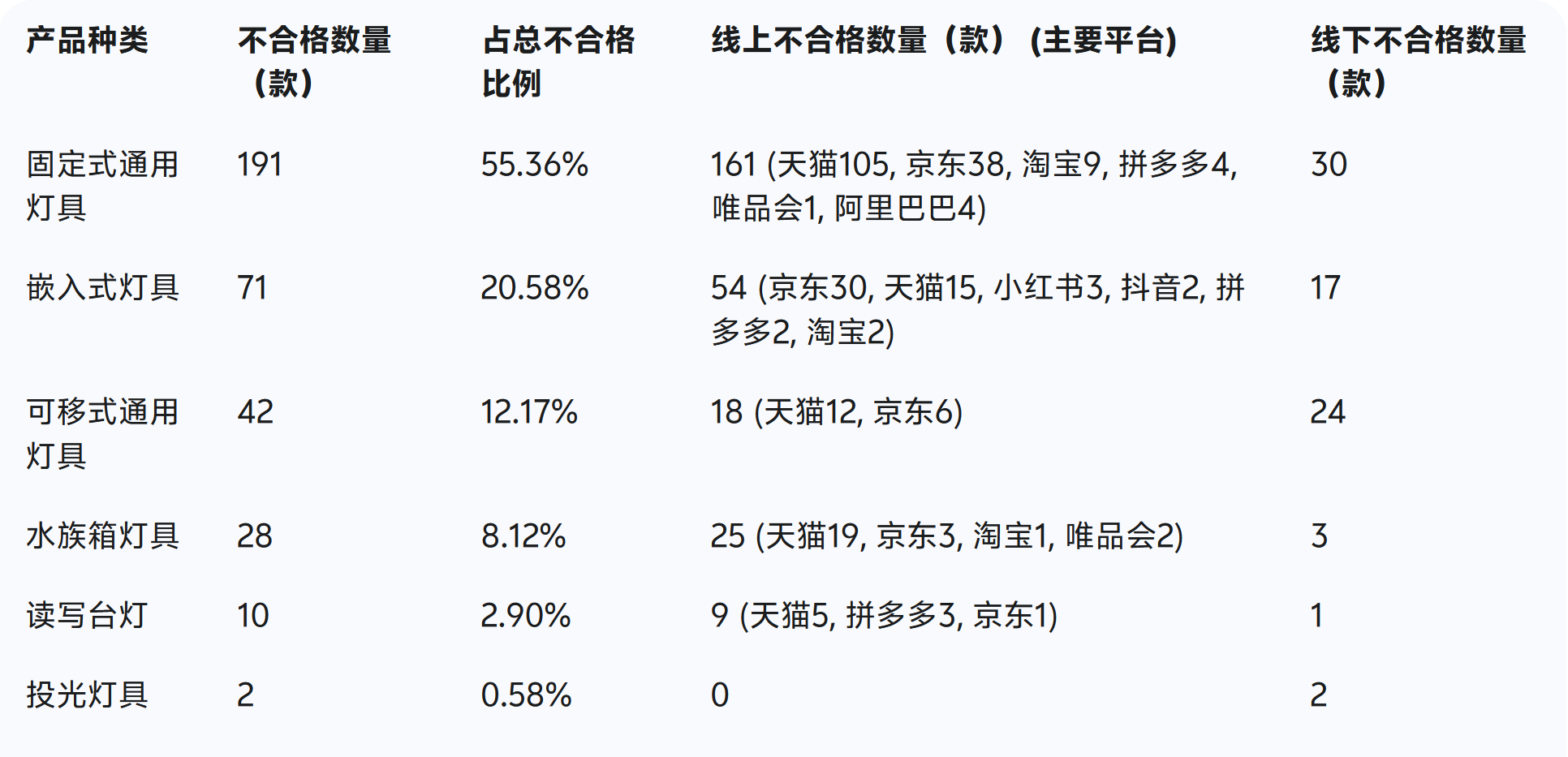
The high rate of non-compliance in online channels is not accidental. Online market competition often relies heavily on low-price strategies, putting extreme pressure on manufacturers to control costs. To compress costs, some producers choose to cut corners on invisible internal components, such as LED drivers and insulation materials, or adopt products that have not been fully designed . This excessive cost compression directly translates into widespread failures in safety standards and performance.
It is worth noting that many of the inspected units mentioned in the notice are online e-commerce companies or traders, rather than traditional lighting product dealers. E-commerce platforms typically adopt a passive mode of waiting for regulatory agencies to conduct spot checks, lacking mechanisms to proactively establish strict entry thresholds and mandatory quality audits and spot checks for products at the front end of the supply chain. This structural defect makes it easier for manufacturers pursuing short-term profits to quickly push non-compliant products through online platforms to consumers nationwide, leading to the concentrated exposure of risks in the online channel during this inspection.

Double-edged sword of industrial clusters
在本次抽查发现的344款不合格灯具中,标称生产单位位于广东省的产品数量达306款。这意味着广东省照明企业生产的不合格产品占比高达89%。这一惊人的数字,深刻揭示了当前中国照明行业“内卷”和质量危机的地域性集中特征。
Guangdong Province, especially the Pearl River Delta region, is the largest lighting industry cluster in China and even globally. Although this region possesses the most complete supply chain, bringing efficiency and cost advantages, it is precisely this over-perfection and low entry threshold that exacerbates the erosion of product basic safety by price competition . Under fierce price wars, many local SMEs, in order to survive, are forced to cut corners, sacrifice safety and EMC compliance to compress costs.
本次抽检结果表明,照明行业的质量问题并非零星事件,而是集中在核心制造基地,由产业结构性内卷所驱动的一场系统性质量危机。只有从源头解决才能从根本上扭转行业“质量免疫力”下降的趋势。

42家“常犯”企业的信誉危机
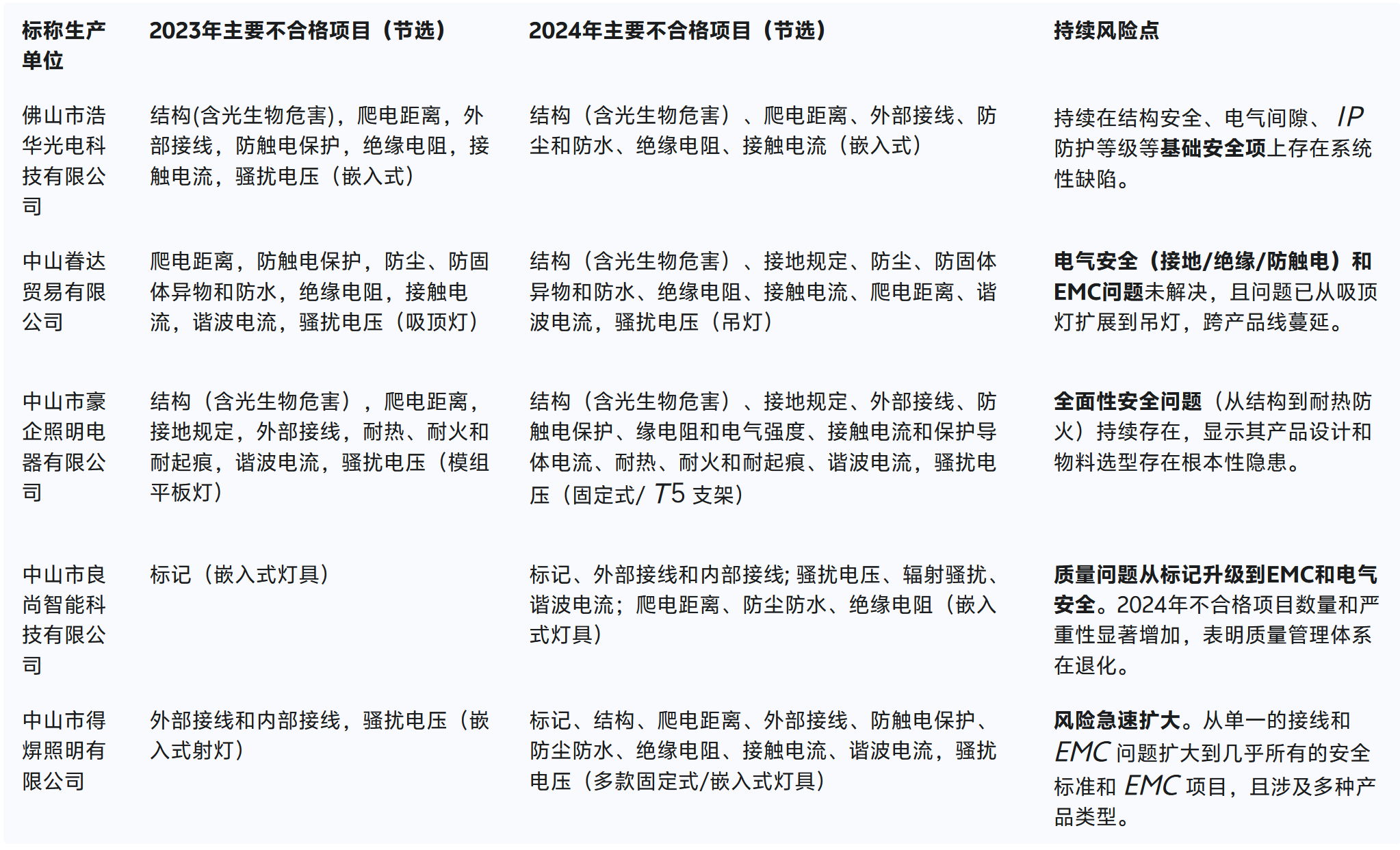
Among the results of this spot check, 42 production enterprises were found to have had non-compliant products detected in consecutive years of inspections, including several internet-famous brands on e-commerce platforms. This indicates that these enterprises lack basic awareness of their primary responsibility for quality. After being exposed for the first time, they did not conduct effective root cause analysis or implement corrective and preventive measures, revealing fundamental and stubborn defects in their quality management systems.
Through in-depth comparative analysis of production enterprises that failed for two consecutive years, it can be found that their quality risks exhibit trends of continuity, diversity, and even expansion :
Dual failure to meet safety standards and EMC compliance
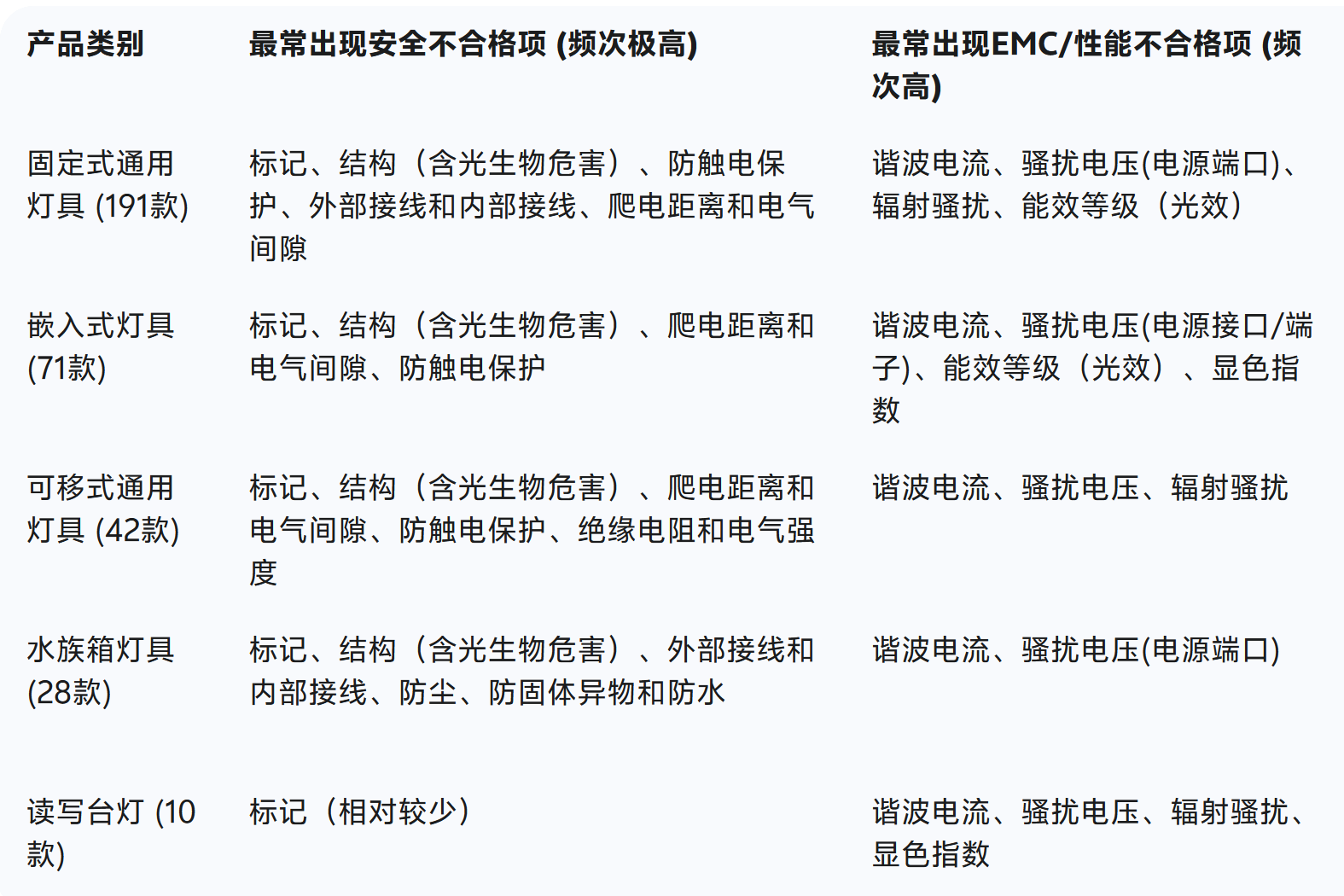
The list of non-compliant items exposed by this spot check covers a wide range from basic electrical safety to electromagnetic compatibility (EMC) and light quality performance. Among them, harmonic current is one of the most common non-compliant issues in this spot check.
Of the 344 non-compliant luminaire products, 50 units were listed separately; they were flagged solely due to harmonic current non-compliance , with production dates prior to the official implementation date of GB 17625.1-2022 "Electromagnetic Compatibility - Limits - Part 1: Harmonic Current Emission Limits (Equipment with input current per phase ≤16A)", which is July 1, 2024.
监管部门对这50款产品进行特别标注,体现了对新标准实施的过渡期考量。然而,这明确警示了许多制造商在新标准正式实施前存在技术滞后和准备不足的问题。随着2024年7月1日这一关键节点已经过去,末能及时升级驱动电源和设计的产品,将面临全面市场禁入的风险。
In addition, both fixed general-purpose luminaires and recessed luminaires exhibit non-compliance with energy efficiency class and energy efficiency limit values . This means these products falsely claim their energy-saving performance at the time of sale, while actually having low light output efficiency, directly undermining consumers' expectations for energy saving and harming their economic interests.
The following table lists the high-frequency risk items for non-compliant lighting products identified in this spot check:
Quality Collapse and Involution Under Price Wars
The large-scale non-compliance revealed by this spot check is not merely a result of production errors, but rather a structural disease of the Chinese lighting industry that has long been under excessive competition and extreme price wars .
The entry threshold for the lighting industry is relatively low, leading to severe product homogenization and causing market competition to focus long-term on price. Especially on e-commerce platforms, where consumer sensitivity to price is extremely high, a competitive model of "bad money drives out good" has formed. To survive, many manufacturers are forced to " compress costs to the limit ", directly sacrificing product quality and safety.
Core component downgrading: The primary goal of cost reduction is the LED driver, which is core to ensuring EMC compliance and grid friendliness. To save dozens of yuan, manufacturers use drivers without PFC or with low-quality filtering components; this is the direct cause of widespread non-compliance in harmonic current and disturbance voltage/radiated disturbance. Safety material substitution: Low-price competition forces companies to use thinner, inferior plastic housings, reducing internal insulation distances, which leads to frequent non-compliance in protection against electric shock, creepage distance and electrical clearance, as well as heat resistance and fire resistance, directly causing electric shock and fire hazards. False labeling of light quality: Companies use low-efficacy LED chips or cheap phosphor to meet low-price demands. This directly leads to false labeling of energy efficiency class, low actual luminous efficacy, and severe non-compliance with color rendering index (CRI) in products like reading lamps that have high requirements for light quality.
简而言之,价格战将企业利润空间挤压到零,导致其完全失去了投资合规性、安全设计和质量体系升级,最终将经营风险和安全隐患转嫁给了消费者和社会。
Editor's Note
Quality is the lifeline of the lighting industry and the foundation for sustainable enterprise development. This large-scale incident of non-compliant luminaire sampling serves as a deep warning to the entire lighting industry regarding its current quality status and future compliance direction.
In the future, more and more consumers will not only focus on the lighting function of products but also place greater emphasis on product safety and light quality. Enterprises with solid quality management systems and good reputation will gain greater development space, while enterprises with continuous non-compliance will face the risk of dual bankruptcy in terms of reputation and market.
Only by adhering to the safety bottom line, returning to the essence of products, and rebuilding faith in quality can China's lighting Industry truly move from being a "manufacturing giant" to a "quality power."
Attachment download:  Guangdong Lighting Product Non-compliance List.docx