
Yuan Qi: The shift from product luminous efficacy to scene luminous efficacy and its impact on the future development of lighting
In the lighting industry, high luminous efficacy is synonymous with energy saving in lighting. It is impossible to talk without mentioning high luminous efficacy; the clamor is deafening. The resulting competition in luminous efficacy has risen like wind and clouds, one wave higher than the next!
So, what is the exact relationship between high luminous efficacy and energy saving? Is it the legendary panacea for energy saving in lighting? Next, we will provide the following detailed analysis.
I. High luminous efficacy is a good medicine but not a cure
High luminous efficacy (high lm/W) is like a car's 'fuel consumption per 100 km': it is merely a single technical indicator, far from being the whole picture of energy saving. Equating high luminous efficacy with an energy-saving panacea is indeed a widely propagated misconception.
Why is it said that "high luminous efficacy is not the only solution"?
1. Efficiency ≠ Energy Saving: High luminous efficacy only means that the light source itself converts electrical energy into light energy efficiently. However, if the luminaire design is unreasonable, more light spills outside the effective illumination area, optical system efficiency decreases, or to pursue high luminous efficacy at the expense of light quality (such as color rendering), leading to the need for higher power or longer lighting duration, then ultimately it may consume even more energy.
2. The trap of "the higher, the better": Due to the high efficiency and declining costs of LED lamps, some projects fall into the misconception of "over-illumination". Originally, only 300 lux (lx) illuminance was needed, but because the lamps are cheap and energy-saving, they achieve 500 lux or even higher. This causes huge energy waste, completely contradicting the original intention of energy saving. The core of energy saving is "lighting according to demand", not "infinite supply".
3. Ignoring system energy efficiency: A lighting system consists not only of the light source (LED chips), but also includes the power supply (driver), heat dissipation system, lens/reflector housing, etc. An LED chip with very high luminous efficacy, if paired with an inefficient power supply, or requiring a large heat dissipation system to maintain its efficacy (which itself may consume electricity), will significantly reduce the overall system energy efficiency.
4. Importance of Light Quality: Blindly pursuing high luminous efficacy may lead to low Color Rendering Index (CRI), excessive blue light content, severe glare, and other issues. A poor lighting environment can damage visual health, affect mood, and reduce work efficiency.
II. Improving System Efficiency is the Cure for Lighting Energy Saving
The real cure is a systematic comprehensive solution; high luminous efficacy is merely the entry ticket and foundation of this solution, not the whole picture. A complete energy-saving strategy should include:
1. Systematic Design:
Efficient overall luminaire: Not just efficient light sources. Choose luminaires with high photoelectric conversion efficiency, reasonable light distribution, and good heat dissipation.
Reasonable lighting design: Perform precise calculations based on space function, usage time, and natural daylight conditions to avoid over-illumination. Harnessing sunlight is the greatest energy saving.
2. Intelligent control (this is currently the field with the greatest energy-saving potential):
Sensor control: lights turn on when people arrive and off when they leave (e.g., corridors, garages).
Dimming control: automatically adjust artificial lighting brightness according to natural light intensity (e.g., areas near windows).
Scheduled zone control: group switching and dimming based on needs for different time periods and areas.
Intelligent lighting management system: centralized monitoring and optimization of the entire building's lighting.
3. High-quality light environment:
High color rendering (CRI > 80, even 90+): makes colors more realistic, reduces visual fatigue, improves comfort and work efficiency. In the long run, this is the greatest 'energy saving' (for people).
Appropriate color temperature: choose cool or warm light according to different scenarios to create a comfortable atmosphere.
Effective glare control: avoid direct light into the eyes, use luminaires with anti-glare design.
3. "Controlling spill light and other unnecessary environmental lighting" — the highest-level and most intelligent energy-saving measure in lighting energy conservation.
1. What is "spill light" and "unnecessary environmental lighting"?
(1) Spill light: Refers to light that shines outside the designated area. For example:
Spill light beams outside the designated functional areas of lighting.
Road lighting shines into the windows of residents beside the road, causing light pollution.
Direct light from building illumination shines into the sky, dimming the stars.
Floodlights at the construction site illuminate the neighboring residential area.
Billboards on commercial streets are too bright, interfering with drivers and pedestrians.
(2) Non-essential ambient lighting:
Offices, hallways, and venues are brightly lit late at night when empty.
Decorative excessive lighting, such as over-lit 'light sculptures'.
Excessively high illuminance levels resulting from the erroneous notion that "the brighter, the better".
2. Why is controlling them a matter of course?
Because this portion of light is pure waste and an energy expenditure with "negative returns":
Zero functional benefit: This light provides no help for any necessary visual task and creates no value.
Causing negative effects: they directly lead to light pollution (affecting astronomical observation, plant and animal rhythms), glare (affecting safety and causing discomfort), and energy waste.
"Energy saving does not mean cost saving": Even if the most efficient LED light sources are used, if they are indiscriminately and extensively abused, total power consumption will still be enormous, deviating from the original intention of energy saving.
3. How to practice the "true meaning" of lighting energy saving?
This requires a combination of technology, design, and management:
(1) Precise luminaire photometry:
Use cut-off or full cut-off luminaires to strictly confine light to the areas requiring illumination (e.g., road surfaces), preventing upward or lateral spill.
Good optical design is "using the fewest lights to illuminate the places that need it most".
(2) Smart control system:
Dimming: Automatically reduce street light brightness to safe illuminance standards when traffic and pedestrian flow are low at midnight.
Spatial-temporal zoning control: Provide lighting only during the times and in the areas where it is needed.
Scenario modes: Set different lighting modes for different scenarios, rather than simply turning everything on.
(3) Scientific lighting standards and regulations:
Comply with and establish stricter limits for Lighting power density (LPD) and glare control standards.
Promote dark-sky-friendly lighting policies to protect the night environment.
4. Change of mindset:
Shift from pursuing "brightness like daylight" to pursuing "just right."
认识到黑暗的价值——一个合理的、有明暗对比的环境才更舒适、更有品质、更节能。
总结来说:照明节能的巅峰,不再是纠结于单个光源还能提升几个lm/W,而在于如何通过卓越的设计和智能的管理,消除每一个“无效的流明”。
这就像节水的关键不是研究怎么让水龙头滴得更慢,而是及时拧紧那个漏水的阀门。“溢散光”和“非必要照明”,就是照明系统中最大的“漏水阀”。
四、“高光效”是解决问题的手段而非目的
"High luminous efficacy only proves that there is a wider range of luminous flux options for designers in larger spaces; it does not prove that energy saving will be better in relatively fixed scenarios."
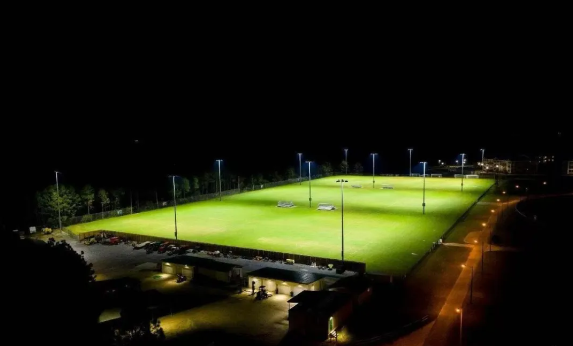
1. Misconceptions about 'larger spaces' and 'range of choices'
Space for technological innovation: High luminous efficacy means technological progress, giving designers and engineers more possibilities. For example, lighting effects that were previously impossible to achieve (such as ultra-thin luminaires or special optical designs) can now be realized thanks to high-efficacy light sources. Expansion of application scenarios: In scenarios where energy is extremely limited (such as deep-sea exploration, space stations, or off-grid solar lighting), high luminous efficacy is the only choice or even a necessity. Without high luminous efficacy, these scenarios might not be illuminated at all. Here, high luminous efficacy directly equates to 'usable' or 'not usable'.
Therefore, the value of high luminous efficacy lies in expanding the boundaries of human illumination; this is a macro-level, strategic advantage.
2. Analyzing misconceptions about 'relatively fixed scenarios'
However, in the vast majority of ordinary, fixed indoor and outdoor scenarios (such as offices, classrooms, factories, roads), a misconception arises:
(1) Premise: The illuminance requirement for the scenario is a 'fixed value'. This is set by lighting standards in advance.
(2) Flawed inference: Because lamp A has higher luminous efficacy than lamp B, using lamp A will definitely save more energy than using lamp B.
Why is this wrong?
It substitutes the premise of comparison. True energy saving comparison is made under the premise of "achieving the same illuminance and light quality", to see who consumes less electricity.
如果用一个光效很高但显色性很差(比如CRI<70)、配光不合理(大量溢散光)的灯,去和一个光效稍低但显色性优异(cri>90)、光学设计精准的灯对比,为了达到相同的、令人舒适的视觉体验,前者很可能需要更高功率来补偿其有效光品质的不足。最终,系统的总能耗可能反而更高。
"High luminous efficacy" is an attribute of a component, while "more energy saving" is the result of a system. One cannot simply equate component attributes with system performance.
System summary of the preceding points:
1. High luminous efficacy is the "foundation" and "necessary condition" for energy saving: If a light source has extremely low luminous efficacy (such as an incandescent lamp), then no matter how it is designed, the ceiling of its system energy efficiency will be very low. Therefore, pursuing high luminous efficacy is absolutely the correct technical direction.
2. But it is not the "guarantee" or "sufficient condition" for energy saving: Having a high-luminous-efficacy component does not automatically mean the final application is energy-saving. Whether it saves energy depends on the entire system:
Does it precisely meet the 'fixed value' requirement? (Lighting on demand, no excess)
Is the optical design efficient? (Reduce spill light)
Is the light quality up to standard? (Avoid having to increase lighting due to poor quality)
Has intelligent control been introduced? (Dynamically adjust according to spatial and temporal needs)
Therefore, we should regard high luminous efficacy as a more powerful and efficient new tool in our toolbox. It gives us the possibility to choose to make more energy saving and excellent design solutions.
But ultimately, whether this tool is used to build an energy-saving building or is wasted and even produces counterproductive effects depends entirely on whether the person using the tool—the lighting designer and decision-maker—possesses a scientific and systematic view of lighting energy saving, akin to 'using good steel on the cutting edge'.
V. The luminous flux for compliant scene lighting is a fixed value, not more is better! Exaggerating high luminous efficacy and piling up luminous flux numbers is a false proposition!
1.为什么说“流明数是定值”?
This is based on a core concept: lighting standards.
National and industry standards: Countries around the world (including China's "Architectural Lighting Design Standard" GB 50034) have established clear illuminance standards for different types of spaces, measured in lux (Lux, lx). It defines "how much luminous flux (lumens) is needed on a certain plane".
Scientific basis: This standard value is not arbitrarily set, but is the result of extensive visual efficacy studies, taking into account:
Space function: Precision assembly workshops (750-1000 lx) > ordinary offices (300-500 lx) > corridors (50-100 lx).
User age: Older adults typically require higher illuminance than younger people.
Precision of task: The requirements for reading a paper book (300 lx) and suturing blood vessels (10000+ lx) are vastly different.
Meaning of "fixed value": For a scene with known area and known function, the total luminous flux (in lumens) required is indeed a "fixed value" that can be precisely calculated:
Required total lumens (lm) = Target illuminance (lx) × Area (m²)
The primary task of lighting design is to meet standards, not to exceed them.
2. Why is "piling up lumen counts" a fallacy?
Because once the above concept of "fixed value" is understood, the absurdity of piling up lumen counts becomes glaringly obvious:
(1) Energy waste: Light exceeding standards is pure energy waste. For an office that only needs 300 lx, achieving 800 lx more than doubles the energy consumption, which goes completely against the original intention of energy saving.
(2) Light pollution and glare: Excessive light inevitably leads to spillage, glare, and other light pollution issues, resulting in 'negative return' lighting.
(3) Health hazards: Excessively strong light suppresses melatonin secretion in the human body, disrupts circadian rhythms, affects sleep, and is particularly detrimental to the visual health of children and the elderly.
3. Reduced comfort:
Lack of contrast between light and dark, and high-luminance environments easily cause visual fatigue and psychological discomfort. A good lighting environment should have rhythm, focus, and layers.
4. How does ‘exaggerating luminous efficacy’ become a false proposition due to ‘piling up lumens’?
This is a common commercial deception and cognitive bias:
Misleading rhetoric: 'My luminaire has a luminous efficacy of 200 lm/W, so it is especially energy-saving!' This statement hides a potential logic: 'Since it saves so much energy, it doesn't matter if it's brighter.'
Masking real needs: It diverts consumer attention from the correct question 'How much light do I need?' to the wrong question 'Which lamp looks brighter?'. It seems as if the luminous efficacy number becomes the score in a competition, where higher is better, without caring about how much electricity is actually used.
Evading system responsibility: Only talking about source luminous efficacy, while avoiding discussion of luminaire efficiency, optical distribution rationality, smart control, etc., which are truly systemic issues determining overall energy consumption.
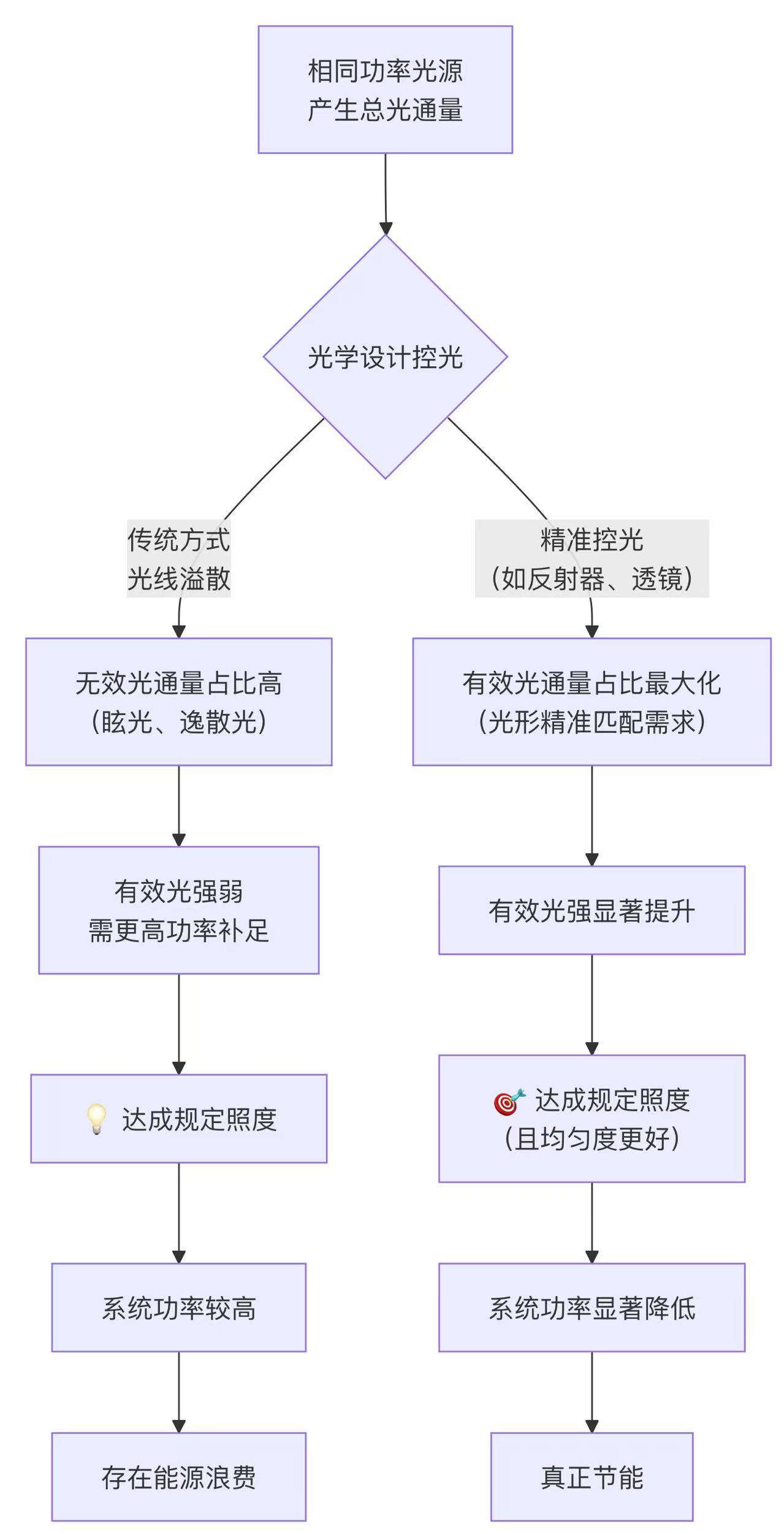
VI. What is the true scientific path for using light?
1. Define requirements: First, determine the target illuminance values based on national standards and space functions. This is the starting point and benchmark for all work.
2. Precise calculation: Calculate the required total luminous flux based on the space area and optical losses (maintenance factor).
3. Optimal selection: Under the premise of meeting light quality (color rendering, glare control, color temperature), select high-luminous-efficacy and high-quality luminaires (note: it is luminaire system efficiency, not just source efficacy).
4. Intelligent control: Combine natural daylighting and human activity; use intelligent sensors and control systems to ensure that illumination is 'supplied on demand', dynamically maintained near a 'fixed value' standard, thereby achieving maximum energy saving.
Final conclusion:
The true essence of lighting energy saving lies not in endlessly 'opening sources' (piling up lumens), but in precisely 'closing outlets' (allocating on demand).
The great significance of high luminous efficacy technology lies in enabling us to achieve that 'fixed value' with less energy, more precisely and with higher quality, rather than providing a grand excuse for squandering energy. High luminous efficacy is a means, not an end. Static high luminous efficacy can only prove that the designer has the ability to solve illumination for broader spaces, and should not be wrongly regarded as an energy-saving measure for limited spaces. Whether a specified scenario is energy-saving depends on the designer's superior dynamic light parameter (including high luminous efficacy) regulation and application capabilities!
以上文章来源于阿拉丁- 精选,作者袁奇