
A flame in winter—
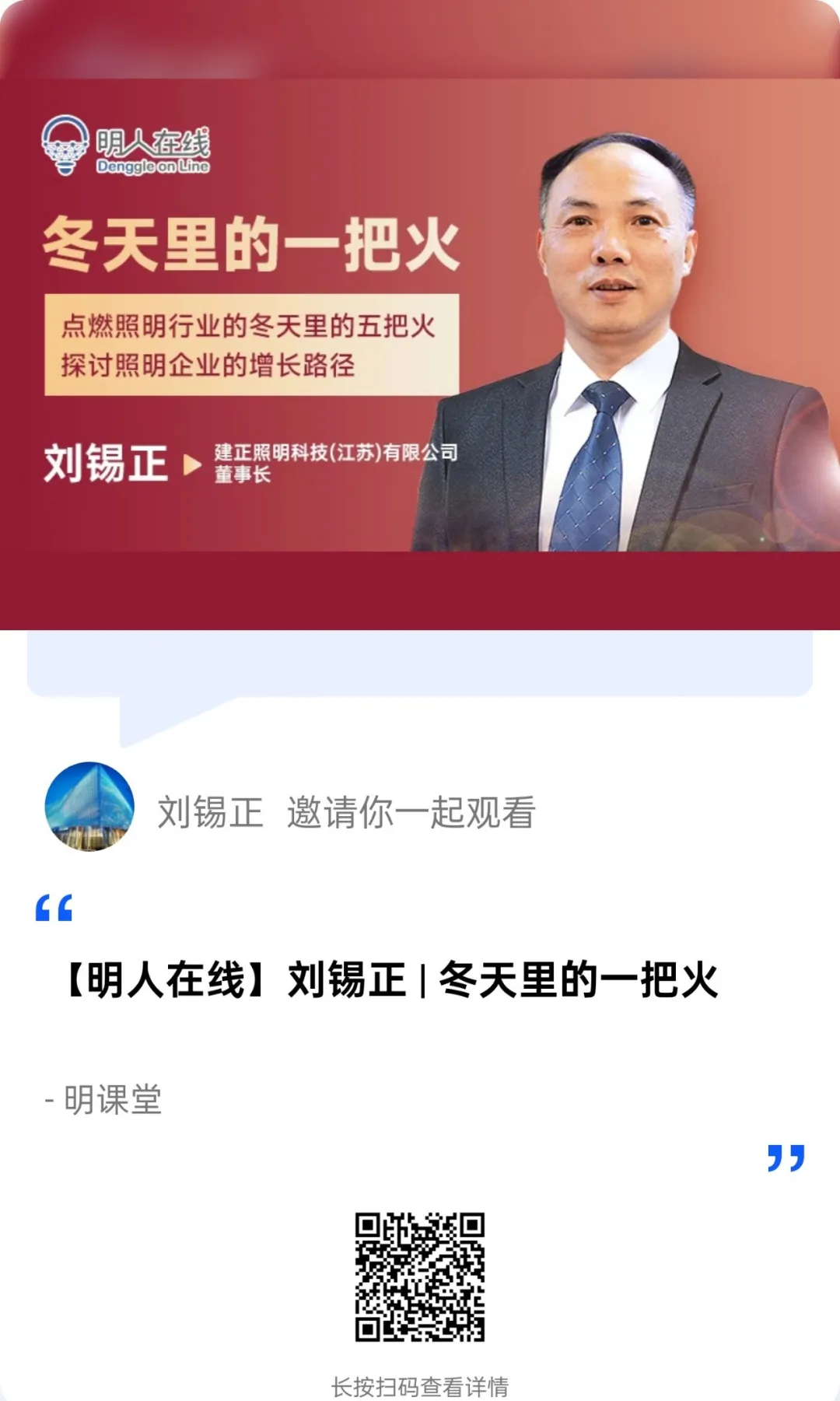
This article is a transcript of an in-depth strategic sharing session for the lighting industry held on January 23, 2026. It was presented by Mr. Liu, a senior lighting professional with 42 years of experience, and featured discussions with industry leaders including Mr. Hong and Mr. Zhao. The core focus revolves around the stark reality that "the lighting industry is experiencing a historic L-shaped downturn," systematically proposing a structural breakthrough path through "five fires": the fire of branding, innovation, value, breaking involution, and changing perceptions. Based on solid evidence—including Tmall data from Double 11 2025 (276 new brands achieved over 100 million yuan in single-day sales), CES 2026 exhibition trends (942 Chinese vs. 1,325 American companies, with AI firms like Zhiyan, Bolian, and Dreame making strong appearances), industry financial reports (34% of lighting companies reported losses), technological trends (AI penetration across R&D, marketing, and supply chain), and the current talent landscape (nearly zero influx of students from Peking and Tsinghua Universities)—the report argues that the traditional OEM model is unsustainable. Only by adopting a long-term, "hard but right" approach to reconstruct the value chain—shifting from OEM/ODM (3–5% gross margin) to brand premium pricing (30%+ gross margin) and hardcore innovation—and leveraging China's advantage of over 20 million engineers, the AI digital workforce revolution, and deep exploration of niche scenarios (such as mosquito-repellent light tubes, mood lighting, and non-visual spectrum applications)—can the industry achieve high-quality survival through this cycle. The conclusion emphasizes: this is not an era of淘汰ing veterans, but a transformative moment where the older generation proactively "lifts up the younger generation"; the spring of the lighting industry is not far off—it lies in the hands of the new generation of "light chasers" riding on the back of AI.
Main Topics and Discussions
Topic One: Industry Status Quo—"The L-Shaped Winter Has Arrived," Structural Crisis Fully Exposed
Data Support: Tmall data from Double 11 2025 shows that 276 new lighting brands exceeded 100 million yuan in single-day sales, yet over 34% of companies across the industry reported losses; traditional lighting brands saw both sales and profits "plummet," while exports faced overall pressure (only smart AI products and electric vehicles bucked the trend).
Deep-Seated Contradictions: 60% of global lighting products are "Made in China," yet domestic brands hold a very small share, with the mainstream still relying on OEM/ODM manufacturing at meager 3–5% gross margins, leaving profits captured by international brands. Production costs are severely impacted by raw material and exchange rate volatility, resulting in extremely weak risk resilience.
Conclusion: The lighting industry has bid farewell to the era of expansion and entered an "L-shaped adjustment period" characterized by competition over existing market share. This winter will last at least five years; simply pursuing sales growth is meaningless. Preserving profit and surviving are the bottom lines for survival.
Topic Two: Breakthrough Path One—Igniting the "Brand Fire": Demand 30%+ Gross Margin from Brands, Rather Than Working for Others
: Century-old brands like Philips and Osram have shifted to a "brand leasing" profit model, demonstrating the ultimate value of brand equity. Meanwhile, domestic companies remain trapped in "manufacturing without brands." Shenzhen Zhiyan Company achieved 6 billion yuan in sales within four years by focusing on a single product (scene-based LED strips) and realizing high price premiums (selling at hundreds of yuan per meter despite a few cents cost), proving that Chinese brands can be built rapidly.
Profit Logic: Citing the "smile curve"—R&D (30% gross margin) and brand sales (30%+ gross margin) represent high-value segments, while manufacturing yields only 3–5%; OEM models strip companies of pricing power and risk resilience.
Conclusion: Building a brand is a "hard but right" endeavor. With a global gap currently existing in AI branding, China's lighting sector must upgrade from being the "world's factory" to becoming a "global brand origin," transforming its manufacturing advantages into brand premium capabilities.
Topic Three: Breakthrough Path Two—Igniting the "Innovation Fire": Reconstructing the Entire Chain with AI to Seize the High Ground of the Fourth Industrial Revolution
Technological Empowerment: AI can disrupt every process in lighting enterprises—significantly shortening R&D cycles and reducing costs; mining data from platforms like JD.com, Pinduoduo, Douyin, and Xiaohongshu enables precise market insights; digital avatar livestreams replace traditional advertising, boosting promotion efficiency; intelligent supply chain and financial analytics cut costs and increase efficiency.
Scenario Breakthroughs: Implemented cases include mood lighting (TV scene-based LED strips), healthy lighting (sleep aid lamps), non-visual lighting (mosquito-repellent light tubes—using UVA bands to repel rather than kill mosquitoes, applied in Japanese fruit cultivation to reduce pesticide use), and spectrum innovation (beyond 380–780nm visible light, vast potential remains untapped in far infrared, ultraviolet, and UVC bands).
Talent and Ecosystem: China's 20 million engineers serve as accelerators for innovation, while platforms like Bilibili and Xiaohongshu make technology dissemination far more efficient than during the CCTV era. MiniMax (founded by Yan Jianbo of Southeast University, 385 employees, 74% of whom are post-95 R&D mainstays, and listed on the Hong Kong stock exchange with a market cap exceeding 100 billion yuan upon IPO) and Dreame Technology (10 billion yuan in six years, expanding from floor cleaners to desk lamps and automobiles) demonstrate the success of the "small but beautiful + hard tech" model.
Conclusion: 2026 is the optimal time for innovative companies to enter the market—the disappearance of traffic dividends forces a return to product strength. AI does not replace humans; it amplifies human creativity. The lighting industry should take the lead in deploying "digital employees," freeing human resources from report statistics and phone surveys to focus on AI-driven questioning, value judgment, and innovative design.
Topic Four: Breakthrough Path Three—Igniting the "Value Fire" and the "Fire to Break Involution": Rejecting False Growth and Building a Win-Win Ecosystem
Value Traps: Low-price dumping in hardware channels is essentially a "box-grabbing corn game"—using low-quality, cheap products to seize one's own original market share, damaging brand image (customer feedback: "Big brand products have gotten worse"), leaving dealers unprofitable, and ultimately causing supply chain collapse (suppliers fleeing, bank bad debts, government bailouts).
Positive Value: While energy-efficient LED bulbs (213 lm/W) are technologically mature, they remain under-promoted because "price wars" obscure their energy-saving value (electricity bills account for 82% of marketing costs; saving electricity means giving away free lamps). Emotional-value products (pet economy, ambient lighting) are growing rapidly, confirming users' willingness to pay for emotional experiences.
Win-Win Ecosystem: Drawing inspiration from Sam's Club (own brands contribute 80% of profits) and Jingdong JZ (using data-driven product selection and centralized procurement to achieve "same quality at half the price"), lighting companies must abandon "going it alone" and co-build communities of shared interests with KOLs (Luo Yonghao/Yu Minhong), platforms, and suppliers—ensuring dealers profit, suppliers grow, and platforms gain user traffic for sustainability.
Conclusion: "Price wars" fundamentally stem from insufficient capabilities; true competitiveness comes from higher efficiency (AI cost reduction), more accurate insights (data-driven decisions), and deeper services (prescribing solutions for users rather than acting as mere "carriers"). Replace vicious involution with value creation.
Topic Five: Breakthrough Path Four—Igniting the "Fire to Change Perceptions": Shifting from Incremental Thinking to Stock Logic, Supporting Youth in Completing Generational Transition
Cognitive Gap: The older generation relies on experience, boldness, and "low-margin, high-volume sales," while the younger generation trusts data, logic, and "value-based pricing." Past successes (such as Opple/Rayside's strategy of large, comprehensive SKUs) have become burdens in the stock era.
Organizational Reform: Stock competition is essentially efficiency competition—East China region's per capita output of 50–60 million yuan vs. listed companies' 1–2 million yuan exposes the ineffectiveness of manpower-intensive tactics. AI must replace repetitive labor, focusing on high-value roles (such as "lighting specialist director"-style product selection capabilities).
Intergenerational Mission: Senior lighting professionals (Mr. Liu/Mr. Hong/Mr. Zhao) agree that their role should shift from "frontline warriors" to "supporters," backing the second generation (Xiao Zhao/Xiao Liu) to lead innovation and internationalization (such as reviving German-owned brands). The reason why top talents from Peking and Tsinghua "vote with their feet" and leave the lighting industry is fundamentally due to the industry's lack of future vision and high-value returns.
Conclusion: The spring of the lighting industry hinges on whether we can achieve cognitive elevation—embracing "small but beautiful" (self-developed single-product champions), adopting "scenario naming" (e.g., "reading lamp bulb" replacing "A60"), and achieving online-offline equality (since July 2025, e-commerce has imposed full taxation, erasing online cost advantages). Ultimately, this will mark a turning point toward "talents from Peking and Tsinghua competing to enter the lighting industry."
Deep Insights
Insight One: The "Non-Visual Value Frontier" in the Lighting Industry Remains Systematically Untapped; Health and Biophotonics May Represent the Largest Blue Ocean
The transcript mentions mosquito-repellent light tubes (UVA repellent), sleep lamps (melatonin regulation), and specialized spectral machine vision applications—all pointing to a severely undervalued dimension: lighting's capacity to intervene in non-visual domains such as human physiology, agriculture, and industrial inspection. Currently, 99.9% of industry products focus solely on visible light illumination, while technologies like UV-C sterilization, far infrared therapy, and narrow-spectrum blue light for plant factories are already mature but lack interdisciplinary integration and commercialization pathways. It is recommended that lighting companies join forces with biomedical institutions and agricultural research institutes to establish "Light Health Laboratories," translating spectral parameters into clinically or agriculturally verifiable efficacy metrics, applying for medical device or green certifications, and unlocking a tens-of-billion-yuan B2B market.
Insight Two: Lagging Deployment of "Digital Employees" Is Becoming the Most Hidden Efficiency Black Hole for Lighting Companies; An "AI Readiness" Assessment System Must Be Established
Comparing CES 2026 exhibitors (25,000 digital employees replacing 40–50,000 human workers) with the current situation in China—where no lighting company has even heard of anyone using them—exposes a generational gap in process digitization. It is recommended to immediately launch an "AI Readiness Audit": quantitatively assess automation levels in R&D (simulation software usage rate), marketing (automatic social media data collection rate), and supply chain (ERP and IoT device direct connection rate), setting six-month攻坚 goals—for example, compressing market research cycles from 30 days to 72 hours and replacing empirical decision-making with real data.
Insight Three: A Negative Cycle of "Talent Reverse Elimination" Has Formed in Lighting Companies; A Dual-Track Retention Mechanism Combining "Tech Equity + Scenario Entrepreneurship" Is Urgently Needed
The root cause of talent drain from Peking and Tsinghua is not just salary, but a lack of career value perception: traditional lighting positions cannot provide cutting-edge practical scenarios such as AI training or photobiology research. It is recommended to draw inspiration from the MiniMax model and establish a "Young Scientist Fund," allowing core engineers to incubate internal innovation projects (such as mood algorithm lamps or mosquito-repellent spectrum modules) through technical equity participation. The company holds shares but does not interfere with operations; upon success, independent financing or acquisition becomes possible. This approach both binds top talent and rapidly converts lab results into cash flow, breaking the deadlock of "having technology but no product, having product but no profit."
This article was compiled and published by the WeChat public account 【Guangju Julele】 based on Mr. Liu Xizheng's salon sharing titled "A Fire in Winter" at Ming Classroom on January 23. Author: Xiaoyao Shanren Xiaoyao Feng.
China Light
The official website of the China Association of Lighting Industry and a full-media platform for the lighting sector. We provide authoritative and timely lighting information while striving to be a growth partner for businesses. From brand promotion and channel expansion to consulting, talent training and participation in standards development, we provide comprehensive professional services to help businesses improve quality and efficiency and jointly advance the high-quality development of the lighting industry.
Business Contacts
仇纯 (Ms.): 158 6155 3579
顾君 (Mr.): 137 7157 5253