
Does using high Color temperature lamps delay sleep?

iLLabLiterature Interpretation Series
Interpretation: Yang Tong
Higuchi, S., Lin, Y., Qiu, J. et al. Is the use of high correlated color temperature light at night related to delay of sleep timing in university students? A cross-country study in Japan and China. J Physiol Anthropol 40, 7 (2021). https://doi.org/10.1186/s40101-021-00257-x
Background and Objectives
Light is an important synchronizing factor for the circadian rhythm; nighttime lighting inhibits melatonin (melatonin) secretion, increasing alertness levels.
The non-visual effect of light is influenced by illuminance, spectral composition, and exposure duration. Regarding the spectrum, blue light suppresses melatonin secretion, having a particularly significant impact on circadian rhythm, while polychromatic light rich in blue is often referred to as high color temperature light.
Objective: This study aims to explore whether using high color temperature lighting at home at night is associated with delayed sleep time in college students. To investigate the general effect of color temperature on sleep, the study included Chinese and Japanese college students from different living environments.
Content and Methods
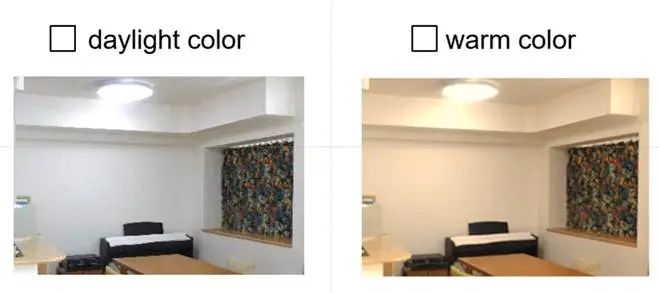
The site selection was in Fukuoka City, Japan and Shanghai, China. With similar latitudes, the sunrise and sunset times differ by approximately 20min. The study used self-administered questionnaires to survey 470 Japanese and 397 Chinese college students, collecting their habitual sleep times and home lighting types (whether the light source category is low CCT or high CCT).
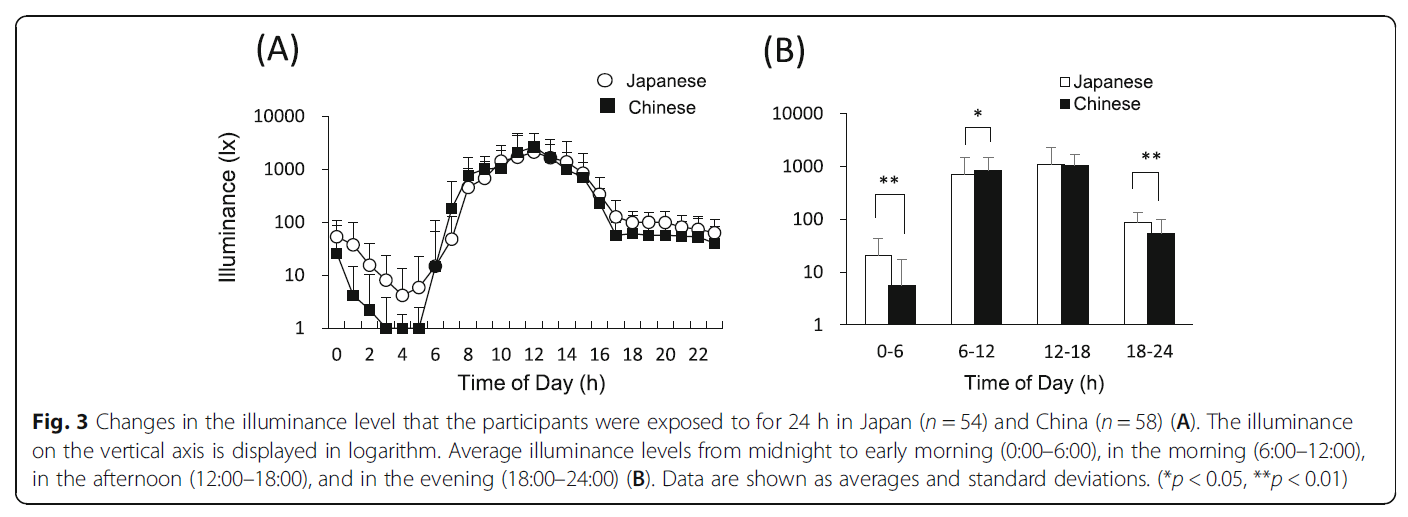
In each country, 60 students were selected to wear portable light sensors to record the 24h light environment levels for approximately two weeks, calculating the average illuminance per hour.
Collected sleep habit parameters include: bedtime, sleep latency (Sleep latency), time to fall asleep, wake-up time, midpoint of sleep (Midpoint of sleep), total sleep time, and social jet lag (Social jet lag, defined as the absolute difference between the midpoint of sleep on free days and school days).
Results and Discussion
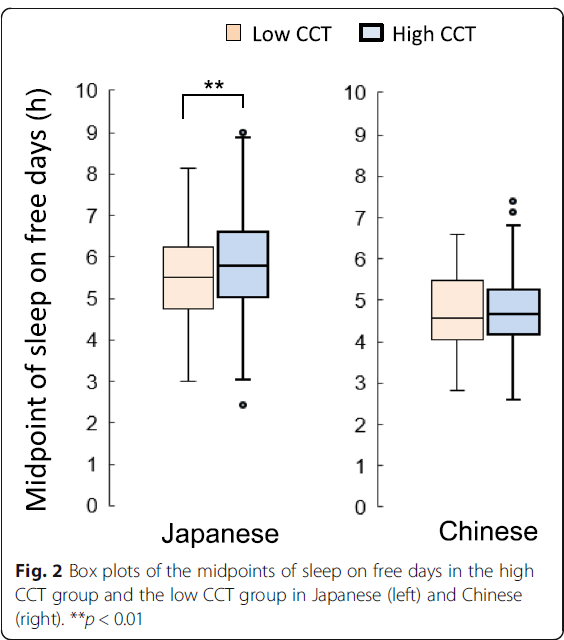
Studies have found an association between the use of high Color temperature lighting at night and delayed sleep time in Japanese students , supplementing previous research on the delaying effect of blue light on Circadian rhythm; however, no significant correlation was found among Chinese students , which may be related to environmental Illuminance levels and lifestyle factors such as accommodation for Chinese students.
Studies have found no significant correlation between illuminance levels and sleep habits, possibly due to multiple factors in real-world environments.
The effect of nighttime lighting on sleep duration and circadian rhythm may be influenced by different lifestyles across countries; living alone relative to shared accommodation may more easily lead to a late-sleep pattern.
Conclusion and Significance
Research has verified that high color temperature lighting is associated with sleep delay in Japanese university students, suggesting the use of low color temperature lighting at night to prevent its effect on sleep delay.
Research has not yet established the universality of color temperature's effect on sleep; subsequent studies need to consider impacts from different social factors, lifestyles, and variations in light sensitivity.
Inspiration and Critique
SH: The study selected a real-world environment with many variable factors, making data processing difficult; this is a common issue in field experiments.
LBY: The comparison of sleep conditions between Chinese and Japanese students mentioned in the article, on what basis did the author make the statistics and judgment? Is it the local time of each group or the time zone time? Different processing methods may affect the analysis conclusions.
YB:中日两个sample的数据除了都是亚洲大学生之外,其他包括年龄、性别、宿舍/居家、学校、专业、色温等都不具备match的条件,几乎是两个独立样本,因此标题里所谓cross-country名至了但实不归。
YB: How were the individuals wearing wristbands selected? What is their representativeness in relation to the overall sample? Is there a time lag between the period of light level measurement and the derivation of overall sleep data? It would be quite interesting to analyze the complete dataset of these 60 individuals separately.
YB:目前色温用daylight和warm二选一,方法上有点儿糙。色温的区别只是一个中间变量,可能受生活方式差等诸多因素影响,即使跟睡眠行为发现有某种相关性,也没有想象的那么强。如果按统计数据陈列出来,真实的均值差可能也只有几百K。宿舍可能统一装高色温,而家里选择暖色多,也可能是选择晚睡的人更喜欢明亮的高色温白光等等。
The above article originates from iLLab Light Source Laboratory, authored by Yang Tong