
Breaking News! Signify Suddenly Raises Prices by 20%: Is the Lighting Industry Facing a Major Shift?
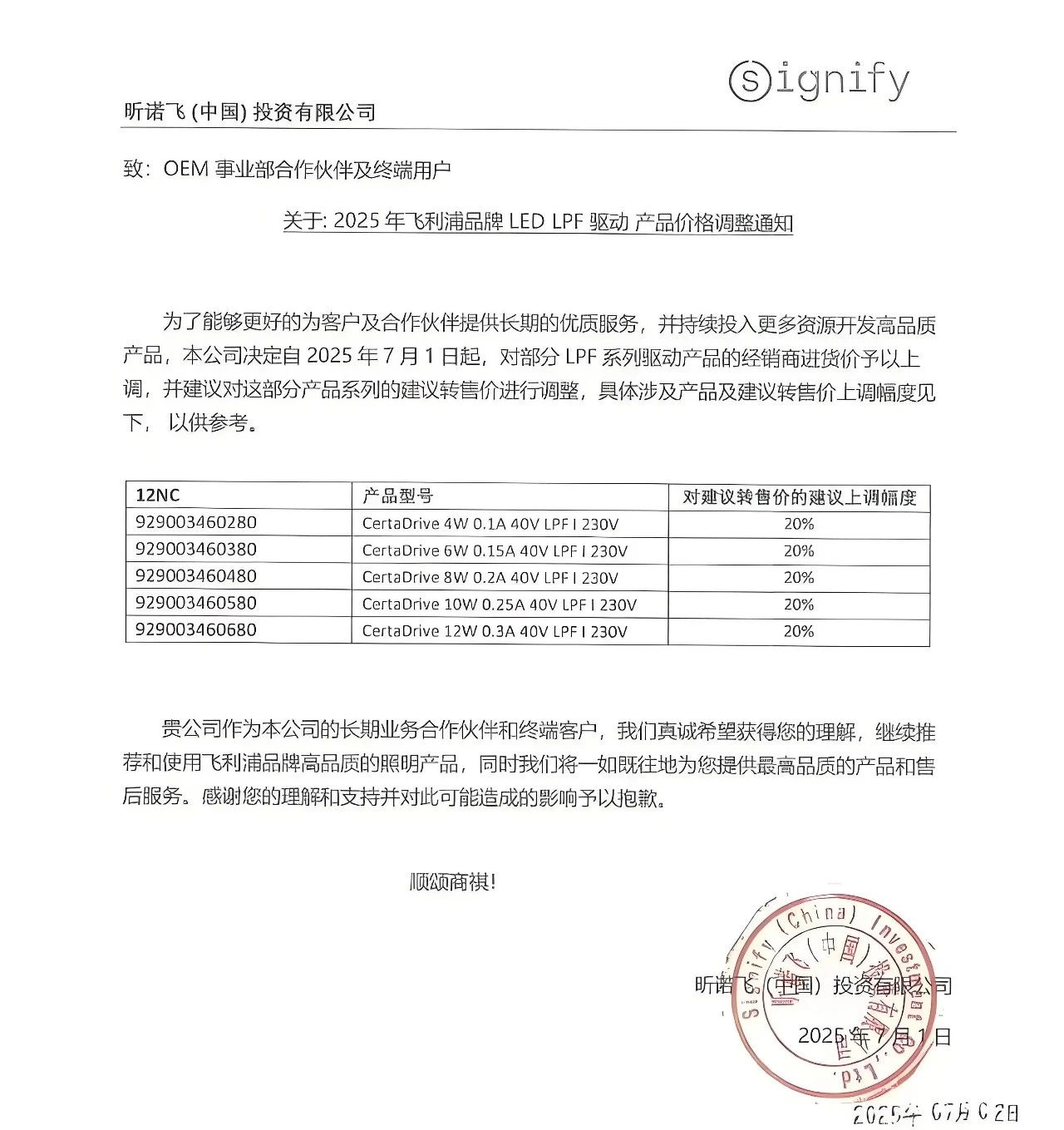
Recently, Signify (China) Investment Co., Ltd. issued a notice announcing that, effective July 1, 2025, prices for certain Philips brandLEDLPF driver productswill be adjusted. This news has caused considerable stir in the lighting industry, drawing attention to the current cost pressures facing the sector.
Price Increase Details
Signify’s price adjustment is significant,coveringthe CertaDrive serieswith five models, including specifications of 4W, 6W, 8W, 10W, and 12W.Notably,this adjustment not only affects dealer purchase prices but also recommends a 20% increase in suggested retail prices,a rare move in the industry that is sure to draw significant market attention.
Reasons for Price Increase
When Signify announced the price adjustment, its official statement focused on long-term value — "providing high-quality service to customers and partners" and "continuing to invest in developing high-quality products." Behind this stance lies a more noteworthy industry reality: lighting companies are collectively under severe cost pressure.
Volatility in the raw materials market is the core source of this pressure.In recent years, various raw materials required by the lighting industry have not only faced tight supply, but their prices have also entered a continuous upward trend, directly leading to a significant increase in product costs. For companies, maintaining existing product quality standards and service levels has gradually turned price adjustments from an "option" into a "necessity".
Faced with this pressure, even industry giants are not exempt. As a global leader in the lighting sector, Signify's connection to the Chinese market dates back to 1920, when Philips lighting products first entered the country. After a century of deep cultivation, it has built a vast network covering production, R&D, and sales, serving both professional and consumer lighting markets.However, even its deep market roots and comprehensive system cannot withstand the penetration of industry-wide cost pressures.
More notably, this price adjustment is not an isolated case. In recent years, driven by factors such as rising raw material prices and increased supply chain costs, Signify has initiated price adjustments multiple times: on February 1, 2025, it adjusted prices for several traditional Philips product series, with increases of up to 10%; on January 2, 2024, it also raised distribution prices and suggested retail prices for certain LED and traditional products. This series of actionsis not only a proactive strategy for companies to cope with costs, but also reflects the widespread state of struggle in the lighting industry amidst cost dilemmas.

Industry Status
In 2025, the market landscape of the lighting industry underwent significant changes, with continuous cost pressures prompting more companies to prioritize price strategy adjustments. This trend was already evident in April this year—the North American market led the wave of price increases. Affected by adjustments in U.S. tariff policies, Acuity Brands and RAB Lighting successively initiated pricing mechanism reforms: after the first round of price adjustments took effect on March 31, Acuity Brands further increased prices on April 7, implementing additional hikes for certain luminaires and electronic products; RAB Lighting announced price adjustments effective May 3, with varying increase rates depending on the extent to which different products were affected by tariff policies.
Behind this industry-wide price change lies the cumulative effect of multiple cost pressures. From the perspective of production factors, supply-demand contradictions in the raw material market have become increasingly prominent: the supply of various basic materials remains tight, with prices entering a cyclical upward channel. Taking PCB as an example, its sharp price rise since early 2025 has directly forced many companies to raise prices for related products. For Signify, the continuous increase in core raw material costs has severely squeezed profit margins, making price adjustment a necessary measure to balance costs and development in order to ensure the continuity of production operations.
The instability of the supply chain system has further intensified cost pressures. Adjustments in the global geopolitical landscape and frequent changes in trade policies have directly impacted the efficiency and cost of cross-border transportation of raw materials. The adjustment of U.S. tariff policies is a typical case, which has directly increased the import and export costs of lighting enterprises. Some companies chose to relocate production capacity to avoid policy risks, but in this process, additional expenses such as equipment updates and personnel deployment arose, forming a cycle of "cost pass-through—capacity relocation—new cost generation", which poses systemic challenges to LED lighting enterprises operating globally.
The structural rise in labor costs should not be overlooked either. With socioeconomic development and industrial upgrading, labor costs across the entire chain of the lighting industry—from production workshops to R&D teams, and from sales terminals to management systems—are showing rigid growth. To attract and retain core talent, companies have to optimize compensation structures and benefit systems, and the increase in these expenditures is directly included in operating costs, becoming another burden on companies.
The interweaving of multiple pressures has made price adjustments a phased characteristic of the lighting industry in 2025, reflecting companies' realistic choices to cope with survival challenges and signaling that the industry will enter a critical period of cost control and value reconstruction.